Cuba's Sugar
p. 142 · Read in the full issue
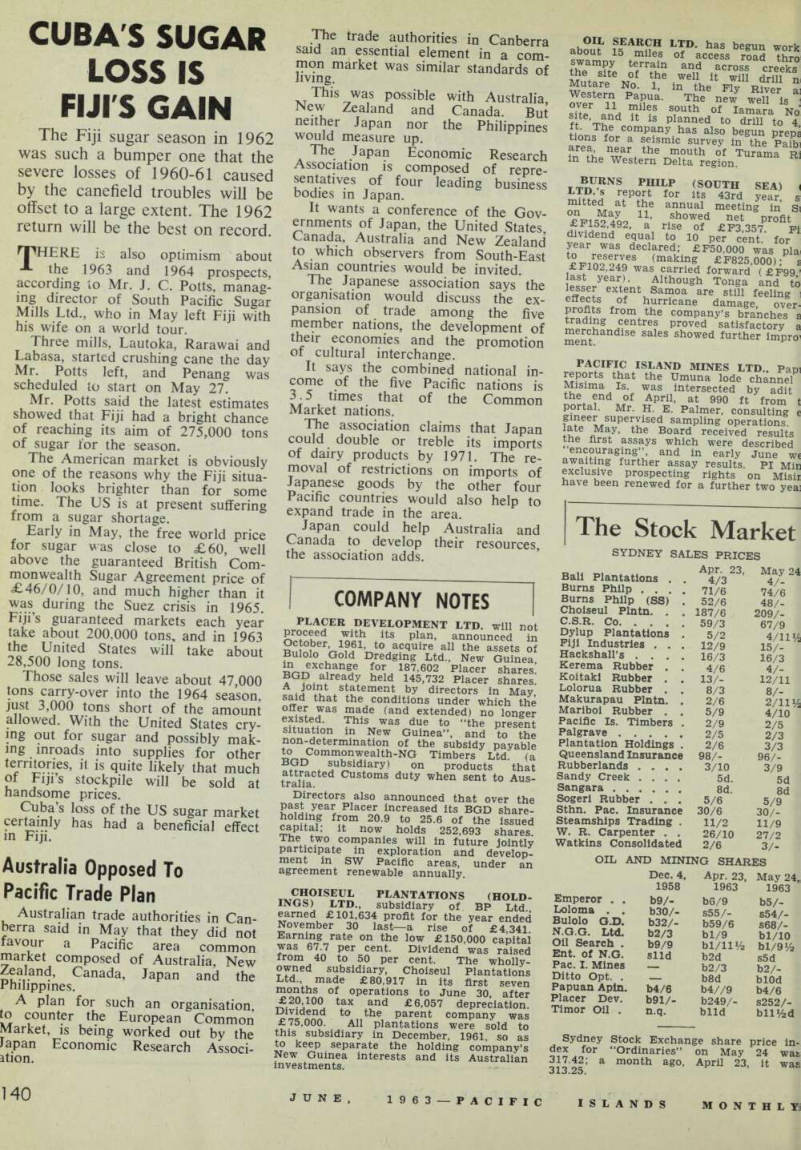
Loss Is
Fiji's Gain
The Fiji sugar season in 1962 was such a bumper one that the severe losses of 1960-61 caused by the canefield troubles will be offset to a large extent. The 1962 return will be the best on record. rPHERE is also optimism about the 1963 and 1964 prospects, according to Mr. J. C. Potts, manag ing director of South Pacific Sugar Mills Ltd., who in May left Fiji with his wife on a world tour.
Three mills, Lautoka, Rarawai and Labasa, started crushing cane the day Mr. Potts left, and Penang was scheduled to start on May 27.
Mr. Potts said the latest estimates showed that Fiji had a bright chance of reaching its aim of 275,000 tons of sugar for the season.
The American market is obviously one of the reasons why the Fiji situa tion looks brighter than for some time. The US is at present suffering from a sugar shortage.
Early in May, the free world price for sugar was close to £6O, well above the guaranteed British Com monwealth Sugar Agreement price of £46/0/10, and much higher than it was during the Suez crisis in 1965.
Fiji s guaranteed markets each year take about 200,000 tons, and in 1963 the United States will take about 28,500 long tons.
Those sales will leave about 47,000 tons carry-over into the 1964 season, just 3,000 tons short of the amount allowed. With the United States cry ing out for sugar and possibly mak ing inroads into supplies for other te / n 49r. i , es ’ h is finite likely that much of Fiji s stockpile will be sold at handsome prices.
Cuba s loss of the US sugar market certainly has had a beneficial effect m Fiji.
Australia Opposed To
Pacific Trade Plan
Australian trade authorities in Can berra said in May that they did not favour a Pacific area common market composed of Australia, New £ealand, Canada, Japan and the Philippines, A plan for such an organisation, to counter the European Common Market, is being worked out by the lapan Economic Research Associ ation.
The trade authorities in Canberra said an essential element in a com mon market was similar standards of living.
This was possible with Australia New Zealand and Canada. But neither Japan nor the Philippines would measure up.
The Japan Economic Research Association is composed of repre sentatives of four leading business bodies m Japan.
It wants a conference of the Gov ernments of Japan, the United States Canada, Australia and New Zealand to which observers from South-East Asian countries would be invited.
The Japanese association says the organisation would discuss the ex pansion of trade among the five member nations, the development of their economies and the promotion of cultural interchange.
It says the combined national in come of the five Pacific nations is 3 5 times that of the Common Market nations.
The association claims that Japan could double or treble its imports of dairy products by 1971. The re moval of restrictions on imports of Japanese goods by the other four Pacific countries would also help to expand trade in the area.
Japan could help Australia and Canada to develop their resources, the association adds.