Territories TALK-TALK
pp. 119-125 · Read in the full issue
From time to time the question has arisen as to where the nost popular meeting-place of old-time Territorians is located n Sydney. In Germany, however, there is no doubt whatsoever mt that the New Guinea Club in Hamburg is the most popular endezvous.
vJD June this year is an important month in the club’s history. The t prominent member—Heinrich olph Wahlen—will celebrate his i birthday on the 4th. He was i in Hamburg in 1873. [.R.W. needs no introduction to / Guinea; even recent arrivals ? read of his pioneer work in Western Islands. [e arrived in NG in 1895 as a k for the famous firm of Hern m and Co., which at that time its headquarters on Matupi id, long before Rabaul was even ight of. [is boss at that time was Max si, a nephew of the founder of firm, Captain Eduard Hernsheim,
who was also Norwegian Consul in the Colony.
Thiel was a popular man, a won derful host and lived the life of an Eastern potentate on Matupi.
He was of the chair-borne execu tive type rather than the jungle tramping explorer pushing his way into the unknown seeking for undis covered potentialities. He concen trated on trading, not the planting-up of new areas of coconuts.
Wahlen, on the other hand, al though only a clerk, was gifted with longer vision and, during his travels about the Bismarck Archipelago, realised the possibilities of the West ern Islands.
In 1903 he planted his first coco nut on Maron (in the Hermit Group) and commenced the erec tion of his famous Wahlenburg home, which withstood storm and stress of two world wars and—so far as I know—is still standing. At the time of expropriation in 1921, when the Treaty of Versailles be came operative, he owned about 3,200,000 coconut palms on his various estates.
After World War I he still main tained interests in Dutch New Guinea and the islands.
Calling
Edie Huson Once again we have the missing persons bureau in operation.
A letter from an old-time Terri torian acquaintance told me she is trying to find the location of Mrs.
Edie Huson, who at one time lived with her hubby, Charles, on Harra mon plantation down, Buka way.
Immediately after World War II she was living at King’s Cross. Charlie died in the late thirties.
The mention of Charlie Huson awakens memories. I met him first in Faisi in 1917 when he was on his way to collect a schooner being built in Sydney for Mrs. Calder, of Toboroi and the Mortlock Islands.
Its name was Frances, after her daughter, who is now Mrs. Kroening, of Toboroi.
Charlie was well-known in the
With Tolala
Solomons. In earlier years he had gone recruiting with Sam Atkinson to Malaita. At that time Charlie came under the category of a “blown away Scandinavian”. There were many in the Islands then, Danish and Norwegian seamen, who had “jumped ship” and found an appro priate locale in which to put their knowledge of seamanship to good practice, under congenial conditions.
In those days it was not an un known practice to buy “strings of copra” (half coconuts, smoked, strung on kanda ) for “muskets”, but, according to these old traders when talking of the past, they said they would not supply ammunition at the same time; that would come later and, when delivered, it was found not to fit the rifles previously supplied.
Little wonder then that the Malaita men were hostile when whites arrived!
Jack London, the American author, who was down that way together with his secretary (I don’t remem ber whether she was a blonde or not) in the early 1900’s in his Snark, had quite a bit to say about these doings, but the real history of the Solomons yet remains to be writ ten. And I don’t know who is going to do it.
Incidentally, Charlie Huson figured in a court case that came before the military authorities at the Cen-
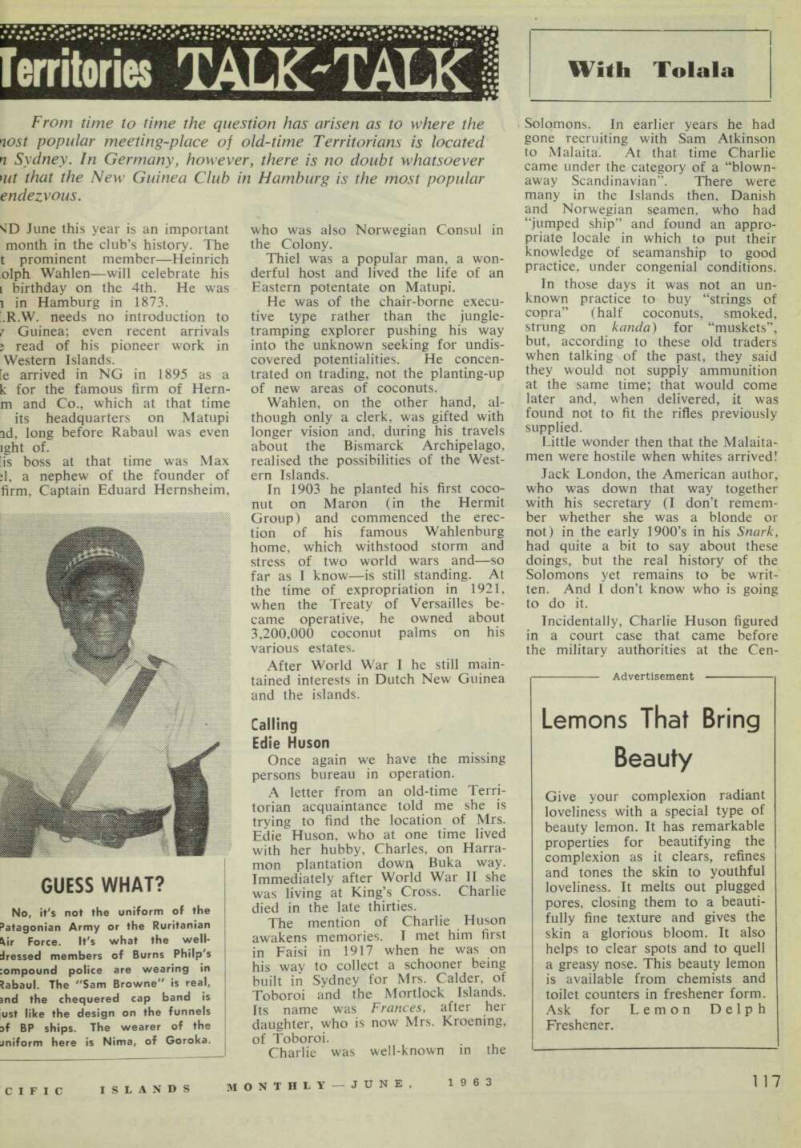
Guess What?
No, it's not the uniform of the Patagonian Army or the Ruritanian Air Force. It's what the well dressed members of Burns Philp's compound police are wearing in Rabaul. The "Sam Browne" is real, and the chequered cap band is [?]ust like the design on the funnels of BP ships. The wearer of the uniform here is Nima, of Goroka.
Court, Rabaul, about the end 917 when he sued Mrs. Calder breach of contract, le case was heard by Major land, an Acting Judge, who gave rdict for Mrs. Calder. An ap was lodged and heard by t-Colonel Seaforth Mackenzie was dismissed. It did, however, e considerable interest at the There were few civil actions re the courts in a land under ial law and civilians were just small fry. was Charlie Huson who secured contract of planting-up Jame [d, off the Buka mainland, in 1920 i the original owners, the & P.G. (the Long-Handle i) realised that the old German had to be observed.
Improvements
nder these, within 20 years of eehold being granted a certain ortion of the area had to be oved. The laws came into force 899 when the Imperial German eminent took over from the Neu lea Kompagnie administration, i the Buka-Bougainville area ral plantings besides Jame dated i 1920, such as Kessa, Matthias, a, Mabiri—for the same reason, harlie made a good job of plant up Jame —in more ways than While doing the Jame job he :ted an area opposite on the iland of Buka and planted it up himself. It eventually became len plantation. He was taking a at that time, because the ac ition of virgin land under the tary occupation was not permitted, a foreshore of virgin bush, as passed along in a schooner, gave ndication of long lines of planted muts.
Main Rival knew Charlie well. He was my n rival when I was trading down Buka in the early thirties for ra, shell, ivory nuts and what 2-you, and relationships between ers—even at that late period— Id be somewhat strained, to say least. And copra prices were m to £lO a ton at Rabaul! >espite the competition between we were quite good friends; deed a bottle of beer when we ; lent each other a case of >sene or a caddy of tobacco if or the other was short, and it a reasonably clean game. Even ve both sent “spies” to test out i other’s mark on the copra scale, to find out how many lailais >chus shell) for a stick of tobacco.
The Change
In Trade There have been a good few changes in the trade requirements of natives over the past 50 years.
They are probably equal to the changing conditions which the present-day housewife has to face with her supermarket, as contrasted to the old grocer-shop counter with its personal service, delivery of goods and other old-fashioned ameni ties. They have disappeared along with courtesy and civility, and have been exchanged for glamorous pack aging, high-pressure salesmanship and trade promotion.
In 1912 I was trading for Queen Emma down in Buka (my predeces sor was none other than “Karkar”
Schmidt). Actually the HSAG Co.
had taken over the interests of Mrs.
Kolbe a few months earlier but the
S p“ ,5"“ ml*
F in black or red stencil “h* smoked p ; The trading site was still known a . s “Station belong Missus” as dis tinct from “Station belong Matupi”, which was Petats Island, where Eric Sjoberg, a hefty Swede (who later died as the result of having too short a fuse to his plug of dynamite when shooting fish), represented Hernsheim and Co.
Essential lines displayed on the shelves of the trade-store consisted of fish-lines and fish-hooks of every size; Rabaul Red powder for male facial adornment and nobs of wash-
blue for the same purpose. (The e Buka was a vain, conceited ibitionist in those days, spending rs in* adorning his face and hair i red, blue and white designs, ie of which were really artistic), orcelain pipes were another ular line; beads, stick tobacco, 5, knives of every description. :ury lines were mostly confined jews harps, fringed lavalavas, )ed singlets, leather belts (the mrite being a replica of the ce boys’ belt, with buckle bear the German Imperial Crown and motto Gott Mit Uns ); porcelain i-band rings had a place and real ary lines were tinned meat, fish rice. orcelain pipes were purely a us symbol. Over on the mainland Buka very good clay pipes were le by the men of several villages, a man smoking an imported por lin pipe was just too “U”. ome 20 years later I returned to trading station to find, not un urally, of course, that the “mon s” of my earlier days had become men of the island, lut they remembered me. And, arently, I had not been such a Imperialist or colonialist or it-have-you and I had looked ;r their sick and given them food ;n they were hungry, etc But ir tastes had differed. soon found my shelves were :ked with such “essential” lines as [y-coloured lavalavas, electric :hes (which required batteries), :tz lanterns and table lamps (which uired kerosene and wicks), Cap i tobacco and newspaper for
cigarettes; matches (the old fire-stick was on the nose), razors, cut-throat and safety, with blades (broken glass or clam-shells were not good enough for the new snobocracy); mouth-organs (they spurned the idea of jews harps) and they wanted bottles of scent and cakes of fancy soap.
They had become more choosey in their porcelain pipes; only a certain model would suit them. They were very particular regarding their beads: Only a certain line from Italy met with their approval in size and colour. I was fortunate in my buying from Rabaul to obtain monopolies in both these lines!
And so much for the changes in
trade. I can only speculate as to what they consist of now, 30 years later. But that is something for their co-operatives to worry about, I expect.
I surmise the day of the old-time trader has passed and the transistor sets and radiograms, the motor trucks and the benzine supplies and outboard motors are something for the indent officer of the local co operative to nut out ... I often wonder if they are any happier in these modern days than their fore fathers were some 50 years ago.
I just wonder, because we are do ing our best to teach them what the Joneses are doing in other coun tries, and this, of course, will increase
The late "Karkar" Schmidt.
sale (to them) of non-essential imodities of our own goods and, i result, so we are told, this will her qualify these one-time happy, •free people to attain their “inde dence”.
Jo doubt Sir James Kirby and his n of tycoons may have something say on this subject; and then haps they won’t. (They did; see [39).
idom Thoughts
lie opinions expressed by Senator J. D. Turnbull (Independent, mania) after a tour of P-NG in •il and reported in the South Paci- Post were well worthy of note; y were fearless and realistic but ;ived little publicity in the Syd- Press.
We should either give this place k tot the natives,” he said, “or must defy the United Nations say straight out that this country le strongly criticised the medical linistration for issuing an edict L native medical officers should called doctors (as well he might). think we could do with more ependent members of Parliament king P-NG tours and expressing ir views. They are not tied to ty politics; they can speak their i minds and the truth as they I it, nor be afraid of having their les caned by the party Whips. ‘ like an Independent because, m iably, he has guts to stand on own and he is realistic. And, ither thing, he does not usually eive VIP treatment, which so ;n has a tendency to make their ervations all cock-eyed.
Miter reading Minister Hasluck s ech in the House on the second ding of the P-NG Bill, 1963, and n his remarks at the opening of YWCA triennial convention in nberra a few days later, I made a newhat vain attempt towards onciliation. .
Tn the one hand he was saying at the P-NGites had to do m ler to attain their “independence ; the other hand he was deploring X “there is a terrific personal de nd being made on each one ot m and I think sometimes it is ire than they should stand .
He went on to say that native jple had great personal strains on im in the drive towards selt
/ernment. There were agricultural
icers, medical officers, co-operative icers. District Commissioners and ssionaries “telling juld organise their lives ... Alt But who is making these demands.
Matron Aileen Chapman, who re tired not so long ago as matron of the Scarba Children’s Home at Bondi, and was named “Mother of the Year”, is a sister of Mrs. Edna Greenwood of Rabaul.
Some time ago I plugged for an “elite” of P-NG to gird up their loins and get along with the business of “independence” instead of wait ing for a general education scheme to qualify every native to become a potential elector. Time was the factor.
But nothing was done —officially.
Now one cannot but help read about P-NG’s elite going hither and yon;
acquainting itself with the hidden mysteries of the civilised world.
Selected teams have visited Parlia ment House, Canberra, and in reply to a question in the House as to whether P-NG M’sLC had travelling privileges to enable them to visit Australia, and especially Canberra’s Parliament, Minister Hasluck assured the questioner (Mr. Beazley) there would be no difficulty in arranging finance for the visit of any member of the Legislative Council.
Another elite member who gets around is Alice Wedega from Papua.
She has recently returned from at tending a world conference for Moral Rearmament in Japan. Her com panions for the trip were Mr. and Mrs. Russel Abel, of the Kwato Mission at Samarai. Alice Wedega said that at the conference they discussed “What goes wrong with Man—in the country, in the world” —and tried to find an answer. She has been seven or eight times to Australia, has visited India and New Zealand. John Guise, another Papu an and another mission member has also been around, and is well-known for his oratorical abilities.
These are the people who wifi be come the leaders in the “Independ ence” racket/move/gesture/or what you-like. But it will not be a walk over by any stretch of the imagina tion. . . . There are still a few Angry Young Men about and, from what I hear, more since May 1.
Let’s hope that our free Press does not precipitate any untoward inci dent as a result of its over-enthusi astic correspondents.
Alice Wedega.