Living Legends Of Damien Parer
p. 97 · Read in the full issue
Damien Parer
Like most of the Parer family, Damien went to New Guinea to work—but it was in a different way.
He went there as an Australian Department of In formation cameraman during the Pacific war; put a new dimension into war-time documentaries; and died in action in 1944 at the age of 32 while filming Americans going into action at Palau, Caroline Islands.
Damien parer was the seventh child of “Pop” Parer nd his wife, a delightful couple /ho kept hotel at Wau, New Juinea, in the 1930’s in the in srvals when Pop was not evolv ig systems for breaking the bank t Monte Carlo.
Damien was the brother of ''once and Bernie; and cousin of lay, Bob and Kevin—all well nown in their day in the Terri ary. He was intended for the riesthood but became, instead, iterested in photography and /hen in 1933 his father persuaded lustralian film producer Charles diauvel to give Damien a job iere was no turning back. • The Eyes of Damien Parer i a pictorial record of what Lustralia’s ace war cameraman chieved between 1940 and his eath in 1944. The pictures have een chosen and the narrative written by Frank Legg, war cor espondent for the ABC in most f the campaigns Damien covered, nd it is in itself, almost a pocket ized account of the Australian ampaigns in the first four years f the war.
Damien Parer sailed for the liddle East with the first con ngent of the 2nd AIF in Janu ry, 1940, and filmed the first ctions in the desert of North ifrica. When the Australians 'ere withdrawn from the desert ir the disastrous adventure in rreece and Crete, he was with lem to record the fighting and le evacuations.
He was with them again in the yrian campaign that followed nd covered the air and naval ssaults on Tobruk. But when le Australians were withdrawn ■om the Middle East he went
too, and in early 1942 he was in New Guinea.
It was Parer’s war films, as much as anything, that created the legends of the Kokoda Trail and the so-called Fuzzy-wuzzy Angels who toiled across it, car rying supplies in and wounded out.
He filmed the final capture of Kokoda and the Morobe cam paign and with one break in Timor, covering the work of the Australian commandoes there, re mained on the job in P-NG until August, 1943.
About that month, the Depart ment of Information ordered Parer to Broome, in Western Aus tralia, where the heads of the Department anticipated a Japanese landing. Parer thought the idea was ridiculous and this was a vital factor in his decision, to resign from the Department and accept one of the pressing invita tions American film companies had extended to join them.
He began to work for Para mount at the end of 1943 and although he had stipulated that he still follow the Australian cam paigns, he did, in fact, thereafter cover only American operations.
In September, 1944, he landed with the Americans at Peleliu in the Palau Group and, as was his habit, went in alongside the first tank, hoping to film the marines who followed it. Concealed Jap anese machine gunners opened up on him and he died instantly.
Frank Legg does an excellent Job of recreating the character of Damien Parer: A young man whom the gods surely loved; un usual; different —even amongst the unusual Parers.
(The Eyes Op Damien Parer.
Published by Rigby Ltd., Adelaide. 35/-.)
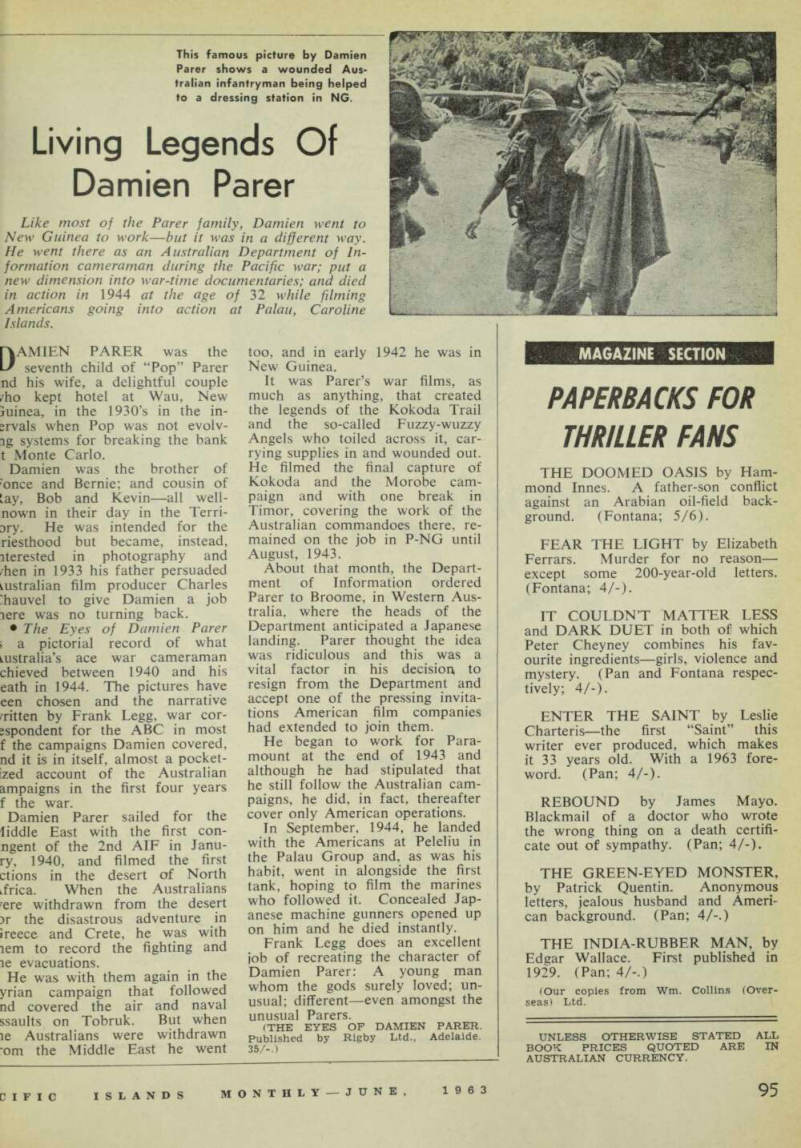
This famous picture by Damien Parer shows a wounded Aus tralian infantryman being helped to a dressing station in NG.