Native Clergy
p. 55 · Read in the full issue
[?]eed Seen To Raise Standards For Native Clergy
tie need to raise the standard
raining at Anglican theolo
colleges in the Pacific was
sed by delegates at a recent
lican conference in Honiara
heological education.
E Bishop of Melanesia, Rt. Rev.
Alfred Hill, chaired the confer and the Bishop in Polynesia, tev. John C. Vockler, and the Assistant Bishop of New Guinea, lev. David Hand, were present.
Dp Hand is now Bishop of New ;a). They were accompanied by wardens of their theological col- The chairman of the Aus n Board of Missions, Rev. n F. W. Coaldrake, also at d. legates agreed that with the de ment of education in the Islands, besides being spiritual rs of their people, must also be of learning to command the re and following of their adherents. was stressed that the three can theological colleges in Suva, BSIP, and Dogura, PNG, tly needed increased staff, better ment, a wider choice of text and good libraries from which nts, the clergy and others in ed in theology could borrow s conference resolved that: The Church outside the Pacific d seriously consider providing equipment, scholarships and dal aid for advanced courses ic abler theological students both i the Pacific and overseas.
The assistance of the Church within and without the Pacific ;es (New Guinea, Polynesia and lesia) must be solicited to estab first-class Amglican theological ies at each theological college, ately, full-time librarians should Dpointed, and opportunities for ng potential librarians overseas d be sought.
Staffs of Pacific theological ;es must include indigenous >ers if their work is to be fully d to the needs of the Pacific es and the future of the col is to be ensured. Every effort
must be made to choose such people and establish bursaries to train them adequately. • Specialists, both clergy and laity, were needed in such fields as: Urban areas, labour lines, radio, Press, hos pitals, prisons, Armed Forces, police, Missions of Seamen, chaplaincies to Government schools and other in stitutions, youth work, women’s work, adult education and stewardship. • The three dioceses needed a preparatory college in each diocese, a Central Anglican Theological Col lege for normal ordination training, and facilities for suitable students in government or multi-denominational colleges for higher theological train ing or university education. • Churches of the Anglican Com munion should be asked to train and supply theoiogical educators for the staff of the three theological colleges, and it was hoped that such educators might be found in Africa or Asia.,
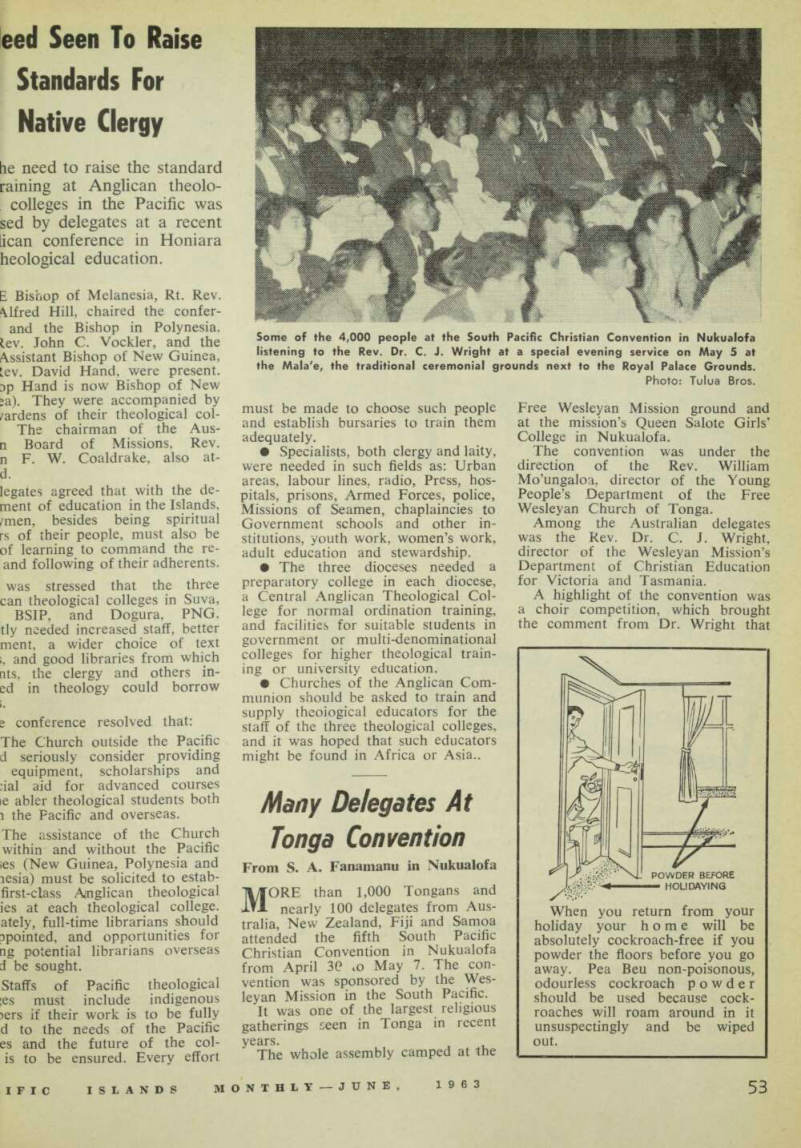
Some of the 4,000 people at the South Pacific Christian Convention in Nukualofa listening to the Rev. Dr. C. J. Wright at a special evening service on May 5 at the Mala'e, the traditional ceremonial grounds next to the Royal Palace Grounds.
Photo: Tulua Bros.