New Wharf Will Mean Brighter
pp. 47-49 · Read in the full issue
Future For Bougainville
Bougainville’s first overseas wharf, to be built at Kieta next year, should put Bougainville on the map at long last.
AS a result of it, Bougainville planters and business people are looking forward to a new lease of life for the Forgotten Isle. Bougainville has taken a back seat for too long.
Its big and growing copra and cocoa production provides a big proportion of P-NG’s wealth, yet in return Bougainville has had virtually nothing done for it. Roads are poor or non-existent, and shipping services, on which the island is so dependent, have been given little encouragement.
For many years Bougainville people fought for an overseas wharf before the Port Moresby Administration finally relented. The local people had to insist that the proper place for it was in the beautiful deep water harbour at Kieta.
Work is almost finished on a reclaimed area, made by bulldozing a hill, which will have two copra sheds and a privately-owned cocoa shed.
One of the copra sheds, it is expected, will be used as a P-NG Copra Marketing Board depot.
Tenders will be let soon for the wharf to be built off the end of the bulldozed area. It will be about 60 ft. by about 20 ft., allowing one hatch of a ship to be worked.
There is plenty of depth, and local people expect the Bank Line ships,
apart from the regular Tulagi, will use it.
The setting-up of a Copra Board depot at Kieta will mean that most Bougainville copra will be shipped there instead of to Rabaul, where most of it goes at present. For most planters it will be cheaper to freight it to Kieta than to Rabaul. And the depot should help overcome the shipping problems which Bougainville people have had to contend with for many years. It was because of ship ping shortages that the Bougainville Company was formed and the Polur rian was purchased, , Made A Difference The Polurrian made a big dif ference to planters. With the help of small vessels available locally, she was able to keep plantations clear.
The tragic loss of the Polurrian in late March—together with 33 people, including the master, Captain Peter Fenwick—has caused a backlog of copra, and contributed to a drop in the overall P-NG production figures for this year.
It is likely that in the next few years Kieta will replace the small island of Sohano as administrative headquarters for Bougainville. Kieta was the headquarters in German times, Kieta already has a hotel—the only
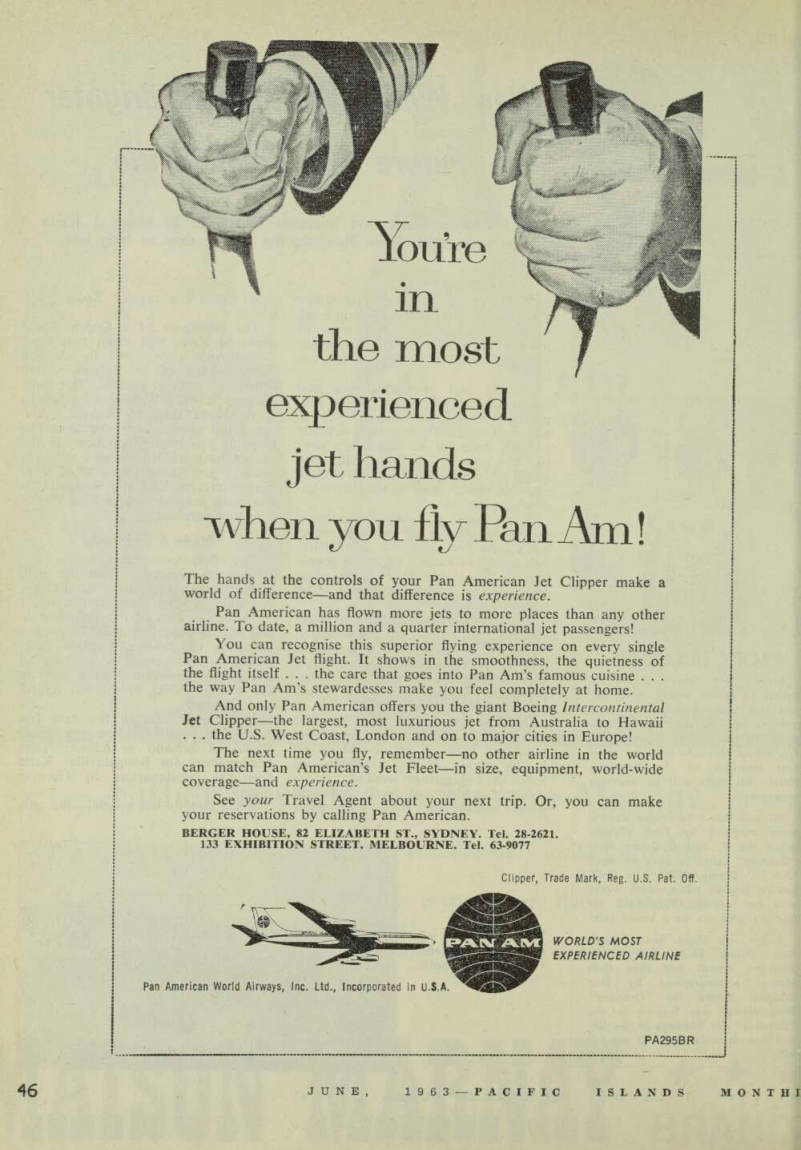
The "Polurrian" off the beach at Bonis Plantation. - Photo: Marjorie Long.
on Bougainville—and when the wharf is built those on the east expect big development in , especially on the commercial At least one of the big stores come in, and the new wharf mean a slipway and other sup ig businesses. th this kind of development should come such things as and badly needed roads for the jtten Isle.
Recollections Of
An Old Friend
.S. MARJORIE LONG, formerly of Bonis plantation, Bougain and now of Sydney, spoke for Bougainville people when, in a for PIM, she mourned the rian as a good friend. She wrote: 11 plantations welcomed the in 1951, that a new ship would arrive for the coastal trade, anters and traders, their copra i filled to the roof and burst were waiting for clearances; 0 bags of copra were waiting mpment. The Bougainville Ship- Company had been formed residents as shareholders), and purchased the 400-ton Polurrian ngland and had refitted her to he island trade.
Contrast sharp contrast in appearance to yar-worn ships we had had was rian’s dark green hull, white structure and bigger propor all of which made her stand like a swan among ducklings she began her work between ul and Bougainville in 1952. he pronounciation of her name 1 source of speculation until her ;r, Bill Hallam, introduced her all and explained that the em s was on the second syllable.
Hallam was Polurrian’s master several years. As well as a )le master he was a good host, gave parties on board during ;tmas if he happened to be in Passage. olurrian was involved in several snts that I remember. On one ier early trips from Buka to ul with decks piled high with i, she ran into a storm and Dned some of her cargo to save ssible capsize. On another oc n Polurrian rescued Wong You’s boat Horn and the Government er Nivani, from a reef off the Bougainville coast. Rescue opera took two and a half days be ; of rough seas and high winds, hen there was the day I was ring over Polurrian’s rail while was at Bonis plantation loading
copra when I slipped and fell and broke several ribs. Bill Hallam quickly turned the ship around and took me to the medical officer at Sohano.
“Polurrian relieved the inter mittent shortage of fresh food and supplies felt at the southern end of Bougainville at a time when there was an inadequate air service, and she also ensured regular shipments of copra. And she carried fresh food freight-free, a gesture much appre ciated by the Bougainville Company’s customers.
“Vale Polurrian .”
Compulsory Education In
Two Areas of P-NG
Compulsory education for children of six years of age has been extended to the Popondetta township area of Papua—the second area in Papua- New Guinea to have compulsory education. The other area comprises a group of villages near Port Moresby.
The children may attend either mission or Administration schools, said the chief of the P-NG Division of Primary Education, Mr. R. C.
Ralph, in May.