Work, Work!"
pp. 39-40 · Read in the full issue
[?]u've "Goff To Work, Work!"
three-day patrol into the
dtive and rugged Western
hands was one of the high s of the 23-day tour of ja-New Guinea in May of :ralia’s Governor - General, 1 De L’lsle. It was his first to New Guinea.
E Governor-General walked om Wapenamanda to the Baiyer y over a tough route. The >1 was headed by Acting tant District Officer D. J. Hood, included 40 native carriers who 3ed up and down the gruelling food and equipment, in metal s slung on poles, iring his tour the Governor :ral was welcomed as a friend ever he went; but he repeatedly the natives, in effect, that if wanted independence, they would to keep on carrying cargo up down hills. e Governor-General was accom :d on his tour (but not on the -day patrol) by his daughter, the Catherine Sidney. He visited Moresby, Lae, Madang, Goroka, antu, Kundiawa, Chuave, Mount n, Kerowagi, Nondugl, Banz, ak, Hayfield, Maprik, Angoram, ; omin, Rabaul and Kokopo. an open-air welcome to the tory at Ela Beach Oval, Port rsby, on May 2, Lord De LTsle a pageant of progress in a series
of 10 tableaus which depicted such things as the arrival of the first missionaries and P-NG business ad vancement.
Earlier, Mr. John Guise, MLC for East Papua, had said in an address of welcome: “We ask you and your Govern ment and the United Nations to stand beside us with continued in terest, as your great country stood by the world in the year 1939 and following, to safeguard our human rights and dignity and assist us towards our ultimate destiny of the freedom of self-determination by us in Papua and New Guinea.”
The gist of the Governor-General’s reply was that the only effective path to self-determination was hard work.
At Goroka, nearly every person in the town and from surrounding areas gathered at the airport to greet the Governor-General. At Kainantu, some of the villagers who waited at the airport to see his plane arrive had walked for two to three days to be present.
At Agarubi, he said: “Australia wants very much to lead you in the path of progress, but the day will come when the Terri tory of Papua and New Guinea will have to stand on its own feet.
“You can help by sending all your children to school, also by learning new ways of agriculture and by tell ing your children they must improve their skill and learn new trades.
“You can only become strong and
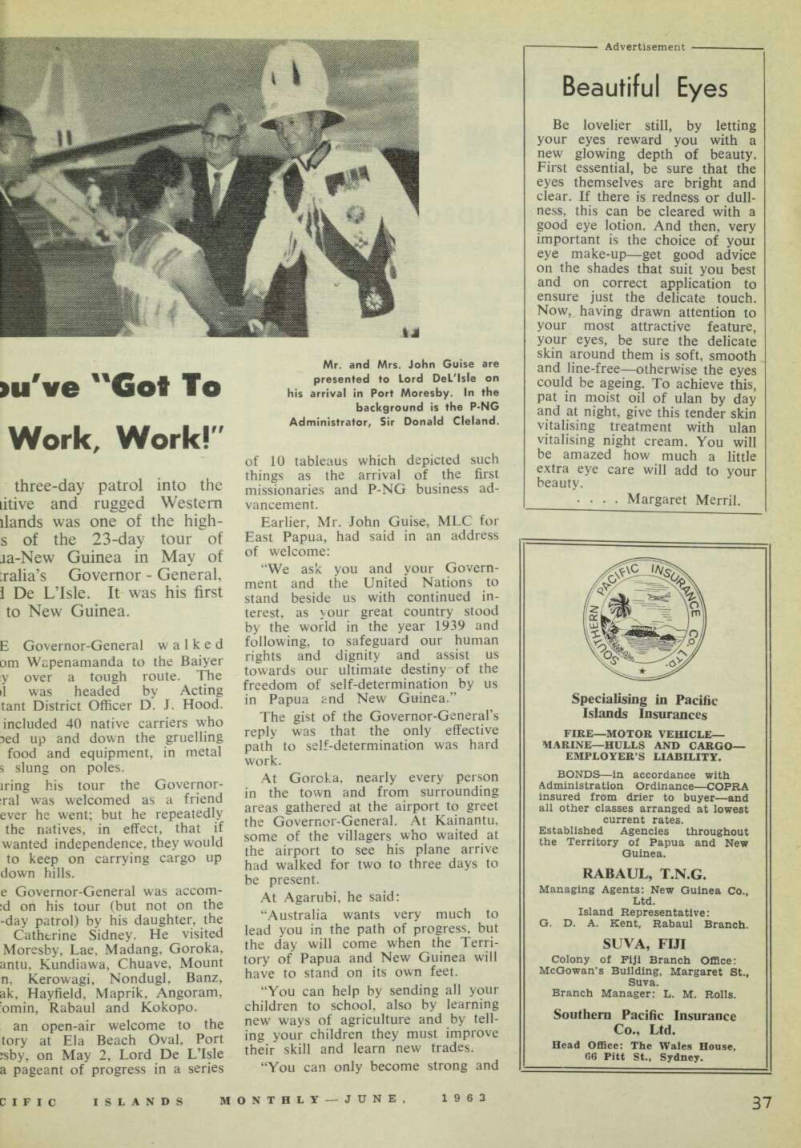
Mr. and Mrs. John Guise are presented to Lord DeL'lsle on his arrival in Port Moresby. In the background is the P-NG Administrator, Sir Donald Cleland.
united people by observing law order . . . and can only make ; selves prosperous by working h Along the 60-miles from Gc to Kundiawa, Eastern Highlands people gave the Governor-Ge and his daughter a welcome sue had never been seen in this pa the Highlands.
Almost every mile of the tacular mountain roads was st with flowers and the roadside similarly decorated.
At times the Governor-Gen< car was brought to a halt by cr< thronging around it. At N Village, leaders with painted be wearing ceremonial bird of par plumes, surged forward as the ve slowed down.
Speaking in pidgin, the \ villagers invited the Governor eral to stop the car.
“Get out of your car,” they “we want to see what you look when you stand up.”
After opening a new ma school at Kundiawa on May 8, ' De L’lsle completed a twe journey of 150 miles from Go to Mount Hagen. On May 10, h< gan his three-day patrol from We amanda to the Baiyer Valley.
This, he said afterwards, was longest and hardest walking he done since the war, and as a winner, Lord De LTsle is no stra to tough work.
He said the journey had ena him to see a very good cross-sei of patrol work, and nobody had doubt that he was impressed the job being done.
"Great Confidence"
Referring to the people he had along the way, the Governor-Gei added: “Obviously they have j confidence in the Administrator At Mt. Hagen, one of the to leading native businessmen prese him with a letter asking him to r Papua-New Guinea a State of tralia.
The man is Kup Ogut, vice: sident of the Mt. Hagen Local ♦ eminent Council, who has travr in Australia.
In his letter, Kup Ogut saio fully realised other countries w; like to own New Guinea.
“My own conviction is tj country must become a State of . tralia both to protect Australia protect us from people who c be our enemies,” he said.
“We ask you to look after country and our people so that o nations cannot steal this place’*