Sir Hugh Ragg
pp. 31-33 · Read in the full issue
Dies In Suva
Sir Hugh Ragg, the “Grand Old Man of Fiji”, died suddenly at his home at Tamavua, Suva, early on May 24 at the age of 81. He had not been in the best of health for some time and had suffered several minor heart attacks, one of them on his 81st birthday on January 26.
BUT each time he had made a quick recovery, and the day be fore his death was at work as usual, after having attended the 7.30 a.m.
Ascension Day Mass.
A public-spirited man, he served
for more than a quarter of a century in the Legislative and Executive Councils. After his retirement from the political field 10 years ago his ad vice was often sought, and just as often accepted, on matters relating to the welfare of the Colony.
He was an elected member of the Legislative Council from 1926 to 1947. In 1947 he became a nomin ated member and did a three-year term. He was a member of the Exe cutive Council from 1945 to 1954.
His outstanding contribution to the economy of Fiji was his major role in the development of the tourist in dustry.
Sporting, social and philanthropic activities claimed much of his time and he gave of his best in all. He established bowling clubs and tennis courts, after an active younger life in cricket, tennis, golf and bowls. In the days when horse racing flourished Sir Hugh owned a string of race horses. For 14 years he was secretary of the Ba Amateur Turf Club.
At the time of his death he was chairman of the Leper Trust Board.
Prominent among his work for worthy causes was the part he played in setting up the War Memorial Anti- Tuberculosis Fund, of which he was chairman till his death. To raise the money Sir Hugh made a personal tour of Fiji and in three months helped to raise £635,000, to which the Government added a subsidy of £30,000.
He was knighted in 1947 for his
public, political and philanthropic
services.
Sir Hugh was born at Suva, the third son of Hugh Hall Ragg, the original Ragg in Fiji, who migrated to the Colony from England, via Melbourne, in 1869. Sir Hugh went
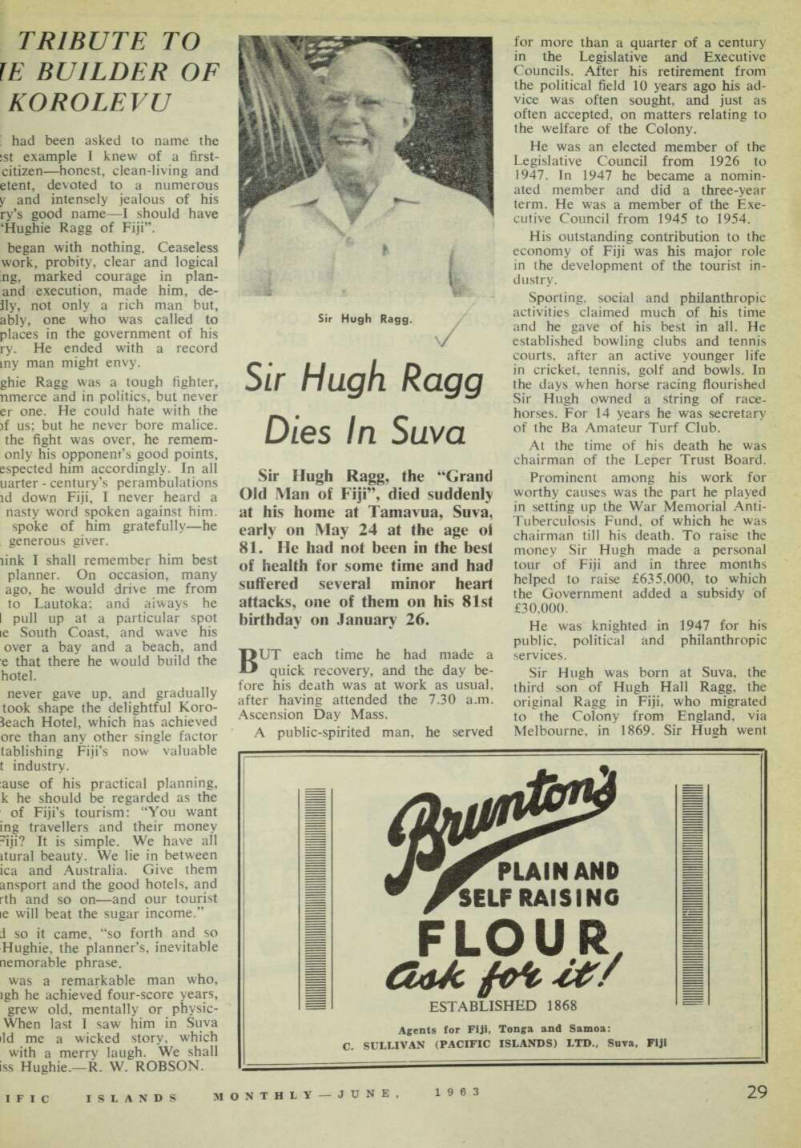
Sir Hugh Ragg.
Marist Brothers School at Suva, ft when he was only 12 to work s father. succeeding years he worked as nual” boy, and in various com il houses at Suva, Lautoka, i and Ba. It was in 1921 that ugh launched a venture which 0 grow into a foremost hotel ss and make Sir Hugh one of Colony’s leading commercial became the licensee of the Ba which had accommodation for 'sons. He and his wife ran the till 1933, when Sir Hugh took dest son, David, into partner 'ive years later Northern Hotels ame into being, and their first iion was to buy the Lautoka ti the war there were thousands ops stationed in Fiji and his made money. war had been over for a few s only when he began expand ipidly. He built the Rakiraki first, followed later by the ac- Dn of Nadi Hotel (1948), ia Hotel (1950), Tavua Hotel ). the world famous Korolevu Hotel (1953) and the Beach r Hotel at Deuba (1957). In iry, 1958, Northern Hotels se a lease of the Club Hotel, from Morris Hedstrom Ltd., sting a link which had been g from the chain. 1 characteristic enterprise he fed the hotels from time to to keep them in line with n hotels overseas. His contribu ) the tourist industry, and his in its future, cannot be red in terms of £sd.
Hugh was married twice. His ife (nee Dora Petrie) died in luenza epidemic in 1918. They ven children, all of whom bear cond name of Petrie. In 1920 [ugh married Miss Adrienne ine McMichan (formerly of lia). Lady Ragg, his two sons fe daughters survive him.
Hugh was a director of the imes and Herald Ltd. re are 28 grandchildren and gre at-grandchildren. ness houses throughout Fiji leir flags at half-mast the day igh died. Flags were flown at ast on Government buildings xt day when he was buried at I Suva Cemetery. funeral was probably the big ver seen at Suva, and was a g tribute to the high esteem in he was held by all races.