Tropicalities
pp. 27-30 · Read in the full issue
kt the end of May the Australian Government was still lickering about, attempting to obtain permission rom Indonesia for seven West New Guinea students to omplete their studies in Port Moresby. The students rere sent to the Papuan Medical College by the Dutch administration, and after the Indonesian takeover lie Indonesians asked for their return to Pest New Guinea “on the next plane”.
students feared reprisals for rticles they had written last 3n Indonesia’s claims on West Tuinea and applied by telegram e Australian Prime Minister, tobert Menzies, for political a. ee of the students are due to their medical course in 1965 our in 1966.
Garfield Barwick, Australia’s er for External Affairs, told ment that he thought the “right ” was to see whether the Indo s would let the students finish itudies. should just think so! ile the Australian Government sen fussing about, being careful
not to tread on any Indonesian toes, the Fijian Government has gone ahead and adjusted a similar problem without any fuss at all.
Fiji has four West New Guinea students attending the Fiji School of Medicine (formerly the Central Medical School) who were also re quested by Indonesia to return home.
The students were told by Fiji that they could remain and, furthermore, that the Government would meet the cost of their courses.
The British Ambassador at Djakarta was asked to inform the Indonesian Government about Fiji’s decision. And the Indonesians accepted the decision.
One of the Suva students will finish
his course at the end of this year.
A second will finish it next year and the remaining two in 1965.
Will the students go back to West New Guinea when they have finished their courses in Fiji?
We’ll make a prediction: We predict that if they pass, the Fiji Government will allow them to re main and work in Fiji.
"Teach-Yourself" Editor
Beats The Gun
THERE were some red faces in Western Samoan Government circles early in May when Samoana, one of Apia’s two weekly newspapers, published details of the Lauterbach- Stace economic report on Western Samoa (see page 33).
The reason for the consternation was that only the previous day the Government had announced that de tails of the report were still on the secret list.
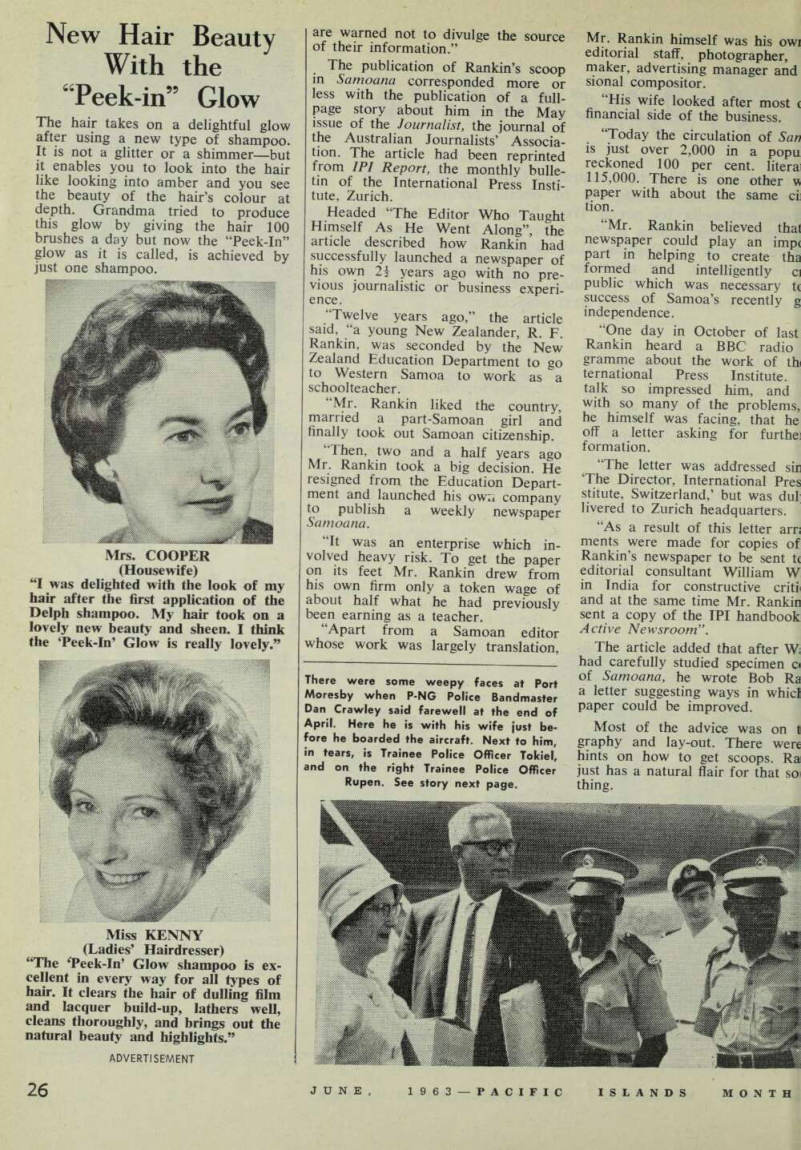
The publication of the Lauterbach- Stace story ahead of the gun was another triumph for Samoana’s en terprising managing director, manag ing editor and general factotum, Bob Rankin.
Rankin is not the sort of person to gloat, but with the story on the front page and his rival beaten, he couldn’t resist cocking a gleeful snook at the Government with a small par. in his “Around the Town” column.
“Most details of the Lauterbach- Stace Report, as revealed in Samoana, are still on the Govern ment secret list,” he said. “Readers
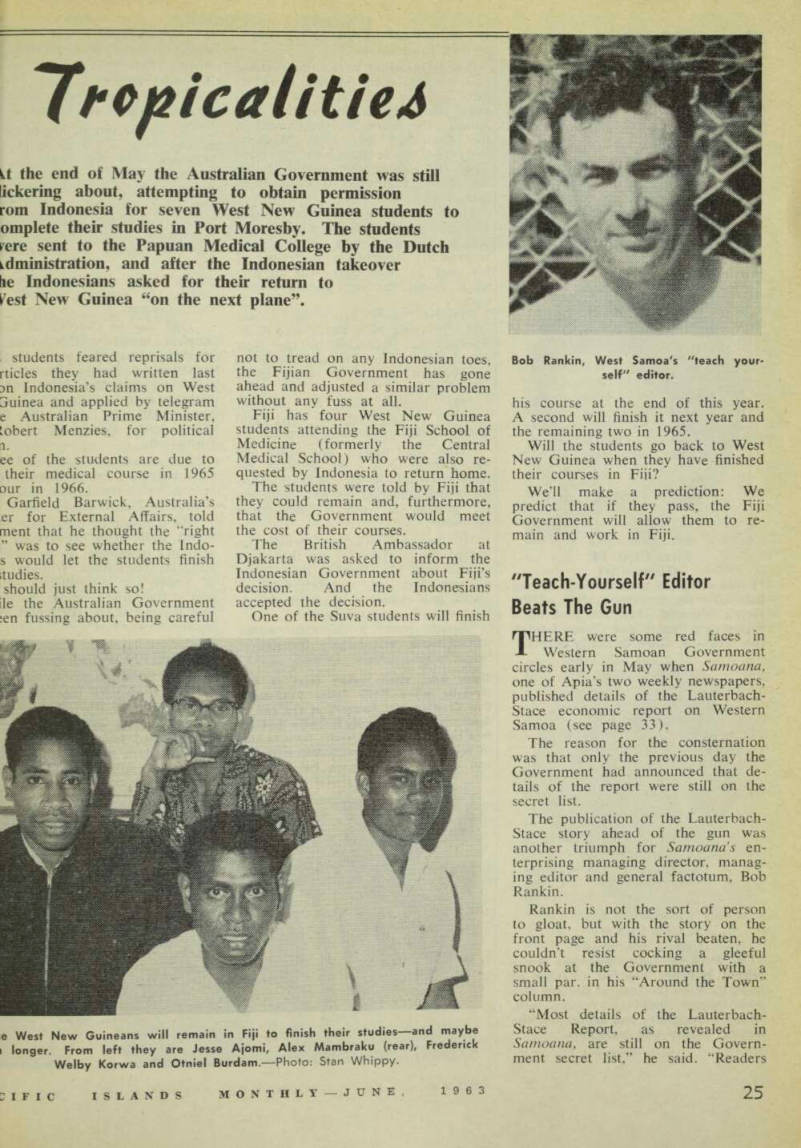
[?] e West New Guineans will remain in Fiji to finish their studies —and maybe [?] longer. From left they are Jesse Ajomi, Alex Mambraku (rear), Frederick Welby Korwa and Otniel Burdam. — Photo: Stan Whippy.
Bob Rankin, West Samoa's "teach your self" editor.
are warned not to divulge the source of their information.”
The publication of Rankin’s scoop m Samoana corresponded more or less with the publication of a full page story about him in the May issue of the Journalist, the journal of the Australian Journalists’ Associa tion. The article had been reprinted from IPI Report, the monthly bulle tin of the International Press Insti tute, Zurich.
Headed “The Editor Who Taught Himself As He Went Along”, the article described how Rankin had successfully launched a newspaper of his own years ago with no pre vious journalistic or business experi ence, “Twelve years ago,” the article said, “a young New Zealander, R. F.
Rankin, was seconded by the New Zealand Education Department to go to Western Samoa to work as a schoolteacher.
“Mr. Rankin liked the country, married a part-Samoan girl and finally took out Samoan citizenship.
“Then, two and a half years ago Mr. Rankin took a big decision. He resigned from the Education Depart ment and launched his owii company to publish a weekly newspaper Samoana.
“It was an enterprise which in volved heavy risk. To get the paper on its feet Mr. Rankin drew from his own firm only a token wage of about half what he had previously been earning as a teacher.
“Apart from a Samoan editor whose work was largely translation,
Mr. Rankin himself was his owi editorial staff, photographer, maker, advertising manager and sional compositor.
“His wife looked after most c financial side of the business.
“Today the circulation of San is just over 2,000 in a popu reckoned 100 per cent, litera 115,000. There is one other w paper with about the same cl tion.
“Mr. Rankin believed that newspaper could play an imp< part in helping to create tha formed and intelligently ci public which was necessary tc success of Samoa’s recently g independence.
“One day in October of last Rankin heard a BBC radio gramme about the work of th« ternational Press Institute, talk so impressed him, and with so many of the problems, he himself was facing, that he off a letter asking for furthe] formation.
“The letter was addressed sic ‘The Director, International Pres stitute, Switzerland,’ but was dul; livered to Zurich headquarters.
“As a result of this letter am ments were made for copies of Rankin’s newspaper to be sent t( editorial consultant William W in India for constructive critl and at the same time Mr. Rankin sent a copy of the IPI handbook Active Newsroom”.
The article added that after W; had carefully studied specimen o of Samoana, he wrote Bob Ra a letter suggesting ways in whicl paper could be improved.
Most of the advice was on t graphy and lay-out. There were hints on how to get scoops. Ra just has a natural flair for that so) thing.
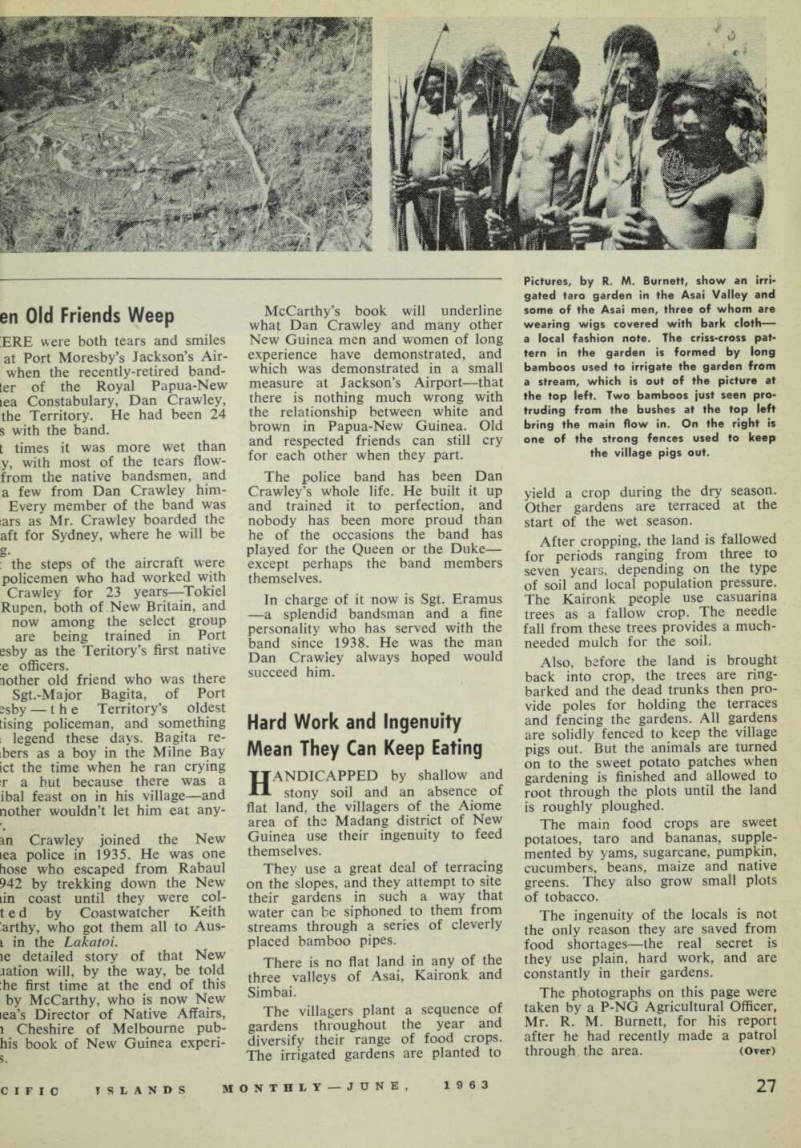
There were some weepy faces at Port Moresby when P-NG Police Bandmaster Dan Crawley said farewell at the end of April. Here he is with his wife just be fore he boarded the aircraft. Next to him, in tears, is Trainee Police Officer Tokiel, and on the right Trainee Police Officer Rupen. See story next page.
en Old Friends Weep
ERE were both tears and smiles at Port Moresby’s Jackson’s Air when the recently-retired hand ler of the Royal Papua-New lea Constabulary, Dan Crawley, the Territory. He had been 24 s with the band. t times it was more wet than y, with most of the tears flow from the native bandsmen, and a few from Dan Crawley him- Every member of the band was ;ars as Mr. Crawley boarded the aft for Sydney, where he will be g ; the steps of the aircraft were policemen who had worked with Crawley for 23 years—Tokiel Rupen, both of New Britain, and now among the select group are being trained in Port esby as the Teritory’s first native :e officers. lother old friend who was there Sgt.-Major Bagita, of Port ssby the Territory’s oldest tising policeman, and something . legend these days. Bagita re fers as a boy in the Milne Bay ict the time when he ran crying r a hut because there was a ibal feast on in his village—and nother wouldn’t let him eat any an Crawley joined the New lea police in 1935. He was one liose who escaped from Rabaul 942 by trekking down the New tin coast until they were col te d by Coastwatcher Keith arthy, who got them all to Aus i in the Lakatoi. le detailed story of that New aation will, by the way, be told fie first time at the end of this by McCarthy, who is now New lea’s Director of Native Affairs, i Cheshire of Melbourne pub his book of New Guinea experi-
McCarthy’s book will underline what Dan Crawley and many other New Guinea men and women of long experience have demonstrated, and which was demonstrated in a small measure at Jackson’s Airport—that there is nothing much wrong with the relationship between white and brown in Papua-New Guinea. Old and respected friends can still cry for each other when they part.
The police band has been Dan Crawley’s whole life. He built it up and trained it to perfection, and nobody has been more proud than he of the occasions the band has played for the Queen or the Duke— except perhaps the band members themselves.
In charge of it now is Sgt. Eramus —a splendid bandsman and a fine personality who has served with the band since 1938. He was the man Dan Crawley always hoped would succeed him.
Hard Work and Ingenuity
Mean They Can Keep Eating
Handicapped by shallow and stony soil and an absence of flat land, the villagers of the Aiome area of the Madang district of New Guinea use their ingenuity to feed themselves.
They use a great deal of terracing on the slopes, and they attempt to site their gardens in such a way that water can be siphoned to them from streams through a series of cleverly placed bamboo pipes.
There is no flat land in any of the three valleys of Asai, Kaironk and Simbai.
The villagers plant a sequence of gardens throughout the year and diversify their range of food crops.
The irrigated gardens are planted to
yield a crop during the dry season.
Other gardens are terraced at the start of the wet season.
After cropping, the land is fallowed for periods ranging from three to seven years, depending on the type of soil and local population pressure.
The Kaironk people use casuarina trees as a fallow crop. The needle fall from these trees provides a much needed mulch for the soil.
Also, before the land is brought back into crop, the trees are ring barked and the dead trunks then pro vide poles for holding the terraces and fencing the gardens. All gardens are solidly fenced to keep the village pigs out. But the animals are turned on to the sweet potato patches when gardening is finished and allowed to root through the plots until the land is roughly ploughed.
The main food crops are sweet potatoes, taro and bananas, supple mented by yams, sugarcane, pumpkin, cucumbers, beans, maize and native greens. They also grow small plots of tobacco.
The ingenuity of the locals is not the only reason they are saved from food shortages—the real secret is they use plain, hard work, and are constantly in their gardens.
The photographs on this page were taken by a P-NG Agricultural Officer, Mr. R. M. Burnett, for his report after he had recently made a patrol through the area. (Over)
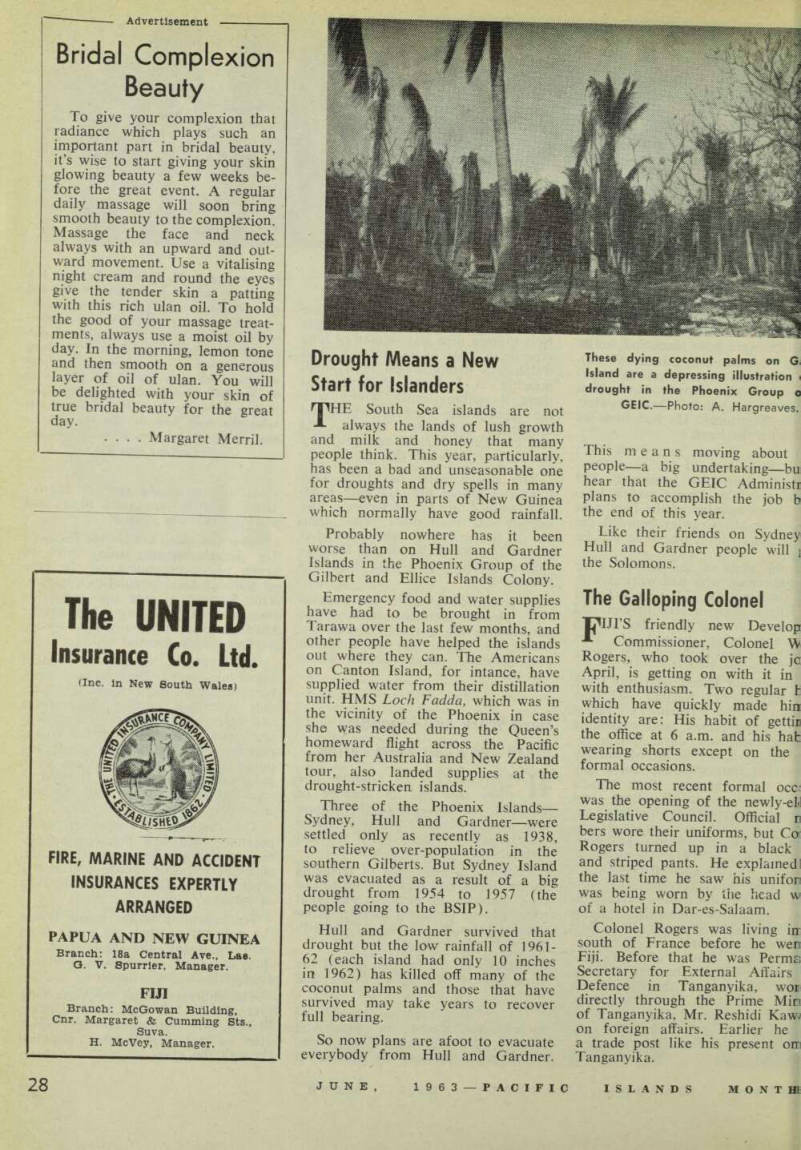
Pictures, by R. M. Burnett, show an irri gated taro garden in the Asai Valley and some of the Asai men, three of whom are wearing wigs covered with bark cloth — a local fashion note. The criss-cross pat tern in the garden is formed by long bamboos used to irrigate the garden from a stream, which is out of the picture at the top left. Two bamboos just seen pro truding from the bushes at the top left bring the main flow in. On the right is one of the strong fences used to keep the village pigs out.
Drought Means a New
Start for Islanders
South Sea islands are not always the lands of lush growth and milk and honey that many people think. This year, particularly, has been a bad and unseasonable one for droughts and dry spells in many areas—even in parts of New Guinea which normally have good rainfall.
Probably nowhere has it been worse than on Hull and Gardner Islands in the Phoenix Group of the Gilbert and Ellice Islands Colony.
Emergency food and water supplies have had to be brought in from Tarawa over the last few months, and other people have helped the islands out where they can. The Americans on Canton Island, for intance, have supplied water from their distillation unit. HMS Loch Fadda, which was in the vicinity of the Phoenix in case she was needed during the Queen’s homeward flight across the Pacific from her Australia and New Zealand tour, also landed supplies at the drought-stricken islands.
Three of the Phoenix Islands— Sydney, Hull and Gardner—were settled only as recently as 1938, to relieve over-population in the southern Gilberts. But Sydney Island was evacuated as a result of a big drought from 1954 to 1957 (the people going to the BSIP).
Hull and Gardner survived that drought but the low rainfall of 1961- 62 (each island had only 10 inches in 1962) has killed off many of the coconut palms and those that have survived may take years to recover full bearing.
So now plans are afoot to evacuate everybody from Hull and Gardner.
This means moving about people—a big undertaking—bu hear that the GEIC Administr plans to accomplish the job b the end of this year.
Like their friends on Sydney Hull and Gardner people will > the Solomons.
The Galloping Colonel
■piJFS friendly new Develop
Commissioner, Colonel W Rogers, who took over the jo April, is getting on with it in with enthusiasm. Two regular h which have quickly made him identity are: His habit of gettir the office at 6 a.m. and his hat wearing shorts except on the formal occasions.
The most recent formal occ: was the opening of the newly-ek Legislative Council. Official n bers wore their uniforms, but Cot Rogers turned up in a black and striped pants. He explained I the last time he saw his unifon was being worn by the head w of a hotel in Dar-es-Salaam.
Colonel Rogers was living in south of France before he wen Fiji. Before that he was Perms Secretary for External Affairs Defence in Tanganyika, won directly through the Prime Min of Tanganyika. Mr. Reshidi Kawv on foreign affairs. Earlier he a trade post like his present om Tanganyika.
These dying coconut palms on G.
Island are a depressing illustration < drought in the Phoenix Group o GEIC.—Photo: A. Hargreaves.