Challenge To Land Titles Could
pp. 13-15 · Read in the full issue
Rock New Guinea Economy
From R. W. Robson.
Rabaul, May 25.
At no time in the 30 years I have known this country ye I found among European interests in this area a greater ise of uneasiness.
1 circumstances surrounding the ttacks by the Tolais upon land here —and especially the current appeal in the Varzin Plantation -have created a general fear that ad titles in this Territory may safe. finance institution now is ed to grant credit on the ty of land. This, of course, that all small capital works depend upon bank loans will to a halt. st people here are so confused j development that they do little than curse. But the few who iderstand blame the Canberra —and I think quite rightly— lowing such a thing to happen, tain high officials in Port by have been so leaning over ards, in their eagerness to get with the United Nations and atives, that they have become c. They have lost sight of the ount need for protecting funda l European interests and thus
maintaining here some spirit of co operation between the European com munity and the planners in Port Moresby and Canberra who think they can defy the lessons of history and the laws which govern human nature.
Appeal Court Sits All this week, P-NG’s Chief Justice Mann has been sitting inconspicuously as an appeal court in a Council hall in Vunadidir, a little village out be yond Toma.
The presence there of the court has not been publicised. But it is known that it is taking evidence “in connec tion with the Varzin case”, and alarm among many Europeans has grown accordingly. (See also PIM, April, P- 39.) The Administration is wary and withdrawn on the subject of “the Varzin case”. There is no comment, I have been warned that I may not comment on the merits of the claim— it is all “sub judice”.
I am going to set out the history and cause of this extraordinary de velopment, but I may nol comment upon the issues involved. But I am free to point out the probable effect of the case, whatever the verdict may be.
The Germans, 1885-1914, syste matically examined all claims for NG land before granting titles and re corded them in the German Ground book.
The Australian Administration, es tablished under the League of Nations after World War I, took over all German property. It was “expro priated” and sold, and the proceeds of such sales went towards paying the German War Debt established under the Treaty of Versailles.
The Australians had the Ground book, and thus knew the history of the properties taken over.
By the Land Registration Ordinance of 1924, the ex-German properties were brought under the British form of registration, which was based on the Torrens system. It provided that, before registration of the land con cerned, there should be investigation into any native claims to it.
Once satisfied there were no native claims, the properties were placed in
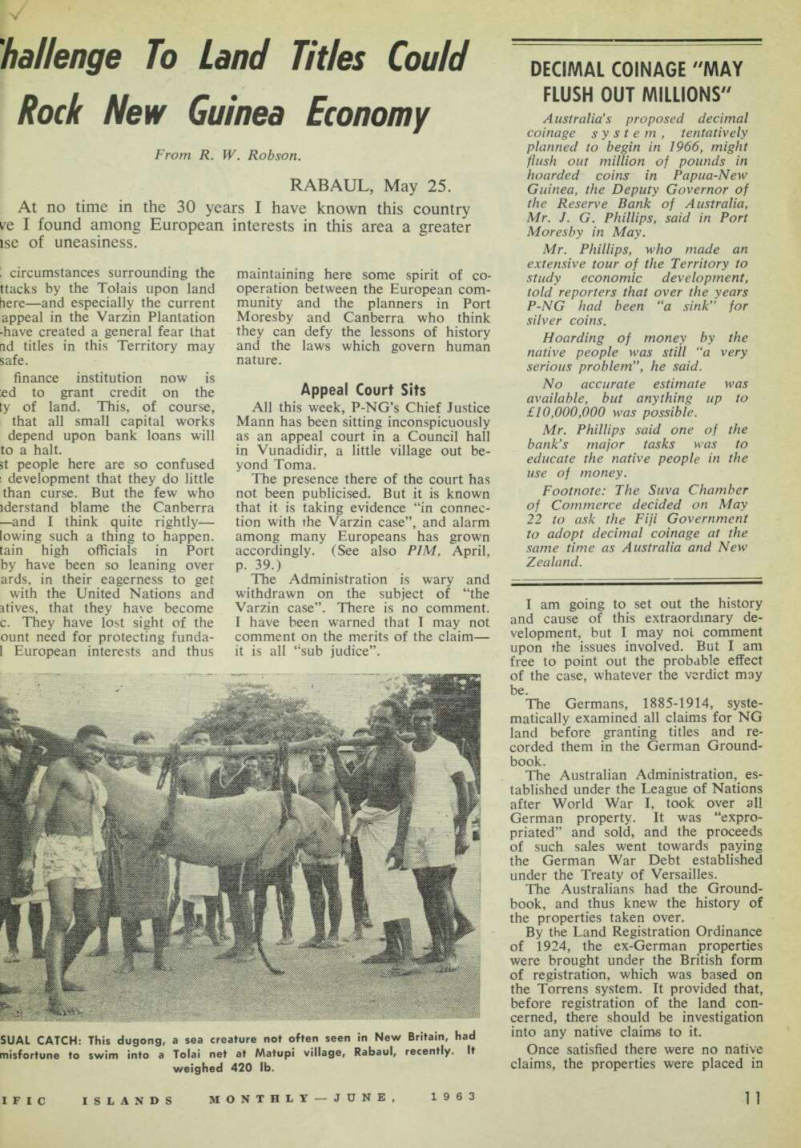
SUAL CATCH: This dugong, a sea creature not often seen in New Britain, had misfortune to swim into a Tolai net at Matupi village, Rabaul, recently. It weighed 420 Ib.
.egister in the care of the lian of Expropriated Properties; ic Custodian issued to buyers based on the Torrens system, implied “indefeasibility”, r to World War 11, the Cus had photostat copies made of les issued; so that, although idministration records were lost the Japanese invaded New l, the Australian authority had i data to allow it to restore was done through the Land Restoration Ordinance of 1951. lommissioner for Land Titles given authority to inquire r there were any native rights t his discretion, to order the tion of the titles, n the Varzin claim to restora f title was presented, some were made by natives; but Commissioner McCubbery, l long investigation, dismissed im, and orders for the restora the title to Mrs. A. Richards wner since the death of her isband) were issued on August 30. seemed to be the end of the But the 1951 Ordinance pro :or an appeal to the Supreme against any decision of the Commissioner; and stipulated within which it may be lodged, tter stipulation was not clear; it is the reason why the Varzin was not lodged until February, e was a lengthy hearing by the ic Court, and Mr, Justice gave an interlocutory judgment ember, 1962. It gives no major is —it merely provides the with an opportunity of bring ther evidence on points which iks need clarification, this further evidence (about claims to the Varzin lands) has been heard at Vunadidir the past week.
The appellants are village Tolais; and the thing that surprises many Europeans is the method of their representation before the court.
Their case has been prepared, and they are represented at the court, by the Public Solicitor, who is an officer of the Administration. All right, but this Administration has a Crown Law Department, Secretary of which is Mr. W. W. Watkins. Within that de- 1 partment there are a Crown Solicitor (Mr. S. H. Johnson) and a Public i Solicitor (Mr. W, A. Lalor).
Thus we have the spectacle of an officer of the department (the Publiq Solicitor) fighting for the Tolai natives for what they claim are their ancient rights in Varzin; while oppos ing him is another lawyer of the same department representing the Crown Solicitor, who is fighting for the Custodian of Expropriated Pro perty and the Commissioner for Titles, who contend that the Varzin
property belongs properly to Mrs.
Richards.
The interlocutory judgment says that the Chief Justice, as at Novem ber, 1962, concluded “that the pre war registered title (to Varzin) was not conclusive as against the appel lants (the Tolai natives), either as to whether the land was validly brought under the operation of the Lands Registration Ordinance (of 1924) or whether the Custodian was entitled to the interest specified”.
Thus the New Guinea community has learned, with horror, that it is possible to review the titles issued by the Custodian between the wars.
Hitherto, it always had been as sumed that these titles were “based on the Torrens system”, and there fore completely secure; and financial transactions were made accordingly.
The local view is that the situation calls for forthright comment upon the performances of the Canberra and Port Moresby officials responsible for policies and law-drafting; but we now reach the “sub judice” stage, and must await the end of the Varzin case.
That end may be a long way off.
There seems to be a certainty of High Court appeal, whichever side wins; and then—according to this inter locutory judgment—a certainty of an appeal for compensation by which ever side finally loses.
Meanwhile (a) no financial institu tion seems ready to lend money on Territory land; and (b) the intelligent Tolai natives of the Gazelle Peninsula feel that it is not a bad old world where one can get such valuable legal services for nothing.
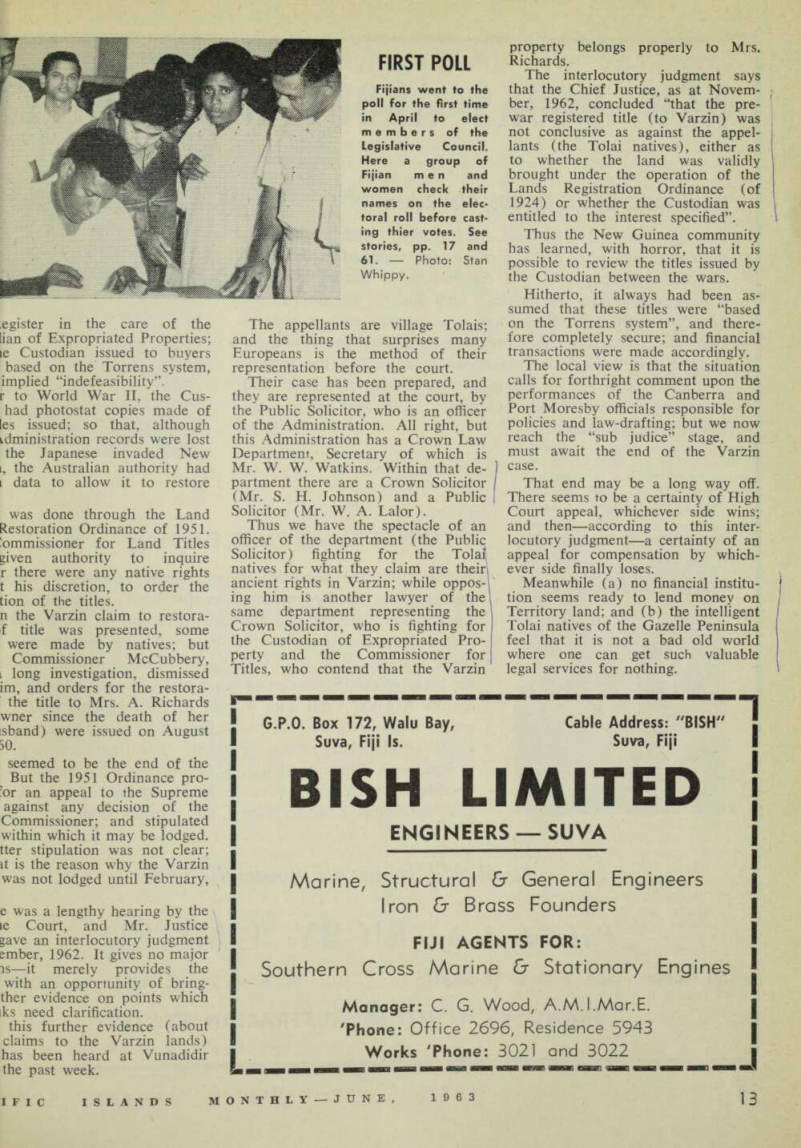
First Poll
Fijians went to the poll for the first time in April to elect members of the Legislative Council.
Here a group of Fijian men and women check their names on the elec toral roll before cast ing their votes. See stories, pp. 17 and 61. - Photo; Stan
Whippy.