Indonesia’s New Guinea
pp. 7-8 · Read in the full issue
Takeover Poses Border Problem For Australia
By Stuart Inder
With only a month passed since the takeover of Nether lands New Guinea on May 1, Indonesia is pushing its plans so fast, and with so much self-assurance, that uneasiness is grow ing in the eastern half of New Guinea about just what sort of neighbours the territory is getting.
INDONESIA is behaving already as if she held firm sovereignty over West New Guinea, instead of merely holding the reins of adminstration relinquished by the Dutch.
The Indonesian Information Minis ter announced in May the start of a big propaganda campaign designed, unashamedly, to convince the Papuans of West New Guinea, that they are really Indonesians, and that they needn't expect to get a chance to decide they are anything else.
The Dutch-Indonesian Agreement of last August, which gave the Papuans the right to “choose freely” by 1969 whether they wanted self determination or to remain with In donesia, is to be made a dead letter as early as possible.
The general uneasiness at this In
donesian method of administration — the method of telling the people what is best for them—is shared by the Australian Minister for Territories, Mr. Paul Hasluck, who told Federal Parliament in May that it was a method “Australia had turned its back on” on its own side of the border (p. 17).
Big P-NG Advance Mr. Hasluck was seeing through Parliament a bill which gives Papua- New Guinea a 64-member legislature, elected from a common roll, from next March. The new legislature will have a big native majority.
On the Indonesian side of the border Indonesia had just announced establishment of a 38-member Coun cil, with not a single elected member,
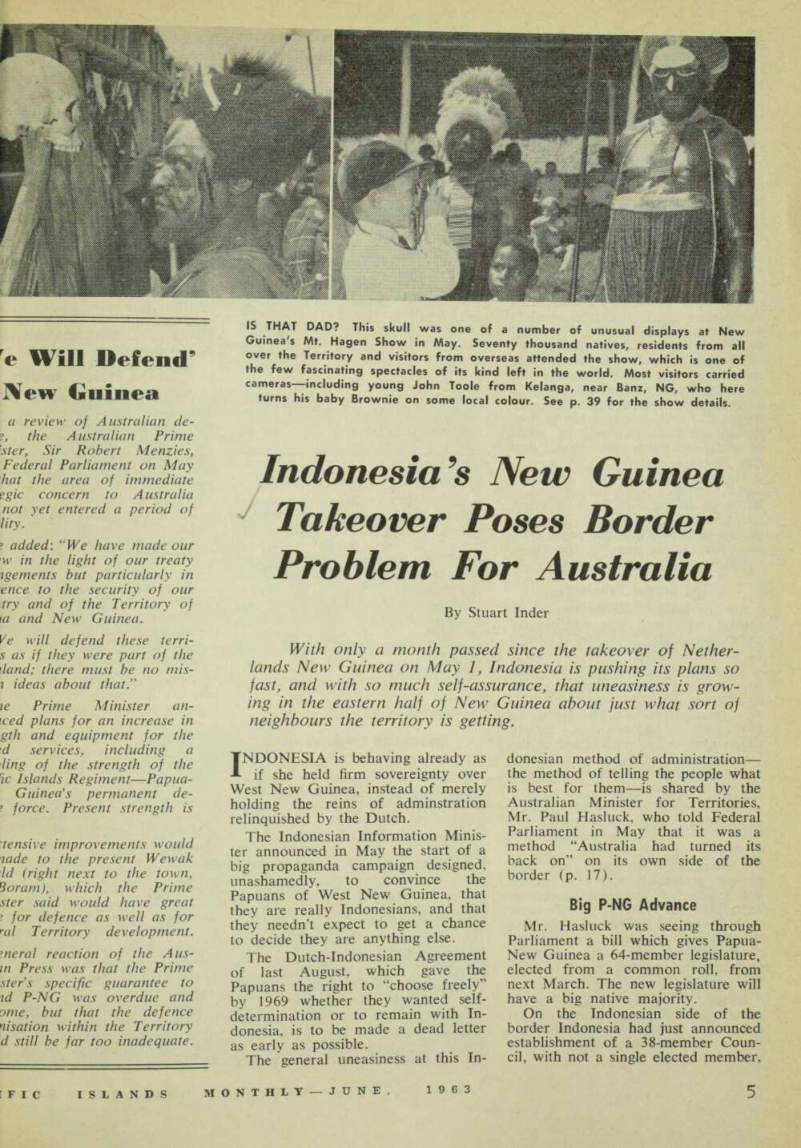
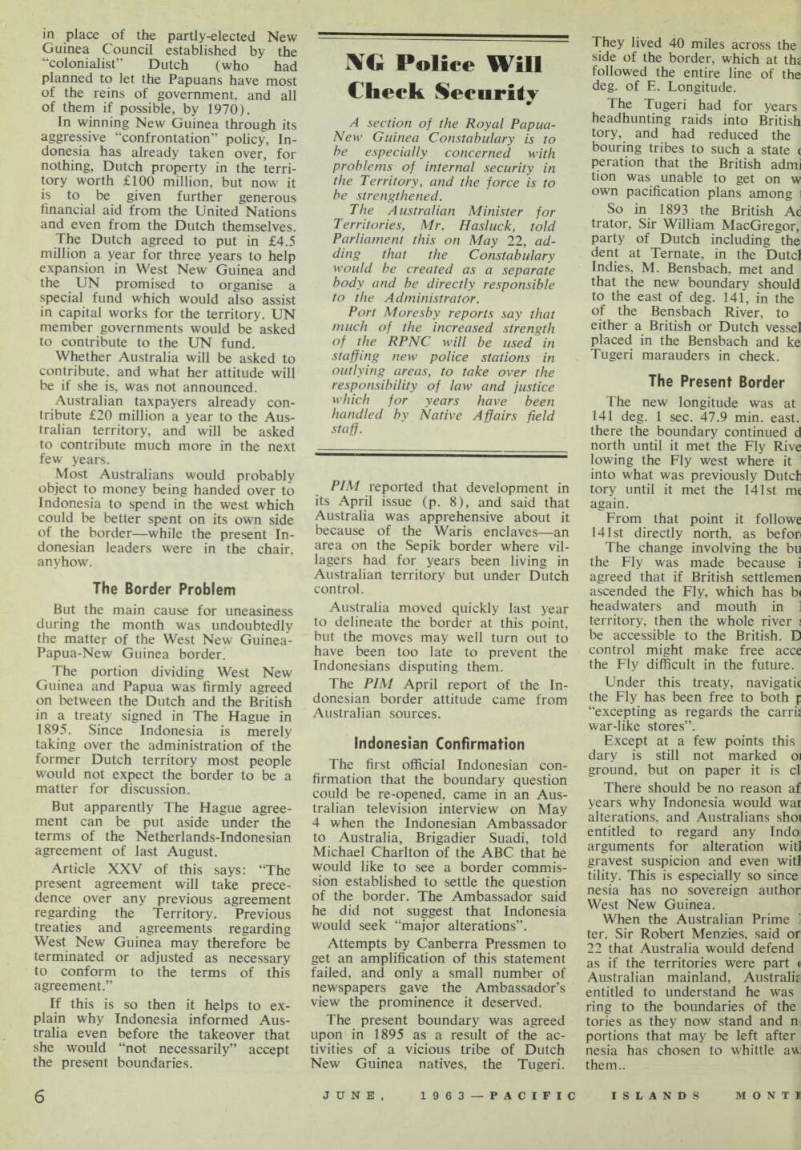
IS that DAD? This skull was one of a number of unusual displays at New Guinea s Mt. Hagen Show in May. Seventy thousand natives, residents from all over the Territory and visitors from overseas attended the show, which is one of the few fascinating spectacles of its kind left in the world. Most visitors carried cameras—including young John Toole from Kelanga, near Banz, NG, who here turns his baby Brownie on some local colour. See p. 39 for the show details.
in place of the partly-elected New Guinea Council established by the “colonialist” Dutch (who had planned to let the Papuans have most of the reins of government, and all of them if possible, by 1970).
In winning New Guinea through its aggressive “confrontation” policy, In donesia has already taken over, for nothing, Dutch property in the terri tory worth £lOO million, but now it is to be given further generous financial aid from the United Nations and even from the Dutch themselves.
The Dutch agreed to put in £4.5 million a year for three years to help expansion in West New Guinea and the UN promised to organise a special fund which would also assist in capital works for the territory. UN member governments would be asked to contribute to the UN fund.
Whether Australia will be asked to contribute, and what her attitude will be if she is, was not announced.
Australian taxpayers already con tribute £2O million a year to the Aus tralian territory, and will be asked to contribute much more in the next few years.
Most Australians would probably object to money being handed over to Indonesia to spend in the west which could be better spent on its own side of the border—while the present In donesian leaders were in the chair, anyhow.
The Border Problem But the main cause for uneasiness during the month was undoubtedly the matter of the West New Guinea- Papua-New Guinea border.
The portion dividing West New Guinea and Papua was firmly agreed on between the Dutch and the British in a treaty signed in The Hague in 1895. Since Indonesia is merely taking over the administration of the former Dutch territory most people would not expect the border to be a matter for discussion.
But apparently The Hague agree ment can be put aside under the terms of the Netherlands-Indonesian agreement of last August.
Article XXV of this says: “The present agreement will take prece dence over any previous agreement regarding the Territory. Previous treaties and agreements regarding West New Guinea may therefore be terminated or adjusted as necessary to conform to the terms of this agreement.”
If this is so then it helps to ex plain why Indonesia informed Aus tralia even before the takeover that she would “not necessarily” accept the present boundaries.
PIM reported that development in its April issue (p. 8), and said that Australia was apprehensive about it because of the Waris enclaves—an area on the Sepik border where vil lagers had for years been living in Australian territory but under Dutch control.
Australia moved quickly last year to delineate the border at this point, but the moves may well turn out to have been too late to prevent the Indonesians disputing them.
The PIM April report of the In donesian border attitude came from Australian sources.
Indonesian Confirmation The first official Indonesian con firmation that the boundary question could be re-opened, came in an Aus tralian television interview on May 4 when the Indonesian Ambassador to Australia, Brigadier Suadi, told Michael Charlton of the ABC that he would like to see a border commis sion established to settle the question of the border. The Ambassador said he did not suggest that Indonesia would seek “major alterations”.
Attempts by Canberra Pressmen to get an amplification of this statement failed, and only a small number of newspapers gave the Ambassador’s view the prominence it deserved.
The present boundary was agreed upon in 1895 as a result of the ac tivities of a vicious tribe of Dutch New Guinea natives, the Tugeri.
They lived 40 miles across the side of the border, which at tha followed the entire line of the deg. of E. Longitude.
The Tugeri had for years headhunting raids into British tory, and had reduced the bouring tribes to such a state < peration that the British admi tion was unable to get on w own pacification plans among i So in 1893 the British Ac trator, Sir William MacGregor, party of Dutch including the dent at Ternate, in the Dutcl Indies, M. Bensbach, met and that the new boundary should to the east of deg. 141, in the of the Bensbach River, to either a British or Dutch vessel placed in the Bensbach and ke Tugeri marauders in check.
The Present Border The new longitude was at 141 deg. 1 sec. 47.9 min. east, there the boundary continued d north until it met the Fly Rive lowing the Fly west where it into what was previously Dutct tory until it met the 141st m( again.
From that point it followe 141st directly north, as befor The change involving the bu the Fly was made because i agreed that if British settlemen ascended the Fly, which has b< headwaters and mouth in ] territory, then the whole river ! be accessible to the British, D control might make free acce the Fly difficult in the future.
Under this treaty, navigatic the Fly has been free to both f “excepting as regards the cams war-like stores”.
Except at a few points this dary is still not marked oi ground, but on paper it is cl There should be no reason af years why Indonesia would war alterations, and Australians shoi entitled to regard any Indo: arguments for alteration wit! gravest suspicion and even witl tility. This is especially so since nesia has no sovereign author West New Guinea.
When the Australian Prime ] ter, Sir Robert Menzies, said or 22 that Australia would defend as if the territories were part < Australian mainland, Australis entitled to understand he was ring to the boundaries of the tories as they now stand and n portions that may be left after nesia has chosen to whittle aw them..