400 Miles Into The Highlands
pp. 132-133 · Read in the full issue
Of New Guinea
A motoring holiday on the roof of New Guinea is still a little way into the future but is now at least a possibility. Road maps issued recently by an oil company show the way that it is going to be done.
A SERIES of detailed road maps and street plans covering the towns and more closely settled dis tricts of Papua and New Guinea has been issued by the Touring Service of the Shell Company of Australia.
These maps are right up-to-date, and are by far the best yet issued.
The principal map is for the big and growing town of Port Moresby, and shows the streets not only in the capital itself but also in the suburbs of Konedobu, Kaevaga, Koki, Badili, Matirogo and Boroko.
There are detailed street maps of Rabaui and Lae; a very useful map showing the present condition of the roads system in the Highlands, from the top of the Markham River right across through Kainantu, Goroka, Minj, and Mt, Hagen, to Wabag.
There is even a series of strip maps, especially designed for the motorist who wishes to travel from Lae to Mt. Hagen and Wabag.
These maps are not very detailed, as yet, and the sectional mileages are difficult to understand, but they are the first of their kind and as such, invaluable.
It all seems to bring the day nearer when the motoring tourist will be able to pick up a hire-and-drive car at Lae and make his own way into the Highlands. The rugged and adventurous could do it now—but the Highlands road, in spite of the new road maps, would be a shock to most suburban motorists.
The Leron River, which was bridged last year, removed the main navigational hazard from the low lands section of the road, but there
still are other streams not yet bridged that present problems to the novice.
The biggest trouble spot on the road at present is undoubtedly the Kassam Pass, where in the course of a half dozen miles the narrow gravel road winds up from the val ley floor some thousands of feet, in steep grades and hairpin (and hair raising) bends to the top of the pass. On the way—if you can bear to take your eyes off the road—
are some spectacular views over the headwaters of the Markham and Ramu Rivers.
However, better things are in the melting pot right now—tenders are shortly to be called for the re construction of the Kassam Pass section of the road and it is antici pated that something like £600,000 will be spent in the coming finan cial year on improving it to the stage where even ordinary motorists will be able to tackle it.
When that section is complete, it is anticipated that a further £400,000 will be spent on the Kassam-Kainantu section of about 40 miles and after that another £192,000 on the 60 miles between Kainantu and Goroka.
All this should come about within the next couple of years.
The improvement of the 150 miles of road to Mt. Hagen from Goroka
is not yet in the estimates. T used extensively by local mol and although the road in thu tion reaches the highest poii the whole Highlands route (1 Pass, at 8,175 feet, about 25 out of Goroka), it hasn’t the obstacles as those provided orig by the rivers of the Upper Mar and the haul up to Kassam Pai When all the new road wc complete, this road from Lae open up a new dimension in t travel in the Territory. It isn farfetched to look forward nc the day when there are, as w the existing hotels, motels at s gic points along the route foi such travellers.
Apart from its good clima perpetual springtime at elev from 5,000 to 7,000 feet, its sc and its coffee plantations, the lands have a dense populatic friendly and picturesque natives though much of the area has be civilised and, in parts, urbanis< recent years, it is possible st see these people very muc their age-old native state by small deviations off the main i The trick to the whole busine increased tourist traffic—whicl evitably must come even withoi Shell map—is going to be he keep these people natural am spoiled.
In spite of President Soek contention that we should be ash to present primitive natives tourist attraction, it is a fact 90 per cent, of the reason why v come to the Pacific Islands see, meet and observe the indig people and the way they live.
The map has been distri through Shell agents in Papus New Guinea and has been grati received by residents. It is free on request to motorists ii Territory.
The "Pacific Islands Monthly" is a member of the Australian National Travel Association (ANTA) and the Pacific Area Travel Association (RATA), which are pledged to promote tourist travel in their areas.
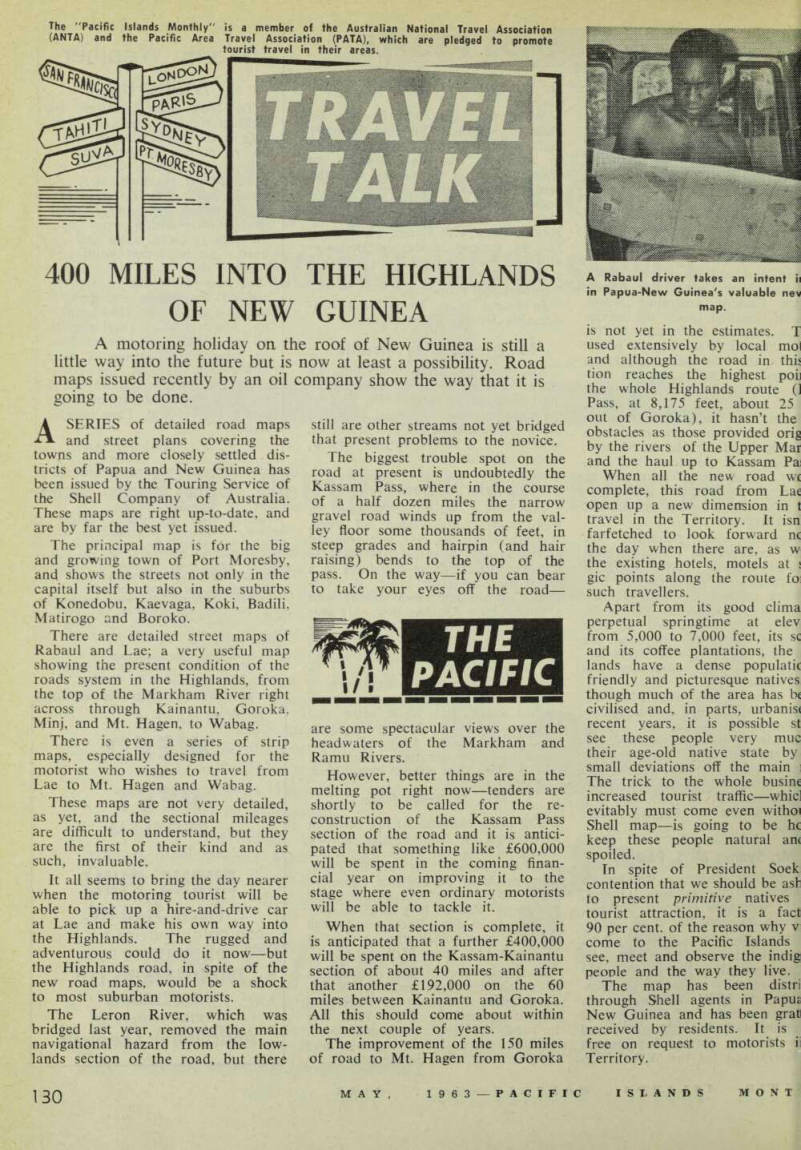
A Rabaui driver takes an intent ii in Papua-New Guinea's valuable nev map.
ig Kong in
sole Form 3NGKONG is fabulous. There is just not another place like And because it is near at 1 to the South Pacific, this British my on the edge of Red China is iming more and more popular Islands residents planning to do sthing interesting with their lives. 3AC in April inaugurated a new :t Boeing 707 Australia-Hongkong ice which is a useful connection anyone planning to visit Hong -5 from anywhere in the South fic. It leaves Sydney at 11.30 on Tuesdays and Thursdays and you to Hongkong about 9.30 the ; night with only one short stop •arwin en route. sing this service it is possible to d 22 hours in Hongkong—re ing to Sydney on the 7 p.m. plane Wednesday. Not many people Id plan to make a one-day air t to Hongkong, but a PIM staff who did just that on the in iral flight in April, reported it a lot to commend it. le tight schedule forced him to ahead in detail so that he could n a day what other tourists took to do. Thus for anybody with half-a-night-and-a-day to spare 'ongkong while en route to some e else, and who wants to get the out of it, he submits the follow
ing tested recipe.
Book in at the hotel (in his case the Hotel Merlin, Kowloon, a new hotel, single rooms 35-60 Hongkong dollars per day or double 60- 90 dollars, and thoroughly recom mended) after taking the special hotel transport provided at the airport.
Take a rickshaw (50 cents for every five minutes) to the ferry, a ferry ride across the busy harbour to Hongkong itself, and a cab to the top of Victoria Peak where the view at night is one of the most unforget able sights of the world. Return to Kowloon across the harbour by wallah-wallah (motor boat) at three dollars per boat, after wandering around Hongkong streets.
Take an early breakfast, make an other ferry ride to Hongkong and climb the peak again, this time by the fantastic funicular (at 60 cents), and from the top hire one of the many small taxis there to take you to Re pulse Bay, have a beer at the lovely hotel and return by the coast road via Aberdeen, and the floating village.
After a Chinese lunch, shop, re turn to the hotel, shop again on the Kowloon side (which is better), check out of the hotel after arranging at the desk to have a sedan and driver standing by for a trip around the New Territories, including the China border. Take a look at the vast new resettlement apartments before getting your driver to drop you off at the airport in time for a quick drink be fore you climb aboard the 707.
The Hongkong dollar is worth about 1/6 Australian. Air fares from Sydney are First Class, £230 single, £437 return; Economy £166/5/single and £3lB/18/- return. If you fly Qantas, you stop at Manila in stead of Darwin.
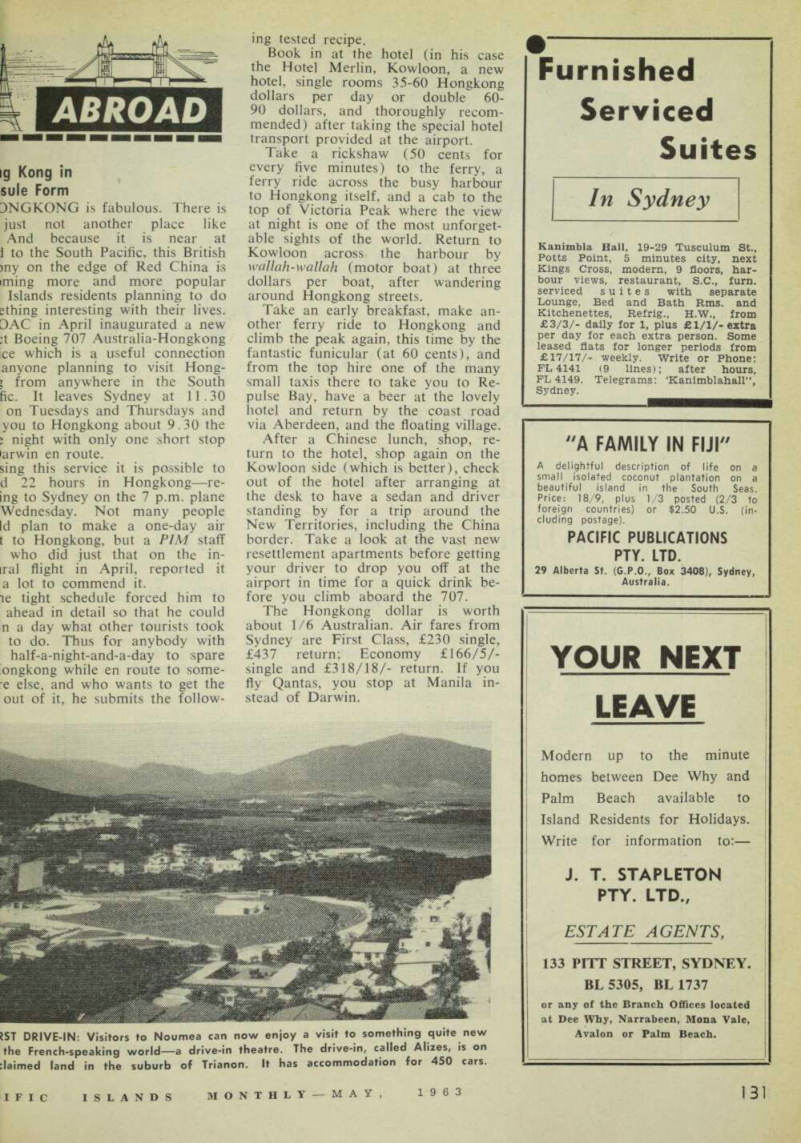
RST DRIVE-IN: Visitors to Noumea can now enjoy a visit to something quite new the French-speaking world—a drive-in theatre. The drive-in, called Alizes, is on [?]laimed land in the suburb of Trianon. It has accommodation for 450 cars.