Woman's Harrowing
pp. 119-120 · Read in the full issue
Evidence At "Polurrian" Inquest
Jenny Viva, a 22-year-old
widow, of Ranoga, BSIP, said at a Rabaul inquest in April that five natives had pushed her, her husband and two babies from a raft after the island trading ship Polurrian sank on a 200-mile voyage from Sohano, near Buka Island, to Rabaul on the night of March 28.
SHE said that her two children—a year-old boy and a two-year-old girl—later died in her arms, and her husband was taken by a shark.
Mrs. Viva, one of 29 survivors of the Polurrian disaster, was giving evi dence at an inquest before the Rabaul Coroner, Mr. F. J. Winkle, into the death of the ship’s captain, Peter Fenwick, an Australian. Thirty-three other people, mostly natives, are be lieved to have died when the Polur rian foundered.
The Polurrian, a 135-ft. vessel operated by Bougainville Co. Ltd., of Rabaul, left Sohano, on the northern tip of Bougainville, on March 28.
Three planes and six ships began searching for her after radio contact with her ceased.
All the survivors were suffering from exhaustion, hunger and sunburn when they were picked up by two small searching ships, the Matarani and Nirvani, 60 hours after the Polur rian went down. They were later transferred to the freighter Slitan and taken to Rabaul.
Mrs. Viva told the Coroner that soon after the Polurrian sank, she and her husband Daniel, a Seventh day Adventist mission teacher, climbed on to a raft with their two children.
Five or six natives, some swim ming, some holding on to planks, later found them, climbed on to the raft, and threw them into the water.
Mrs. Viva said the natives threw them a plank to hold, and later they found two lifebelts. She and her husband gave their baby boy water wrung from their hair, but the heat was too much and the child died in her arms. Their daughter died an hour later.
That night, Mrs. Viva said, her husband was attacked and carried off by a shark. In trying to fight off the shark, Mrs. Viva lost her lifebelt.
"Kept Her Off"
Next day, she saw a raft with other survivors, but when she paddled to it and tried to climb on it, those on board hammered at her hands to keep her off. Later, after she had told them that her husband and children were dead, they let her get on.
“Later that day a plane saw us, and then a ship picked us up,” Mrs.
Viva added.
When the Coroner asked Mrs. Viva if she could identify the men who had pushed her from the raft, she pointed to five natives in the court room.
Earlier, the Polurrian’s chief mate, Harry Hoehler, told the Coroner that the ship’s lifeboats could not be lowered before the ship was aban doned because of the heavy list to starboard.
A leading seaman of the Polurrian, Katori Karaham, said the ship was
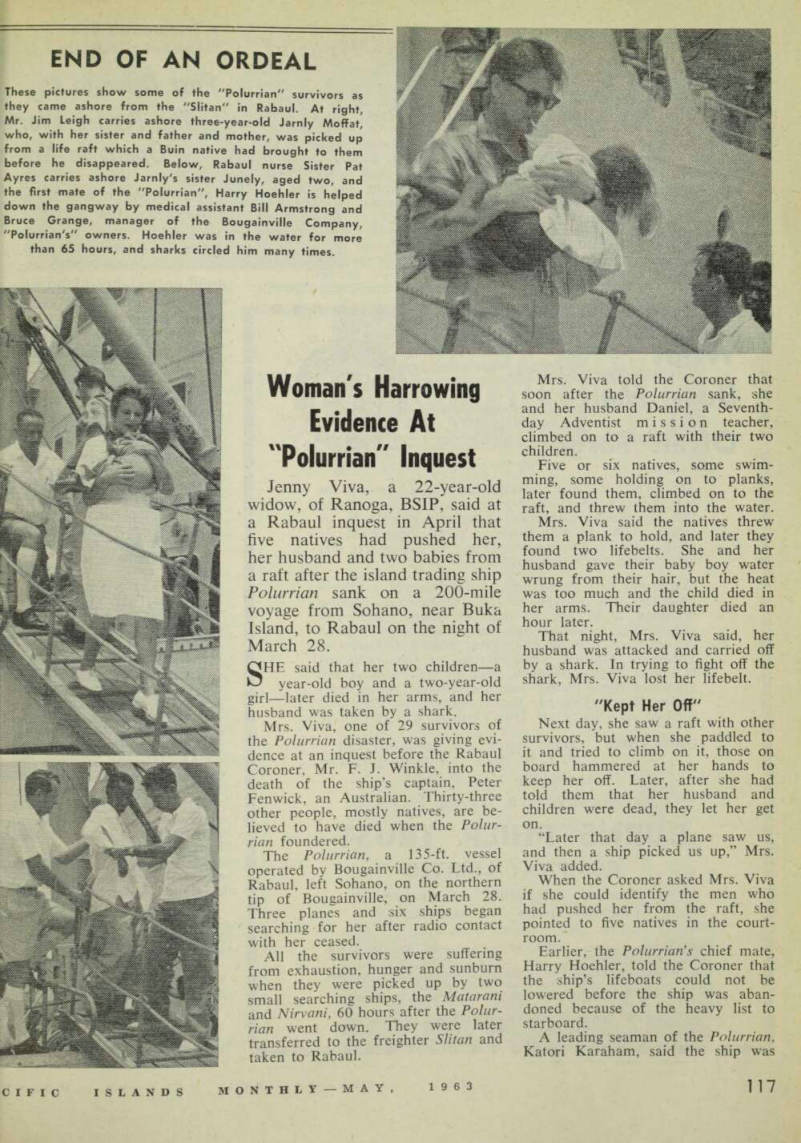
End Of An Ordeal
These pictures show some of the "Polurrian" survivors as they came ashore from the "Slitan" in Rabaul. At right, Mr. Jim Leigh carries ashore three-year-old Jarnly Moffat, who, with her sister and father and mother, was picked up from a life raft which a Buin native had brought to them before he disappeared. Below, Rabaul nurse Sister Pat Ayres carries ashore Jarnly's sister Junely, aged two, and the first mate of the "Polurrian", Harry Hoehler is helped down the gangway by medical assistant Bill Armstrong and Bruce Grange, manager of the Bougainville Company, "Polurrian's" owners. Hoehler was in the water for more than 65 hours, and sharks circled him many times.
carrying a deck cargo “higher than a man” when she sank.
While the ship was being loaded at Bougainville, he said, the crew kept moving her further from the wharf as her bottom kept resting on the floor of the harbour. He added that the weather was fairly good during the voyage.
An engine room attendant, Ouli Segars, gave evidence that the Polur rian had had a leak in her hull, and that this was apparent during the voyage.
The inquest was still proceeding when this issue of PIM went to press.
About 40 witnesses, including all 29 survivors, were expected to give evidence.