Do You Remain Faithfully,
p. 91 · Read in the full issue
Truly, Or Not At All?
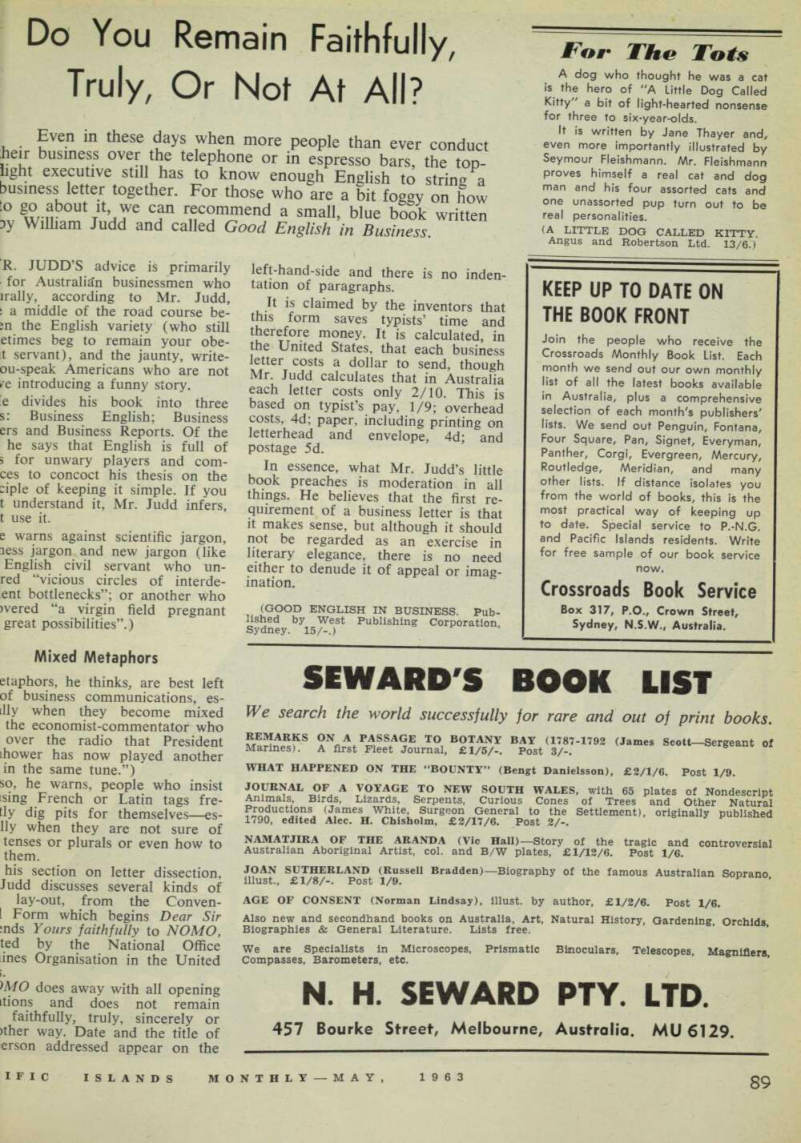
Even in these days when more people than ever conduct heir business over the telephone or in espresso bars, the top hght executive still has to know enough English to string a business letter together. For those who are a bit foggy on how lo go about it we can recommend a small, blue book written sy William Judd and called Good English in Business.
R. JUDD’S advice is primarily for Australian businessmen who irally, according to Mr. Judd, s a middle of the road course he rn the English variety (who still etimes beg to remain your obe t servant), and the jaunty, write ou-speak Americans who are not /e introducing a funny story.
'e divides his book into three s: Business English; Business ers and Business Reports. Of the he says that English is full of s for unwary players and com ces to concoct his thesis on the :iple of keeping it simple. If you t understand it, Mr. Judd infers, t use it. e warns against scientific jargon, less jargon and new jargon (like English civil servant who un red “vicious circles of interde ent bottlenecks”; or another who ivered “a virgin field pregnant great possibilities”.)
Mixed Metaphors
etaphors, he thinks, are best left of business communications, es illy when they become mixed the economist-commentator who over the radio that President ihower has now played another in the same tune.”) so, he warns, people who insist sing French or Latin tags fre tly dig pits for themselves—es lly when they are not sure of tenses or plurals or even how to them. his section on letter dissection, Judd discusses several kinds of lay-out, from the Conven l Form which begins Dear Sir mds Yours faithfully to NOMO, ted by the National Office ines Organisation in the United does away with all opening itions and does not remain faithfully, truly, sincerely or )ther way. Date and the title of erson addressed appear on the
left-hand-side and there is no inden tation of paragraphs.
It is claimed by the inventors that this form saves typists’ time and therefore money. It is calculated, in the United States, that each business letter costs a dollar to send, though Mr. Judd calculates that in Australia each letter costs only 2/10. This is based on typist’s pay, 1/9; overhead costs, 4d; paper, including printing on letterhead and envelope, 4d; and postage sd.
In essence, what Mr. Judd’s little book preaches is moderation in all things. He believes that the first re quirement of a business letter is that it makes sense, but although it should not be regarded as an exercise in literary elegance, there is no need either to denude it of appeal or imag ination.
(Good English In Business. Pub
lished by West Publishing Corporation Sydney. 15/-.)