Soul-Searching In
pp. 89-90 · Read in the full issue
The Month's New Deading
Strange Places
Although both are primarily concerned with a religious lessage, Miracle on the River Kwai, by Ernest Gordon, and annibal Valley, by Russell T. Hitt, have some other aspects.
can be guessed from the title, Ernest Gordon’s story concerns ner—of-war experiences on the rious Burma Railway. He was a ain in a Highland regiment and t the beginning of his 3i years’ isonment at the hands of the nese —at first in Changi, later in land. normal young man, with a hy scepticism about religion, he ted his companions die from work and ill-treatment, from cal diseases or at the hands of lese executioners. i saw them reach the lowest of degradation, where they it with one another over food s from Japanese rubbish pails or from their friends. Morale was i lowest ebb. ;n, some time in 1943, in a camp the River Kwai, he saw a trans ation. Three men gave their lives fellow-prisoners; others began ng their comrades in distress; or red together to read the Bible in new-found Christian faith, d strength to bear the worst that apanese could do.
With Judy Tudor
This was Gordon’s miracle. Other people might have other ways of ac counting for it; Good soldiers are frequently good Christian fundamen talists. And it is a well-known psy chological fact that, driven to a point beyond his own resources, man, by bis very nature, turns to a spiritual power beyond his own reasoning.
But unlike most people who forget miracles as soon as the need for them has passed, Gordon found his voca tion on the River Kwai and after he got back to Scotland entered theologi cal college in Edinburgh, became a Presbyterian minister and as such is now attached to Princeton University,
Usa.
Apart from its miracle, Gordon’s story of his SE Asian war experi ences follows the pattern that is al ready well-documented, except that the surrender found him in Sumatra where, with half-a-dozen others, he
attempted to sail a native ketch to safety in Ceylon. They were thwarted by a Japanese tanker a few hundred miles short of their objective.
Cannibal Valley is a much more holier-than-thou effort, being the ac count, as it says on the jacket, of the “heroic struggle for Christ in savage New Guinea”.
The part of New Guinea that most concerns the book is West New Guinea, when it was still Dutch New Guinea, and the Baliem Valley in par ticular.
The author is a writer on religious matters in America where he is editor of a publication called Eternity. He made the trip to WNG and the Baliem Valley especially to write the story of the pioneering efforts of the Christian and Missionary Alliance.
Baliem Valley, a high valley in central West New Guinea, similar to the Wahgi and other valleys in Aus tralian New Guinea, was discovered by the Archbold Expedition in 1938; and as Shangri-La, during the latter stages of the Pacific war became the scene of sightseeing flights by US
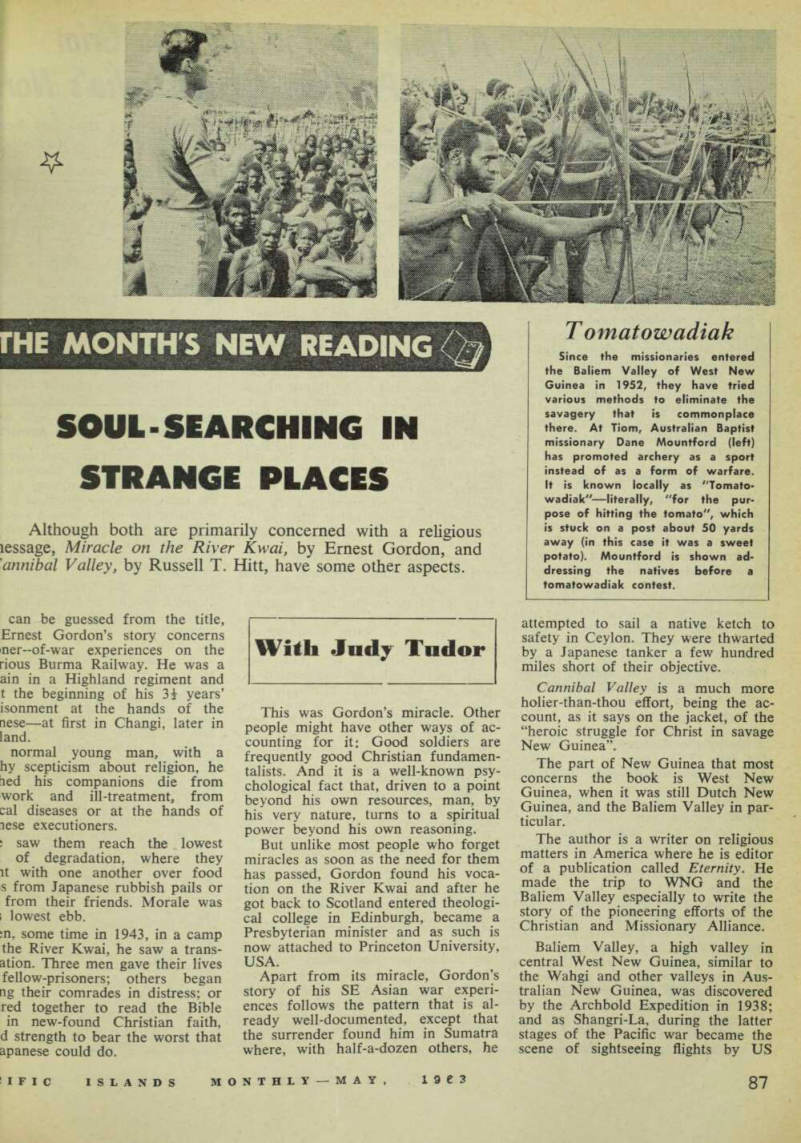
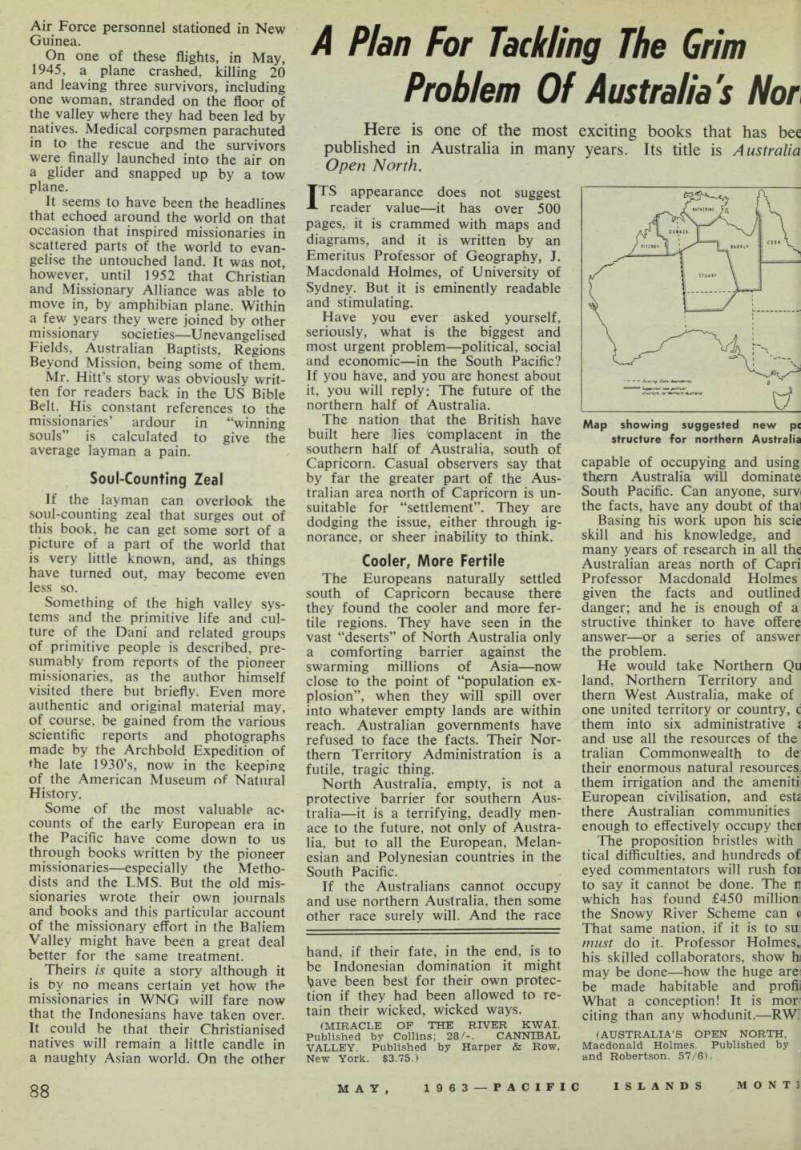
Tomatowadiak
Since the missionaries entered the Baliem Valley of West New Guinea in 1952, they have tried various methods to eliminate the savagery that is commonplace there. At Tiom, Australian Baptist missionary Dane Mountford (left) has promoted archery as a sport instead of as a form of warfare.
It is known locally as "Tomato wadiak"—literally, "for the pur pose of hitting the tomato", which is stuck on a post about 50 yards away (in this case it was a sweet potato). Mountford is shown ad dressing the natives before a tomatowadiak contest.
Air Force personnel stationed in New Guinea.
On one of these flights, in May, 1945, a plane crashed, killing 20 and leaving three survivors, including one woman, stranded on the floor of the valley where they had been led by natives. Medical corpsmen parachuted in to the rescue and the survivors were finally launched into the air on a glider and snapped up by a tow plane.
It seems to have been the headlines that echoed around the world on that occasion that inspired missionaries in scattered parts of the world to evan gelise the untouched land. It was not, however, until 1952 that Christian and Missionary Alliance was able to move in, by amphibian plane. Within a few years they were joined by other
missionary societies—Unevangelised
Fields, Australian Baptists, Regions Beyond Mission, being some of them.
Mr. Hitt’s story was obviously writ ten for readers back in the US Bible Belt. His constant references to the missionaries’ ardour in “winning souls” is calculated to give the average layman a pain.
Soul-Counting Zeal
If the layman can overlook the soul-counting zeal that surges out of this book, he can get some sort of a picture of a part of the world that is very little known, and, as things have turned out, may become even less so.
Something of the high valley sys tems and the primitive life and cul ture of the Dani and related groups of primitive people is described, pre sumably from reports of the pioneer missionaries, as the author himself visited there but briefly. Even more authentic and original material may, of course, be gained from the various scientific reports and photographs made by the Archbold Expedition of the late 1930’5, now in the keeping of the American Museum of Natural History, Some of the most valuable ac« counts of the early European era in the Pacific have come down to us through books written by the pioneer missionaries—especially the Metho dists and the LMS. But the old mis sionaries wrote their own journals and books and this particular account of the missionary effort in the Baliem Valley might have been a great deal better for the same treatment.
Theirs is quite a story although it is by no means certain yet how the missionaries in WNG will fare now that the Indonesians have taken over.
It could be that their Christianised natives will remain a little candle in a naughty Asian world. On the other
hand, if their fate, in the end, is to be Indonesian domination it might have been best for their own protec tion if they had been allowed to re tain their wicked, wicked ways.
(Miracle Of The River Kwai.
Published by Collins; 28/-. CANNIBAL VALLEY. Published by Harper & Row, New York. $3.75.)