Territories TALK-TALK
pp. 51-58 · Read in the full issue

The post-war discoveries being made in P-NG, apparently know no limit. Latest addition to world knowledge was reported by the Territory's Director of Public Health in a special World Health Day broadcast from Port Moresby.
HHE Director announced that, as a L result of a three-year study in ic Eastern Highlands, most of the [Others in that area now fed their dries on finely-ground roasted pea its.
Furthermore he reported that pea it paste mixed in equal portions of riled kaukau provided the “almost ;rfect food for a growing youngster” id was a milk substitute (see p. 63).
Whether this discovery will act as boost to the humble peanut industry mains to be seen. In 1958 the ex irt of the ground-nut meant a bit /er £lOO,OOO for the year to the srritories, but growers both in ueensland and NSW took a dim ew of such competition and the isiness consequently received a bit ; a knock.
If the Director’s discovery for solv g the world’s hunger spots are put to practice then he is deserving of uch praise and credit for the three ;ar study.
However, I expect nursing mothers other territorial areas still persist feeding their off-springs with a >oey paste of taro and coconut milk, ■ ground-up galip nut, as has been eir practice for many a long day.
With Tola 8a
The NG
Pharmacopoeia
There is no doubt but that much research has been carried out con cerning native medicinal herbs, their efficiency and general use. If this has been done then the results have not received much publicity.
Perhaps certain ethical standards preclude their publication unless they are presented in a bottle with a label.
At one time I compiled a list of native herbs and oils picked up here and there in New Guinea, which was then a country with no radio com munication and often no medical ser vice within a gettable distance. 1 thought it both valuable and interest ing.
But the list went west when the Japs came in and all my records in Rabaul were destroyed.
From memory I quote a few: There was the pandanus root soup for blackwater fever; the kaukau leaf poultice for cleaning up tropical ulcers; pig-weed (hervea) tea for asthma; wart-weed juice for eradicat ing warts; croton oil as a purgative; hibiscus-leaf tea as a diuretic; iguana oil (that used to leak through a glass bottle) for rheumatism and similar ailments.
There were pawpaw seeds for ex pelling intestinal worms and the leaves for wrapping tough fresh meat to make it tender; a heated banana leaf as a substitute for surgical silk; red oxide for eradicating head-lice and heated taro leaves for reducing in flammation. To say nothing of the dozen and one secret native potions for abortion; to bring on the menses or to stop them; aphrodisiacs and tranquillisers!
I recall, back in 1913 down in Bougainville, a friend of mine—an ardent dog-lover—sent to Sydney for medicine to cure one of his pets of
[?]WLS CHAMPION: In Port Moresby [?]cently, Mr. R. Mackie (left) received a [?]phy from bowls club captain Mr. A. [?]ittain as captain of the Championship [?]urs. Mr. MacKie also won the trophy [?]r the Singles Championship—after 17 rears of trying. Photo: Papuan Prints.
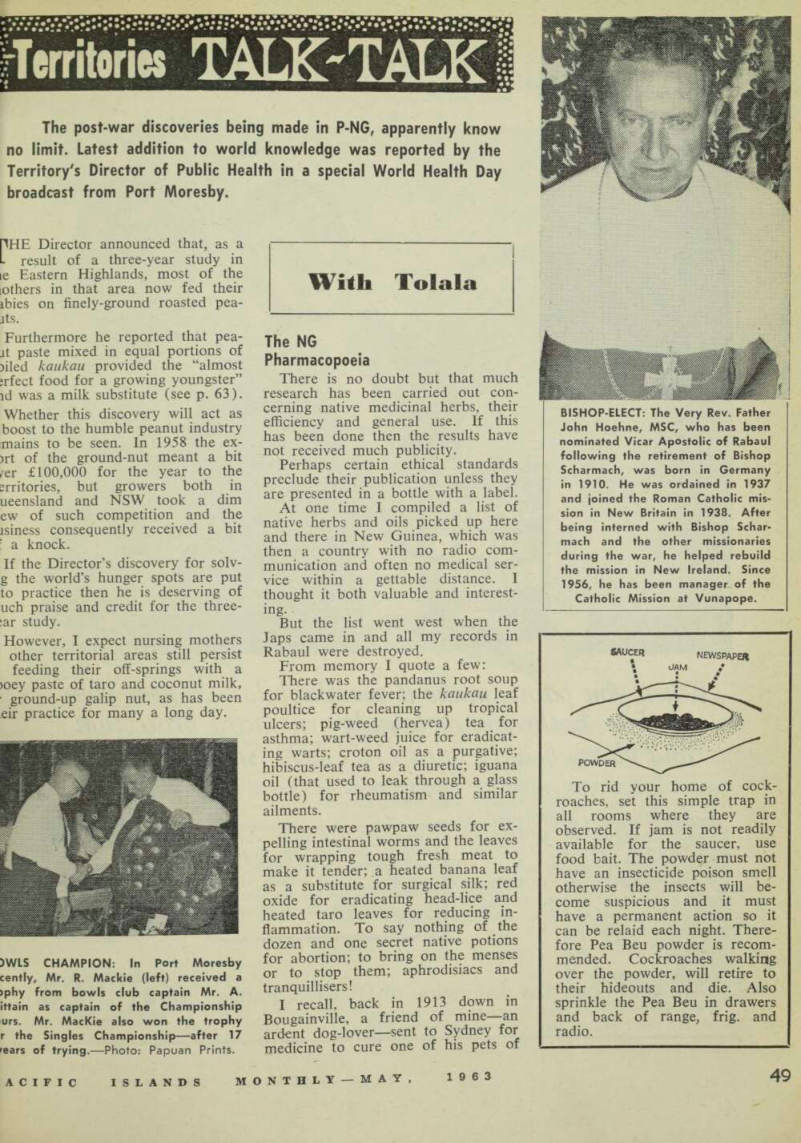
BISHOP-ELECT: The Very Rev. Father John Hoehne, MSC, who has been nominated Vicar Apostolic of Rabaul following the retirement of Bishop Scharmach, was born in Germany in 1910. He was ordained in 1937 and joined the Roman Catholic mis sion in New Britain in 1938. After being interned with Bishop Schar mach and the other missionaries during the war, he helped rebuild the mission in New Ireland. Since 1956, he has been manager of the Catholic Mission at Vunapope.
orms. It duly arrived and he showed to me. 1 examined it and remarked: “You add have saved yourself the trouble [ sending to Sydney, Bill, by asking >ur cook for a betel-nut.”
It was the ordinary areca nut, grow g all over the plantation and to be und in every native’s dilly-bag.
Apart from the medicinal plants ere are many others used for dye g. The Bukas have a plant that ves a permanent dye to the pan mus leaf used, at one time, for the omen’s kurakum (the pandanus iod) and the Buin natives get a anderful yellow dye from another r the fibre used in binding their ng spears.
Somehow I still feel there is much [t to be discovered amongst these ople, before it is too late, and they ve been absorbed in our synthetic romium-plated age.
NG's
>ep South
Buka and Bougainville have often en the “Forgotten Isles” of New uinea, notwithstanding the fact that r the past 50 years or so they have d closer commercial associations th Australia than any other NG strict, owing to the fact that more istralian companies were the first develop the islands to any extent this part of the German colony.
In these later years, however, both ands have made sensational front ge news: The somewhat over blicised Hahalis incident, and now 2 tragic sinking of Politician with its rry death-roll.
It is sad that such a valuable link th these outports and Rabaul should ve had such a tragic ending.
Bouganville’s associations with Aus ilian companies started some years fore World War I in 1914. Toimo pau, down on the island’s south ast, was one of the first, and I ve an idea the company was called ; New Britain Corporation Ltd.
A chap named Hickey (from the lomons) was manager for a while d some years later Tom Ebery was charge before he went trading in lin or taxi-driving in Rabaul.
Numa Numa was opened about at time by an Australian syndicate, mprising a handful of businessmen: )n Piggott (a Sydney fruiterer, who 1 a good business with the Islands the time); George Green (a Mel urne carrier); Harold Reid (general anager of Robert Reid and Co., the ygoods people); and the McEnnally others (who owned a Sydney hat :tory, amongst other things).
These last-named brothers were oard Matunga when she was cap
tured by the German raider Wolf in August, 1917, and consequently spent some time as internees in Europe.
Every year one or two of the directors would make a point to visit Numa Numa to bask in the tropic atmosphere and I think they enjoyed themselves, too.
I remember one year a couple of them came along to visit me at Pororan, a distance of some 70-odd miles, in a small pinnace. It was
open sea from Numa Numa to Buka Passage and they had a bit of a gruelling time—but they cracked hardy, nevertheless. Subsequent sea voyages were made in their ketch.
Saucy Polly.
Arthur Booth was the manager from 1912 until the ’thirties and much of Numa Numa’s success is due to his work. I travelled with him once in Marsina en route to Sydney and he would insist on going down into the
ikehold and doing a shift “just to ep fit”.
The well-known Drummond Thom i relieved him on the plantation er and carried on the good work, it not in the stokehold!
Then in 1913 came the Choiseul antations Limited—a colt out of j BP stable—which has proved a ritable winner in the Coconut akes.
It opened up virgin land on oigainville at Soraken, Baniu, Teo sino and Arigua.
About the same time Captain queaker” Hamilton started Inus mtation, between Numa Numa and opasino. The company was known Associated Plantations Pty., Ltd., d it has had some well-known anagers, but none more highly warded than the present one, Paul ason, who did so much during the panese invasion.
Later a Sydney-sponsored company ened up an area on Buka in Queen iroline Harbour, known as Karola antations Ltd, In its earlier days a ap named Frost was manager; I ew the place better when Jock ven was manager. He married areen Parer, a cousin of the famous iy.
Strangely enough, the companies ntrolling the Bougainville planta ins were inappropriately named: )imonapua (in southern Bougain- Je) was the property of the New itain Corporations Ltd., and its one d only estate; Numa Numa’s com ny was the Buka Plantations and ading Company, with no property
on Buka Island; Choiseul Plantations Ltd., with its four large Bougainville estates was developing no land on Choiseul Island (which is in the
Bsip).
In later years another Sydney com pany started coffee planting on an inland area at Raua Bay (Bougain ville) with the name of Rugen Har bour Coffee Estates. Rugen Harbour is located on the south coast of New Britain.
The reason for the inappropriate name in this instance, if my memory serves me right, is that a Mr. Cogs well (a one-time official in the Gilbert and Ellice Group) had the job of selecting suitable coffee lands and he chose an area at Rugen Har bour, the company was registered and later some technical difficulties arose
over land titles, or something, and then an inland area of Raua Planta tion, originally owned by Queen Emma, then HSAG and eventually C. I. H. Campbell, who was the suc cessful tenderer for the Exproboard property, was alienated.
I met Cogswell as he was touring about the islands in the schooner Vella, with a chap named Mackay as master. Later, Mackay, only a young fellow, met a tragic end when down the south coast of New Britain in Vella; he was murdered by the local natives.
Poor old Buka and Bougainville!
Geographically located in the Solomon Islands, but attached to New Guinea for politics and rations; with their inappropriately - named com panics, but their very sophisticated
[?]THDAY PARTY: At her 21st birthday [?]rty in Port Moresby recently, Miss Mar [?]et Turner was handed the "key of the or" by her father Mr, Tom Turner. The party was held at the Bowling Club.
Photo: Papuan Prints.
intry—in some parts. I often wonder hen it will come into its own.
There are some valuable mineral ;lds waiting to be discovered there iccording to old records which I ive seen) and I hope I shall see the ly when Bougainville does come to its own . . . But it will have get a move on! iat Word
ndependence"
Invariably these days when you :ar the name New Guinea men- Dned it is soon followed by some ference to “independence”.
It is a popular association of ideas, en as when you mention King’s ross you conjure up . . . well, you mjure up ideas of a Perfect Night ife: soft lights, stirring music, ikling glasses and sleazy females . . , The word “independence”, when >plied currently to “under ivileged countries” is usually an itonym to “colonialism” as used in derogatory sense.
My dictionary tells me that “inde mdent” means “not depending on ithority; not depending upon some ing else for its validity, efficiency, c. . . . unwilling to be under fiigation to others”. That is the old shioned definition.
Can you for a moment visualise ly “under privileged country” attain g its independence, 1963 vintage, )t being dependent on some other ition or bloc of nations? Or, further ore, can you name one country hich has gained its so-called “inde mdence” and which does not rely 3on another country for support?
With all the vaunted independence
of the world’s nations there is not a single one not dependent upon some other.
The United Nations is pressing for the independence of New Guinea, for self-government or, to voice the desires of the Afro-Asian bloc of UN, to throw off the shackles of colonial ism.
New Guinea has been free of “colonialism” for the past 40-odd years; ever since it became a man dated territory under the League of Nations. Therefore, attaining its in dependence means throwing of its shackles from the UN, not from Australia, which has only been the trustee, acting on behalf of the UN.
To conform with the present agita tion for independence what New Guinea should do is to call a con ference of delegates of all Native Local Government Councils and pass a resolution to secede from the UN and then draw up a bi-lateral agree ment with Australia for its assistance and guidance to a date to be mutu ally agreed.
Impossible? Not at all, if properly organised. The UN is on the way out, anyway. It admits its inability to handle the Laos situation. (Is that getting too near the homeland of the Secretary-General?) And what did it do in the Cuba affair or China’s in vasion of India? And what of the
THEY STICK, TOO: These two new stamps in the P-NG series were re leased on March 27. Reproduced in natural colour, the 5d shows the red plumed bird of paradise, and the 6d shows a cus cus, a member of the opossum family. These are the most attractive and colourful stamps to be released for some time. The glue is better too. It was virtually impossible to stick the old ones down.
sorry handling of the West New Guinea situation? . . .
Despite the struggling efforts of UN public relations, the world is governed today by force, by the stern realism of power, and everyone realises that. The most worthy prin ciples of international harmony which were the basis of the gathering at San Francisco in June, 1945, have been wafted away by the Winds of Realism.
There have been many changes in 18 years.
Bits and Pieces It’s good to know that John Gunther will not be leaving the Terri tory for Canberra’s rarefied atmos
phere. A diplomat in the place of C. R. Lambert may be a welcome change, even if he is a FRAI, but he could be a working one . . .
J. G. will probably go a long way, even in these uncertain times. I like a man who looks straight at you in his Press photographs, not hides be hind a pair of horn-rimmed glasses . . .Two old-timers have gone to rest: Bill Edwards at the age of 67 in Melbourne on March 1. Bill was the first CO at Lae of the NGVR, and later was CO of the NGlB—the first native unit. He was with the TNG Administration back in the early ’twenties . . . John Thomas Ben sted passed away on March 28 at Wentworth Falls, NSW. A popular and well-known old-timer.