Samoan Independence
pp. 43-49 · Read in the full issue
Tamasese: Architect Of West Samoan Independence
• The writer of this tribute, Professor J. W. Davidson, is Professor of Pacific History at the Australian National University, Canberra. He has had a long and close association with Western Samoa and with the late Tamasese. Professor Davidson was Samoa's adviser on the committee which formulated the country's new Constitution.
By J. W. Davidson
In the death of Tupua Tamasese, Western Samoa loses one who, both as a man and as a statesman, will be numbered amongst the greatest sons of his country. He, more than any other man, was the creator of its independence and the firm but sensitive guide who enabled it to advance towards that end with such unusual smoothness.
Samoa his death will be mourned by the whole people as the death a father. Further afield he will most sadly missed—by indigenous ders in other Pacific territories, o knew him as a friend or looked him as an example; by politicians, jrchmen and educationalists, who ew the strength of his devotion to country, to his religion, and to the yancement of knowledge; and by a :at many humble people, who ex •ienced the warmth and steadfast >s of his affection.
Tupua Tamasese Mea’ole was born in the village of Vaimoso, near Apia, on June 3, 1905, the son of Tupua Tamasese Lealofi. He received his education at the Marist Brothers School in Apia.
In December, 1929, his elder brother, who had succeeded their father in the high title of the family, as Tupua Tamasese Lealofi 11, was tragically killed, when police opened fire on a parade of Mau supporters in Apia. Tupua Tamasese Mea’ole was elected to the title shortly after wards.
In 1934 he married None, daughter of Mr. O. F. Nelson (Taisi), a prominent businessman and leader of the Mau. They had two sons and two daughters.
Like his elder brother and his father-in-law, he took a prominent part in the Mau, the movement sup ported by the great bulk of the Samoan people in protest against existing New Zealand administration and in assertion of Samoan rights to self-government. In 1938 he became its president.
After the restoration of amicable relations between New Zealand and the Mau leadership, he became a Member of the Legislative Council (in 1936) and a Fautua (in 1939).
His major role in more recent Samoan political life is discussed be low; but he combined his political work with many other activities. He was a member of the Copra Board (1948-57); the first Chairman of the Board of Directors of Western Samoa Trust Estates Corporation, on its es tablishment in 1957; and a Director of the Bank of Western Samoa. And he was associated with various charit able and sporting organisations.
He travelled widely. In 1938, and on subsequent occasions, he visited New Zealand in an official capacity.
In 1950 he led the Western Samoan delegation to the First South Pacific Conference at Suva.
In 1953 he (and his wife) repre sented Samoa at the Coronation of Queen Elizabeth II and subsequently travelled extensively in Europe. While he was in Rome he was accorded the honour of a private audience with Pope Pius XII.
In 1958 he was the leader of the first Samoan delegation to the UN Trusteeship Council in New York.
When Tupua Tamasese succeeded,
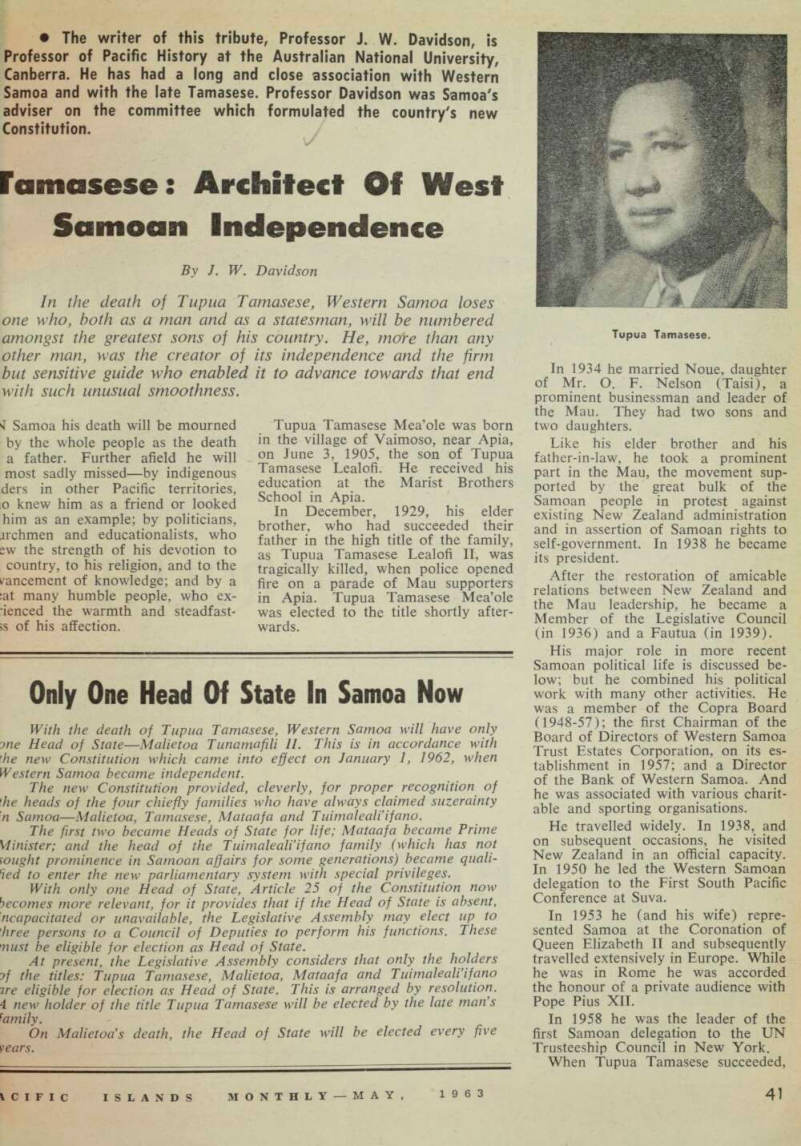
Tupua Tamasese.
i such tragic circumstances, to his tie there were many who doubted hether he would attain the influence f his predecessors.
His youth and the fact that he had >ent most of his life in and around .pia—first as a schoolboy, then as an nployee of a commercial firm—did Dt seem to constitute a suitable ackground for a Samoan leader. For good many years New Zealand ficers in Samoa were inclined to ider-estimate his influence on these ounds.
But, among the Samoans them- Ives, he quickly established himself i a leader of firmness and integrity.
Given these qualities, his wide ading and understanding of Euro ;an ways of thought made his con ibution to Samoan political life an dispensable one. As a Fautua and member of the Legislative ssembly, he became the principal okesman for his people.
In 1946, when the draft Trustee ip Agremeent for the Territory was bmitted to the Legislative Council most on the eve of its presentation the United Nations, he seized the jportunity to obtain a decision in vour of self-government.
He protested at the action which ew Zealand had taken. The right a people to decide their own form government, he declared, was “one the principles for which the war is been fought”.
Lent His Support Samoa wanted self-government, not e further period of dependency which New Zealand had decided commit it. In agreement with his imoan colleagues in the Council, he dined to lend his support to the aft agreement but asked instead that Fono of all Samoa should be called discuss it.
When the Fono met, he devoted mself to winning approval for a tition to the United Nations in the flowing terms: 1) We humbly beseech that Samoa be granted self-government. 2) We earnestly pray that New Zealand will see fit to act as Protector and Adviser to Samoa in the same capacity as England is to Tonga.”
The petition led directly to the ap lintment by the Trusteeship Council a Special Mission to Western imoa and to a declaration of policy r New Zealand in August, 1947, cepting full self-government as its ijective and promising radical con tutional reforms immediately.
Under the new constitution Tupua imasese became a member of the □uncil of State and of the Legis
lative Assembly. In both these capacities and as a member of the Executive Council after its establish ment in 1953, his influence was a predominant one.
In this he was helped by the ap pointment in 1949 of Mr. G. R. (now Sir Guy) Powles as High Commissioner. Mr. Powles recog nised, from the first, the full measure of his ability and influence.
Tupua Tamasese’s political stature grew with his responsibilities.
In the confidential discussions of the Council of State and the Execu tive Council, his tact and skill en
abled him to gain great influence, which, through the High Commis sioner, in turn affected the policy of the New Zealand Government.
His selfless devotion to the cause of Samoan independence and his grasp of the essentials of the most complex problems made it impossible for his views ever to be ignored.
In the debates of the Legislative Assembly he took a very active part but, because of his position, he tried to remain a spokesman for the country as a whole, rather than be come an exponent of controversial opinions (even when his private views
strongly favoured those of a pa ticular group). Much of his i fluence was exercised, in fact, in tl private meetings of Samoan MLA where he sought to obtain agreeme in advance to the line to be adopt* in open Assembly.
As a result of further constitution changes, he and Malietoa Tanumaf II withdrew from the Legislate Assembly in 1957 and from actr participation in the executive gover: ment on the establishment of Cabinet in 1959.
But he remained intimately co: cerned with constitutional develo ment till the Constitution for tl Independent State of Western Same was adopted in October, 1960.
Jointly with Malietoa Tanumaf 11, he chaired the Constitutional Co] vention of 1954, the Working Con mittee on Self-government in 195! 60, and the Constitutional Convei tion of 1960. During the years 195! 60, in particular, his contribution wj an absolutely vital one.
Always well prepared, always cab and tactful, he insisted on pursuir every topic till agreement m reached. In the Working Commits he felt free to put forward his pe: sonal point of view on every issi: and to criticise the views of othei forcefully; but, in the best traditior of Samoan society, he deferred grac* fully to majority opinions when h saw that the numbers were again: him.
Practicable Decisions In the Convention he devoted hin self—with all the dignity of a Tami a-Aiga —to giving members the rigl to express their views, while keepin always in his mind the need to er sure practicable decisions and t secure the adoption of the Constiti tion in ample time for the Prim Minister, Hon. Fiame Mata’afa Fai munia Mulinu’u 11, to present it t the United Nations.
The making of the Samoan Cor stitution and of the other final pre parations for independence const] tuted, as Tupua Tamasese himself fel at the time, his last great work fo his country. Together with Malieto Tanumafili 11, he entered upon th dignified duties of Head of State o: January 1, 1962.
In his own mind, this represented virtual retirement from active politics and his prolonged illness prevents him from performing for any length period even the duties which re mained to him. But he had reason t» feel a satisfaction which is denied t» most men. He had devoted his adul life to the cause of Samoan indepen: dence; and independence had beei attained.
In itself, a narration of Tupu;
amasese’s career conveys something f the quality of the man; but, as one ho worked with him very closely at weral periods over a span of nearly 6 years and who came to regard him s a very close friend, I can give a tore personal assessment.
As a man of deep personal affec ons, he was never able to forget lat his brother had suffered death nd his father-in-law deportation at le hands of New Zealand authorities, n account of their political activities, ut, during his later years at least, nly his closest friends were given a limpse of the depth of his feelings.
He never allowed these events to loud his appreciation of New Zealand 5 a whole or to stand in the way f his appreciation of individual New ealanders.
Politically, however, the unhappy ast probably contributed to the rength of his determination that his eople should gain absolute control f their destiny and that future asso iation with New Zealand or with le Commonwealth should be entered ito only after Samoa, as a sovereign tate, had gained the right to egotiate on terms of formal equality.
His life was given to this cause, te attainment of Samoan indepen ence, and not—it must be stressed -to the satisfaction of personal am ition.
In view of his absorption in olitics, his knowledge, and his skill i negotiation, it was inevitable that e should gain satisfaction from the ossession of political authority.
At an earlier stage, he allowed him ;lf to think of a time when he might ctively lead an independent Samoan overnment—a task for which he fas admirably suited. But he came 3 see that this role could not be ombined with the eminent position a which ancestry and circumstance
had placed him, without the risk of political dissension.
From that time onwards, he ad justed himself to a process of gradual withdrawal from the political arena, with a selflessness and composure of a rare kind. He abandoned—one by one—the fields of activity in which he had worked with such success and personal satisfaction; and he gave no outward sign of the regret that he felt at leaving his former work to others.
Indeed, even in private conversa tion, his concern was with the manner in which those who were enjoying the fruits of his past efforts were shoul
dering their responsibilities. He re joiced when they succeeded; he was saddened by the occasional blunder which he felt he could have pre vented, if it had still been his function to offer advice.
This gradual withdrawal was un accompanied by any relaxation in the effort which he made in the service of the country. During the drafting and consideration of the Constitution in 1960, when he had already retired from the legislature and from most of his executive duties, he still worked, as he had always worked, to the very limits of his physical and nervous resources. (Over)
Malietoa Tunamafili II.
Indeed, over the years, his wife d become sadly reconciled to the :t that any period of critical litical importance was likely to be lowed by one in which he would ve to be carefully nursed through ; ensuing period of illness and ex iistion.
This willingness to give his whole nd and energy, simply and without night of himself, to any cause that :med worthy was intimately re ed to the extraordinary warmth ;h which he was regarded by so my.
A very distinguished Samoan once d to me: “You will have noticed it when Tamasese speaks I never agree with him. When I think of at his friendship has meant to me d my family over the years, I just I’t bring myself to do it.”
Famasese was, of course, the last in to expect such loyalty; but, be ise of the affection which his per lality aroused, he was sometimes :orded it, even when he was insist ; on the need for the fullest dis ssion of all points of view.
For myself—less sensitive, perhaps, in my Samoan friend—l never dtated to disagree with him, on the rly rare occasions when we took ferent points of view.
But —like my Samoan friend —-I, ), knew him as a man to whom, in üble, I would have gone, assured it I would have been given wise jnsel, abundant sympathy, and any Ip it was in his power to offer. In death Samoa has lost a great man; d his family and friends have suf ed a bereavement for which time mot atone.