Ew Council
pp. 31-33 · Read in the full issue
For Norfolk
orfolk Island is to have a icil in the same style as the
dative Councils operating in
ia-New Guinea and Aus
i’s Northern Territory.
i proposal has been put forward >y the Australian Government as ition to Norfolk’s political prob and the details have been ap d by the Norfolk Island Council. - present Council, which was ished in its present form in in succession to the old Ad r Council, has the powers of government. However, because :al dissatisfaction that the powers ot wide enough, the Council has in an advisory capacity since tablishment. one stage the Minister for Terri , Mr. Hasluck promised Norfolk 1 a referendum so it could decide
just what kind of political arrange ments it wanted, but the referendum was not held.
The latest announcement follows a long series of conferences between Council members and the Adminis trator, Major-General R. H. Words worth.
The new Council will require amendments to the Norfolk Island Act of 1957 and the Norfolk Island Council Ordinance of 1960. The amendments, which in April were ap proved by councillors, are now be fore the Minister. They will require his acceptance and then will have to be passed by Federal Parliament. It is not expected, however, that the
principle of the new proposals will be altered.
The new plan will give Norfolk Island a Council of eight elected members with the Administrator as ex officio chairman. The Council will have the right to consult and advise on the budget, and to initiate or dinances. It will be given power in some circumstances to hold referen dums.
If the Administrator does not ac cept the Council’s advice he must re port his reasons to the Minister. The Minister has the right of veto.
In announcing the plan, General Wordsworth said it would “place in the hands of the people a very full
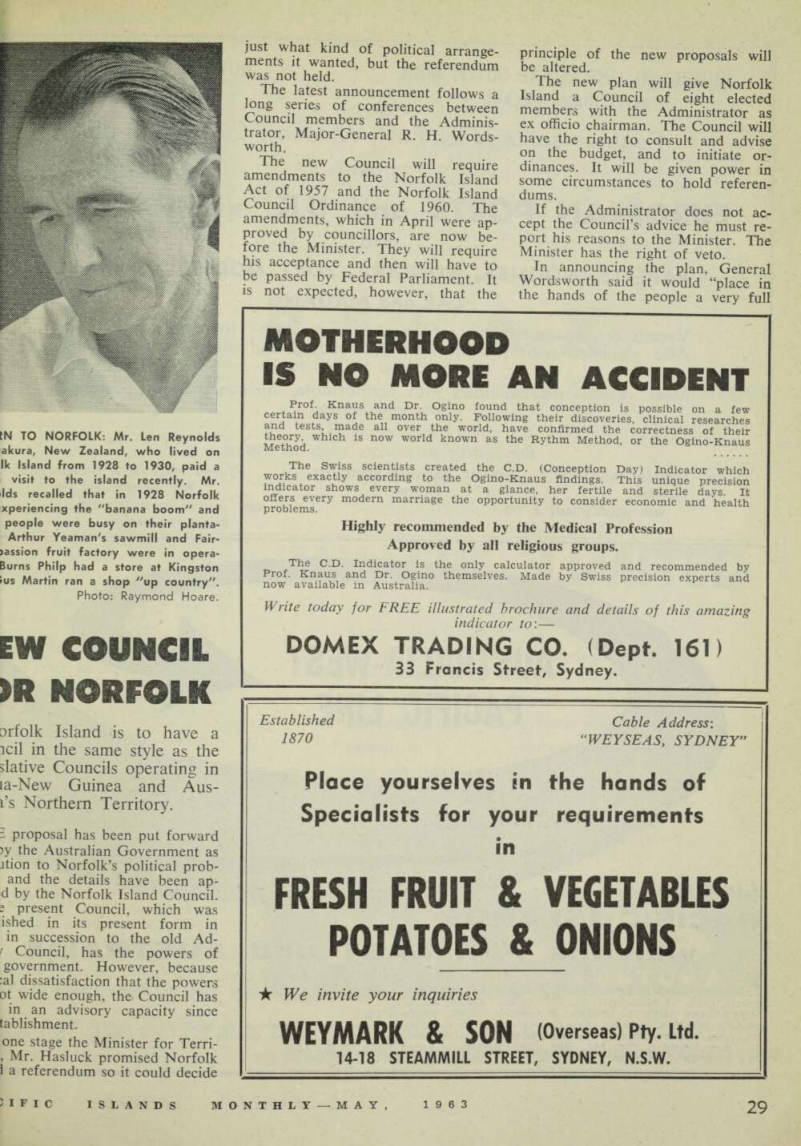
[?]N TO NORFOLK; Mr. Len Reynolds akura, New Zealand, who lived on [?]k Island from 1928 to 1930, paid a visit to the island recently. Mr. lds recalled that in 1928 Norfolk xperiencing the "banana boom" and people were busy on their planta- Arthur Yeaman's sawmill and Fair passion fruit factory were in opera- Burns Philp had a store at Kingston [?]us Martin ran a shop "up country", Photo: Raymond Hoare.
ce in the running of their own lirs; and ensure they receive what y desire, having nothing forced >n them”.
Je said it was the Minister’s in tion to give Norfolk Island the m of government it wanted if it > within his power to do so, al ugh the island had to remember finet and the Australian Govern at had the last say. jeneral Wordsworth paid a tribute the work and co-operation of the mcil in the last few months of otiation. ir. Hasluck is expected to visit rfolk Island in June, during the mty Day celebrations.
Tie new plan has been well re ed on Norfolk Island, n a letter to the Norfolk News , mcil president F. J. Needham that the new proposals meant the people would be the Admini tion and that “for the first time e 1896 Norfolk Island will have locratic government”. [e said that although there might :eething troubles he was confident Norfolk had evolved a “practical, py form of government”.
Ir. Needham said the Admini tor could not act without Council er the new plan—if he did not i to accept the Council’s advice had to refer the matter to the ister, who would decide whether must act as advised or otherwise.
Ir. Needham added: “Naturally Minister will not wish to abuse power of veto. This gives a mrable balance of power to the tors through their elected repre atives. The ultimate authority 5, as it must as long as we remain of the Australian community, in hands of the Australian people
.^ eir ducted representative— the Minister for Territories”.
Most laws except emergency measures will be initiated by the Council they will, of course, be subject to approval by the Minister after they have been translated into legal terms by the experts in Oanbonra. Therefore [the people of Norfolk] will be virtually making their own laws, one major aim we set out to achieve for them.”
At a meeting of the Norfolk Island Council on April 9 the Administrator reported that the development of the
tourist industry on Norfolk seemed to offer the best possibilities for the island’s economic development and there were “encouraging signs” that tourism was about to show a marked move forward.
A number of overseas interests had tentative plans for new hotel and motel accommodation and re establishment of a fishing industry was likely soon, he said, It was later announced that Empress Australia Ltd. had acquired the whalin g station and cable station, See "Commentary", p. 11.
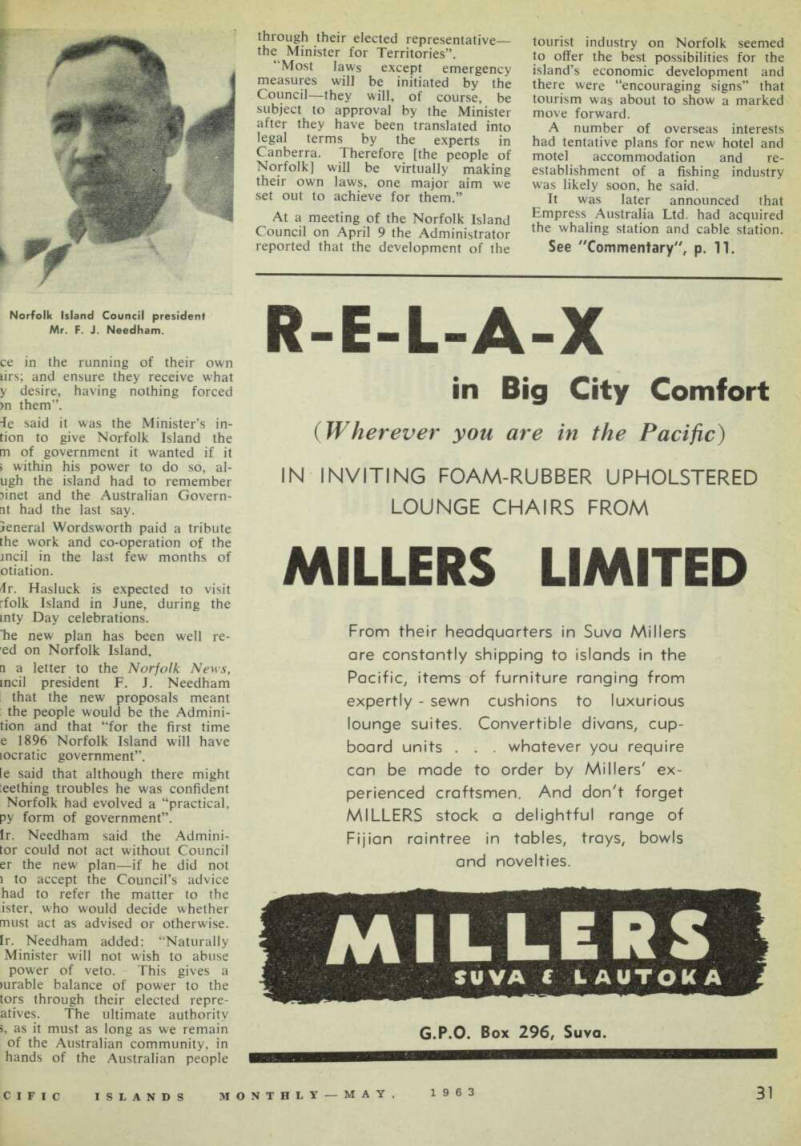
Norfolk Island Council president Mr. F. J. Needham.