Tropicalities
pp. 23-29 · Read in the full issue


With a great deal less publicity than has been given to the rather pampered Nauruans, but with just as many problems, the resettlement of Gilbertese at Gizo and elsewhere in the British Solomon Islands Protectorate is proceeding now at accelerated pace.
THE RCS Ninikoria left Honiara in late March with more Gilbertese settlers for the Shortland Islands, and three members of an advance party to prepare Wagina Island, in Manning Strait, for settlement.
The first 20 Gilbertese from the overcrowded Phoenix Group arrived in Gizo, BSIP, in 1955, as an advance party; they were followed the next year by 200 other settlers and in 1958 by 200 more.
The population now is about 600 and integration has been such that they are now marrying amongst the local people and have intimated that they would like to be known as “Solomon Islanders” and not as Giibertese This present happy state of affairs is not to say that the colony has no growing pains. A great deal of unrest and plain homesickness was experienced during the first five years of the experiment, a lot of it rooted in an inadequate appreciation of how these people felt about land ownership Not to own land, in their opinion, was indicative of a slave state and just leasing land was regarded as the same thing as not owning it.
The BSIP Government is now try ing to resolve the business of land titles and is hopeful that full legal title will be given to those who want it some time this year. About 700 acres are involved, each family plot being about four acres.
About 200 peopl e—3o or 40 families—have moved out to the Shortland Islands where they have the right to buy land from an old Trading Corporation estate, Others are migrating there direct from the GEIC, under their own steam. At first the local Shortland islanders were not keen about the new colonists but now have become reconciled to the idea, to the extent of asking them to nominate a mem ber f° r the Local Government Coun cil, to which the settlers already pay ta * es - . , Now that most of the initial difficulties of resettlement have been overcome, the Western Pacific High Commission, which is responsible for both the over-populated GEIC and the under-populated BSIP, experts to move and resettle about 1,000 people a year, At first they will probably go to Choiseul but the people of Ysabel have also asked that their area be
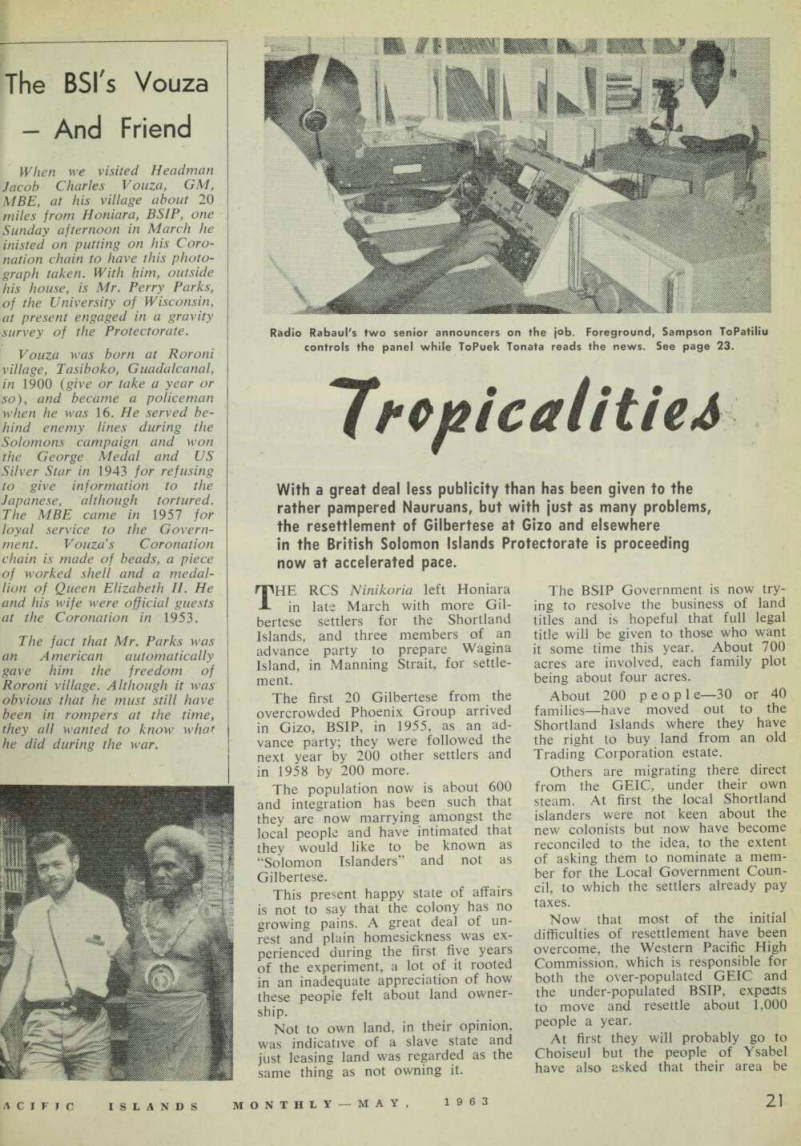
Radio Rabaul's two senior announcers on the job. Foreground, Sampson ToPatiliu controls the panel while ToPuek Tonata reads the news. See page 23.
idered. They are the first mon Islanders to realise some of problems of underpopulation and to do something about it, and e migrants go there it will be the time that they will settle on e land. herever else the Gilbertese have settled in the BSIP, it has been ;ither Crown land or old estate
io Rabaul Gives Them
at They Want
ITIVE and European personnel of Radio Rabaul—the local Ad stration radio station—were in ing mood after they read PlM’s uary article, p. 33 ( P-NG on shold of New Radio Develop 'eryone concerned with Radio ml tackles the job with mis iry zeal and what made them Jest about the article was its tion that “the quality of the mission is poor . . . break is are frequent’’. le only time they were off the air i they should have been on it, claim, is when one thunder storm them off, and then the break i was short-lived, ithout going into the pros and of whether the P-NG Adminis m should go into the broadcast business or not; or whether the should be left to the ABC, we’d to say that when we took it upon elves to visit Radio Rabaul ios recently, we found some en iastic workers who obviously had t of satisfied customers. To our actised eye, too, the transmitting pment seemed modern and
adequate and reception at the listen ing end good.
Under the guidance of station manager Jim Leigh and two other Europeans, the programme arranging and broadcasting is done by the native staff—each of whom has, in addition, a news-gathering round in Rabaul.
As the transmitter is one used by the local tele-communications service during the day, the station broadcasts only from 5 p.m. to 9 p.m. five days a week and from 6 p.m. to 10 p.m. on Fridays and Saturdays. Apart from the ABC national news and the ABC Territory news, all brodacasting is in the local Tolai language and in Pidgin. Daily Tolai news services are compiled from the work of the station’s roundsmen and, increasingly, from news items sent in from all over the Gazelle Peninsula and elsewhere by listeners.
During the sessions of the P-NG Legislative Council, daily resumes of proceedings are taped in the local dialect and Pidgin by New Britain native MLC’s and sent to the Rabaul station.
There is, however, little effort made to turn the station into an Adminis tration propaganda medium, as some feared. To the contrary, those run ning it seem to be leaning over back wards to give the Tolais what the Tolais want —which, of course, doesn’t please all the critics either.
What the Tolais want, apart from
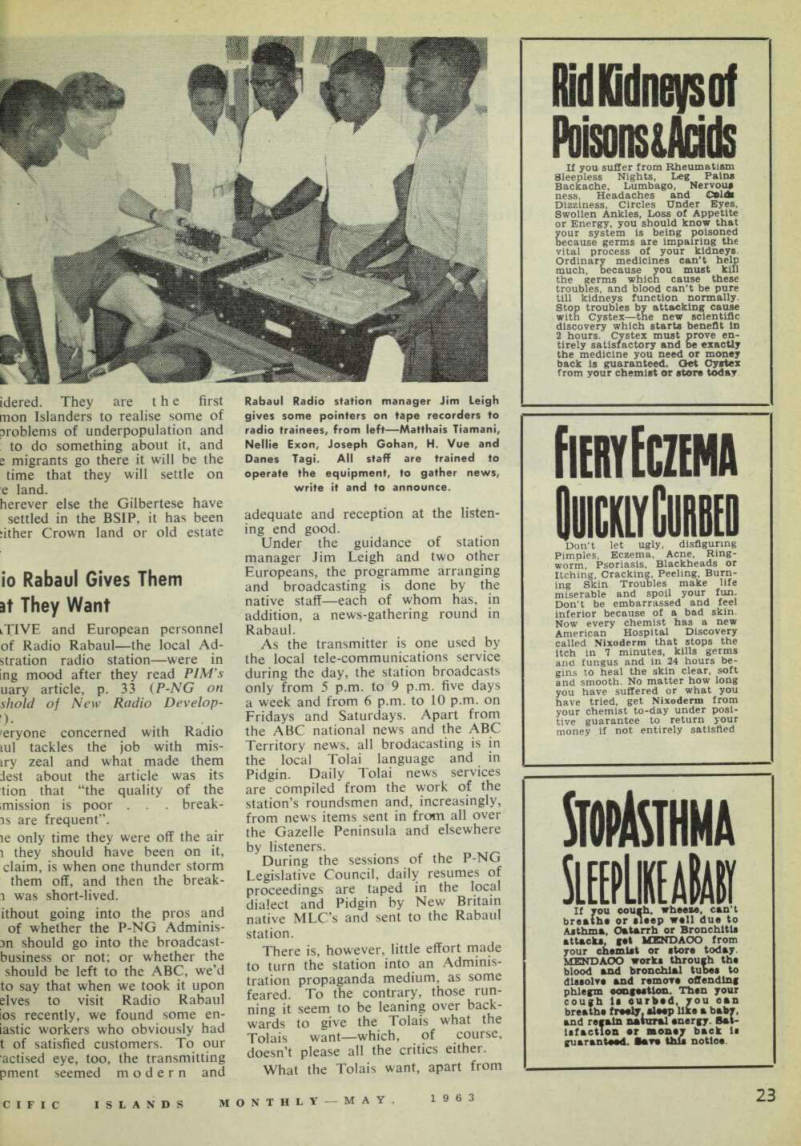
Rabaul Radio station manager Jim Leigh gives some pointers on tape recorders to radio trainees, from left—Matthais Tiamani, Nellie Exon, Joseph Gohan, H. Vue and Danes Tagi. All staff are trained to operate the equipment, to gather news, write it and to announce.
about their own doings in their language, is pop tunes. The >n received over 11,000 requests individual songs during the last ;h, which from a population of )0 or so is a fantastically high ;. Another popular programme t only with Tolais—is the Rabaul Parade, based on sales of discs the Rabaul Music Shop, with ommentary and presentation in n. dio Rabaul was established with )lai audience in view—no one The Tolais, notorious for fre tly disliking what is done for , even when it is good, nonethe ike their own radio, tablishment of the station was lally tentative and experimental, uccess means that it will stay others like it will be established here. In March, a second inistration radio station began iting in Wewak. Later this year will be another at Kerema, in 3ulf District of Papua and, at later stage, one will operate Cameron Plateau when it be s the new headquarters of the ; Bay District. Native personnel Wewak have been trained at ) Rabaul.
Mystery Boxes
the TAA Fokker Friendship from Lae, New Guinea, to ara, BSIP, on March 5, we intrigued with two young Ameri who got out of the plane at ’ way-stop, set up some mysteri ittle white boxes and peered into . The picture shows them at at Munda airfield, BSIP. ie young men are Dr. Thomas on and Mr. Perry Parks, of the ersity of Wisconsin, and the in dents they had with them are
gravity-meters. They will be in the BSIP for some months, making a gravity-magnetic survey of the Group, supported by the BSIP Geological Survey Department.
They were joined later in March by a US Army Map Service officer who had with him a new type altimeter which is capable of giving readings to one-tenth of a foot. Alti tudes are important in gravity measurements.
Gravity measurements are vital to an understanding of the crust of the earth and what is under it and is a modern instrument in the location of possible oil and mineral fields.
The BSIP investigations are part of a world-wide project being under taken by the University of Wisconsin and supported by a grant from the American Science Foundation. This particular project is scientifically
fundamental and not connected in any way with mineral research.
But the Solomons is an interesting area on its own account —some of the greatest gravity anomalies have already been proved to exist there.
One result of this is that plumb bobs do not hang vertically from a theodolite and another is that space vehicles have been observed to do a little wavering in the orbits over the area.
It is obviously a good thing for the missile-firers of the future to know about these things if the weapons are to be guided into targets on the other side of the world.
Mr. Parkes, who arrived in Honiara direct from the Antarctic, left Honiara a few days after his arrival to make a 100 miles walk across the gold-bearing centre of Guadalcanal. Dr. Laudon went off for a couple of weeks in West New Guinea to tie a few gravity readings there into the world map before May 1, when the Indonesians take over.
As he said, some countries are strangely suspicious of scientists with mysterious little boxes.
New Guinea Playground
THE Queensland coast just north of Brisbane, especially Moo loolaba and Maroochydore, is fast becoming a rendezvous for New Guinea people. More and more of them are holidaying along the coast as far north as Tewantin. And after experiencing the climate, sampling the abundant produce of the lush mountains and valleys, fishing in the various rivers, and swimming on the long stretches of beautiful beaches, they all want to go back.
Plenty of first-class motels are
What are they doing? See below.
available, and the Sunday m ing drink session available at hotels is icminiscent of drin conditions in the Territory. Besi there is always the friend who 1 up with the latest news from Top. Many New Guinea pe miss the friendliness when they c south , on leave to the big cities, in these north coast places the pe are kindred spirits, and good fel ship abounds.
At the rate that Territorians buying land and building f Caloundra to Noosa, it is a fair that there will be a little 1 Guinea along the coast some tim the near future.
During the last two months, people, all from Lae, sighted arc the coast included the Wests; V and Nancy Idstein and daugh Dayl and Judith; Mr. and I Lionel Baker, of Gabensis plantat near Lae; Mr. and Mrs. Jim L( (he is with DCA), and Mrs. Nc Cahill.
Seen on the Quensland north coast by Robertson's camera are (top) old-timer Shanahan, formerly of Wau; Mrs. Nc Cahill, of Lae's native clinic; and, be!
Mr. and Mrs. Vince Idstein, and daugh Dayl and Judith.
ey Sought Him Here,
ey Sought Him There
R. Victor De Bruijn, A
Dutchman, who these days re :es (or otherwise) in the long ded title of Urbanisation Research armation Centre Officer of the ith Pacific Commission, had a :h simpler title during the war. was then known as The Jungle ipernel. ie got that title for defying the anese for two years in what was n Dutch New Guinea.
Dr. de Bruijn, who was born in a, went to the Wissel Lakes area the mountainous interior of West w Guinea in January, 1939, as a itrict Officer. The Wissel Lakes re seen from the air in 1936, and de Bruijn was the first Dutch cial to go there.
Je quickly learned the language of local Stone Age people and was ipted as one of them.
Vhen the war came and the anese invaded West New Guinea, , de Bruijn started a systematic anti anese propaganda campaign ong the natives in case the Japs ►uld try to establish a base at the ssel Lakes.
Eventually, when the Japanese sur nded the area, his campaign paid because the natives immediately ved out of the villages where the >anese settled and went elsewhere, a result, the Japanese had hardly / contact with the natives and could ; use them as guides or carriers.
Meanwhile, Dr. de Bruijn and 30 ives had moved further inland
where they lived in isolation for two years, although Netherlands Indies planes dropped supplies to them from the air. Dr. de Bruijn carried on his duties as a civil administrator until he and his native assistants were evacuated in mid-1944.
On returning to civilisation, he found that the Dutch newspapers had dubbed him The Jungle Pimpernel, Japanese-controlled Radio Batavia, on the other hand, claimed that the stories about him were pure inven tion, designed to boost Dutch morale.
ard the "Mariposa" in Sydney on a recently was Dr. Victor de Bruijn, now with the SPC.