The BSIP Elysian Fields At
pp. 15-20 · Read in the full issue
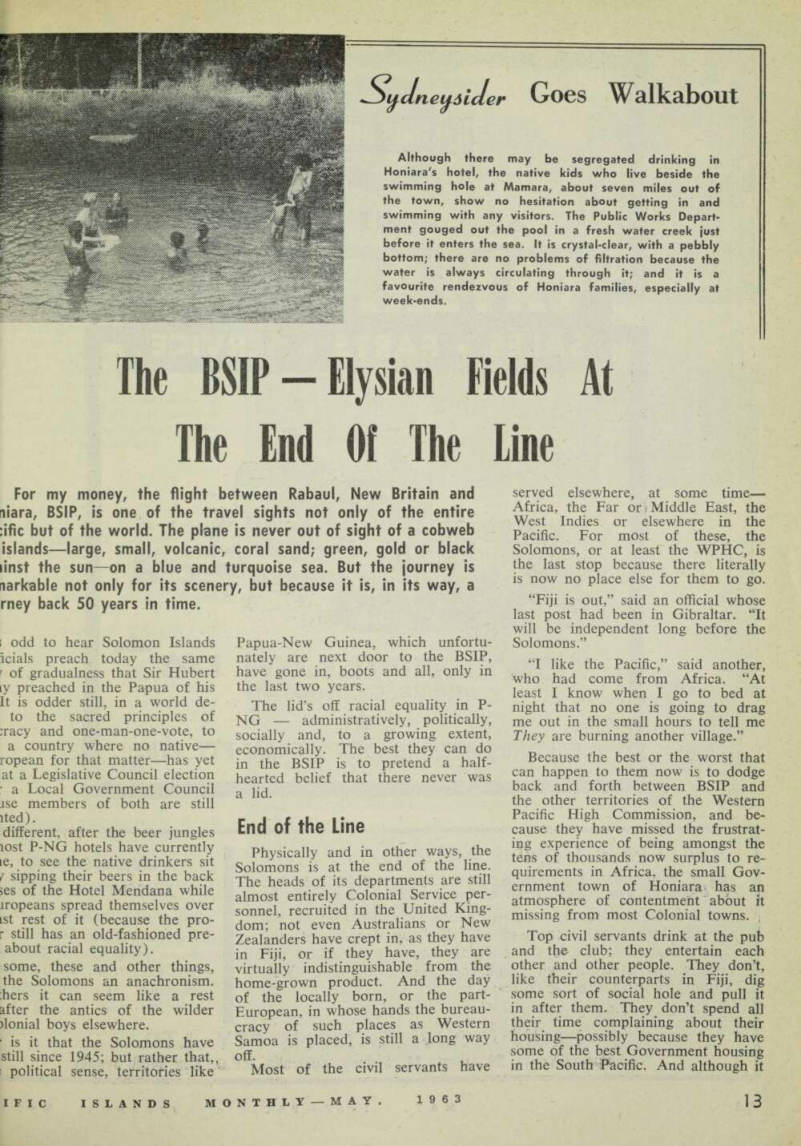


The End Of The Line
For my money, the flight between Rabaul, New Britain and riiara, BSIP, is one of the travel sights not only of the entire :ific but of the world. The plane is never out of sight of a cobweb islands—large, small, volcanic, coral sand; green, gold or black linst the sun —on a blue and turquoise sea. But the journey is fiarkable not only for its scenery, but because it is, in its way, a rney back 50 years in time.
i odd to hear Solomon Islands icials preach today the same r of gradualness that Sir Hubert ly preached in the Papua of his It is odder still, in a world de to the sacred principles of :racy and one-man-one-vote, to a country where no native— ropean for that matter—has yet at a Legislative Council election • a Local Government Council ise members of both are still ited). different, after the beer jungles lost P-NG hotels have currently ic, to see the native drinkers sit / sipping their beers in the back >es of the Hotel Mendana while iropeans spread themselves over ist rest of it (because the pro r still has an old-fashioned pre about racial equality), some, these and other things, the Solomons an anachronism. ;hers it can seem like a rest after the antics of the wilder ilonial boys elsewhere. ■ is it that the Solomons have still since 1945; but rather that,, i political sense, territories like
Papua-New Guinea, which unfortu nately are next door to the BSIP, have gone in, boots and all, only in the last two years.
The lid’s off racial equality in P NG administratively, politically, socially and, to a growing extent, economically. The best they can do in the BSIP is to pretend a half hearted belief that there never was a lid.
End of the Line
Physically and in other ways, the Solomons is at the end of the line.
The heads of its departments are still almost entirely Colonial Service per sonnel, recruited in the United King dom; not even Australians or New Zealanders have crept in, as they have in Fiji, or if they have, they are virtually indistinguishable from the home-grown product. And the day of the locally born, or the part- European, in whose hands the bureau cracy of such places as Western Samoa is placed, is still a long way off. , Most of the civil servants have
served elsewhere, at some time— Africa, the Far or Middle East, the West Indies or elsewhere in the Pacific. For most of these, the Solomons, or at least the WPHC, is the last stop because there literally is now no place else for them to go.
“Fiji is out,” said an official whose last post had been in Gibraltar. “It will be independent long before the Solomons.”
“I like the Pacific,” said another, who had come from Africa. “At least I know when I go to bed at night that no one is going to drag me out in the small hours to tell me They are burning another village.”
Because the best or the worst that can happen to them now is to dodge back and forth between BSIP and the other territories of the Western Pacific High Commission, and be cause they have missed the frustrat ing experience of being amongst the tens of thousands now surplus to re quirements in Africa, the small Gov ernment town of Honiara has an atmosphere of contentment about it missing from most Colonial towns. , Top civil servants drink at the pub and the club; they entertain each other and other people. They don’t, like their counterparts in Fiji, dig some sort of social hole and pull it in after them. They don’t spend all their time complaining about their housing—possibly because they have some of the best Government housing in the South Pacific. And although it
:knowledged that the British re is all but a dead duck, few inclined to avoid the responsi of finishing the job they have on. Because they are the last of line, they are, in many ways, ing to the task a distillation of iat was good in British colonial dally, things have changed very in a decade except that women given up wearing long gowns )cktail parties. And it is still urely place. In a period when ining-room servants at some of Moresby’s hotels are quite cap of turning out the lights to get f guests by 7.30 p.m., Honiara lines at eight and even nine, t like Port Moresby, Honiara guilds as though the present ad tration were going to last 1,000 , although it manages to do so considerably more charm, place of the fibro-cement sheds i multiply like rabbits all over dobu hills for the accommoda of P-NG’s public servants, the has compressed most of its il staff into a new Secretariat ng. It is built on the spot that he American frontline 20 years is in three storeys of concrete ruction and, unique for a Gov ;nt office building, is fully air tioned. niara’s newest Government hous s also in permanent concrete, unit built at considerably less
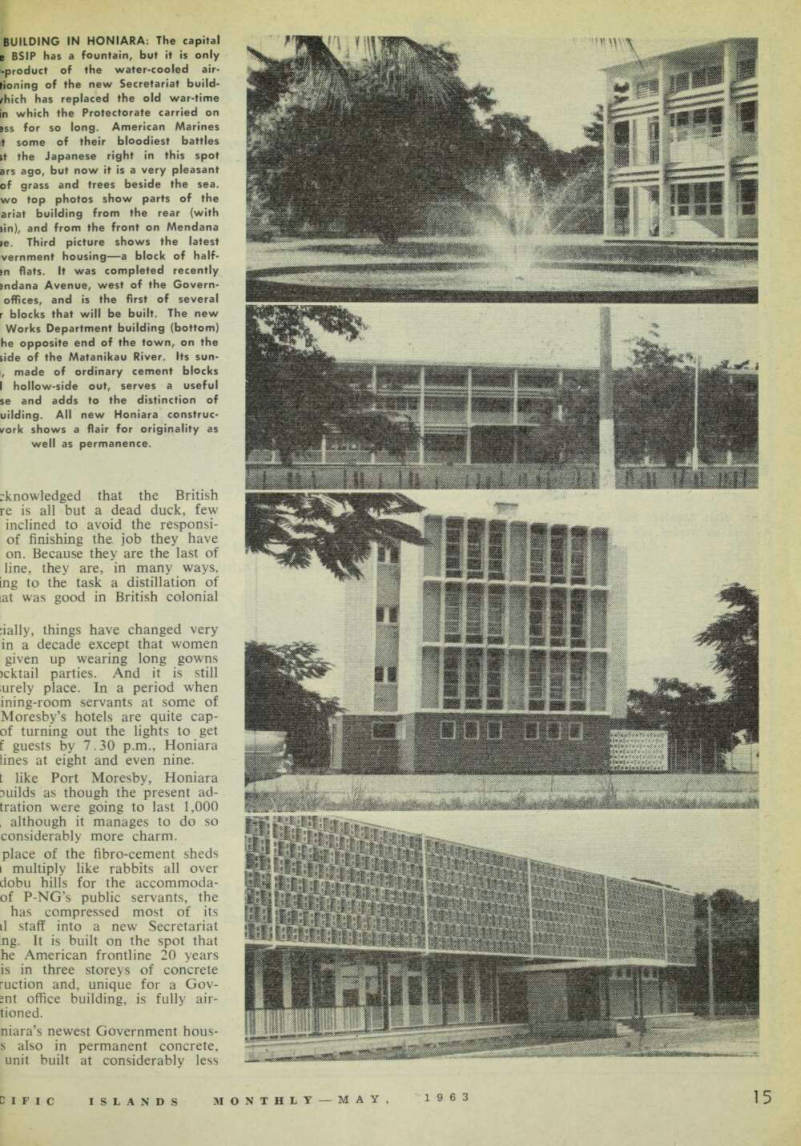
BUILDING IN HONIARA: The capital [?]e BSIP has a fountain, but it is only [?]product of the water-cooled air [?]tioning of the new Secretariat build [?]hich has replaced the old war-time [?]n which the Protectorate carried on [?]ss for so long. American Marines [?]t some of their bloodiest battles [?]t the Japanese right in this spot [?]ars ago, but now it is a very pleasant of grass and trees beside the sea. [?]wo top photos show parts of the ariat building from the rear (with [?]in), and from the front on Mendana [?]e. Third picture shows the latest vernment housing—a block of half [?]n flats. It was completed recently [?]ndana Avenue, west of the Govern offlces, and is the first of several [?] blocks that will be built. The new Works Department building (bottom) he opposite end of the town, on the side of the Matanikau River. Its sun [?], made of ordinary cement blocks [?] hollow-side out, serves a useful [?]se and adds to the distinction of [?]uilding. All new Honiara construc [?]ork shows a flair for originality as well as permanence.
than one of Port Moresby’s jrban fibre boxes. In Honiara’s housing development of Kola, i house sits virtually on its own with a magnificent outlook over ) Strait, and beyond, ut if the Solomons are cosily iniscent of Africa 30 years ago, Fiji 20 years ago, and P-NG at ;ven later stage, there is another to the picture. At a time when t young countries spend a lot of hitting their collective chests and ng where do we go from here, impossible not to ask the same I of the Protectorate, nd where does it go? Eighteen s after the end of the war, the * is still living on expectations hopes, although economically it now be on the threshold of ter things in a sudden overseas est in the exploitation of its »ts, its minerals and its fish, ay of these things, if they come it, could give the Protectorate internal revenue it has always ;d and which it has always at »ted to get by grinding the few taxpayers it does have into the
als Must Do It
could provide the money for ti-needed native education which dragged its heels in the BSIP i than in any other territory, with possible exception of the New rides. could provide the climate in h a not very deeply entrenched >pean commercial life could exist, it still is unlikely to sustain the ushioned type of European enter : we knew in the last part of century and the first 40 years lis; an enterprise in which people >ted their lives as well as their mes and in which they put back did not just take out. this sort of development—the that has no short-term limita i—is to be done by anyone, it ; now be done by the Solomon iders.
Dr this reason, it is unlikely that ; will ever be in the Solomons the pseudo-political partnership een European and native that initially survive in Papua-New lea. BSIP politics, too, in the late analysis, must be left to indigene. is all the more surprising then officials can tell you with straight 5 that the villagers are still in ble of casting a vote for a local icillor; that the once militant ching Rule movement has idled away into some odd-ball ious deviations; and that no one
is politically ’ impatient or even bitious.
As things stand at the momer seems that it is the Australians have learned a lesson from Africj It is, anyhow, the Australians —perhaps too smart for their good and certainly with tongu cheek—are putting the P-NG na into majority government while a tiny minority are fit for it; are coercing reformed headhui and Highlanders wearing bunche leaves and kapul-fur wigs common-rolls.
It’s the British administrators the Solomons, who know Afri where They sometimes burn d villages in the middle of the nig who affect to see the South T Pacific as some sort of Elysian J where no haste is necessary where everything will turn out the best, in the best of all pos; worlds.
The thing is, of course, that could be right—although in the of recent experience it seems unlil
Hole In The Heart. A 12-Ye
schoolboy and a young New Gu schoolteacher returned to Port Mo in April from Australia after both been successfully operated on for a heart complaint. The operations we[?] the condition known as "hole in heart". The schoolboy is Simon [?] from Apugi village, near Kandrian, Britain. Simon's heart condition was covered when an Administration [?] team visited the area. Walter Ivaga[?] is from Yindigum village, near Ang in the Sepik. Walter graduated a Administration teacher at the G[?] Teachers' Training College in 1962.
Simon Peter is pictured above in Moresby with Sister Estelle Smith, o Port Moresby General Hospital, whil his way home.