Australian Coastal Island
pp. 7-8 · Read in the full issue
May Be New Home For Perplexed Nauruans
By a Staff Writer
Although the task of finding the Nauruans a new home is still udded with some 18-carat problems, indications are that the ulti ate solution will be an island off the Australian coast.
VIE of the problems are those involved in the fact that before bing can be settled, the Aus m Government, a State Govern the United Nation Trusteeship icil, the three Trustee powers tralia, New Zealand and the ed Kingdom), and the Nauruans all to be satisfied, it although the surface of the )col involved in this may yet :ely have been scratched, it idy appears that an off-shore ralian island could be the best promise between the Australian [land settlement Australia offered nid-1961, and the rehabilitated ru suggested by some Nauruans.
Bongst the islands that have idy been inspected are Prince of ;s, off the top of Cape York nsula; and Hinchinbrook, Curtis Fraser islands, all off the north snsland coast.
Prince of Wales is deep in the tropics, comparatively inaccessible and was soon written off. Of the other three, Hinchinbrook lies off Cald well, in about 18 deg. S Latitude; Curtis lies off Rockhampton, right on the Tropic of Capricorn; and Fraser lies off Maryborough, in about 26 deg. S. Lat.
All three islands are tucked in close to the coast although one end of big Fraser Island sticks out into the waters of the Barrier Reef like a thumb.
Curtis, which forms part of the port for Gladstone, is separated from the mainland by only a nar r o w channel which, at one point, at low tide, is virtually dry land.
Most of the interest recently has centered around Fraser and Curtis Islands, and of the two, Curtis appears to be the more likely to be available.
When the idea of an Australian home for the Nauruans was first publicised, the Rockhampton and District Research and Promotion Bureau wrote to both Common wealth and Queensland Governments and said that they would like to have the Nauruans settle in their district. They suggested three areas that they might like to look at. One was Broadmount, the old port of Rockhampton; one was Casuarina Island—a low tidal island in the river; and the other was Curtis Island.
Curtis is 180 Sq. Miles The Nauruans inspected the first two and did not like them. They flew over Curtis Island and at first were not impressed with that either be cause it looked flat from the air but they were later persuaded to revisit it on foot.
Curtis is about 180 sq. miles in area. At present it has four grazing properties on it —some freehold, some leasehold—but otherwise is un roaded and undeveloped. It is under stood to be reasonably fertile, to have
adequate rainfall and good fishing.
Its highest point is about 600 feet and the terrain is generally undulat ing.
Fraser Island is about three times larger than Curtis and so far the Nauruans have received no pressing invitations from the Mayor and cor poration of Maryborough.
Although Fraser’s other name of Great Sandy generally describes it, about half of it (because of a sub stratum of an impervious peat-like substance) supports large natural forests. These are State controlled, tenders being called from time to time for the felling rights. The logs themselves are transported to Mary borough and sawn there, and thus create considerable employment.
Fraser "Unavailable"?
Although no one has yet said so in public, it seems likely that because of its timber resources the State of Queensland would be most unwill ing to have Fraser Island alienated by the Nauruans or by anyone else.
It is understood that the Nauruans themselves asked to see Fraser and that an inspection of Curtis was sug gested to them by the Australian Gov ernment. But neither event should be taken to mean that the Nauruans have officially and firmly asked for either island or have even shown any unanimity over what they do want.
Although the Nauruans have talked a great deal on the subject of re
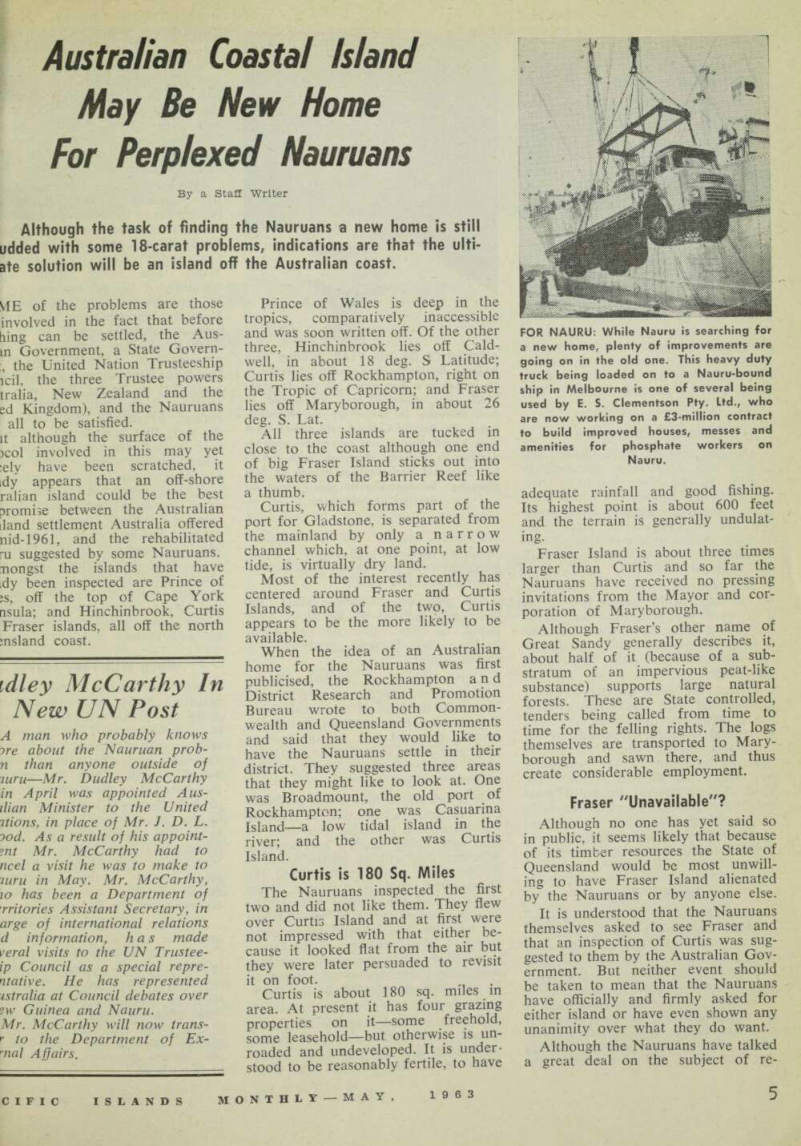
FOR NAURU: While Nauru is searching for a new home, plenty of improvements are going on in the old one. This heavy duty truck being loaded on to a Nauru-bound ship in Melbourne is one of several being used by E. S. Clementson Pty. Ltd., who are now working on a £3-million contract to build improved houses, messes and amenities for phosphate workers on Nauru.
settlement in the last two years, what has emerged has been largely con tradictory because they have not them serves known what they want.
At various times ( PIM, Dec., 1962, p. 17), they have wanted a separate island and an exclusive society; their own laws and their own special ser vices. At other times it has been re ported that they don’t want anything of the sort: That while they want their own land—because being land less signifies a slave state to a Nauruan—and want to remain a compact community for their own moral support, they also want to be close enough to the mainland for their children to go to secondary schools in the nearest big Australian town; and in order that they may themselves have other benefits of Western civilisation in the same way.
Some have even expressed a wish that they should be placed in a posi tion where they can engage in a tourist industry.
Mainland Connection The fact that the three Queensland islands that have been discussed in relation to the Nauruans have their butt-ends up against the Australian coast, seems to suggest that some one has his eye on the advantages of easy access to the mainland and that they are not too concerned with exclusiveness.
The Nauruans have not indicated yet if they would settle for Curtis if it were available (and too much promotion could be as good a reason as any for them to turn it down), but superficially Curtis has certain advantages.
Firstly, the local people have in dicated that they would like to have them. Although this is not altruistic, as several millions of pounds of de velopment money would necessarily have to be spent on the Nauruans’ new home, it at least creates the right climate for a successful good neighbour policy. One of the fears of the Nauruans, when a mainland home was suggested for them, was possible racial discrimination by Aus tralians.
Curtis is Bigger Curtis Island is 20 times as large as their homeland but in climate and the environment of beach and reef is not dissimilar. And, although it is completely separated from the main land, it could, if the Nauruans wished, be joined to it by a causeway or even a bridge. In the same way the island could get such service as elec tricity from the mainland and in Rockhampton and Gladstone the
Nauruans would have big-town facilities such as high schools, shop ping, airways, railways, radio broad casting and television.
On the other hand, when the Nauruans wanted to be alone they could, in effect, pull up the draw bridge, and become exclusive on Curtis Island.
Curtis Island, or another similar island, does appear to give to the Nauruans the best of two worlds and if anything has emerged from the several years of talk on the subject of a new home it is that the Nauruans want the best of as many worlds as they can get.
It is calculated that it will probably cost at least £4,000,000 to resettle the Nauruans, probably one-third of that sum being needed for housing.
Whether this will be partly financed by the three countries that hold the Trusteeship—that is Australia, New Zealand and the United Kingdom— in a proportion yet to be worked out; or whether the phosphate industry will pay is not known. If the latter, it is likely that increased royalties will have to be levied on phosphate in the years of life left to the work ings.
It is calculated that the Nauruans, directly and indirectly, are getting something like 24 per cent, of the proceeds of the sales of the phos
phate but this is dissipated in se ways.
In 1961-62, for example, £49 was paid by the BPC to the Ac istration in a lump sum to mal the difference between local and expenditure. Another £l4 was paid to or credited to indiv Nauruan landowners as a rc on phosphate mined on their I Large sums were likewise paid the Nauruan Royalty Trust (which keeps the Nauruan Local ernment Council and the ho fund afloat), and into the Nat Community Long-Term Invest Fund. The latter, made uj royalties of 1/- per ton on ever of phosphate exported, is Nauruans’ resettlement fund and vested on their behalf to the 2,000 AD. On June 30, 196 amounted to £616,931 and eve royalties were increased in this partment to make the fund quicker it is still unlikely tc enough to resettle the Nauruar the style that is expected, at the that it is likely to be needed other money will have to advanced.
It was suggested two years when Nauruan resettlement firsl came a live issue, that it would gradual business over 30 years, idea now seems to be that the sc it is done the better. This rr sense; there is little point in sj ing any more money than necei on Nauru when the same m could more profitably be speni the new home.
When Will They Leave?
But just when and how Nauruans will bring themselve: make the break with their home is another matter. They are very taken care of where they are, have the sympathetic interest of world as well. Once the seven wonder of their resettlement is ac« plished, they will have to settle d to the prosaic business of earnii living like anyone else, and it is fundamental fact that probably mi Nauru’s present leaders appear prima-donnas in their reluctanct make up their minds about t Nauruans really do want.
The two islands now most tas about in relation to the Nauru Curtis and Fraser, have a past industry and a timber industry 1 spectively. Few people who 1c anything about the Nauruans care them either as sheep or cattle hen or as timber getters. But they simply have to be something— the biggest question of all is g» to be: what?
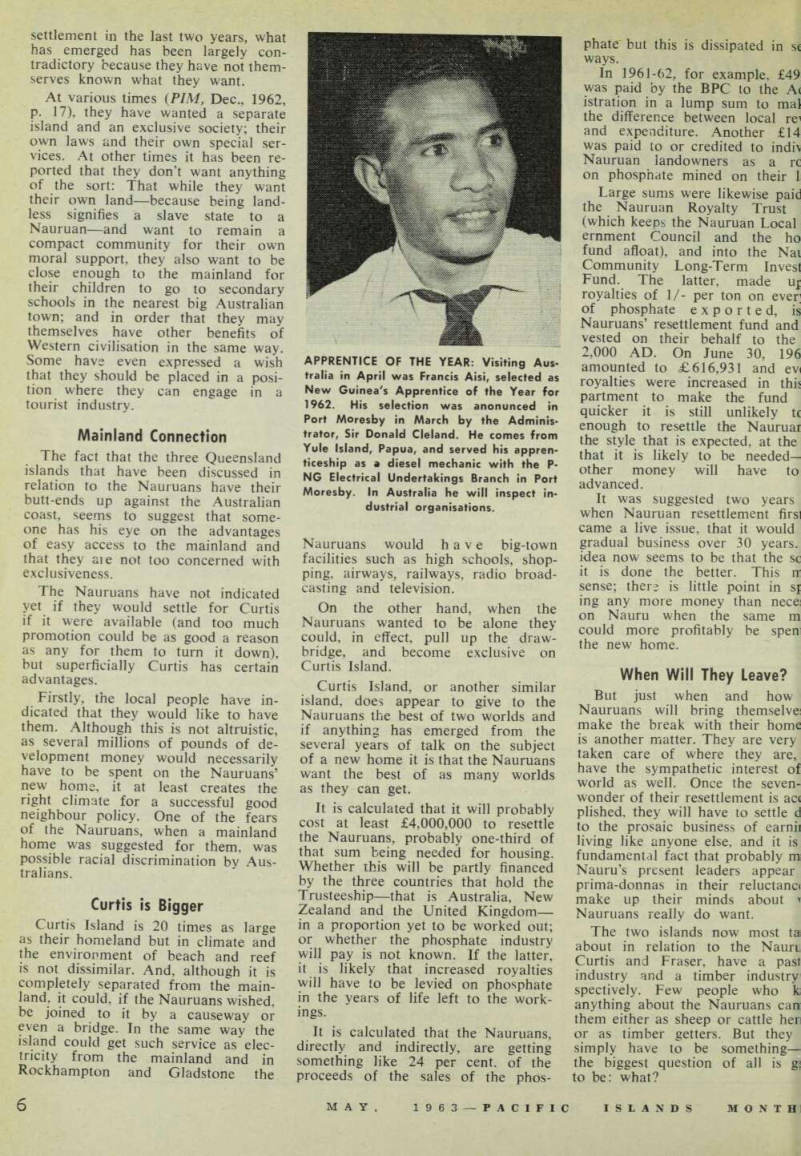
Apprentice Of The Year: Visiting Aus
tralia in April was Francis Aisi, selected as New Guinea's Apprentice of the Year for 1962. His selection was anonunced in Port Moresby in March by the Adminis trator, Sir Donald Cleland. He comes from Yule Island, Papua, and served his appren ticeship as a diesel mechanic with the P NG Electrical Undertakings Branch in Port Moresby. In Australia he will inspect in dustrial organisations.