acific Commerce and Produce
pp. 153-154 · Read in the full issue
[?]pra Prices 'May over' During 1962
>resent there appears to be
oundation for thinking that
very in copra prices may
alise during 1962, said Mr.
cDonald, chairman of the
Copra Marketing Board,
monthly report, issued in
loresby on February 1.
decline in Philippines supplies, :ause of 1961’s below average is unlikely to be offset by rease in exports from Ceylon mesia. It is also likely that will be unable to supply Europe with all the oilseeds ; required, hence their require will no doubt have to be from Western sources, added to the further possi )f increased consumption in and USA should create a >ound demand situation and >rices. average monthly Philippines ce during 1961 was £59/8/9 , hence there is some room rovement on the present price, averaged £57/15/- Sterling January, general situation of the oil arket during practically the jf January was characterised rm trend, which is somewhat ling when one considers the quantity of oils and oilseeds e for world consumption at continued Mr. McDonald, surprising was the sudden i the Philippines copra price end of the month (from !\ Sterling on January 2 to Sterling on January 30). s been suggested that the pre ite of the Philippines internal y has probably had a tern effect on copra prices. Ex have been holding back on its in an endeavour to offset ;cts of the devaluation of the id this may be the answer to Iden drop over the last few E January, as dealers unload >pra holdings.
' Production Up Slightly
a production in Papua-New during 1961, as reflected by
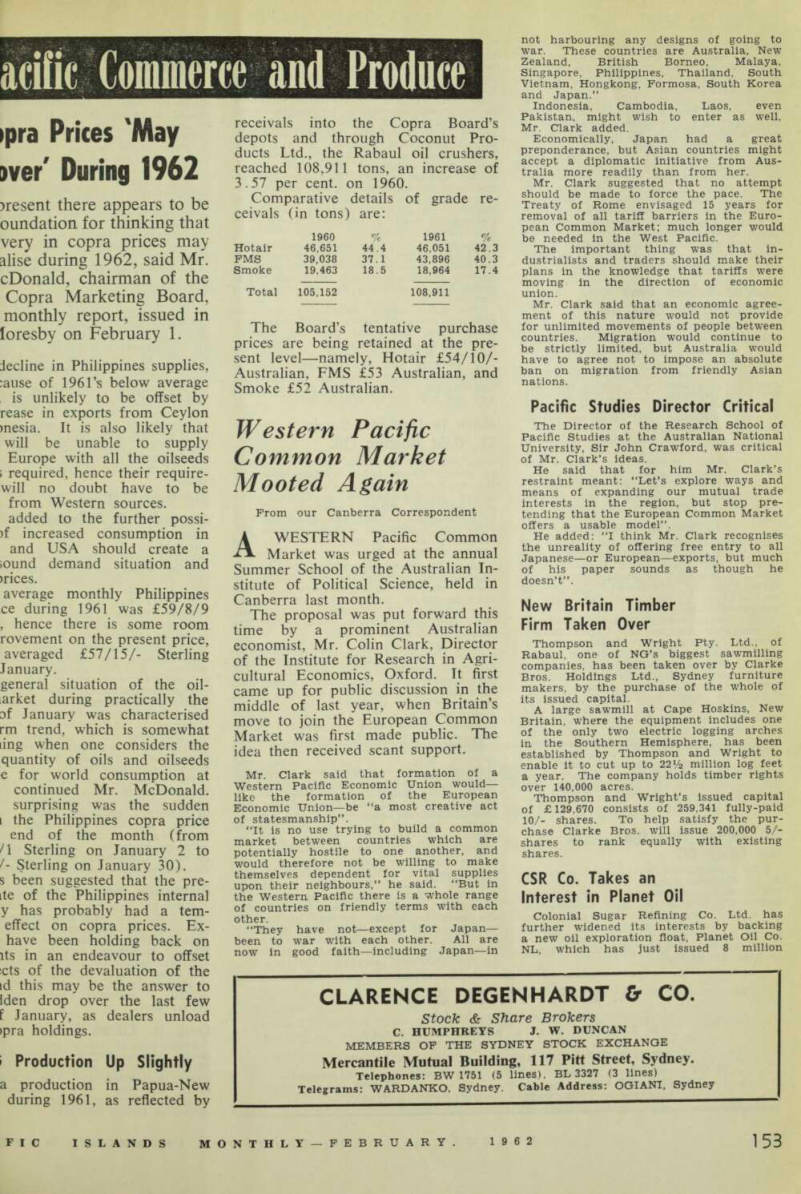
receivals into the Copra Board’s depots and through Coconut Pro ducts Ltd., the Rabaul oil crushers, reached 108,911 tons, an increase of 3.57 per cent, on 1960.
The Board’s tentative purchase prices are being retained at the pre sent level—namely, Hotair £54/10/- Australian, FMS £53 Australian, and Smoke £52 Australian.
Western Pacific
Common Market
Mooted Again
From our Canberra Correspondent A WESTERN Pacific Common Market was urged at the annual Summer School of the Australian In stitute of Political Science, held in Canberra last month.
The proposal was put forward this time by a prominent Australian economist, Mr. Colin Clark, Director of the Institute for Research in Agri cultural Economics, Oxford. It first came up for public discussion in the middle of last year, when Britain’s move to join the European Common Market was first made public. The idea then received scant support.
Mr. Clark said that formation of a Western Pacific Economic Union would— like the formation of the European Economic Union—be “a most creative act of statesmanship”.
“It is no use trying to build a common market between countries which are potentially hostile to one another, and would therefore not be willing to make themselves dependent for vital supplies upon their neighbours,” he said. “But in the Western Pacific there is a whole range of countries on friendly terms with each other.
“They have not—except for Japan been to war with each other. All are now in good faith—including Japan—in
not harbouring any designs of going to war. These countries are Australia, New Zealand, British Borneo, Malaya, Singapore, Philippines, Thailand, South Vietnam, Hongkong, Formosa, South Korea and Japan.”
Indonesia, Cambodia, Laos, even Pakistan, might wish to enter as well, Mr. Clark added.
Economically, Japan had a great preponderance, but Asian countries might accept a diplomatic initiative from Aus tralia more readily than from her.
Mr. Clark suggested that no attempt should be made to force the pace. The Treaty of Rome envisaged 15 years for removal of all tariff barriers in the Euro pean Common Market; much longer would be needed in the West Pacific.
The important thing was that in dustrialists and traders should make their plans in the knowledge that tariffs were moving in the direction of economic union.
Mr. Clark said that an economic agree ment of this nature would not provide for unlimited movements of people between countries. Migration would continue to be strictly limited, but Australia would have to agree not to impose an absolute ban on migration from friendly Asian nations.
Pacific Studies Director Critical
The Director of the Research School of Pacific Studies at the Australian National University, Sir John Crawford, was critical of Mr. Clark’s ideas.
He said that for him Mr. Clark’s restraint meant; “Let’s explore ways and means of expanding our mutual trade interests in the region, but stop pre tending that the European Common Market offers a usable model”.
He added: “I think Mr. Clark recognises the unreality of offering free entry to all Japanese—or European—exports, but much of his paper sounds as though he doesn’t”.
New Britain Timber
Firm Taken Over
Thompson and Wright Pty. Ltd., of Rabaul, one of NG’s biggest sawmilling companies, has been taken over by Clarke Bros. Holdings Ltd., Sydney furniture makers, by the purchase of the whole of its issued capital.
A large sawmill at Cape Hoskins, New Britain, where the equipment includes one of the only two electric logging arches in the Southern Hemisphere, has been established by Thompson and Wright to enable it to cut up to 22 V 2 million log feet a year. The company holds timber rights over 140,000 acres.
Thompson and Wright’s issued capital of £129,670 consists of 259,341 fully-paid 10/- shares. To help satisfy the pur chase Clarke Bros, will issue 200,000 5/shares to rank equally with existing shares.
CSR Co. Takes an
Interest in Planet Oil
Colonial Sugar Refining Co. Ltd. has further widened its interests by backing a new oil exploration float. Planet Oil Co.
NL, which has just issued 8 million
Comparative details of grade re-
ceivals (in tons) are:
I960 % 1961 % Hotair 46.651 44.4 46,051 42.3
Fms 39,038 37.1 43,896 40.3
Smoke 19,463 18.5 18,964 17.4 Total 105,152 108,911
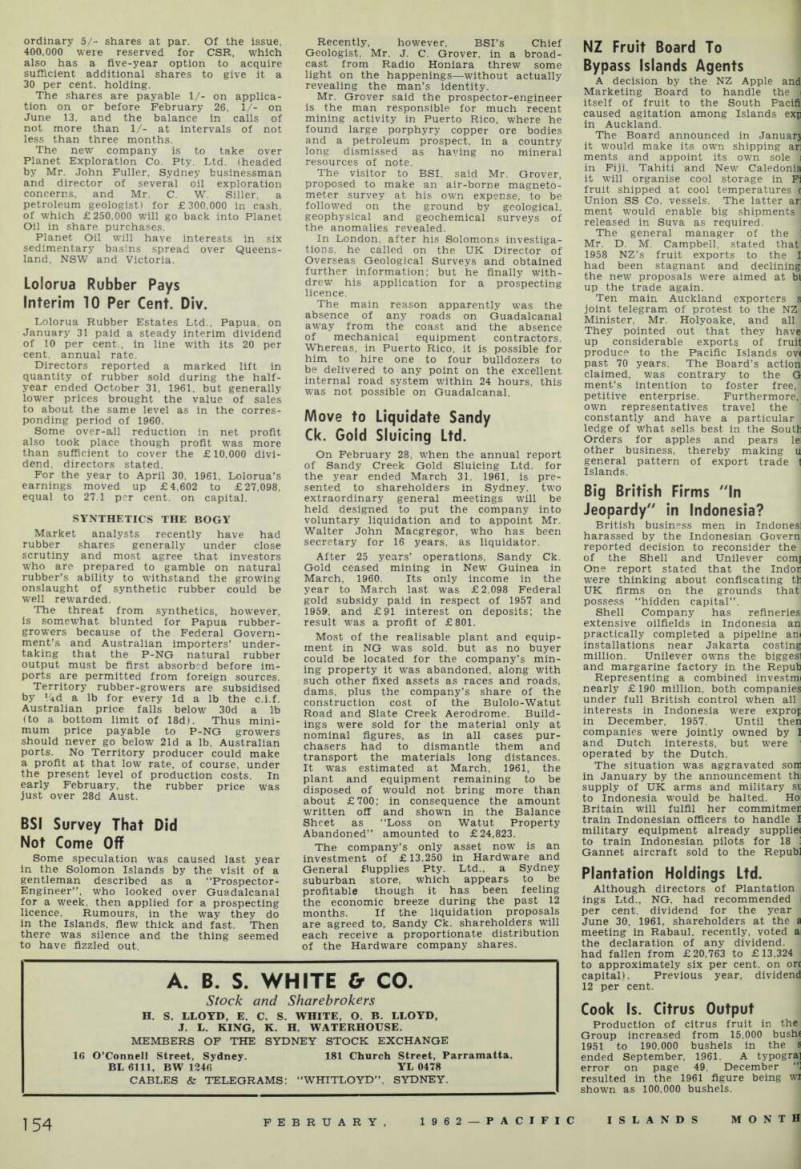
ordinary 5/- shares at par. Of the issue, 400,000 were reserved for CSR, which also has a five-year option to acquire sufficient additional shares to give it a 30 per cent, holding.
The shares are payable 1/- on applica tion on or before February 26, 1/- on June 13, and the balance in calls of not more than 1/- at intervals of not less than three months.
The new company is to take over Planet Exploration Co. Pty. Ltd. (headed by Mr. John Fuller, Sydney businessman and director of several oil exploration concerns, and Mr. C. W, Siller, a petroleum geologist) for £300,000 in cash, of which £250,000 will go back into Planet Oil in share purchases.
Planet Oil will have interests in six sedimentary basins spread over Queens land, NSW and Victoria.
Lolorua Rubber Pays
Interim 10 Per Cent. Div.
Lolorua Rubber Estates Ltd., Papua, on January 31 paid a steady interim dividend of 10 per cent., in line with its 20 per cent, annual rate.
Directors reported a marked lift in quantity of rubber sold during the half year ended October 31, 1961, but generally lower prices brought the value of sales to about the same level as in the corres ponding period of 1960.
Some over-all reduction in net profit also took place though profit was more than sufficient to cover the £lO,OOO divi dend, directors stated.
For the year to April 30, 1961, Lolorua’s earnings moved up £4,602 to £27,098, equal to 27.1 per cent, on capital.
Synthetics The Bogy
Market analysts recently have had rubber shares generally under close scrutiny and most agree that investors who are prepared to gamble on natural rubber’s ability to withstand the growing onslaught of synthetic rubber could be well rewarded.
The threat from synthetics, however, is somewhat blunted for Papua rubber growers because of the Federal Govern ment’s and Australian importers’ under taking that the P-NG natural rubber output must be first absorbed before im ports are permitted from foreign sources.
Territory rubber-growers are subsidised by V4d a lb for every Id a lb the c.i.f.
Australian price falls below 30d a lb (to a bottom limit of 18d). Thus mini mum price payable to P-NG growers should never go below 21d a lb, Australian ports. No Territory producer could make a profit at that low rate, of course, under the present level of production costs. In early February, the rubber price was just over 28d Aust.
BSI Survey That Did
Not Come Off
Some speculation was caused last year in the Solomon Islands by the visit of a gentleman described as a “Prospector- Engineer”, who looked over Guadalcanal for a week, then applied for a prospecting licence. Rumours, in the way they do in the Islands, flew thick and fast. Then there was silence and the thing seemed to have fizzled out.
Recently, however, BSl’s Chief Geologist, Mr. J. C. Grover, in a broad cast from Radio Honiara threw some light on the happenings—without actually revealing the man’s identity.
Mr. Grover said the prospector-engineer is the man responsible for much recent mining activity in Puerto Rico, where he found large porphyry copper ore bodies and a petroleum prospect, in a country long dismissed as haying no mineral resources of note.
The visitor to BSI, said Mr. Grover, proposed to make an air-borne magneto meter survey at his own expense, to be followed on the ground by geological, geophysical and geochemical surveys of the anomalies revealed.
In London, after his Solomons investiga tions, he called on the UK Director of Overseas Geological Surveys and obtained further information; but he finally with drew his application for a prospecting licence.
The main reason apparently was the absence of any roads on Guadalcanal away from the coast and the absence of mechanical equipment contractors.
Whereas, in Puerto Rico, it is possible for him to hire one to four bulldozers to be delivered to any point on the excellent internal road system within 24 hours, this was not possible on Guadalcanal.
Move to Liquidate Sandy
Ck. Gold Sluicing Ltd.
On February 28, when the annual report of Sandy Creek Gold Sluicing Ltd. for the year ended March 31, 1961, is pre sented to shareholders in Sydney, two extraordinary general meetings will be held designed to put the company into voluntary liquidation and to appoint Mr.
Walter John Macgregor, who has been secretary for 16 years, as liquidator.
After 25 years’ operations, Sandy Ck.
Gold ceased mining in New Guinea in March, 1960. Its only income in the year to March last was £2,098 Federal gold subsidy paid in respect of 1957 and 1959, and £9l interest on deposits; the result was a profit of £BOl.
Most of the realisable plant and equip ment in NG was sold, but as no buyer could be located for the company’s min ing property it was abandoned, along with such other fixed assets as races and roads, dams, plus the company’s share of the construction cost of the Bulolo-Watut Road and Slate Creek Aerodrome. Build ings were sold for the material only at nominal figures, as in all cases pur chasers had to dismantle them and transport the materials long distances.
It was estimated at March, 1961, the plant and equipment remaining to be disposed of would not bring more than about £700; in consequence the amount written off and shown in the Balance Sheet as “Loss on Watut Property Abandoned” amounted to £24,823.
The company’s only asset now is an investment of £13,250 in Hardware and General Supplies Pty. Ltd., a Sydney suburban store, which appears to be profitable though it has been feeling the economic breeze during the past 12 months. If the liquidation proposals are agreed to, Sandy Ck. shareholders will each receive a proportionate distribution of the Hardware company shares.
NZ Fruit Board To
Bypass Islands Agents
A decision by the NZ Apple and Marketing Board to handle the ji itself of fruit to the South Pacifi caused agitation among Islands exp in Auckland.
The Board announced in Januarj it would make its own shipping an ments and appoint its own sole ]l in Fiji, Tahiti and New Caledonia! it will organise cool storage in Fi fruit shipped at cool temperatures Union SS Co. vessels. The latter an ment would enable big shipments I released in Suva as required.
The general manager of the I Mr. D. M. Campbell, stated that 1958 NZ’s fruit exports to the I had been stagnant and declining the new proposals were aimed at bi up the trade again.
Ten main Auckland exporters s joint telegram of protest to the NZ Minister, Mr. Holyoake, and all They pointed out that they have up considerable exports of fruit produce to the Pacific Islands ov( past 70 years. The Board’s action claimed, was contrary to the G ment’s intention to foster free, j petitive enterprise. Furthermore, own representatives travel the ; constantly and have a particular ledge of what sells best in the South Orders for apples and pears le: other business, thereby making u general pattern of export trade t Islands.
Big British Firms "In
Jeopardy" in Indonesia?
British business men in Indonesi harassed by the Indonesian Govern: reported decision to reconsider the of the Shell and Unilever comj One report stated that the Indon were thinking about confiscating th UK firms on the grounds that possess “hidden capital”.
Shell Company has refineries extensive oilfields in Indonesia an practically completed a pipeline am installations near Jakarta costing million. Unilever owns the biggest and margarine factory in the Repub Representing a combined investmi nearly £ 190 million, both companies under full British control when all interests in Indonesia were exprop in December, 1957. Until then companies were jointly owned by I and Dutch interests, but were ' operated by the Dutch.
The situation was aggravated sora in January by the announcement thi supply of UK arms and military su to Indonesia would be halted. Ho Britain will fulfil her commitmeri train Indonesian officers to handle I military equipment already supplie< to train Indonesian pilots for 18 ] Gannet aircraft sold to the Republ
Plantation Holdings Ltd.
Although directors of Plantation ings Ltd., NG, had recommended i per cent, dividend for the year June 30, 1961, shareholders at the a meeting in Rabaul, recently, voted ai the declaration of any dividend. j had fallen from £20,763 to £13,324 j to approximately six per cent, on ore capital). Previous year, dividend 12 per cent.
Cook Is. Citrus Output
Production of citrus fruit in the Group increased from 15,000 bushc 1951 to 190,000 bushels in the s ended September, 1961. A typogra] error on page 49. December “1 resulted in the 1961 figure being wi shown as 100,000 bushels.