Pacific Report
pp. 115-137 · Read in the full issue

The month’s round-up of news and pictures of people and nts, from PIM correspondents in the South Pacific.
some Pay Rise
ome Fiji Officers
e than 300 of Fiji’s 2,200-odd srvants received a handsome 25 ;nt. rise in salary early in y, retrospective to April 1, These “designated” officers are ates, although in many cases rm “expatriate” has been ex -1 to include the sons of officers ime to Fiji from other countries, sons have lived in Fiji nearly ir lives. increase is on gross salaries salary plus post allowance, has operated since early in and is in addition to special privileges for officers’ wives lildren, and special allowances j children. whole of the increased salaries e pensionable. Previously the llowance was not regarded as lable. system has left a number of ; anomalies, and at the best is to cause locally-born officers wistful eyes at the “designated” n the monthly pay day. Locally fficers, except those “designated” ictly the same grade as the ex es, will find the difference in s in some cases is £3OO to acally-born head of department ;s £2,400 a year, plus £3OO post nee. An expatriate in the same ment, on the same basic salary ost allowance, will now receive r 5. new award still leaves the or of Medical Services as the >est paid man to the Governor, las apparently not qualified for crease because he is not in the nated” list. The DMS will now £4,687/10/- a year, just £125 than the chief executive, the ial Secretary. il servants have the right to opt 2 new conditions, but it is hardly that any of them will knock the 25 per cent, increase. The Civil List, due for publication arch 1, should contain some re
vealing figures.
The cost of the increase will be borne by the Britsh Government. The plan had its origin in Britain’s wish to ensure that as colonies and terri tories moved towards independence they should have the best officers that money could buy.
Britain will also pay the post allow ances to designated officers. These had previously been borne by Fiji. The saving to Fiji has been estimated at <£60,000 a year, but against this will have to be offset the higher pensions which Fiji will pay to the designated officers.
The poor old British taxpayer, once again, is caught with the burden, and among the officers who will be accept ing the increase are two who have chided local people for consistently crying out for aid from Britain.
Armadillos Will
Fight Guam's Snails
Texans have an American repu tation for both flamboyance and for somewhat extravagant gestures.
And when the SS Guam Bear sailed from San Francisco on January 20, she was a 20th Century Noah’s Ark because of these two traits.
Governor Bill Daniel of the Terri tory of Guam had visited the United States last November, when he talked to his brother, Governor Price Daniel of Texas, about the need for im proving the quality of Guam live stock.
The two Governors enlisted support of their friends, including that of an other important Texan, US Vice- President Lyndon B. Johnson.
The Texas State Fish and Game Commissioner and Governor Buford Ellington of Tennessee were ap proached.
As a result, a number of thorough bred bulls were donated, as well as
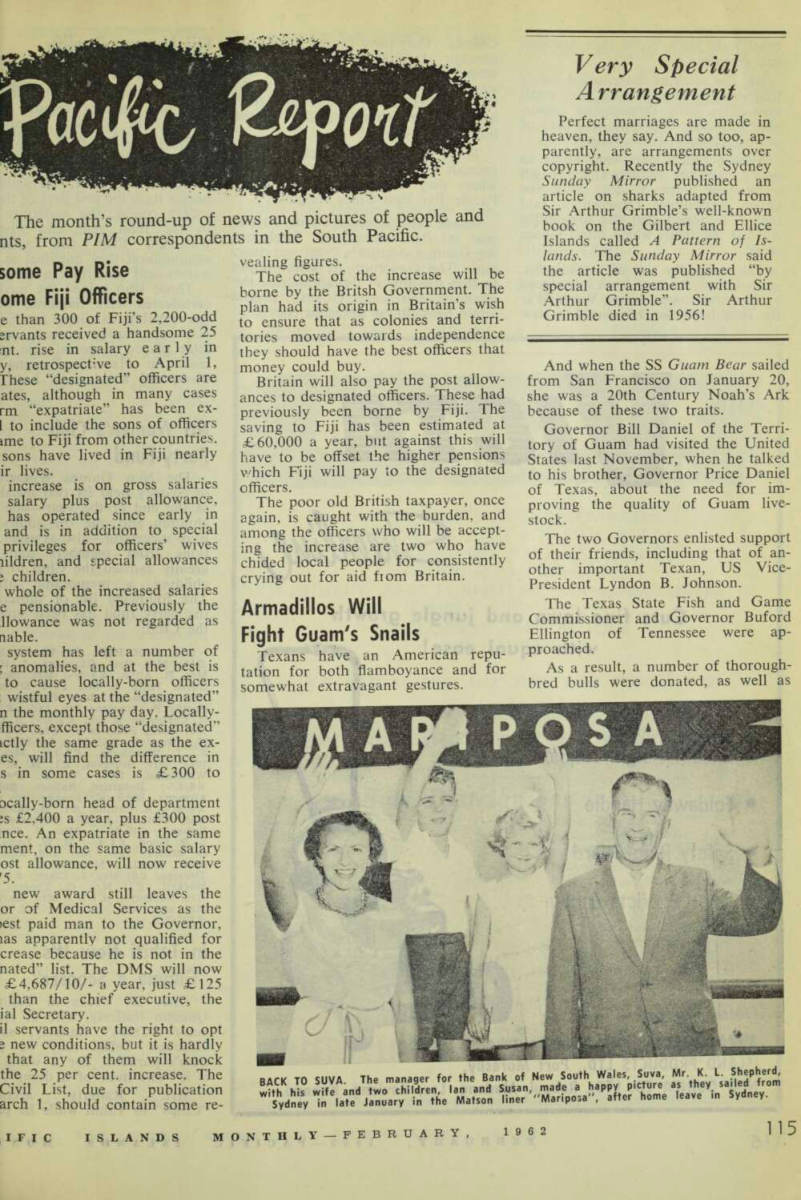
BACK TO SUVA. The manager for the Bank of New South Wales, Suva, Mr. K. L. Shepherd, with his wife and two children, lan and Susan, made a happy picture as they sailed from Sydney in late January in the Matson liner "Mariposa", after home leave in Sydney.
quail, milk goats, boars, deer, stallions and peacocks.
But the prize of the unusual list of freighter passengers were two small armadillos, little three-pound armor plated animals that may take care of one of Guam’s worst pests.
Robert Fears, who went along to take care of the animals and to begin a two-year term of duty with the Guam Agriculture Department, said that it is hoped that the armadillos will eat the snails which infest Guam crops.
The snails, the size of a man’s fist, are believed to have been introduced by Japanese troops during World War 11. They were also introduced to New
Guinea. Fhey have caused huge crop damage at Guam, as well as else where in the Pacific. Armadillos like warm climates, Fears said, and should like the snails. “If things go right,” he said, “we’ll ship armadillos by the hundreds to Guam.”
Three huge trucks carried the animals from Texas to San Francisco, where they were placed aboard the Pacific Far East Lines freighter.
Guam now imports about 90 per cent, of its foodstuff, Ed Engledon, the Guam Governor’s Press secretary, said. The Governor, he said, “hopes to stop the flow of dollars outside the territory and help Guam’s people attain agricultural self-sufficiency”.
Fiji Nurses Qualify
Under New Scheme
Four nurses from Fiji (three Fi and one Indian) recently rece: their New Zealand medals! certificates. They were the first gi from Fiji to qualify under the, New Zealand curriculum.
Under the new curriculum nurses took the first part of their i wifery course, the maternity coi in the final year, and when I passed their final professi examination they qualified as ger nurses and maternity nurses.
Those who gained the medals! certificates were Sainimili Bainf (an erstwhile candidate for Fiji’s ] Hibiscus beauty contest, and I later played a special role in a made in Hawaii), Peniana Rs Pushpwati Reddy and Latu Vit v/alu.
NG Women's Club
Party Fund
The New Guinea Women’s I of Sydney held its two usual pa at the end of the year—one for children and one for adults. J were successful —also as usual. D tions from members and fri greatly assisted the Club to give children a memorable afted The following list of subscriber the party fund has been suppliei the Club: Mrs. A. M. Page, £2; Mrs. B. Perr! £10; Mrs. Pye, £1; Mrs. J. Rossi Mrs. R. Allan, £5/5/-; Mrs. Bennid Burns Philp & Co., Port Moresby] New Guinea Co. Ltd., Rabaul, £lO, Pacific Publications Pty. Ltd., £2/2 A R. Carpenter & Co., £3/3/-; B. G. E £3; Burns Philp & Co. Ltd., £3/3/-I H. Johnston, £1; Mrs. M. Melrose,j E. J. Wauchope, £2/2/-; Mrs. M 10/-; Mrs. Sturgess, £1; H. R. &1 Whiteman, 10/-; V. B. Pennell £6/6/-; Returned Sailors, Soldier Airmens Imperial League of Aust £5/5/-; A. Collins, £1; M. Nott, £'■ Lady Cleland, £l/1/-; New Guinea!
Rabaul, £lO/10/-; Miss J. Ewen, E. R. Good, £4/4/-; M. W. Laws, £1 B. Mears. 16/-: Mr. and Mrs. Di Reid, £2/2/-; Mrs. Watt, 10/-; I Thomas, £5; Mrs. L. Clark, £l/1/-| Mockeff, £1; Mrs. G. Thomas, £1 Mrs. Normoyle, £l/1/-; Mrs. Margeth Mr. and Mrs. Baldwin, £2. TO £ 107/2/6.
In Tahiti Now It's
"Gimme a Scooter"
After 26 weeks in Tahiti, j Quentin Rafferty, wife of Austri actor “Chips” Rafferty, says j although Tahiti may be a v man’s paradise, for a white wo it is “one heck of a dump”.
Mrs. Rafferty accomp!
“Chips” to Tahiti while he playe
on the Bounty. She told the newspapers those weeks for e among the most miserable ever spent. said Tahiti was now in a t stage; tourism was boom the old idyllic ways were ng with it. More and more is were becoming spoilt and try. Tahiti the Gentle Island, :ome Tahiti the Takedown with everyone trying to make ranc and prices skyrocketing, Rafferty said scores of celebrated vahines were hired ing girls for the movie, but >f them turned out to be , squabbling little minxes”, tig up house with a white still the big thing among ut instead of the traditional give me a blue-eyed baby’ iea nowadays is ‘Gimme a cooter’.” idded for good measure that number of elderly couples d settled in Tahiti told her id become disillusioned and to quit the place.
Story: Two For
in New Guinea
■NG police sergeant Gonene 37, on January 25 was com for trial in Goroka, NG, on e of attempted murder, ad been charged with the wil irder of an elderly native near the Wonenara patrol miles south east of Goroka, 2 3 last year. The magistrate re was insufficient evidence to Gonene on a wilful murder so it was changed to attempted s claimed Gonene, in an statement, admitted shooting •man while he was carrying patrol officer’s order to burn in a native village. The patrol
had allegedly been attacked by the villagers who used arrows.
Patrol Officer Otto Alder, 24 was later committed for trial on charges involving arson, and on a charge of having unlawfully wounded a native.
Violent Jap Deaths
In American Samoa
The eighth Japanese has now been buried in a graveyard in Fagaalu, American Samoa, in an area set aside by the local Shimasaki family for Japanese from the Van Camp Tuna Company chartered fishing fleet. Of the eight, seven met their death by accident or violence. The last victim, Kiyohanru Yokoyama,
aged 25, was found floating on the reef near Leloaloa Village on De cember 3. His body contained 21 stab wounds. A captain and a boat swain alleged to be implicated in the murder have been sent to Japan for trial. A correspondent says it is well known that the Japanese fishermen are seldom involved in public brawls; but have problems among them selves.
US Samoa Reviews
Liquor Laws
American Samoa will establish a liquor board to review some aspects of Samoan liquor laws.
It is hoped the board will submit a report for discussion at the March
a of the Legislature, so that be dealt with early, present beer is sold to every in American Samoa but hard is restricted. The Goat Island which is financed mainly by servants and local business is the only organisation entitled sort liquor for its members, and nor H. Rex Lee feels the pre system shows discrimination, s expected the board will com the President of the Legisla te Speaker of the House, an member, and church represen 5. is unlikely the average Samoan ake to hard liquor in quantity se it is much cheaper to drink
nmercial Oil
ew Guinea"
j head of the Geology Depart at the University of Tasmania, ssor S. W. Carey, said in ry that he was confident there sil in commercial quantities in
New Guinea. He was to fly to New Guinea in late January to begin a geological report for Papuan Apin aipi Petroleum Pty. Ltd., and Oil Search Ltd., the Commonwealth Bureau of Mineral Resources, and the University of Tasmania.
Professor Carey is an expert on the geology of New Guinea.
In 1936 Professor Carey recom mended that a well be sunk at Puri —the well in which small quanti ties of oil were later discovered.
Attack on Anti-CSR
"Snipers"
There was significance in the way that certain Indian members of Fiji Legco attacked the CSR Co. on Feb ruary 2, when the Fiji Government submitted a bill to allow the company to register South Pacific Sugar Mills Ltd. without incurring liability for stamp duty (which would have been £100,000).
The bill was passed by a large majority. The need for the bill arose out of the Trustram Eve Report on ways and means of bringing stability into the Fiji Sugar Industry. The in dustry has suffered greatly (£2,000,000 loss in 1960-61) through attacks upon it by a small section of Indian growers, led by irresponsible Indian agitators and lawyers.
One of the recommendations was that the CSR transfer all its Fiji assets to a Fiji-registered subsidiary company, so that the company’s Fijian operations would be more readily available for examination by the new authority governing the sugar in dustry.
The company complied; but quite properly pointed out that, as this new registration was not its idea, it should not be penalised by stamp duty.
Mr. J. Madhavan, Indian MLC,
Administrator
On Tour
Papua-New Guinea Administrator, Sir Donald Cleland, and Lady Cleland took a first-hand look recently at the Kairkua sub-district in Papua's Mekeo area. At one stage (top) the official party was ferried across a river on the Kanosia Road. Another time they got aboard a 60 ft double canoe powered by a 35 hp outboard. In the lower picture is a fish freezing chamber owned by a native controlled company which the party inspected.
Photos: K. Vellacott-Jones
as one of the group which led 60 strike of growers, accused ivernment of voluntarily fore -0100,000 for the benefit of the said the company was “a oly which had an assured and a guaranteed price.” It ndreds of acres of land it had ;d very cheaply and which it >w leasing at a good profit. It ade millions in the past, and ; Report guaranteed £1,000,000 rofit for each of the next eight A. I. N. Deoki, an Indian (who was against the group led the 1960 strike) supported ladhavan. He said he would een happy if there was an as j from the company that, at ght time, shares in the Fiji ary would be made available public of Fiji, and that local rs would be appointed as re ;nded by the Commission, attack by the two Indian mem ipon the CSR gave the im n that a section of the Indian s will carry on their war ; the company under the new ons. general manager of the Em- Gold Mining Co. Ltd. (Mr.
Cayzer, a nominated member Council) brought the Indian ogues back to earth. He said ad he been elsewhere than in uncil he would describe some things said by Messrs. Deoki ladhavan in a crude word of stters. ne of their remarks disclose abysmal ignorance or sheer isy, and in any case they are dely irrelevant,” he said. ; question is simply this. Does ant this company to be registered ; Colony, where there will be to its books and so on, or not? i wants this registration, then is no question of giving the ny anything. We will either it to be registered free—or it Dt be registered at all.”
Cayzer said it was time some- Totested strongly against the ual sniping which went on in Council against the CSR. He 3 interest in the company, but the backbone of the industry i. n he warned: “The sniping that n is enough, if it continues, to the company get out of the / altogether. ere are thousands of very f Indians in Fiji, and there are >f people among them who are rous,” he said. want to point out that they
Would not be here at all if it were hot for the CSR. But for the com pany their fathers and grandfathers would not have come to Fiji, but would have starved on the streets of Calcutta or Bombay, Because they have come here they have thrived— and good luck to them! They have worked hard, admittedly; but it is base ingratitude to the company and to this country, for some of them to behave in the way they do.”
That virtually ended the matter although there were other speakers, including Ratu Penaia, who confined himself to: “I support Mr. Cayzer’s observations.”
The bill was passed in one sitting.
Fuss and Bother
Over Lae's Eclipse
In Lae, New Guinea, interna tional scientists on February 5 iftade perfect observations of the fatal eclipse of the sun when cloudk' obscuring it rolled away the minute the eclipse began. Lae was chosen as the best site in the Pacific from which to watch the eclipse.
Groans of frustration came from scientists and a large party of Jap anese newspapermen as the first phase of the eclipse began with rain clouds still covering the sun.
Then the groans changed to cheers
as 10 minutes later, at 0851 local, ti precise time of the total eclipse, d clouds parted.
Darkness fell on Lae and two stai Venus and Mars, could be seen! the sky.
Many native people locked thea selves inside houses and the eeri crowing of roosters could be in the sudden hush.
Townspeople stood in small groui and traffic came to a halt.
A member of the large Japanej expedition, Dr. A. Saito, said hi party had been able successfully 1 carry out their 11 experiments.
The United States, Swiss and Au! tralian scientists also reported su( cess with their experiments.
The 14-man Japanese party, fror five institutions in Japan, had worka long hours in the previous few days checking equipment and making sur in last-minute preparations.
All the scientists and the larg party of reporters, photographers an radio men, were feverishly active be fore dawn, but as the minutes tick© by closer to the time of the eclipa and the clouds still loomed, th atmosphere was tense with frustri tion.
The moon’s shadow had covera five-eighths of the sun when tin clouds parted, allowing the success ful observation.
The Japanese interest in the eclips was particularly intense and one Jap anese photographer, who was senq ing his pictures by radio direct I Tokyo, estimated that each pictun cost a million yen (about £1,250.) bj the time it was published.
Japanese experiments included maf netic observations, polarisation o the solar corona, observation of flasl spectrum, observation of the day ai glow, the chromosphere spectruo studies of the corona and ionq spherical variations.
The other parties were mainly in terested in the corona—the flames am gases emerging from the sun whid can be observed during the eclipse] History was made at Lae two day before the eclipse when two new! pictures were radioed from Lae tc Tokyo. These were sent from La< at 10.30 a.m. and were on the street! in Tokyo at 2.30 p.m. in papers sell ing three million copies. Never be fore had picturegrammes been sen from Lae.
Japanese supplied the equipmen and they were sent by technicians o| the Department of the Posts an( Telegraphs.
Large numbers of Japanese news men representing newspapers, mag azines, television and radio, were u Lae to cover the eclipse.
eclipse caused many headaches j Administration in attempting y native apprehension, some weeks before the eclipse were persistent complaints, eventually erupted into a discussion, that members of ;hovah’s Witnesses sect were ing fear” into native workers he eclipse. The Administration in the discussion officially, but t name the sect, e plantation workers were re to have asked for repatriation to await the eclipse. They told mployers they believed “a great eligion would be formed.” this brought a reply from Mr.
Beyer, presiding minister of the Congregation of Jehovah’s Wit who said accusations had been and the Witnesses did not what they were being accused ere was no proof of anything.
Mr. Beyer added: “Jehovah’s Wit nesses are not found teaching the natives anything about the eclipse that would not be found in any re liable encyclopaedia. If there is any suspicion, let’s see the names and places involved. I would like to challenge anyone to produce proof that Jehovah’s Witnesses are using the eclipse as a means of intimidating the natives either in New Britain or elsewhere,”
Whatever the rights and wrongs of the allegations it was pretty obvious to most New Guinea people that many natives didn’t need any encouragement from anyone for be lieving the worst of the eclipse.
Repeated assurances by Adminis tration officers that the sun would be obscured for only 2i minutes (mak ing it as dark as when there is a full moon on a clear night) failed to con vince many, who prepared for a long period of darkness.
One trader at Bulolo reported that one villager purchased from him seven four-gallon drums of kerosene.
This native believed the sun and the moon were going to come into con tact with each other and would take a long time to disentangle.
Some village natives in the Mark ham Valley built very small grass huts to crawl into while the eclipse was on.
Despite warnings of damaged eye sight, other natives bought hundreds of pairs of cheap sunglasses from traders.
Official statements warned that in Australia during an eclipse some time ago there had been many cases of permanent blindness and others had lost more than 50 per cent, of
DNEY. These Fijian visitors were among the guests at a recent social evening of >lynesian Association in Sydney. They are Mr. A. Bowerman of Suva, Mr. Alex Manueli, uma, and Mr. George Valentine, of Suva, who has now gone on to the United Kingdom.
sight. More than 1,500 schools e Territory were sent special ngs. People were advised to the eclipse through two pieces oked glass, or else to watch it ihadow on the ground or walls, i total eclipse could be seen not in Lae, but in the principal s of Bulolo, Kainantu, Goroka, [agen and Finschhafen.
in American
New Guinea
m “By the Way” a daily feature ie Los Angeles Herald, by nist Bill Henry (he was a war pondent in New Guinea during ar): v Guinea would seem to be of r interest and value to arch jists, miners and fruit-growers to ambitious South Pacific >rs. The Papuans themselves no signs of being able to de their vast area but the Aus is, in particular, would not look nuch tolerance on the presence orth of their big continent of dy as grasping and trouble as the Indonesians. >ody in his right mind believes le Indonesians have any rightful to New Guinea but India’s has by his subjugation of Goa, ;d the appetite of all sorts of ■grade imperialists who always more anxious to annex a bit of louring territory than to do ling worthwhile about the ter they already control. v Guinea is an unfriendly island ie men of the Wisconsin 32nd itfit Henry was with) probably envy anybody who thinks of it Peasant place in which to em )n a military expedition though hemselves did very well down
e for Fiji-lndian
|ner in Sydney
one-man exhibition of hand -1 dress and furnishing fabrics, 1 by the Canadian Trade Com ner in Australia (Mr. S. V. at a Sydney store in January, some high praise from Sydney s for the talents of Fiji-lndian designer, Douglas Ram Samuj. mg Ram Samuj comes from a nown family in Fiji—his three Mrs. Albert Jayant, Mrs.
Narayan, and Sister Leila Ram , are all prominent in the Fiji community at Suva, icated at Scots College, Welling-
ton, NZ, he studied art at Melbourne Technical College, Victoria, then went to England, graduating from Manchester College of Art with both the National Diploma (Design) and the Diploma of Associateship. For the past couple of years, he has been teaching art and allied subjects in Sydney, as well as engaging in free lance designing.
Ram Samuj is also a water-colourist of some ability—five of his paintings were featured at a Sydney art show ing last October.
Adi Cakobau Choir
Tour Great Success
Back in Fiji in January with a host of happy memories behind them were girls of the Adi Cakobau school choir who won the hearts of thousands during a month’s tour of New Zea land.
The school principal, Miss F.
Charlton, commented: “The girls made firm friends not only on the stage but particularly in private houses where they were billeted.
“The people with whom the girls stayed were surprised by the high educational standards and the gen eral deportment of their guests. They repeatedly asked what sort of a school it was that could produce such girls.
“At every town where the choir stayed the hostesses who had billeted them went to the bus to see them off
and many of the women cried wl they parted. People frequently ca: to me and said how lovely it was have the girls in their home.” 1 When they came to leave New Z land there were so many farev calls for the girls that the 'pli bringing them back to Fiji was] layed for half an hour at When pai.
In all, the choir gave 16 cona in New Zealand.
Melbourne Man Will Direcl
Papua-New Guinea's Indusl
A Melbourne man with the big| new job in Papua-New Guinea! been squeezed into a shared office hind the “smallest desk in the Te tory”.
He is Mr. Geoffrey D. CannonJ Papua-New Guinea’s first Dire] of Trade and Industry.
“It’s a very small desk, but thi will improve,” he said. He had! reached Port Moresby in Jami following a flight from Uganda!
Melbourne and Canada.
Mr. Cannon is working on an portant job to co-ordinate Pai New Guinea’s quickly develol trade and industry. He will steer] cou n t r y’s industrial developm native co-operatives, business, 1 control migration and help iron tariff problems.
He was appointed in Septemb He is a one-man department i but he will soon acquire a 30staff by absorbing the Departmen Customs and Marine.
Mr. Cannon was born educated in Melbourne. He sei with the Royal Australian Air F in the Middle East and in Eud winning the Distinguished FI; Cross. He went to East Africa 1946 and, until he left for Papuaj month, lived seven years in Ke and eight in Uganda.
While there he was a leadei Local and Central Governn bodies, and member of var financial, marketing and comma boards.
From 1957 until late Deced last year, he represented Euroj commercial interests as a nomin member of the Uganda Legist Council.
He was for four years a men of the Uganda Coffee Marke Board and a member of the B( of Management of the Uganda Ci and Savings Bank, the Aerodri Advisory Board and the board governors of the Kampala Techi Institute.
He also was a director of sev Uganda companies.
Mr. Douglas Ram Samuj with a length of his hand-printed "Polynesia” fabric.
Africa, Mr. Cannon said, was 15 years ahead of Papua-New i politically and economically.
Papua-New Guinea we must against one thing: Allowing il development to outstrip lie development,” he said. “If ippens, the people will suffer.”
New Guinea’s exports earned 5,911 in 1959-60.
Administration’s Assistant Ad ator, Services, Dr. J. T. :r, said recently that the r’s economy was in a “pre position—caused, generally, r-supply on world markets.
Ja for Fifth
Pacific Conference
c was going ahead in Pago American Samoa, in January reception of the delegates to th South Pacific Conference, eld there in July. The date was alised in late January, but it / to be from July 18-28. New is are being erected to ac date the visitors, who will Tom every South Pacific terri id Tonga.
Conferences are held every ears, and give indigenous rep ives the opportunity to meet ;s. wing the opening by the in, the conference will hear *t by the Secretary General, . R. Smith, on the SPC’s nd receive a review of action in resolutions made at the 5 conference held in Rabaul ?. Probably the most im resolution made then, las since been put into opera one calling for the estab t of a South Pacific Games ) be held in Suva in 1963). ig the Fifth Conference dele dll discuss papers and hear on the following matters: ods of training Pacific s in business methods and s; needs for, and methods of, interest and support for steps rove the quality of agricul oduce, including standardisa id inspection schemes, and imes to increase marketing y; changing role of women in th Pacific territories; of obtaining a reasonable between social advancement nomic development in South territories with due regard ur problems and increasing ons;
The importance of organised adult education schemes in South Pacific territories; The importance of relating educa tion to the needs of a territory.
They Haven't Much Time
Left to Study the Natives
Formation of an International Committee on Urgent Anthro pological Research in New Guinea was announced in Amsterdam late in January by Dr. Jan van Baal, former Governor of Netherlands New Guinea and now director of the Department
of Anthropology of the Royal Tropical Institute of the Netherlands.
Plans for the international co ordinating groups were made last year at the Pacific Science Congress.
Representatives of 10 nations and areas have been named to the advisory committee of the group. They in clude: Dr. J. A. Barnes of Australia, Dr.
C. S. Belshaw of Canada, Dr. J. V. de Bruyn of Netherlands New Guinea, Dr. R. Firth of Great Britain, Dr. W.
H. Goodenough of the United States, Dr. Murray Groves of New Zealand, Dr. J. Guilart of France, Dr. Charles
Julius of Papua and New Guinea, Dr. C. A. Schmidt of Switzerland, and Dr. van Baal, representing Holland.
Because of the rapid spread of ad ministration and mission influence, Dr. van Baal believes that only an other 10 years or so remain to study primitive societies which have had no contact with the civilised world. This time limit is, of course, based on Dutch retention of West New Guinea.
Civilisation is “penetrating into the primitive areas of New Guinea with increasing speed and effective ness”, he said.
The committee will promote an
thropological field work throughout both halves of New Guinea with hope that knowledge of the primitive societies can be obtained before western influence changes them. It will publish a bulletin twice or three times yearly. The first bulletin con tains a comprehensive listing of pro jects recently completed, now under way or scheduled to begin.
Vila Helps Ship
In Trouble
There was some excitement in Vila, in the New Hebrides in late January when the 9,000-ton Swedish vessel
Carla, en route from NZ to Ja radioed that she was taking in v and needed help. When the mes arrived, Burns Philp, acting as ship’s agents, asked help of jl Cook, then in Vila Harbour on su work.
The Cook’s navigational ol went out to Carla in a BP lai and brought in the Carla five h later. Divers from the Cook\ local marine engineer W, Geaj discovered a 12 ft. crack in ship’s side. The ship was thei times listing almost 20 degrees! the vertical.
Cook’s pumps got to work] engineers got on to the task of ting their way through the carg heavy NZ logs to repair the I from the inside.
Cook was making her third] to the New Hebrides in eight mo She has been concentrating on veying the area near the site c overseas wharf that is to be bui Vila which at present has none The Condominium Public Department has meanwhile bu 60 ft. tower of tubular steel v is to be put on the sea bed] the site of the new wharf, and house the platform on which g gists will install drilling apparat study rock formation.
"Not Too Many"
Tourists for W. Samoa
According to Apia hotel prop] Mrs. Aggie Grey, West Samoa more tourists —but “not too m Aggie Grey and other Apia bui people want to see more done t courage tourists to visit Samoa, I has been described as a tourists! dise without tourists. The pi strict control of entry pe effectively prevents the entry ol wanted beachcomber types, 1 Grey believes.
Apia has four hotels with a of about 150 rooms. Hotel tarif eluding meals range from I £2/10/- daily for a single room] out a bath to £3/10/- for a cc with a shower.
Many Europeans consider the sent Samoan liquor laws a ban to the development of the tourii dustry. Liquor can be bought with a permit and permits are i on a points system.
One of the joint Heads of !
Tamasese, said recently, “We d< want organised tourism as they in Hawaii. We like people to j to see how we live and to enjoy 1 selves. But we do not want it| big organised scale. That can \
rime Minister Fiame Mata’afa smayed recently to find that in Hawaii was just like any lay of the week, report of the Government ed committee on economic de ent (see page 71) recommends e Government should not do g to encourage full - scale . The committee did, however, lend that the Government encourage more tourist liners at Apia. The committee’s view tourists are less likely to cause if they are living on ships.
icted Legco
SIP Yet
i unlikely that the British n Islands Legislative Council we any elected members in ir even one, as an example, as d by Mr. E. V. Lawson at :nt BSIP Council meeting.
BSIP Legco, which was inonly in December, 1960, : through a stage of evolution 1 eventually come up with a cted body—but everything is ccording to the plan and the aesn’t include elections this Lawson recommended that ould be one elected European and a European electoral : believed that this would be ning and show the Solomon s “how to run an election unified manner”.
Chief Secretary said there ther ways of teaching the about a democratic form of lent and the Government be aat the key lay in local gov first. He said it was a formid iness setting up the machinery eral elections—the constitu >uld have to be amended, >n introduced and voters d. ler member pointed out that r. Lawson was proposing was opean member elected by the n voters—and not a full-scale election at all. But the Gov . in the form of the Chief y, turned the idea down just
Patrol Goes After
Fax-Dodgers
r armed native police led by n Native Affairs officers and fficers moved into villages on and, Bougainville, P-NG, on / 6, to arrest villagers who to refuse to pay taxes.
Administrator of Papua-New
Guinea, Sir Donald Cleland, said the action followed persistent refusal by 700 natives in four villages to pay personal tax of <£2 each.
The four villages, on the north west coast of Buka, had formed their own “welfare group”, which the Ad ministration did not recognise, the Administrator said.
Attempts to persuade this group to join Administration-sponsored Native Local Government Councils had been unsuccessful. (Native Local Government Councils can levy their own taxes but where native groups refuse to join them, the Administration taxes the natives to raise funds for Local Government purposes.) Originally the Buka Welfare Society was ostensibly well-disposed towards the Administration and a nearby Roman Catholic Mission but late last year its attitude changed to one of non-co-operation.
Administration patrols into the area had been told that the people refused to pay the tax because there was not enough money in the area and because the Administration re fused to give them a medical aid-post.
In fact they have access to an Ad ministration aid-post three miles from their villages and a hospital at the nearby mission.
In spite of the efforts of the Assist ant District Officer who had “patiently and sympathetically” explained the reasons for taxation they still had re fused to pay the taxes. And additional persuasive tactics by native members of the Legislative Council, Yin
Tobaining and Nicholas Brokam, were no more successful.
The decision to send police into the area was taken after consultation with the District Officer for the area.
P NG Government
At Grass Roots Level
A conference of Papua - New Guinea Local Government Councils was held in Port Moresby between January 8 and January 12, and if the matters discussed were not of the same magnitude as those that bedevil the UN, they were of con siderable importance to the native people concerned.
Local Government Councils are a post-war growth and are set up in areas where the natives are sufficiently advanced to manage their own affairs.
They have the right to levy their own taxes and carry out local road build ing, school construction, health measures and so forth. The Councils played an important part in the elections last year that gave P-NG its first elected members of the Legis lative Council.
The Councils have given the P-NG native people their first glimmering of democratic government but some of them still have got a long way to go, as they were sharply reminded by the Director of Native Affairs, Mr. J.
K, McCarthy, during the conference.
When the Vunamami (New Britain) delegate asked, in effect, when the Councils were going to be allowed more power, Mr. McCarthy
READY, SET GO! This was the scene in the New Guinea Club, Rabaul, at Christmas when more than 250 youngsters of all ages did a rough kind of justice to their annual Christmas party. There were films, and, of course a visit from Santa.
reminded delegates that some Coun cils had been operating for 11 years, and they still had to seek the constant assistance of Native Affairs officers in the supervision of their every-day Council work. He said that when he was present at a Local Government Council meeting in the Highlands, the people had asked that a patrol officer be made available to each Council to supervise their activities.
Mr. McCarthy told the conference that before there could be any further advancement in the scope of Council responsibilities the Councils must be able to handle their own affairs at the local level. At present the Councils were still not able to prepare their own simple sets of estimates, order stores and arrange to let contracts covering capital works for the Councils.
All this had to be done by the supervising Native Affairs officers, whereas the Councils should be able to organise and carry out these re sponsibilities on their own with a minimum amount of supervision from government officers. This was what the Administration wanted, and this was essential to any further develop ment of Council activities.
Amongst many matters discussed during the conference was that of bride price. Some delegates from districts that have suffered wild in flation in this commodity were all for getting the practice of making pre-marriage payments to the bride’s family down to a standardised sum.
It was alleged that up to £l,OOO was paid for a bride in the Hanuabada (Port Moresby) community; and that even in the Highlands as much as £2OO or £3OO changed hands.
The Rabaul district seems to have got a better grip on the situation than most, and a delegate from there said that the standard price had remained unchanged for years at £lO.
A retirement benefit scheme for employees of Councils—clerks, cocoa inspectors, aid-post employees and the like—was discussed and referred to the Administration for further action.
The need for more schools was the wish of most delegates and particu larly of delegates from Highlands districts. Although Administration schools in Eastern and Western High lands have increased from eight in 1956 to 43 in 1961 demand is still outstripping the Department’s ability to keep up. The Director of Edu cation assured delegates that every thing posible was being done to bring about the desired result.
Other matters discussed included
the drift to the towns from village life; adoption of a European system of surnames; a proposal made last year that Councils should put three per cent, of their income into a fund for sending representatives to visit such countries as India and Africa; and the request that European Native Affairs field staff should be allowed to stay in the same area for at least six years.
It was decided at the end of the conference that the 1963 conference would be held in Manus District.
Trade Scheme 'Not
So Bad After All'
Bids for the purchase of the Bl Trading Corporation closed* January 31 but at date of going press the name of the succea bidder had not been announced!
The Trading Corporation stai life as the Trade Scheme after! war and at that time was regar as a socialistic substitute for I private enterprise Big Firms that! not returned to the BSIP a hostilities ceased in 1945. It 1 created during the UK’s post socialistic period when it 1 imagined that the islands would much better off if “Europ exploiters” did not return to Protectorate.
However, these ideas have I modified with time when it was] that even the European capitalist! his place in the scheme of thi The Trade Scheme has changed,!
A few years ago it becamel Trading Corporation but it contif to be the biggest retail distribute the Group and supplied o services usually undertaken by pri enterprise.
Over the years the Corporation gained friends. It was interestin hear at the recent meeting of BSIP Legislative Council, Mr. E Lawson, who represents private ei prise, backing up Solomon Is! members who said they didn’t j to see it sold.
Mr. Francis Bugotu moved! the Government withdraw J Corporation from sale. He said] the natives regarded it as theirsj hoped that some day they n run it themselves. In any event,] saw it as a symbol of help friendship from Britain.
Mr. Lawson said that there w time when the local Chambei Commerce had asked the Gcr ment to sell the Corporation but, the Chamber had changed its j and would not like to see an ou concern getting it and sending profits out of the country.
In reply, the Financial Secre Mr. A. M. Wilkie, said that Government believed that it st not engage in trade either on its account or in association with pr enterprise (which is also a chanj heart since 1945); and he couldoj its new owners exploiting anyo or if they did, the public had its weapons for dealing with it.J any event it was too late to with it from sale. Solomon Islai could get together and make a for it if they liked.
NEW GUINEA SCENE. The travelling van (top), which sells a frozen dairy food similar to ice cream, is popular with Rabaul natives these days. It travels to villages and also does very good business on Saturdays at the Rabaul market. Lower photo shows Mrs. H. West presenting a special prize for child art to Louise Patterson, 11, at the Rabaul Art Society's first Territory-wide exhibition, held recently.
There were eight prizes totalling 100 guineas.
Are Clue to
II Problem
reliminary report by the BSIP iment Entomologist, Dr. P. J. eenslade, on research into the of the Amblypelta insect, causes early nutfall on coconut ions, states that research work the last 10 years has con that two kinds of ants will palms from these insects, e ants, which live in the palms t the insects, are liable to be sd by two other species, which ) protection to the palms.
Greenslade says that work is ing concentrated on controlling ielta by modifying ant popu attempts have been made by •lantation owners to introduce the useful species into coconut but he considers that the suc failure of these experiments >ended on unrelated and spon ; changes in the ant population area. dailed programme of research aspect of ant life and ment has been planned, in the study of the relation be their surroundings and their
distribution, and the reproduction rate of each type of ant. This pro gramme is expected to take several years, and in the meantime, field trials are being carried out to find effective deterrents for the two use less ant species, and to encourage the leaf-building ant, which orotects coco nuts against Amblypelta.
Planters Carry BSIP
On Their Backs
The British Solomon Islands Pro tectorate is one of the Pacific terri tories that has the distinction of hav ing both income taxation and an ex port tax, and with the present low prices for copra this is making life economically difficult for the BSIP planter.
The matter of the 15% export duty on copra was brought up again at the latest Legislative Council meet ing in Honiara by Mr. E. V. Law son, but while sympathising with him, and the planters he represents, the Financial Secretary, Mr. A. M. Wilkie, could give no hope of relief.
The Government depends on ex port duty for a large slice of its revenue and even if the duty were reduced to 10 per cent., this would lose the Government £-80,000 in revenue, said Mr. Wilkie. This sum simply would then have to come from somewhere else.
What Mr. Wilkie says is probably true, but unless prices for copra im prove considerably, which seems un likely, it is hard to see why anyone should want to remain in the copra producing business in the Protec torate.
It was at this same meeting that the High Commissioner, reviewing affairs in the Protectorate, stressed how important it was to encourage economic development. He spoke of the commercial interest there currently is in exploiting timber re sources in Kolombangara, and other parts of the Western District. He said, too, that it was hoped to expand the cocoa industry from the 3,600 acres that are now under that crop.
Surveys of mineral resources were also under way—and there was a substantial programme of nickel prospecting on Choiseul. When and if all or some of these experimental crops and surveys bear economic fruit, the heat will no doubt be off the poor old copra industry. In the meantime it is expected to continue as the milk-cow of the BSIP, which may make bureaucratic sense but is also likely to frighten off any other enterprise that otherwise might be encouraged to establish itself there.
Queries on Rabaul
Volcanic Measures
Construction of an emergency air strip for use in the event of a volcanic eruption was urged in Rabaul, New Guinea, in early February.
Speaking at a meeting of the Town Advisory Council, Councillor R.
Darcy asked what arrangements existed for the movement of essential aircraft should an eruption occur.
The present airstrip serving the town would be out of commission in the first five minutes of an eruption, Councillor G. Kent stated.
In reply, the District Officer for East New Britain, Mr. Harry West, said a plan existed for the construc tion of a landing strip at Vunakanau, 10 miles from Rabaul. (Vunakanau is the site of a large wartime Japanese airfield on top of an escarpment west of the town.) However, chances of an eruption were slight, Mr. West said.
A report from the Government
WEDDING. Married in Rabaul—Mr. per, of Rondo Plantation, and Miss ckwell, of Sydney. The ceremony abaul Anglican Church of St. George the Martyr.
OFF TO ENGLAND. Makereta Dawai flew 18,000 miles from Fiji's Nadi Airport to London in January to join her husband, Orisi Dawai, at Rochdale, Lancashire. Orisi, a former Fijian Rugby captain, left for England last year to play Rugby League for Rochdale Hornets.
Orisi captained the Fiji team which toured Australia early last year and was also captain of the team which toured New Zealand successfully in 1957. Makereta has been a clerk in the Native Land Trust Board for the last nine years. A brother, George Cavalevu, is also a former Fiji Rugby representative, and was captain of the Fiji Rugby team in New Zealand in 1951. He was an outstanding five-eighth.—Photo; S. A. Whippy.
Vulcanologist stationed at Rabaul stated he had checked all volcano outlets and found no evidence of pressure build-up which could cause an eruption.
Jubilee of Pacific
Islands Society
Of the small group—mostly Islands residents—who formed the Pacific Islands Society in Sydney in 1937, only five still retain member ship; and it is hoped that they will have a part in the jubilee celebration of the Society’s foundation, which will
take place later this year. The five are Mrs. Olga Page, formerly of Samoa and Tonga, who was the Society’s hostess for several years; Mrs. M. K. Beasley; Mr. Fred Hennings, of Fiji, who is still an active member of the Council; Mr.
Eric Ramsden, now a resident of New Zealand; and Mr. R. W. Rob son, publisher of Pacific Islands Monthly.
The Society will hold its annual meeting on February 22, when it will wish bon voyage to its President and Hostess, Mr, and Mrs. N. H.
Foxcroft, who depart shortly on a world tour. The Society meets
monthly, and is more a social ti a cultural organisation—altho there usually is at each gathering address on some Islands subject.
They Brought the
New Year In
It was a pretty good New Ye Eve party for 22 citizens of Cristoval, BSIP. They ended in I Kira Court in January to exp away the fact that they had destrc young trees, thrown firecrackers invited the village people of B to come out and fight (an invita that the villagers declined).
The court was told that when m bers of the Constabulary went oi Ahia village to investigate the c plaint, they were insulted by soro the village people. All in all,' men of Ahia who obstructed] police were each given three mo gaol, and 22 men who played u] Hada were given gaol sentences fined.
Beetles Will
Attack Flies
The New Hebrides Departmen Agriculture hopes to import a quai of Pachylister chinensis beetles, w are used to keep down the com house fly, and were successfully perimented with by the Bu Miniere on Erromanga, last tember.
The current importation is b supplied by Mr. B. A. O’Connor, entomologist with the South Pa Commission, and will be used Tanna. The beetles feed only on larvae of the house fly, and are valuable in fairly densely popul areas like Tanna, as an aid to hyg and general cleanliness.
New Manganese Industry
In New Hebrides
A large and important installs now is operating on the east c of Efate, in the New Hebrides; ai large and growing production tl from of manganese ore is likel; strengthen the economy of the Co minium.
The face of that countryside River Forari area) has changed s June, 1955, when M. Obelliam geologist of the French Oce Phosphate Company discovered I ganese ore close to the river, company spent three years on s and exploration, and then obta a 25-years’ concession over 4 hectares of land, and proceede* plan and make the installation.
plant necessary to mine the as placed on the site of the deposit, at the head of Metensa A wharf was built. A village ise the staff, with all amenities, jilt between the wharf and the A pumping station was placed ; river Forari, and water was d three miles to a reservoir the mine, where it is used to he ore from the crushed rock ibstance in which it is found, laterial is carried from mine iher, and on down to the wharf Dn moving belts, luction commenced in January, 1 indications are that this well d industry will be of great to New Hebrides. The British rench Resident Commissioners New Hebrides on January 8 e first shipment of manganese ;ing loaded into the Japanese amaushi Maru.
ets Plenty
jblicity in Sydney
got more than its share of ty on Sydney TV, radio and Press in February when Qantas a fortnight’s display of all Fijian, by arrangement with ji Visitors Bureau. Secretary ,ane was on hand to keep the Hing. foyer of Qantas House was out Fiji style and the local ; were offered yaqona speci ported from Fiji. Films of Fiji hown, and reef fish were on mg the visitors the festivities id was Mr. H, C. Monckton, : Manly, a former Secretary of Pairs, who brought in some old raphs and had a yarn with orn Don Lane. Mr. Lane, ly, concentrated on interesting agents in the charms of Fiji.
alia's New Interest
ighbouring Condominium
e official activity has followed d of research by the Australian ment of External Affairs into lian land interests in the New es Condominium.
Australian Commonwealth iment has held land rights :or over 50 years—ever since e Sir James Burns offered the variously estimated then to be n 80,000 and 100,000 of the Jago’s best acres) to the then new Australian Government, nd, which had been acquired Burns Philp subsidiary which mt of existence, was formally
accepted by the Government, about 1906; and for many years Australia maintained, or partly maintained, a solicitor in Vila, who was expected to pursue, before the Joint Land Court, the Commonwealth’s claim to formal titles.
The solicitor was not maintained there after World War 11, and the matter seemed to be forgotten.
More recently, however, some new data has been collected; certain officials from the Department have visited the Condominium; and now it is authoritatively reported that an Australian legal man will be en couraged to settle in Vila, so that he may be available to press the Australian land claims when oppor tunity offers.
This is a rich archipelago. It is very near to Australia; and, under the peculiar system of government which it enjoys (joint supervision by British and French Colonial Office officials) it gives more freedom and opportunities to private enterprise than usually are found in this over governed age.
Ambrym In
Eruption Again
When the volcanoes on Ambrym in the New Hebrides erupted in January, volcanic clouds could be seen as high as 15,000 ft. above the island, and the eruption could be seen from as far off as Santo, The Condominium Government and the British Administration char tered the New Hebrides Airlines Drover, to enable the officer in charge of the Geological Survey, Dr. R.
Curtis, and Monsieur Priam, the Condominium Mining Officer, to make an aerial reconnaissance of Ambrym. They saw dense clouds of smoke and steam rising from Marum volcano.