Pacific Shipping And Cruising Yachts
pp. 99-113 · Read in the full issue
The interest of the big international shipping companies the Pacific is growing—a dramatic change from the state of firs of a little over a decade ago when there were no regular senger ships on the trans-Pacific route between Australasia 1 North America.
ORDING to reports from Dndon, even the Cunard Line iking Pacific in its planned :ment of the Queens. Earlier jar it was planned to build r giant vessel for the Queen replacement, as a prestige , as it is generally conceded le day of this type of ship is Although there is some sort b value still in having crossed [antic in either of the Queens, ijority of travellers are willing ;go this honour and travel by ?lanes on the Atlantic routes *un with the frequency of an buses. use of the astronomical cost giant replacement for Queen his plan was scrapped later in When a replacement is built 11 probably be planned with to getting her through the a Canal so that Cunard can he round-the-world trade and in more Pacific cruises in the m winter. This will limit the 45,000 tons—the tonnage of ; Canberra, which is the largest date to pass through Panama.
HE BIG SHIPS: Pride of the fleet, 42,000-tons Oriana, ted her first year of service :ember 3. It was a year free able in which the big liner ust about every record in the stralasia-Pacific book. She three round voyages from upton to Australia, NZ and ; one round trip to Australia, uises—a big year’s work for P anuary 9, the same company’s southbound from US west orts, and the Orcades, north occupied the whole length of ng’s Wharf, Suva—the first vo Orient ships have been in gether. coincidence of their arrival t lost on an Australian tourist which sent a party of 104 a the Orcades and transferred t Suva to the Orsova for the journey. le liners left the wharf, Orcades , each saluted the other with ; of blasts on their sirens, jether it was a good day for
Suva traders, who are already looking forward to the next coincidence.
• Another Cruise Ship At
SUVA: Ten days after Orsova- Orcades passengers had been let loose on Suva, the port had a visit from a Dutch-owned, German registered cruise ship, Seven Seas, carrying 560 passengers from Aus tralia and New Zealand.
The vessel is owned by Europe- Canada Line and generally operates between Bremen, West Germany, and Montreal, Canada. Her January cruise included visits to Pago Pago, American Samoa, Nukualofa, Tonga, two days and a night in Suva, and a call at Noumea, New Caledonia.
Suva turned on the full treatment for visitors—including the Fiji Military Band, free hibiscus flowers handed out by two of Suva’s prettiest girls, Indian curio sellers—and some rain.
• Did Monterey Pas
Sengers Like Noumea? The
Matson liner Monterey made her initial call at Noumea, New Cale donia, on Sunday, January 14, remain ing there from 8 a.m. to 4.30 p.m.
Local tourist organisations went to a great deal of trouble to prepare a welcome for the 220 passengers, even
to the extent of making tidy the part of the wharf where the pas sengers landed.
According to Matson Vice-Presi dent, Mr. Terence Rowe, who was on board, the company was pleased with the experimental stay and so were the passengers. Local businessmen are, however, not so sure. According to our own correspondent: “Only about 50 per cent, of the passengers took an interest in the car tours arranged for them and no one was interested in the air tours organised for the ship’s benefit. Very few tourists were seen in the streets and the one or two shops which did open did no business. Indeed one would have had to be as crazy as a tourist to leave the air-conditioned ship to stroll in Noumea’s terribly hot and deserted Sunday streets.
“We are all trying to figure out why the Matson Co. sent the ship here on a Sunday, especially as it had been announced that it was a trial run and that future calls would depend on its success.”
It could be that Matson were expecting Noumea to have a Con tinental and not a Colonial Sunday.
• And Now There Are
TWO: With the withdrawal of the P & O Liner Strathnaver from service this month, only two of the five Strath-class vessels built in the 1930’5, and once some of the biggest ships on the UK-Australia service, will be left. They are Strathmore, built in 1935 and Stratheden, built 1937.
Strathaird was withdrawn in May, 1961, and has since been broken up in Hongkong; and Strathallan, built in 1938, was torpedoed four years later while transporting troops to North Africa. (Over)
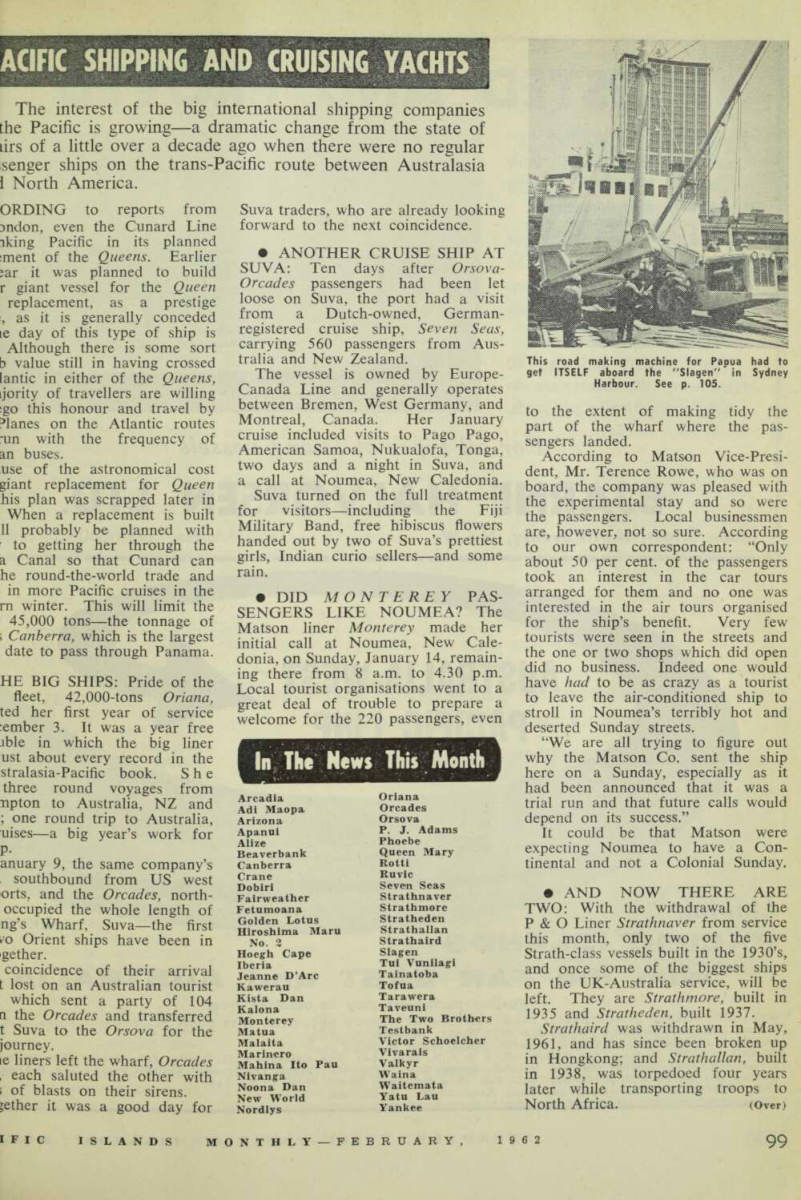
This road making machine for Papua had to get ITSELF aboard the "Slagen" in Sydney Harbour. See p. 105.
laver is the oldest of the five having been built in 1931; smallest —at 22,270-tons —by of hundred tons. She was 3f the P & O vessels to come ill white with buff funnels. ’ the vessels of the line had :k hulls and stone super laver originally had three Dut after post-war refit she with one less. One of her time tasks was to transport tralian 2/4 Battalion and tops to the Middle East in to. tiled 350,000 miles on war returned to her peace-time 1948, becoming a one-class 1954 with the introduction * post-war ships like Iberia idia. s, three years older than er, and another veteran of Australia service is also being n this month.
Stralia’S Biggest: The
hip yet built in Australia inched by Dame Patty wife of the Prime Minister, ; shipyards of the Broken Co. Ltd., Whyalla, South , in January. She is a n super tanker, P. J. Adams, the order of the Ampol i Co.
'Anga Handed Over:
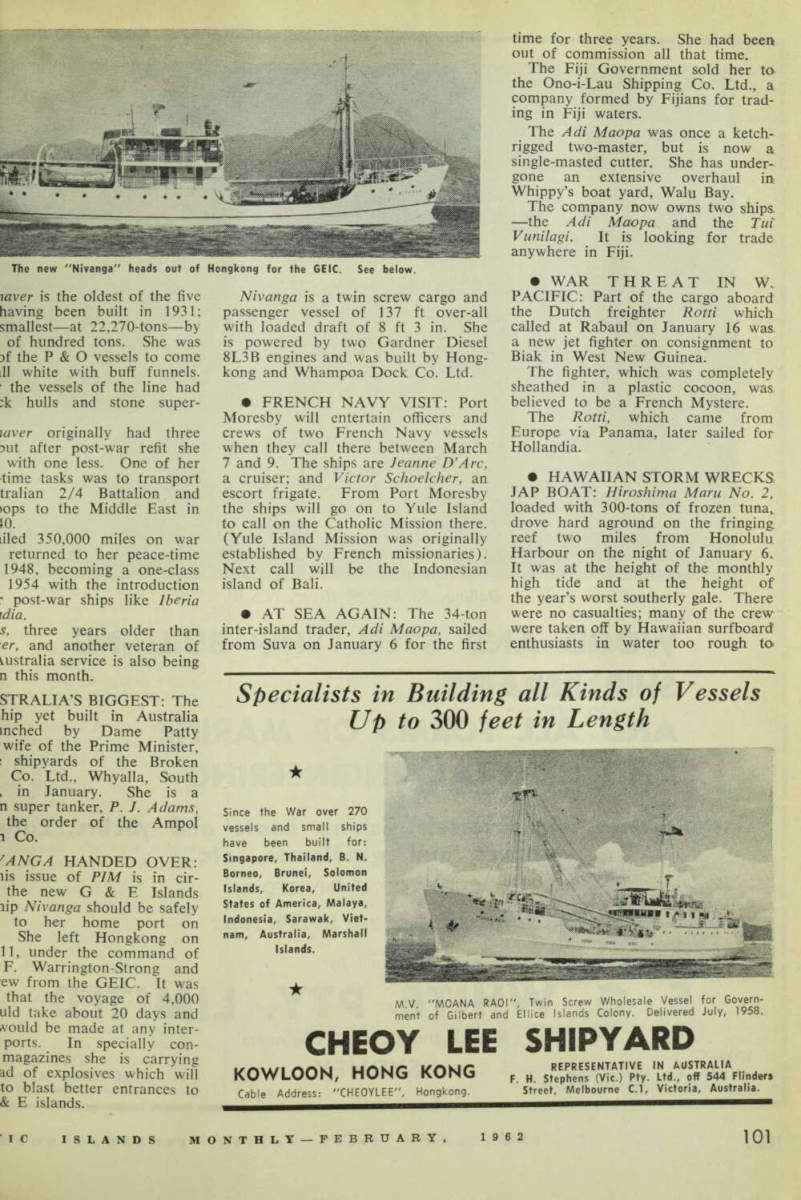
lis issue of PIM is in cir the new G & E Islands lip Nivanga should be safely to her home port on She left Hongkong on 11, under the command of F. Warrington-Strong and ew from the GEIC. It was that the voyage of 4,000 uld take about 20 days and vould be made at any inter ports. In specially con magazines she is carrying ad of explosives which will to blast better entrances to & E islands.
Nivanga is a twin screw cargo and passenger vessel of 137 ft over-all with loaded draft of 8 ft 3 in. She is powered by two Gardner Diesel BL3B engines and was built by Hongkong and Whampoa Dock Co. Ltd.
• French Navy Visit: Port
Moresby will entertain officers and crews of two French Navy vessels when they call there between March 7 and 9. The ships are Jeanne D’Arc, a cruiser; and Victor Schoelcher, an escort frigate. From Port Moresby the ships will go on to Yule Island to call on the Catholic Mission there. (Yule Island Mission was originally established by French missionaries).
Next call will be the Indonesian island of Bali. • AT SEA AGAIN: The 34-ton inter-island trader, Adi Maopa, sailed from Suva on January 6 for the first
time for three years. She had been out of commission all that time.
The Fiji Government sold her to the Ono-i-Lau Shipping Co. Ltd., a company formed by Fijians for trad ing in Fiji waters.
The Adi Maopa was once a ketch rigged two-master, but is now a single-masted cutter. She has under gone an extensive overhaul in Whippy’s boat yard, Walu Bay.
The company now owns two ships —the Adi Maopa and the Tui Vunilagi. It is looking for trade anywhere in Fiji.
• War Threat In W.
PACIFIC: Part of the cargo aboard the Dutch freighter Rotti which called at Rabaul on January 16 was a new jet fighter on consignment to Biak in West New Guinea.
The fighter, which was completely sheathed in a plastic cocoon, was believed to be a French Mystere.
The Rotti, which came from Europe via Panama, later sailed for Hollandia.
• Hawaiian Storm Wrecks.
JAP BOAT: Hiroshima Maru No. 2, loaded with 300-tons of frozen tuna* drove hard aground on the fringing reef two miles from Honolulu Harbour on the night of January 6.
It was at the height of the monthly high tide and at the height of the year’s worst southerly gale. There were no casualties; many of the crew were taken off by Hawaiian surfboard enthusiasts in water too rough to
The new "Nivanga" heads out of Hongkong for the GEIC. See below.
)ver a week later efforts were ag made to keep the cargo ted, but hope was fading that hip or the cargo could be Salvage operations by the US uard were seriously hampered lage problems, with all com on during the first day being an by international code flag lations as to the cause of the ig were also confused. The is attempting to enter Kewalo , a small harbour about a )m Honolulu with a poor that is impassable during 1 storms. The actual ground 'ever, was over a half mile channel. The crew is being id as Japanese vessels pass Honoluluans have noted that shima, named after the atom city, now rests close to the ulk of the battleship Arizona, tombs many of the casualties •st day of the Pacific War.
)Rmal Inquiry On
)ING: The Fiji Marine icided on January 4 that a 3urt of inquiry was necessary jdient into the stranding of Lau on a coral patch in a Balavu lagoon, Lau, on 4.
The Board announced this after a preliminary inquiry when four mem bers of the crew gave evidence. The Board gave no reason for its de cision to send the case on, but a conflict of evidence was probably one of the reasons.
The Master, Andre Vuibureta, said it was daylight at the time of the stranding, 4.50 a.m.; but the Mate, Netani Dauvere, said it was still dark.
The ship at the time was travelling at full speed.
The Yatu Lau was on the reef till 6.30 p.m. on January 9, when she was refloated. She was then towed
back to Suva by Tainatoba, arriving January 14.
According to one official estimate the repair bill to Yatu Lau will be something like £6,000 or £7,000. She is owned by the Fijian Affairs Board for Lau Province.
• Speed-Up Of Nz Ships: The
Union Steam Ship Company has de cided to increase its services to the Pacific Islands from New Zealand and Australia. The Matua, which previously operated to Wellington and Lyttleton from Island ports, will now go only as far as Auckland.
She will thus be able to operate, in conjuction with Tofua, a fort
r service to the Islands from md. To compensate for the the Matua service to southern )rts, the company will run a ■ monthly service with Tara vhich, in addition to taking in on and Wellington, will call tedin and Napier, he islands, Tar aw era will call toka, Suva and Apia.
Waina and Kawerau will main :gular monthly services from irne and Sydney to Lautoka, Apia and Nukualofa, and to Auckland, before return- Australia.
Ll Or Nothing In P-Ng:
irns Philp Line Malaita had a r of about three weeks in in January so that the sailings >s on the Sydney-Papua-New service would be staggered a Even so, six of the eight largest f this run were scheduled to Sydney northbound between ' 12 and January 31. use of this pile-up of ships, were complaints from some •y ports during the month. „ae it was reported that there I vessels in and out of port in istmas-New Year period when 6,000 tons of cargo were all added up to confusion— ertime to be worked and great put on cargo handling and facilities. The task was not ny easier by the fact that an stoms shed had been pulled jst before the rush started in tion for building a new shed, about every ship that trades the Territory visited Lae dur ; period—followed by the in lull. It is always a feast or le with Territory shipping, al with more and more shipping in those waters the famines •tainly getting less frequent, whose main job is carrying can’t stick to hard and fast “s in the face of variable conditions and the only real i to a pile-up of ships is more
and better wharves and more and bigger cargo sheds. (Which requires more and more millions from Aus tralian and Territory taxpayers.)
• Suva Business Men On
WARPATH: Members of Suva’s Chamber of Commerce were in a complaining mood at their January meeting—firstly about the “filthy wharf”, and secondly about the re pair quay at the new Government slipway.
It was suggested that as the Cus toms Department “had men sitting down doing nothing” it should be re sponsible for cleaning up the wharf instead of leaving it to the Harbour Master’s staff which “had enough work to do attending to ships”. (Cus toms Department reply not recorded.) The new repair quay at the slip way, which was also discussed, had only a depth of 10 feet alongside, members complained, although it was supposed to accommodate local vessels up to 1,000 tons. “It is ob vious,” said a C of C member, “that a 1,000 ton ship won’t go into a 10 ft. berth unless it is a flat-bottomed barge.”
The quay had been built under the direction of Wilton and Bell, consulting engineers employed by the Government. They had sent a man out to Fiji to see what was required —and this expert, in turn, had been advised by the Government what was wanted.
• BEETLE BATTLE: Proposed measures to try to keep rhinoceros beetle pest out of the main copra producing areas of Fiji will likely, if adopted, make things more difficult for local shipping.
The beetle is established only on the main island of Viti Levu and one or two small islands off the coast.
The Board has proposed the estab lishment of a series of “scheduled ports of departure” at which all vessels going to non-infested islands would be inspected before leaving.
A special effort would be made to reduce the beetle population in the vicinity of the ports.
The Board is also considering ac quiring a patrol boat to check clear ance certificates of vessels going to non-infested islands.
• They Just Drove It On:
F. H. Stephens Pty., Ltd., shipping agents, used a new method to ship a giant road-making machine to Papua recently on the 750 ton vessel Slagen.
There was no floating crane at Circular Quay, Sydney, where the ship was loading, and the vessel itself didn’t have the gear to lift the 16-ton machine on board.
The problem was solved by waiting till the tide brought the vessel’s deck and the surface of the wharf to the same level. A bridge of planks was then laid between the wharf and ship and the huge grader driven onto the vessel.
The picture on page 99 shows the machine just after it went on board the Slagen. It is now doing road making work at Oro Bay in Papua.
• Fishing Industry For
RAROTONGA?: For some time the Cook Islands Government has been considering long-line tuna fishing with a vessel based at Rarotonga. They have even considered importing
On The
Reef
High and very nearly dry is the "Koyei Maru No. 2" on the Beqa Reef, three miles from Stuart Island, Fiji. The "Koyei Maru" ran aground last November and had to be abandoned by her crew. Photo was taken recently by Capt. S. B. Brown, of the "Maroro".
Gets There
Faster
Some Bainings planters are finding it easier to travel to Rabaul now — like Sandy Kerr, pictured, who bought a fast motor boat and cut down the travelling time by as much as three-quarters.
se to teach local fishermen lethods. d Foods, Ltd., who are at canning orange, pineapple >mato juice, had stated that •e interested in including tuna ■ activities and experiments are ► commence. f in the New Year the auxiliary iren is to be put at the disposal beries Inspector Ron Powell short period of experimental the equipment for which has nported from Japan, tonga must be one of the most ved islands in the Pacific and pplying the local market could quite profitable for a small r. But first catch your fish— I the locals maintain that the t aren’t in the waters around ja and to fish further afield entail a considerable capital ent. Just how much can be by the proposed couple of fishing is debatable—while a : fish may be caught one week lay be little or none the next, versa.
L Vessels In New Zea-
Recently purchased Co e’s vessel, Dobiri, previously ?y Capt. Hugh Williams, made trip to NZ in December. She main in Auckland for the le season, probably returning tonga in March, in Auckland at present is rown’s Apanui. This vessel icky escape from misadventure when she had an engine wn off Manihiki and drifted irds the island. Fortunately ither was very calm and an was able to hold her clear eef while repairs were carried er Brown, who was Master on but who has not been taking ships to sea for some years, me trouble on the return in finding Aitutaki. Eventually ed out the sights with the aid dpper on the Taveuni, Archie g, contact being by radio.
Rwo Brothers In
LE: Christmas was late this the 15 passengers in the 45- Hebrides fishing vessel The others, and for people on Epi re expecting Christmas sup her. le way north from Pila on -r 22 she lost her rudder in :as off Nguna and passengers be landed on another island; ys before that her starter iad burned out in the same
area and she had to be towed back to Vila by the Alize.
• The Navy Dropped In:
Ziz-zagging about in the Pacific in December and January was Her Majesty’s Royal Navy frigate, Crane.
She visited Ocean Island on Decem ber 15, two of the Ellice Islands on December 20 and 21, then went on to Fiji* Tonga, the Cooks, Samoa, Christmas and Fanning Islands before heading home to England. She carries seven officers and 166 men.
• Ran And Usn Exchange:
The second RAN officer has been selected to work with the United
States Navy. He is Lieutenant-Com mander I. K, Wilson, who joined the US Pacific Fleet in January. In ex change, the RAN will get a USN helicopter pilot. It’s part of an ex change plan between the two navies —the first RAN officer to go to the USA was Lieutenant-Commander G.
J. H. Woolrych who’s been at the USN’s Anti-Submarine School at San Diego for 18 months.
• Danish Expedition
Baulked By Indonesia: The
Indonesians, who still see the Celebes and Moluccas as a jumping off place for an invasion of West New Guinea, have caused an alteration in the plans
5 Danish Expedition in their loona Dan. The vessel arrived >aul. New Guinea, on January re the leader of the Indo-Pacific ition, Dr. Mogens Koie, said ey had been refused permission rate in Indonesian waters. The n scientific team of botanists, Ists, ornithologists and a film er had intended using the s as a base for investigations ck of co-operation from the ities had resulted in a switch v Guinea. At first it had been id to go to Biak, in West New l, as planned originally but n fears had resulted in the ig Committee in Denmark g Rabaul. vessel left for New Hanover mary 11 and will stay there weeks before returning to to plan the next step in the ir expedition. details of the expedition were in PIM of July, 1961. The is schooner Noona Dan is by the Lauritzen Shipping Co., imark, and it has been made le, with Captain and crew, free t to the expedition for two The same company owns the Dan which has been made le to Australian Antarctic ions in recent years.
Ew Bank Line Ship: The
,ine recently took delivery in a, UK, of a new 12,140-tons jssel which has been called i k. is one of a number of vessels : on order for Bank Line Ltd. s are William Doxford and shipbuilders) Ltd. it the same time an older Bank jp, Beaverbank, was uplifting •d 1,600-tons of copra from , Gilbert & Ellice Islands
[Sheries Experts Meet;
vey the progress of the last s, 14 fisheries experts from 10 territories will meet at South Commission headquarters ebruary 5 to 13. ast SPC Fisheries Conference Id in Noumea in 1952 when lecided, amongst other things, ►int a technical officer. The J officer, appointed in 1954, . H. van Pel, who served with iccess. He resigned in June, md died shortly after. His will form the basis of dis at this month’s talks.
Ait Em A T A Court
N: The collision of the ata of the Union Steam Ship
Company of New Zealand with the Norwegian freighter Hoegh Cape off the Northern California Coast last October 26 has resulted in two actions being brought in the Admiralty Court at San Farncisco.
Owners of both vessels have filed suit in Admiralty of the Federal District Court seeking, each from the other, $400,000 in damages.
The freighters collided in dense fog.
Both caught fire, but none of the total of 101 crewmen was injured.
In its damage action, the Union Steam Ship Company alleged that the Hoegh Cape had “turned off its radar sometime before the collision”.
The suit also alleges that the Nor wegian vessel had no lookouts and was travelling at excess speed.
The New Zealand firm alleges that the Norwegian owners of the Hoegh Cape operated an unsea worthy vessel because “the officers and crew could not understand one another”.
Officers of the vessel were Norwegian, the suit says, and crewmen were Chinese.
The Waitemata’s owners said that their ship spotted the Hoegh Cape when it was 10 miles away on the radar screens. The Admiralty suit says that the Waitemata reduced speed, then stopped its engines.
The Waitemata, the suit says, was actually backing way when the collision occurred.
Both ships—the Waitemata in bound to San Francisco, the Hoegh Cape, outbound—were assisted to San Francisco Bay by rescue vessels.
News of Cruising Yachts
• MARINERO, American yacht, owned by the Christensons was re ported in Auckland, New Zealand, early December, just arrived from Tonga and points north. They intend to stay three or four months, finding the hospitality “beyond belief”. • NEW WORLD, owned by Gerda and Bill Graebor, who also think New Zealanders are tops, is at Whangarei, North Auckland, where they have had the yacht slipped again to try to cure a leak. (It’s a repeat of the same sort of treatment for the same sort of complaint they had previously in Nukualofa and Suva.) They may sail across the Tasman this month, but when last heard from had jobs ashore. • YANKEE, famous world cruis ing brigantine once owned by the Johnsons ( PIM January), was in Rarotonga, Cook Islands, just before
nas. She is now owned by i Mike Hurst, who operates the name of Windjammer Inc. with this and three other :rs which run out of Miami to hamas on 10-day cruises. is the Yankee’s first round id cruise under his ownership h she made seven with the is. Skipper of Yankee in the cruise is Captain Arthur Kim- He has 22 paying crew mem nging in age from 16 to 79 irried one of them en route, s one of the reasons why he this cruise is more than ly successful. After Raro- Yankee went on to Palmer md and East and West Samoa. 9 RDLYS, the American 71 ft. schooner well known in the Seas (it was originally built ister Bowles of New York), Russell, NZ, in January, from n a year’s cruise to the Pacific tarted from Newport Beach, iia, last August. It’s a two affair. Owner E. W. De (a Portland business man) is ; wife and their five children, ; brother-in-law, Del Rada his wife and three children. crew of three acquired in toll complement is 15. Crew s are Larry Nilsen, Harold > and Nigel Short. Short is ustralia; Stephens is a writer i collection of articles and tries around the world. Nilsen to Tahiti on the Phoebe, y Commander E. K. Watkins, i Africa, who sold her when ill. Larry was to sail to Los for the new owner, but she nasted 600 miles northeast of and reached the Tuamotus ry rig. She was later shipped ma. iIRWFATHER, also Ameri d arrived in NZ ex-Suva in Owner-skipper William is assisted by his wife, three laughter and two crew mem hey expect to stay around d for the next six months so inger children can go to or a while.
IMARANS—Most people by /e heard of catamarans but r e leave New Zealand (where i to be doing most-business ith), we have to report the ice there of a “trimaran”— idging by a photo, looks like more or less than three boats )gether. me was built locally in Auck
land by Mr. Vic Rogers who launched her in early January and expected to set off across the Tasman in February on the commencement of a five years’ world cruise. Named Ruvic, she is 28 ft. 6 in. long and carried 430 sq. ft. of canvas on the day of her launching—which was in gale conditions. The result of this was that the mast was soon lost. This is not expected to delay departure. • GOLDEN LOTUS, newly-built, Hongkong junk owned by New Zealanders, left Hongkong on December 2 and was in Singapore in early January preparing for next leg of
journey which is supposed to be down the Indonesian islands (Dr.
Soekarno permitting), Thursday Is land and Suva. • KALONA, 39 ft. LOA cutter was dismasted 2,200 miles outward bound from San Francisco towards Tahiti during January. The hired crew, consisting of Skipper Cliff Slater (English), Pierre Flyte (French), and Tony Carter (Ameri can), blamed a faulty spreader and lower shroud failure. They jury rigged the boat with spinnaker spars and reached Honolulu in good order, with the emergency rig showing
e of excellent seamanship, jsel’s owner, a San Franciscan, tended joining the boat in \AHINA ITE PUA, a Tahiti left Honolulu in January, towards the Marquesas and it reported putting back to i, Maui, with persistent sea aboard. George Horvath, ind skipper, had recently com milding the boat himself. His was his crew. Present plans arted uncertain, but they will y set out again.
ETUMOANA, Port Moresby ailed by Dr. E. S. Elkington . Edward Price, got to Aus >r Christmas, but not exactly way the owner had planned, ft Port Moresby on December ompany with a third Port f man, Mr. Kevin Reid, who ded for medical treatment in ;, and all went well until in ly hours of December 13 jar Cook’s Passage, 200 miles f Cairns, they hit a reef, wn they managed to pull the f into deep water and take the situation. They had the af taking the vessel out the ay they entered and chance he same reef, or of heading a Lizard Island which they e in the distance. decided to head for the is aid Dr. Elkington in Cairns ater: “At this stage our ketch ing so badly we had to travel ninutes and then bail for 20 even with the motor pump 11 speed all the time”. They Lizard Island that day and lext morning sighted a tanker aaged to attract its attention rror flashes and safety flares is time Reid was very ill and nedical attention. The tanker ifeboat off and collected the i but Elkington and Price re with the ketch. were getting her into the ain when a local fishing boat mg to investigate the obvious around Lizard Island and umoana in tow. By the time y had reached Low Woodie ae fishing boat herself had trouble and the tow was aver to another local vessel, , which finally brought the to Cairns on December 18. na’s hull is pretty badly id will need some extensive efore she is seaworthy again.
LKYR, 25 ft yacht owned
and sailed single handed by retired British Army Major Adrian Heyter, now a new New Zealander, should be Cl^C an Y hme now. He lett Balboa, Panama Canal Zone, and CX 5 eC !u ma * ce caPs at Galapagos and the Tuamotus before heading x?v th TT t 0 , home port of Nelson ’
NZ. He bought the yacht in the UK and left there last June. He hopes to be m NZ by March.
Hayter has made other lone-hand voyages—which he has recorded in his book, Sheila and the Wind. He says he prefers lone-handing because “I don’t have to worry about putting up with somebody else”. Which is just as good a reason as any—but he isn’t altogether a misanthrope, has his lighter moments and a wife and
family in Nelson, to where he migrated some years ago. The reason why he is doing the Pacific crossing i n a hurry is the restrictive currency practices of his adopted country—the yacht cost him more than half of the £Stg.Boo that the NZ Government let him take abroad. • GEIC REGATTA: The first regatta to be held at Tarawa for many years, took place at Bikenibeu on January 13. Local reports described it as “most successful”, Spectators watched open, challenge and obstacle races for sailing boats and power craft from a large canopied flat top. In the evening a string band went aboard the flat top to provide music for dancing.