Hollandia Sweats Behind The Old Invasion Beaches
pp. 76-97 · Read in the full issue
Old Invasion Beaches
The day starts early in this capital of the Dutch half of New Guinea, subject of mounting tension over Indonesian in tention to “ liberate ” it.
GOVERNMENT officials are be hind their desks by 7 a.m. and the banks are open at 7.30 a.m., housewives are out shopping by o a.m. in smart, recently built little shops near the town centre.
They have all begun work before the temperature and the humidity begin their implacable daily rise. By 10 a.m. it is possible to be bathed m perspiration by just standing still somewhere in the shade.
Physical activity for residents, and particularly for visitors, invites a torrent of perspiration, wringing of handkerchiefs and scarlet faces.
This probably explains why all work ceases for the day at 2 p.m. and it is virtually impossible to rouse a Dutchman and his family from sleep between 3 p.m. and 6 p.m. when the town gradually begins to move again.
It has been a long working stretch with only a break of 15 minutes dur ing the morning for a sandwich after a breakfast of egg, salami, cheese, fruit juice, bread and jam or peanut butter and heavy black coffee.
Lunch then reverts to Indonesian food, a memory of the days when the
Dutch ruled the Netherlands East Indies, now neighbouring Indonesia.
The temperature is in the 90’s with near maximum humidity when the
Papuan waiters in the Governmfj Hotel come in with bowls of steair ing white rice. One is set in the cenli of each table and then each perse receives a silver dish of extras li curried fish, or a kind of steam steak, with chile pickle and otf Indonesian delicacies.
Lunch ends with fruit, and abo< 2.45 p.m. the town sleeps—like It rusting tracked landing vehid:
(Continued on p. 97)
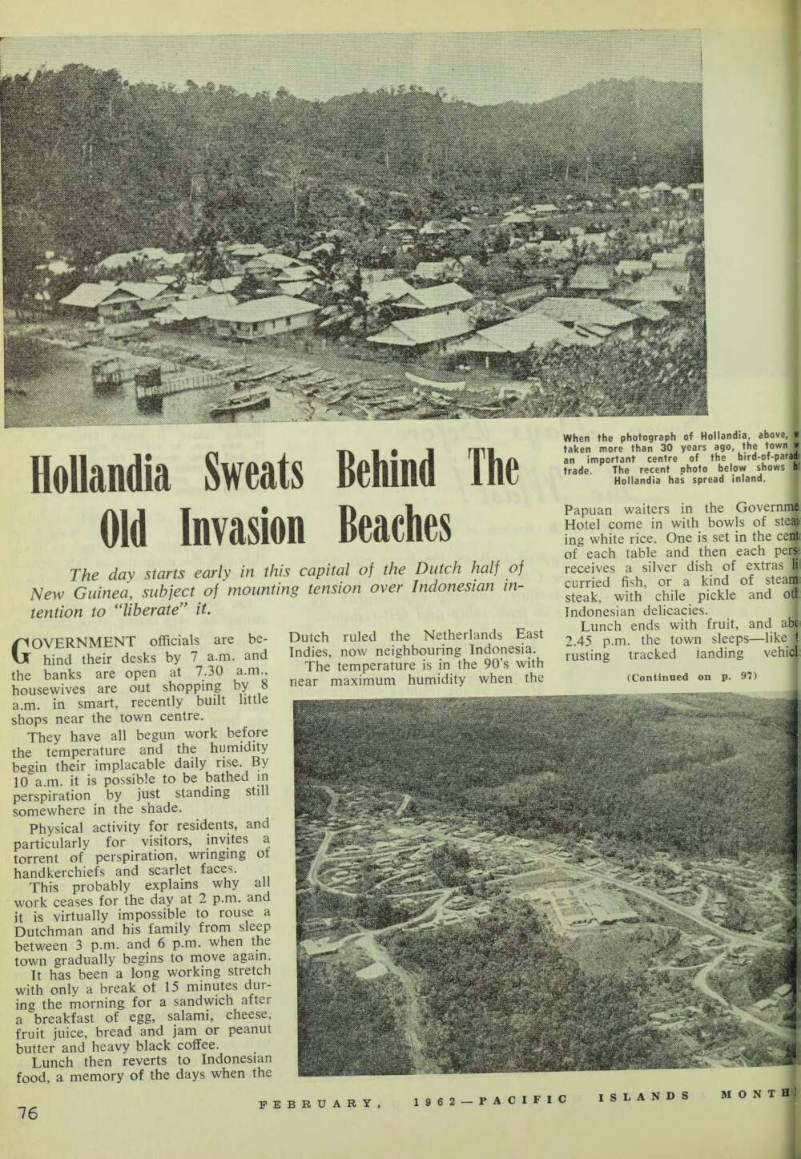
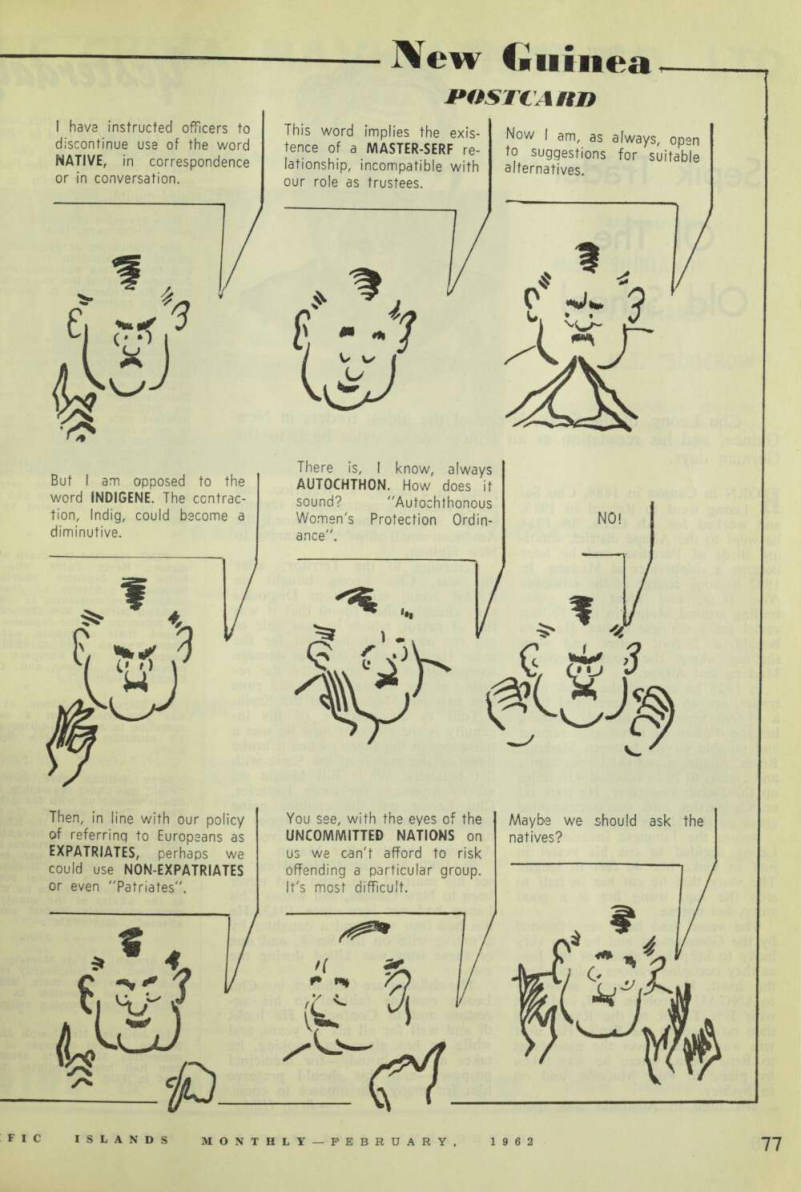
When the photograph of Hollandia, above,[?]
taken more than 30 years ago, the town [?] an important centre of the bird-of-par[?] trade. The recent photo below shows [?] Hollandia has spread inland.
1 and shell-pocked remnants of ashing allied invasion of Jap sfew Guinea in April, 1944. hidden by jungle these heavy >, in which men of the Ameri •ces died with the waves lap ic rear wheels, still dot the *irt sands of ’’lnvasion Beach”, )und the point from Hollandia IT. ng Dutch songs, little Papuan nd girls cram a school at In- Beach right beside the monu ommemorating the Allied land- April 22, after which General hur set up his Advanced Headquarters over the hill and to strike north from his new base G”, as Hollandia, decim n the landings, came to be for the time being, n they wake up late in the on the Dutch come out into
the gardens of the little homes in Hollandia. It is a town of seemingly little people. During the day the women shop and do the housework.
In the evening they can be seen with their husbands and children watering the garden or strolling in the cool.
Hollandia must be one of the very few places in the Far East and South east Asia where servants are few.
Housewives say it is because the Papuan is not inclined to work. Some girls come in to do house cleaning more out of curiosity than anything else and go off again when they have had enough. Washing machines and other work-saving machines of the house are common here.
There are few big cars. Mostly they are the small ones chosen by the family man of France or Italy. Many men and women ride around on motor scooters.
Qn Sunday they go to Church, Organ music and hymns can be heard in the streets on Sunday morning and their Christian faith extends to meal times in the Government Hotel where families sitting around their individual tables may be seen to bend in grace and cross themselves, Hollandia would seem to be a town of ordinarily decent folk rather upset at the fuss they find themselves in
volved in far from home.-
Aap.
Reuter.