Out Again
pp. 73-74 · Read in the full issue
Pacific Islands Monthly
Magazine Section
The Pearlers Are Out Again
From R. Boyd, in Rarotonga.
After four years of waiting, the people of Manihiki have been diving for pearl shell again. The Manihiki lagoon, in the northern group of the Cook Islands, was closed to divers in 1957 because shell was being seriously depleted. But it was opened at last in August and there followed three months of intensive activity.
MANIHIKI is said to be one of the prettiest atolls in the Pacific and certainly there can be few prettier sights than the pearling fleet sailing out to their selected spot in the morn ings.
White sails make a pleasing blend with the rich blue of the lagoon, while an odd dash of orange or brown from some not-so-conservative boat owner adds a delightful contrast. A backdrop of coconuts seven miles away across the lagoon adds the final touch to a fairy-tale picture.
Diving is carried out by skin divers and from machine diving boats.
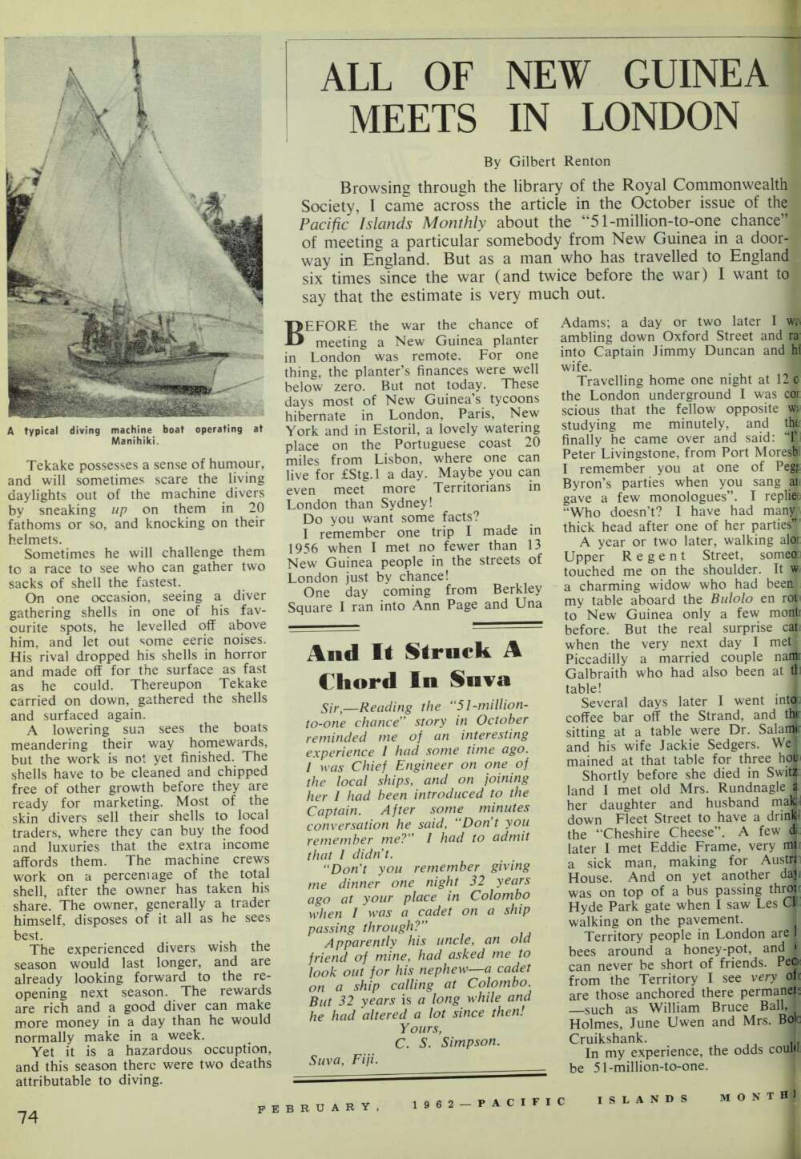
Machine licences are limited to six and operate in depths over 15 fathoms. Their boats are gaff-rigged cutters with short masts and long booms and bowsprits. Crew usually comprises seven men: two divers, a captain and four seaman-pumpers.
Divers wear a helmet and waist length diving suit. Air is pumped down to them from a hand-operated pump, the seamen working in pairs to keep up the supply. Each diver spends three or four hours fossicking in his underwater world, at home with the fish.
The skin divers generally operate from outrigger canoes, still with the traditional Polynesian rig—a single triangular sail with the apex at the extreme bow of the boat. The out rigger, of heavy wood, is always carried to windward so that it is necessary to reverse the whole thing to “go about”.
Dive Deep
Their sole diving aids are diving glasses (usually made by a local craftsman), a cloth glove to protect their hands from spikes of shell or coral, and a lead or iron weight to speed them to the depths. The weight is usually about 10 or 12 lb, but some divers use weights up to 20 lb. Gen eral practice is to have an assistant on the boat whose job it is to pull this weight to the surface after each dive.
Most of the divers operate around 12 fathoms, but quite a few go down to 20. The island’s champion diver, a giant of a man called Tekake Williams, has been down to 30 fathoms and stays down for about four minutes. I thought it was im possible until I saw him in action. (Over)
Tekake possesses a sense of humour, and will sometimes scare the living daylights out of the machine divers by sneaking up on them in 20 fathoms or so, and knocking on their helmets.
Sometimes he will challenge them to a race to see who can gather two sacks of shell the fastest.
On one occasion, seeing a diver gathering shells in one of his fav ourite spots, he levelled off above him, and let out some eerie noises.
His rival dropped his shells in horror and made off for the surface as fast as he could. Thereupon Tekake carried on down, gathered the shells and surfaced again.
A lowering sun sees the boats meandering their way homewards, but the work is not yet finished. The shells have to be cleaned and chipped free of other growth before they are ready for marketing. Most of the skin divers sell their shells to local traders, where they can buy the food and luxuries that the extra income affords them. The machine crews work on a percemage of the total shell, after the owner has taken his share. The owner, generally a trader himself, disposes of it all as he sees best.
The experienced divers wish the season would last longer, and are already looking forward to the re opening next season. The rewards are rich and a good diver can make more money in a day than he would normally make in a week.
Yet it is a hazardous occuption, and this season there were two deaths attributable to diving.
A typical diving machine boat operating at Manihiki.