R A New Corner Of The
pp. 63-69 · Read in the full issue

Vorld-Try The Sepik
By Lillian Schoedler
Are you an anthropologist, an ornithologist, orchid lover writer? Are you an amateur photographer, a collector of ds? Or do you like to play golf, bowls or tennis? Swim, or ?r ski? Go fishing or crocodile hunting? Or discover new ters of the world ahead of the crowd?
Wewak and the Sepik District er rich and happy hunting ak, the headquarters town, has ipean population of 670 (in- Army personnel) and is still enough to absorb the visitor own life, and make him wel town’s main residential area he flat top of a hilly peninsula juts strikingly into the Pacific East of this, a wide curve of ondnues against a background i mountains, with a nine-hole urse along the waterfront, and ng green next to its clubhouse, ach here offers one of the few ) be found in the Territory, in common with most Pacific has fringing reefs that prevent leaking on the beach. Further Moem, another good bathing has shaded picnic grounds, e facilities and dressing rooms, ween the two headlands is Bay, where the water ski club
enthusiasts with their own power launch (visitors welcome) meet on Sunday afternoons. It is possible to
hire boats for fishing; the town’s small shopping centre offers some bargains in Oriental and other wares; the Sepik Club offers hospitality to members and visitors and shows weekly movies. (Over)
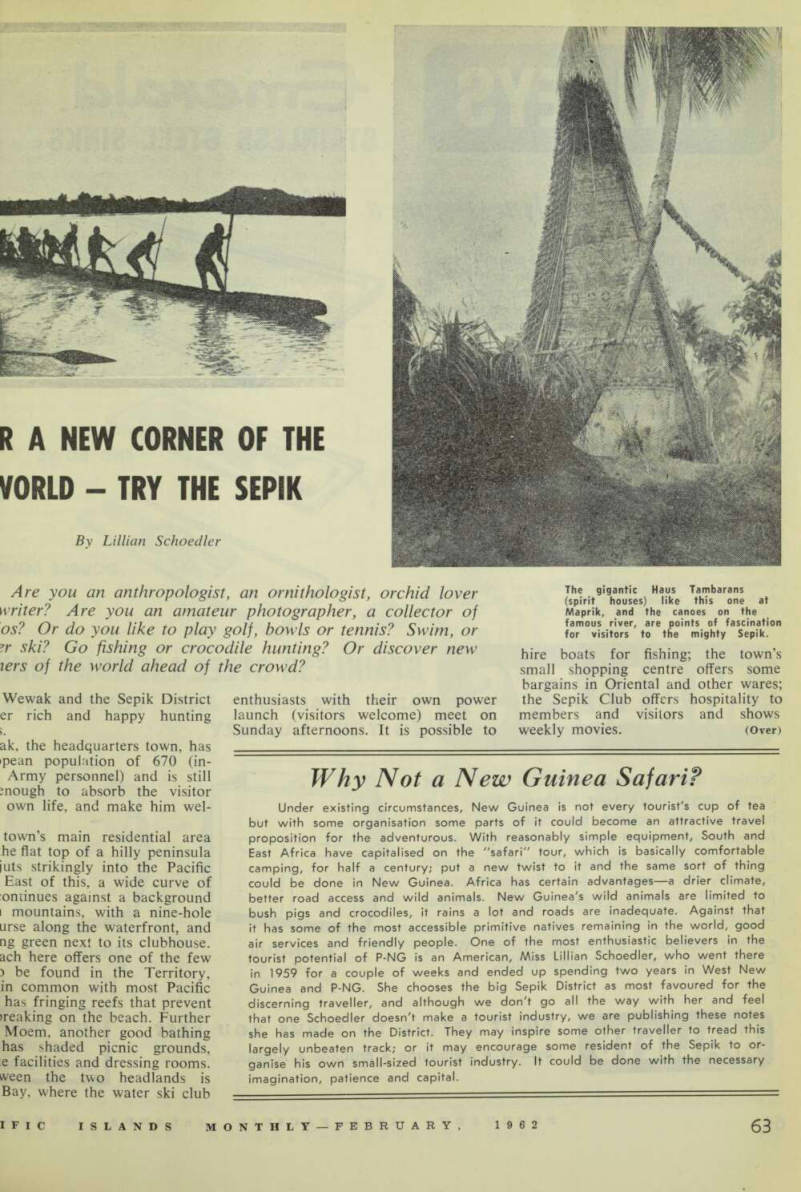
The gigantic Haus Tambarans (spirit houses) like this one at Maprik, and the canoes on the famous river, are points of fascination for visitors to the mighty Sepik.
ds are available for trips in town further afield. One drive with scenery and views runs around ase of the entire Wewak pen . Another extensive view over and sea is possible from a hill ookout where the Japanese had rchlight station during the war, le road to it is difficult, especi during the wet season. Other lead to native villages within rt radius of Wewak; and five out of town is the spot on the Peninsula at which, in August, the Japanese Lt.-Gen. Adachi 4,000 men surrendered to Maj.- H. C. H. Robertson. Anyone in ;d enough can reach it by native . Some day, if the bridges are inished, it will be possible to go id.
Three Hotels ivak is no exception to the Terri need for more and better hotel modation, but the area is for in having three small hotels— t Wewak, one at Angoram and t Maprik. The Wewak Point (tariff <£A3/5/- daily), is well i on the edge of a grassy tree -1 plateau overlooking the sea. oms are simple, without wash , but an adjoining modern bath md-shower unit has a Territory —hot running water! Rooms ic reserved well in advance, as s so frequently in New Guinea, are taken for long periods dministration personnel until an find living quarters of their Reservations should be verified (early specify exclusive occup -or you may find yourself with n mate. And you must be pre fer a “certain informality” in and for competition from the haracteristic of so many New i hotels). But this is no worse i pubs in countless smaller Aus mainland communities, and they are improved, are best i off to “local atmosphere”! er ships or planes can get you wak. Burns Philp’s Malekula 3,700 tons gloss, carrying 12 gers calls there irregularly er Papua-New Guinea cir ut of Sydney and Brisbane, stops also at Port Moresby, ii, Kavieng, Rabaul, Alexis- Madang and Lae. The Shansi ssengers) of the New Guinea lia Line also calls regularly, every seven weeks, on a round )yage from Sydney and Bris which includes also Port >y, Samarai, Lae, Madang, g and Rabaul.
TAA and Ansett-MAL have connections to Wewak from
anywhere in the Territory and from the Australian mainland via Lae and/ or Madang.
Wewak has easy plane connections also to and from all points in the New Guinea Highlands.
The 30,200 square mile Sepik Dis trict lies at Wewak’s back door, and Wewak is not only its administrative centre but also the principal take-off point for most parts of the area. Its main feature, of course, is the twist ing Sepik River, New Guinea’s largest, which winds so tortuously from its source near the Dutch New Guinea border to the sea that its entire 700mile course (500 of them navigable for small vessels) is contained in a corner of the Territory only 200 miles
wide.
Planes go from Wewak to Angoram in 25 minutes (£A9/18/- return), and to Ambunti (in 40 minutes, £AI3/19/return), both on the Sepik River; to Maprik (in 20 minutes, £AB/2/- re turn), with its picturesque tambaran houses, and to remote Telefomin (90 minutes). In addition, planes are avail able for charter.
Angoram, 68 miles up-river from the sea, is an attractive settlement on a low rise on the banks of the Sepik itself, with a sub-district office, a hospital, two mission stations, two sawmills, a clubhouse, a small golf course, and a good little hotel run by Peter and Meg England. Its varied and interesting residents include
Jile hunters and traders who ply yer. Trips on the Sepik in canoes >utboard motors can be arranged rious picturesque Sepik villages. >-day run up the smaller Keram a tributary, takes you to Goro and Kambot villages with their ive but picturesque jutting l houses. With an early start on cond day, a detour can usually :luded to Kamberamba, another village entirely built over water and with a life that is en aquatic. trip is made in a double -driven canoe, with a small ed shelter set on top for sun losquito protection. The canoe nned by two natives, one of runs the motor while the other, bow, wards off floating logs river grass. Crude overnight ■ is available at a reed-con d “House Kiap” on the river it Gorogopa; bedding and food be carried, but the hotel at am can arrange this. In 1960, £l5 for the two-day run.
Colourful Ambunti t)unti is 180 twisting river miles :am from Angoram, but only a air hop. Here the usual Sepik ids give way to low hills, on one of which are Ambunti’s □vernment dwellings. It is an istrative post and nothing else, w visitors go beyond. The next he patrol post at May River, ree-day boat journey upstream, little especially rewarding en Sometimes it is possible to the run between Angoram and iti in one of the small ships y up and down the Sepik from ig or Wewak, carrying supplies, schedules are unpredictable, eir passenger comfort negligible sy give the “feel” of the river, an experience are inexpensive
even if along most of the Sepik itself the natives are no longer picturesque or outwardly distinctive to the casual observer. Civilisation’s influence has brought the sloppy T-shirt and shorts or trousers in place of original native dress—or undress. Many of the tam baran houses (Haus Tambarans) along the Sepik have, unfortunately, been allowed to fall into decay. Fre quently their highly-decorated bark fronts have been embellished by photos of movie actresses or pin-up girls put up by the natives. Between Angoram and Ambunti—at Kanga naman—one of the best-preserved is still to be found, set back slightly from the river and not visible from it. It can be reached only by boat or canoe from Angoram or Ambunti.
Charming Maprik
Maprik (el. 600 ft) is one of the most charming inland centres in the entire Sepik area, perhaps in all of New Guinea. There is a dry weather, \ery rough road to it from Wewak but the usual transport is by air. An attractive Dutch-born couple, Roy and Toos Peters, run a home-like small hotel set under enormous spreading rain-trees near the airstrip (daily tariff £A3/10/-).
The best of the local Haus Tam barans is a three-mile jeep ride from Maprik, at Bainyik, where there is also a government agricultural station and a farmer-training school for natives. Maprik’s sport and com munity-minded residents have a tennis court and have utilised the airstrip as a golf course. Colourful carvings from Haus Tambarans, ceremonial and dance masks, etc., can still occasionally be found in or near Maprik, but are more easily available now from the headquarters of the Native Council, which collects and sells all sorts of native artifacts which range from the ethnologically valu-
[?]ik, "one of the most charming inland centres in the Sepik... and perhaps in all New Guinea..." Here is the Maprik Hotel.
to frankly tourist pieces. On k’s many back roads older s often still roam completely th from Maprik a road leads 30 miles to the little settlement twi on the Sepik River, This is d take-off place for a day’s run to the charming Chambri though this is not an easy trip mge. In one corner of the Lakes, om, a unique and much-sought type of pottery is made and y the natives—one of the few ; in all of New Guinea for this )f handicraft.
To Telefomin taps the best flight of all out wak, if the weather is clear, Telefomin on its 4,700 ft i in the remote mountains be he Sepik Valley. A “restricted” ntil very recently, it can now ted freely either on a day-re ight from Wewak, or for a stay if private accommodation arranged. (There are no public :s). Even during a short stop airstrip, however, you can get pictures of the natives, un xcept for the curious phallo which are characteristic of the and a photograph also of the lent and plaque in memory of young Australian patrol , Harris and Zarka, who were ed by the natives there in 1953. r trip from Wewak is rather ve (£A3I/10/- for the return but it offers some of the most /e views over the Sepik basin, redible windings of the Sepik and on a very clear day, even snow-covered tip of Mt. Juliana e border in West New Guinea.
Sepik District has over 50 strips—most of them for light
aircraft only—and there are other flights by chartered aircraft than those mentioned, for example, to Lumi, a rugged and beautiful patrol post inland; and to Aitape and Vanimo on the coast north of Wewak. Wewak is also on the regular trunk-line air service between Lae, in Australian New Guinea, and Hollandia in West New Guinea. r _, ■ • • 11 tie Administration is not pushing tounsm in the Territory, nonetheless, the District Commissioner’s office in Wewak will be glad to answer any questions about the Sepik District from visitors, either before or after they arrive in the Territory.]
II
industrial Development
n Tnnna 'unyd Work is now under way with the clearing on an area of land south present Tonga Copra Board and Construction Co. at Havelu, near Nukualofa.
This extension of the industrial area used for factories to extract coconut oil for soap manu facture and for the manufacture of tins for desiccated coconut; the manufacture of hardboard and the making of coir from coconut husks for use in mats, rope, twine, brushes etc.
[?]s interesting Christ the King Cathedral, of P-NG's largest churches, was [?]ed in 1958 by Divine Word missionaries [?]place one built from wartime scrap.