Fountains Are
pp. 55-57 · Read in the full issue
Stydneysider At Home Base
Fountains Are For Art’s Sake
Whether to fount and where to fount has been the question in Sydney since a late model Lord Mayor went overseas a few years ago and came back with the idea that our city should be turned into a water
garden.
IT was this same Lord Mayor who was carried away with those hanging baskets of flowers that festoon Oxford Street, London (or “festooned”, past-tense; they were missing from London last summer). Sydney got its baskets of petunias—great prospecting-dishes full, hanging in threes from tripods along the Elizabeth Street side of Hyde Park. The fountains took a little longer, but in 1961 the deliberations of the 1958 Fountains Committee began to bear fruit.
Unfortunately, Sydney suffers from the same dis advantages fountain-wise as London: No town-planners were present at their birth and they, Topsy-like, just grew, minus the open plazas and squares of most Continental cities, their streets long, narrow, off-square or boomerang-shaped.
Add, in Sydney’s case, the strong, saving nor-easterly sea-breezes of summer; the blustering westerlies of winter; and the cool-change, wild southerlies of any season, and it will be seen that a fountain in Sydney needs space if her citizens are not to get a bath every time they move within 100 yards of it.
The Famous Archibald Sites have to be made, searched for or simply popped into one-block-wide, four-blocks long Hyde Park, in the centre of the city. Hyde Park got its first real fountain in 1932 as a memorial to Jules Francois Archibald, founder and editor for 25 years of the Bulletin. (He died in 1919.) It is a classical piece, in bronze, depicting Apollo, Diana and a minor god, with the traditional fixings of lutes, bows and arrows, stags, turtles, hounds and other livestock, which spout in appropriate directions to give the bronze gods their water sheen. Generations of university students have played pranks with it; small boys have relieved the heat of summer by occasionally bathing in it; and country visitors have gazed upon it, slightly bemused by the allegory of it, even after reading the plaque that gives the explanation. (Over)
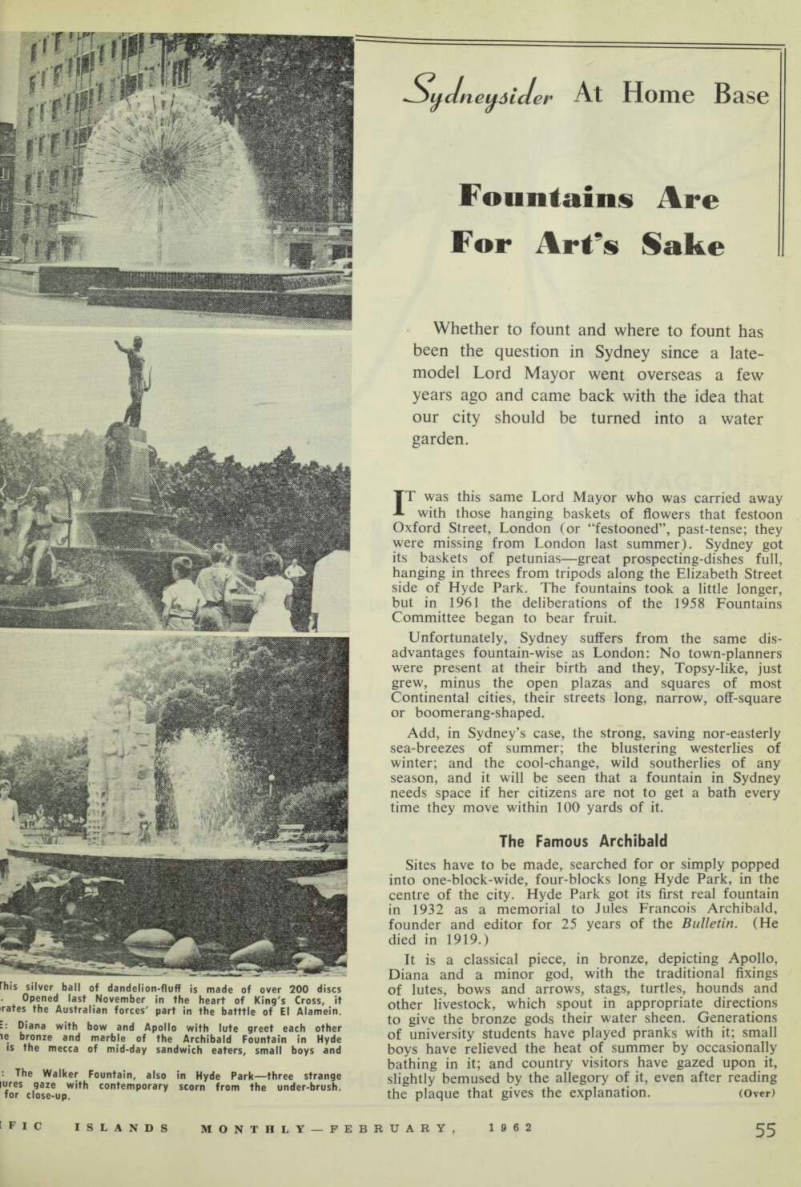
This silver ball of dandelion-fluff is made of over 200 discs Opened last November in the heart of King's Cross, it rates the Australian forces' part in the batttle of El Alamein.
E: Diana with bow and Apollo with lute greet each other [?]e bronze and marble of the Archibald Fountain in Hyde is the mecca of mid-day sandwich eaters, small boys and [?]: The Walker Fountain, also in Hyde Park —three strange [?]ures gaze with contemporary scorn from the under-brush, for close-up.
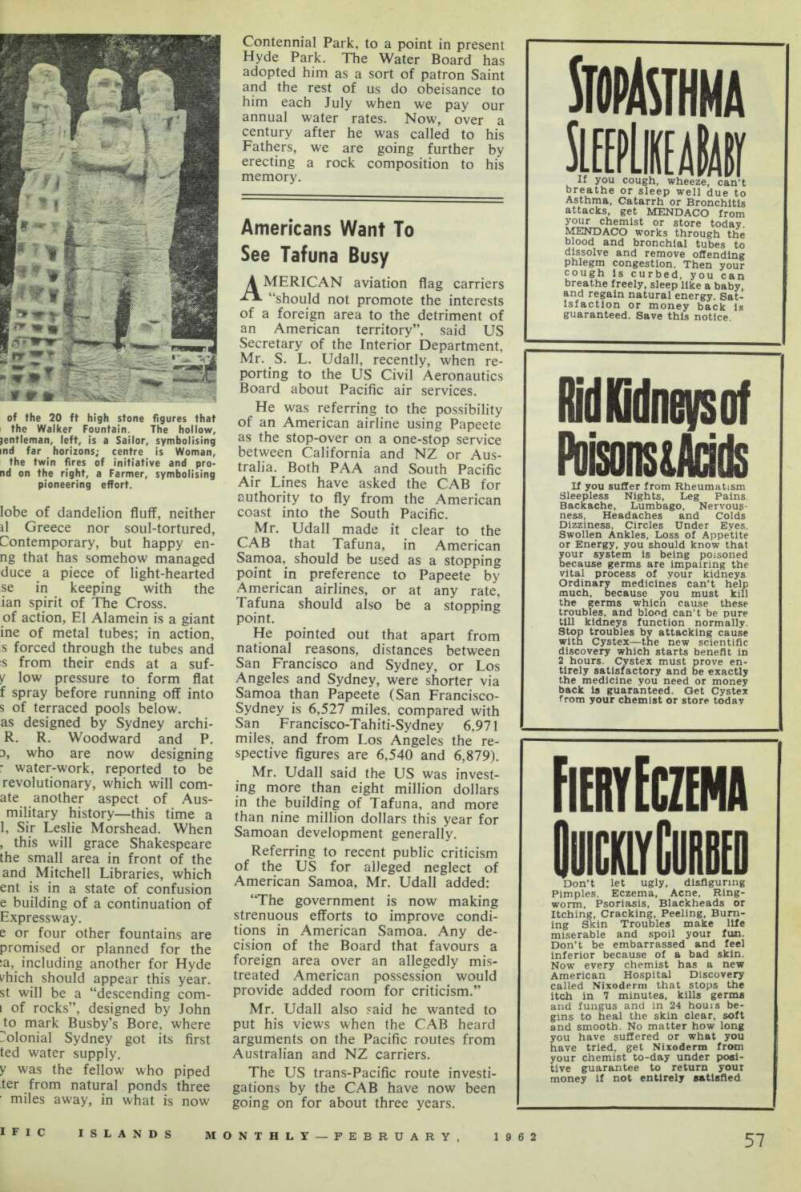
They may be even more bemud this year if they walk half a bl< southwards in the park and ca upon a second fountain, only c year old, and erected to the mena of one Frederic Joseph, pion member of the Walker family of \ State. It is a walk that takes 1 from the Glories of Greece, over grass and 30 centuries into a pi tree secluded nook that is press over by three, soaring, stone tot< pole figures.
After Greece a la Archibald, it the sudden impact of an sub-orbital landing on Easter Isla The fountain that goes with tl juxtapositioned figures is a moj spout of water falling into a saucer that empties itself on wa worn stones below. Its significj is dwarfed by the stone figures alo looking on from the background.] The whole thing was executed Gerard Havekes, and for those I don’t catch on immediately, ther an explanation on a bronze tablet! says: The Labours and Beauty of Pioneering Mankind are Depid by Three Figures— Water, Fire and Earth and i Flanking Font.
WATER —A Fisherman looking the sea and new horizons.
FIRE—A Woman, depicting Wot hood and Intuition, protecting Fire of Initiative and Progress EARTH —A Farmer, depicting pioneering efforts upon which country has developed. [There are other existing tri< and pools of water in Hide Pa like the ancient soot-begrimed I ber that dribbles water from a cei vase near the corner of Park St the painted pool of Aboriginal d< at the bottom of the garden to memory of Georges V and VI; the reflecting pool in front of War Memorial.] Dandelion Fluff at The Cro Sydney’s newest and most ta about fountain is El Alamein since November, has sat and water in silver circles at King’s C where Darlinghurst Road, Mai Street and Elizabeth Bay Road i It was opened by the Lord M; standing under a giant umbrelh the wettest Saturday in the w< spring that Sydney has produced century of weather recording.
But since the summer has i back, this memorial to the 2nd i Second World War North Af campaigning, has become a 2
lobe of dandelion fluff, neither il Greece nor soul-tortured, Contemporary, but happy en ng that has somehow managed duce a piece of light-hearted se in keeping with the ian spirit of The Cross, of action, El Alamein is a giant ine of metal tubes; in action, s forced through the tubes and •S from their ends at a suf y low pressure to form flat f spray before running off into s of terraced pools below, as designed by Sydney archi- R. R. Woodward and P. 3, who are now designing * water-work, reported to be revolutionary, which will com ate another aspect of Aus military history—this time a 1, Sir Leslie Morshead. When , this will grace Shakespeare the small area in front of the and Mitchell Libraries, which ent is in a state of confusion e building of a continuation of Expressway. e or four other fountains are promised or planned for the :a, including another for Hyde yhich should appear this year, st will be a “descending com i of rocks”, designed by John to mark Busby’s Bore, where Colonial Sydney got its first ted water supply. y was the fellow who piped ter from natural ponds three ■ miles away, in what is now
Centennial Park, to a point in present Hyde Park. The Water Board has adopted him as a sort of patron Saint and the rest of us do obeisance to him each July when we pay our annual water rates. Now, over a century after he was called to his Fathers, we are going further by erecting a rock composition to his memory.
of the 20 ft high stone figures that the Walker Fountain. The hollow, gentleman, left, is a Sailor, symbolising and far horizons; centre is Woman, the twin fires of initiative and pro [?]nd on the right, a Farmer, symbolising pioneering effort.