Celebrate Independence
pp. 47-51 · Read in the full issue
Happy Scenes As Samoans Celebrate Independence
From a Staff Correspondent in Apia Events in Apia, Western Samoa, from January 1 to January 5, ran true to programme planning, but not to history.
It was a very happy occasion, planned and conducted most successfully by the new Samoan Government.
THE attainment of independence by Western Samoa, on January 1, when the United Nations and the Trustee nation (New Zealand) grace-
fully bowed out, and the Samoans took over the government, was cele brated with fervour over five full days.
Samoans from all over the Western Group, and a large number from American Samoa, in the east, filled Apia to overflowing. Every class, Samoans, part-Europeans and Euro peans, joined in with zest.
For a week, the century-old, bay side town echoed to the joyful noises of singing, feasting and dancing. For a week, distinguished guests from all the countries bordering the South Pacific were lavishly entertained.
Apia’s famous Beach Road was not always so happily occupied.
It is not quite 100 years since it was filled with bitter fighting, while the armies of rival claimants to king ship slugged it out on the stark shingle beaches and in the lovely valleys, and the unburied dead lay where they had fallen. It is only 30 years since the last shootings in Apia, when the dead included High Chief Tamasese, brother of the distinguished man who
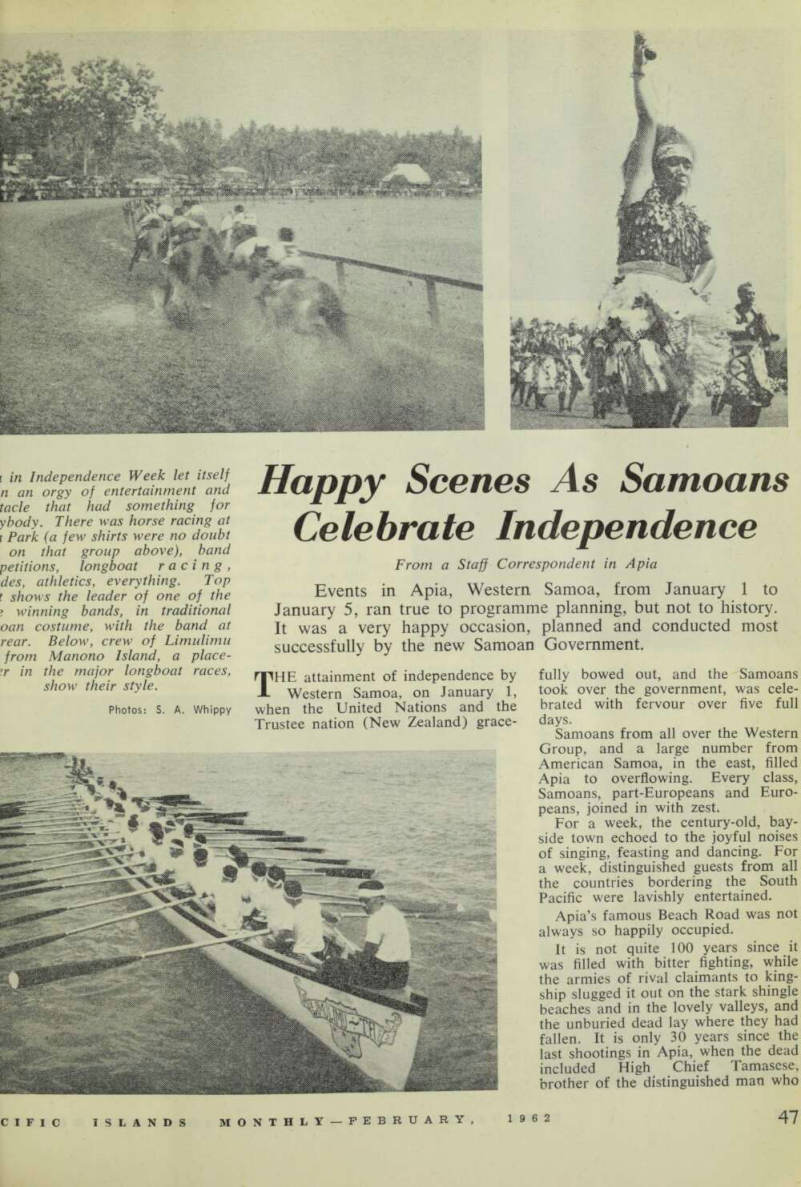
[?] in Independence Week let itself [?] n an orgy of entertainment and [?] tacle that had something for [?] ybody. There was horse racing at [?] Park (a few shirts were no doubt [?] on that group above), band petitions, longboat racing, [?] des, athletics, everything. Top [?] shows the leader of one of the [?] winning bands, in traditional [?] oan costume, with the band at [?] rear. Below, crew of Limulimu from Manono Island, a place [?]in the major longboat races, show their style.
Photos: S. A. Whippy
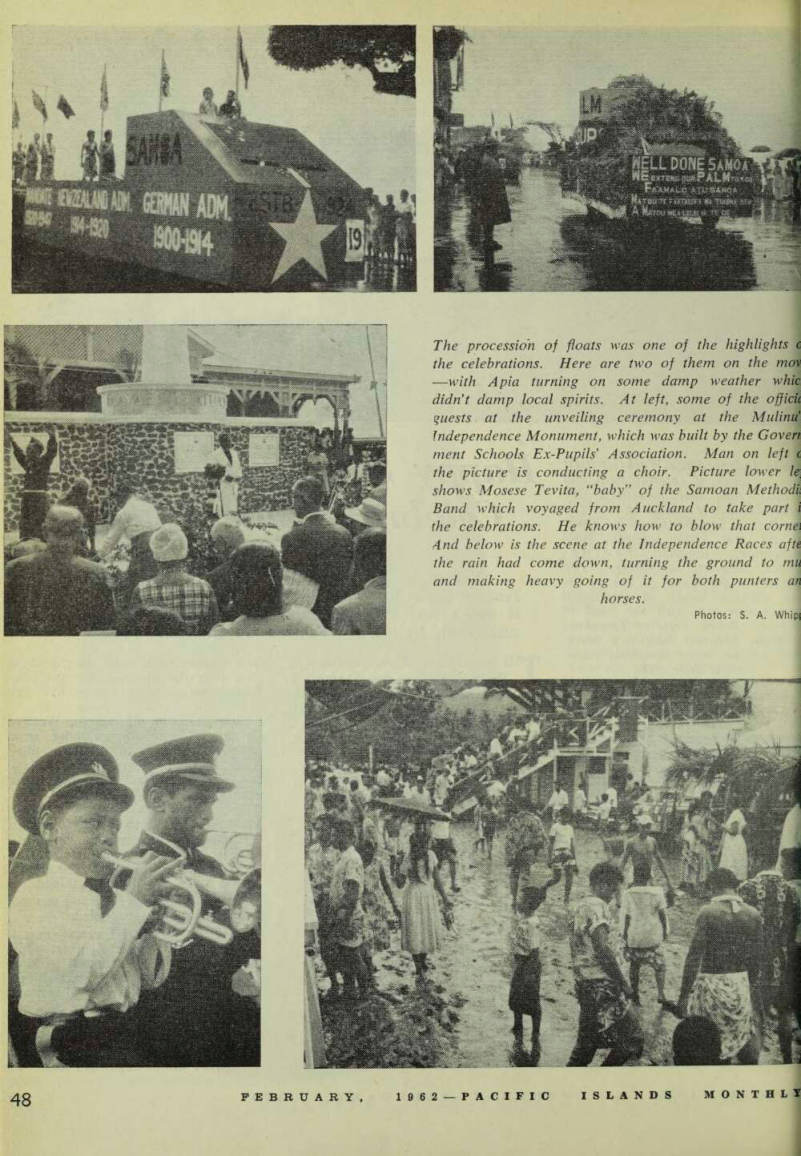
The procession of floats was one of the highlights [?] the celebrations. Here are two of them on the mo[?] —with Apia turning on some damp weather which [?] didn’t damp local spirits. At left, some of the offici[?] quests at the unveiling ceremony at the Mulin[ ?] Independence Monument, which was built by the Goverr [?] ment Schools Ex-Pupils’ Association. Man on left [?] the picture is conducting a choir. Picture lower le[?] shows Mosese Tevita, “baby” of the Samoan Method[?] Band which voyaged from Auckland to take part [?] the celebrations. He knows how to blow that cornel [?] And below is the scene at the Independence Races after the rain had come down, turning the ground to mu[?] and making heavy going of it for both punters an[?] horses.
Photos: S. A. Whip[?]
r is one of the two Heads of State, hose dark days seem now to be ipletely forgotten. .11 Samoans, irrespective of old il differences, came together, in icings that seemed completely srnal. The present-day heads of kingly families (Heads of State, Prime Minister) co-operated rteously and amiably in showering n their guests the hospitality for :h Samoa is famous, he only sour note came from iter Pluvius. That unpredictable sent heavy showers upon the id every day. This really was not arkable—when the Samoans de d to celebrate independence he rn January 1 and 5, they asked it, because that is the very heart he wet season. ut the Samoans saw a portent in way in which the rain-god be sd. •n the Monday morning, while the r Nation was being created in t solemn ceremonies on Mulinu’u it, the assembled thousands looked asily over their shoulders and :hed the clouds creep down over lima, and a veritable downpour upon Mount Vaea, only 2,000 Is away. ut the deluge stopped there. Not ugh drops fell on Mulinu’u to ipen the proud new flag.
The proceedings began solemnly,
with prayers—nominally, at least, Samoa now is wholly Christian.
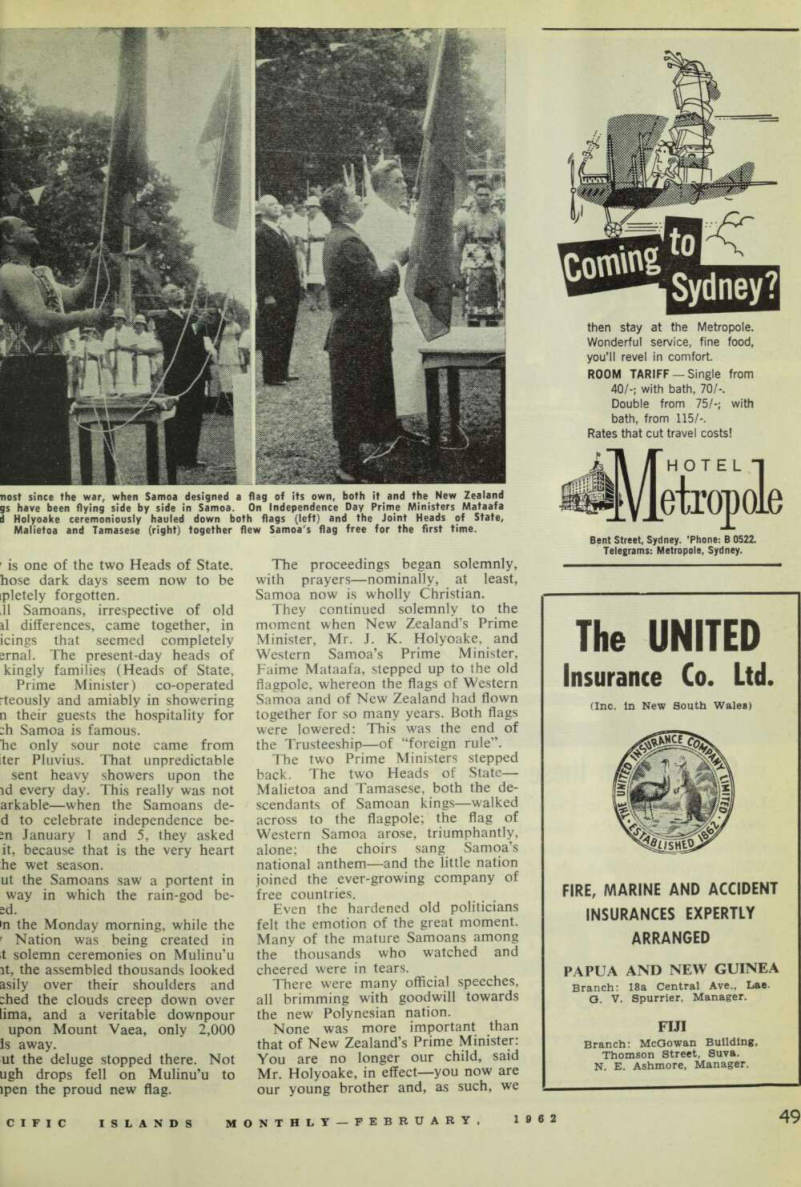
They continued solemnly to the moment when New Zealand’s Prime Minister, Mr. J. K. Holyoake, and Western Samoa’s Prime Minister, Faime Mataafa, stepped up to the old flagpole, whereon the flags of Western Samoa and of New Zealand had flown together for so many years. Both flags were lowered: This was the end of the Trusteeship—of “foreign rule”.
The two Prime Ministers stepped back. The two Heads of State— Malietoa and Tamasese, both the de scendants of Samoan kings—walked across to the flagpole; the flag of Western Samoa arose, triumphantly, alone; the choirs sang Samoa’s national anthem—and the little nation joined the ever-growing company of free countries.
Even the hardened old politicians felt the emotion of the great moment.
Many of the mature Samoans among the thousands who watched and cheered were in tears.
There were many official speeches, all brimming with goodwill towards the new Polynesian nation.
None was more important than that of New Zealand’s Prime Minister: You are no longer our child, said Mr. Holyoake, in effect—you now are our young brother and, as such, we
most since the war, when Samoa designed a flag of its own, both it and the New Zealand [?]gs have been flying side by side in Samoa. On Independence Day Prime Ministers Mataafa [?]Holyoake ceremoniously hauled down both flags (left) and the Joint Heads of State, Malietoa and Tamasese (right) together flew Samoa's flag free for the first time.
must see that you prosper and grov And thereupon he told the Samoai that New Zealand had arranged t give Samoa £45,000 per annum, fc a while, to help it over its admind trative teething period—this is i addition to the £BO,OOO per annul with which NZ subsidises Samoa education.
Kindly sentiments were expresse by the representatives of neighbourin Islands countries, Fiji and Tongs American Samoa, Cook Islands, Niu< by the larger Pacific countries—Ad tralia, whose delegation was led b Territories Minister Paul Hasluck an included a New Guinean nativ official; and by the overseas Britain, and The Netherlands an West Germany. All sent valuabl gifts.
There was another solemn momer when Tamasese unveiled the Indc pendence Monument, built at a cos of £BOO, by the Samoan Governmen Schools Ex-Pupils’ Association.
The events generally followed th programme published in Decembe PIM (page 36).
Probably, the two most picturesquj events were the presentation mad* by the Districts, and the great cana races in Apia Bay.
Some scores of Tongans, led by th< Premier, Crown Prince Tungi, witl their famous brass band, arrived ii Apia in the Tongan motor-vesse Aoniu.
When the time for District gift!
Aggie Grey's celebrated Apia Hotel was [?] important cog in the social wheels durig[?] Independence Week. Aggie herself (abov[?] published a big newspaper advertisement wis[?] ing all of Samoa well and pointing out th[?] "Samoa's work was only beginning".
some 50 Tongan men and n, with traditional songs and s, laid before their hosts a huge precious mat, long lengths of and 100 bottles of scented ut oil. ice Tungi, with his famous smile l huge red umbrella, was pro t in all proceedings. The m never will forget the friend of their nearest neighbour and ze of that umbrella. : procession of “floats” greatly •ed the judges—all the trading had spared neither ingenuity nor se in their exhibits, first prize eventually went to Nelson and Co., Ltd., with Philp (SS) Co. in second An exhibit by the Public ; Department depicting the / of Samoa in an ingenious way 'armly applauded.
'thing from 15,000 to 20,000 : gathered around the bay to the races between the fautasi tyle Samoan longboats with up rowers on each side) which had en seen since 1948. Sala’aumua 1 off first prize (£200) easily, vo boats from Manono Island ; neck and neck for second, re were some accidents. 1-known Dean Knowles Ryer- United States Commis on the South Pacific Commis and here as a most interested tor, fell and dislocated his er when visiting the tomb of t Louis Stevenson, and was to hospital. v Zealand’s Prime Minister, Mr. ake, cut his visit short and re to New Zealand, when advised 5 sudden death of one of his ers.
[?]gift to the New Samoa was this set [?]ee chairs designed in generous pro [?]s for the bigger-than-average Samoan [?]entarians. Fiji presented the desk and [?]it right. The five items were designed [?]ilt by the Fiji Public Works Department [?]a Fiji timber known as yaka, with [?]of different timber. George Griffen [?]d the chairs and Frank Smith the desk.