Canberra
pp. 39-41 · Read in the full issue
Ommentary
m our Canberra Correspondent nfucius said: “When rape les inevitable, relax and en- T seems to be the guiding inciple of Australia’s external > in 1962—and what a switch rom the Spender line of the fifties. e no mistake about it! There :en no sudden, dramatic re of policy. er it has been a gradual change udes, an adjustment of ideas its. Most thinking Australians alised that the national attitude ; Indonesian claims on West juinea has been changing, rnment statements have been so for a long time—although by their omissions than by g which was spelt out. is why for some people it > a shock when the Melbourne last month announced a ’ in Government policy.
Herald said nothing new. All said had been written in one - another, piecemeal, at some another. But stated boldly article, the old facts looked to some people, frightening, is what the Herald, and its aper the Sun News-Pictorial, : Government has accepted view that Indonesia will soon control of West New Guinea; believes that it is better to e Indonesia as a friendly ?hbour with a common front ier than to risk our security supporting what may be a rt-lived Dutch presence in \G, ;tralia may join with the US seeking to influence President karno to accept a compromise ition; h a solution would satisfy both onesian nationalism and allow Dutch a dignified retreat from •osition which can no longer maintained “except at the t of losing goodwill for the ite man throughout most of a”; itralia feared that if it sup ted the Dutch this might be ved in Asia as a form of lite colonialism”;
• There were fears that this would strengthen the cause of Com munism in Indonesia itself; • The UN debate on NNG had shown that Asian sympathy was on the side of Indonesia; and • Hopes of a compromise settle ment have been encouraged by Indonesian statements hinting at possible acceptance of a tran sitional period in which the em phasis would be on Indonesian administration—rather than on Indonesian sovereignty.
The articles caused an immediate sensation, especially as they appeared within hours of the Minister for Ex ternal Affairs, Sir Garfield Barwick, having passed through Melbourne on his way to Hobart.
Sir Garfield issued a statement de scribing the articles as “unofficial” and “speculative”—two words which said nothing, because they did not deny their truth.
He certainly said that there had been no change in Australian policy, which had been set out by the Prime Minister, Mr. Menzies, after Cabinet had spent two days discussing New Guinea early in January.
Meant Nothing
This also meant nothing, because although the articles suggested that there had been a sudden change, the real change was by gradual evolution from the Spender policies of the early ’fifties, through the Casey- Subandrio talks of 1959, through the period in which Mr. Menzies himself administered External Affairs, right up to Sir Garfield Barwick’s recent accession to External Affairs.
But to anyone with the wit to read between the lines of history, the articles presented a viewpoint which was a far cry from the not-so-far-off days when Australian efforts were concentrated on persuading the some what reluctant Dutch to remain in NNG—in Australia’s interests.
Labour men were quick to seize on an opportunity to embarrass Sir Garfield Barwick, First into the field was the Deputy Leader, Mr. Gough Whitlam, who pointed out that the stories had ap peared “on the very day that Sir Garfield passed through Melbourne”.
He challenged Sir Garfield to say
whether he had been in any way responsible for these reports of a change in policy.
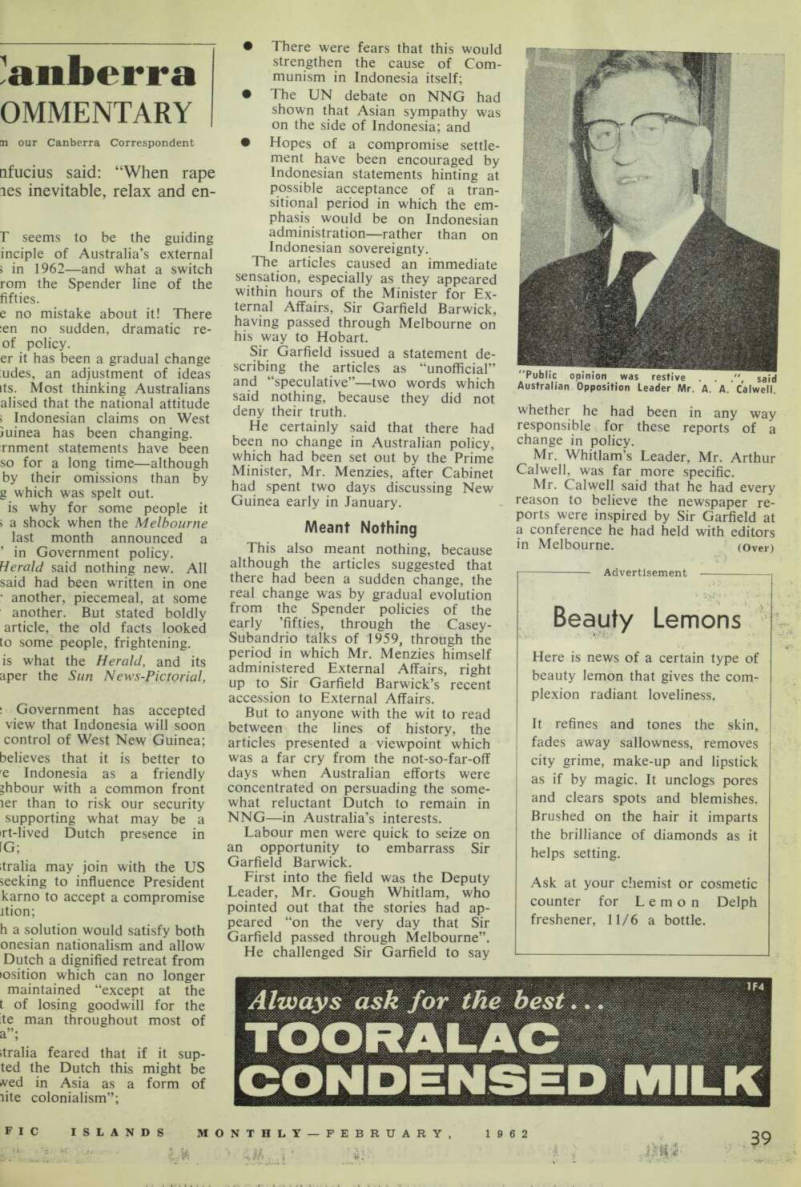
Mr. Whitlam’s Leader, Mr. Arthur Calwell, was far more specific.
Mr. Calwell said that he had every reason to believe the newspaper re ports were inspired by Sir Garfield at a conference he had held with editors in Melbourne. (Over)
"Public opinion was restive...", said Australian Opposition Leader Mr. A. A. Calwell.
ir Sir Garfield to pretend the published something of its own ig instead of something inspired m was dishonest, hypocritical auseating,” Mr. Calwell said.
Calwell—still trying to gain deal point or two—went further, jggested that the articles had 1 great concern in Government h concern, he said, that he be- Mr. Menzies had ordered Sir Id to try to mollify Australian opinion, which was becoming singly restive about the issue, le observers thought that they see support for Mr. Calwell’s ition of “orders” to Sir Garfield phrasing of Sir Garfield’s state describing the articles as lative”. :h of the statement was devoted -stating principles which Mr. es had enunciated after the •y Cabinet discussion. (See te.) 1 some of the phrases used by arfield were so typically those Prime Minister that many ob > believed Mr. Calwell could ave been justified in concluding Ithough the voice was that of the hands behind the state were those of Esau—the elder al son.
Said Enough!
then, Sir Garfield apparently it that he had said enough. in the Calwell charges were it to his notice his answer was: an talk until he is red in the Calwell accused Australian lats in New York, Canberra Isewhere of “peddling a new ilian Munich line”, anxiety to take points for the f short-term political expediency >ose difficulties for the Labour when the show-down comes in il Parliament on New Guinea, lough he has presented the t policy as a sort of “Munich •longlo” and has bitterly at- President Soekarno as a dic many Labour men feel that t Government policy is much realistic than the old line, s when Caucus meets its prob ill be to decide just how far to the Government on the New a crisis. 1 in such a finely-balanced Dent that will be a delicate >n indeed.
DENOTE: In this major state of Australian policy, the Prime er implied that Australia would ) to war over NNG.
He said that: “No responsible Aus tralian would wish to see any action affecting the safety of Australia on the issue of war or peace in this area except in concert with our great and powerful friends.”
The “great and powerful friends” were clearly Britain and the United States—neither of which has given the slightest hint that it would em broil itself over NNG.
In his statement, Mr. Menzies em phasised Australia’s reliance on Indo nesian assurances that force would not be used.
Later, on February 10, Mr. Calwell
again attacked Mr. Menzies “ap peasement” policy and declared; “If Indonesia . . . seeks to use force to create a potential threat to Australia’s security then the threat must be faced,”
To this, Mr. Menzies replied that Australia would be “crazy” to declare war on Indonesia in the event of aggression against NNG.
“It is inescapable that although we have throughout recognised Dutch sovereignty, every nation in Asia supports the Indonesian claim,” he said. The Prime Minister said Aus tralia was ready and willing to pro tect its own territory of P-NG.