Vavau For Spanish Crown
pp. 19-140 · Read in the full issue
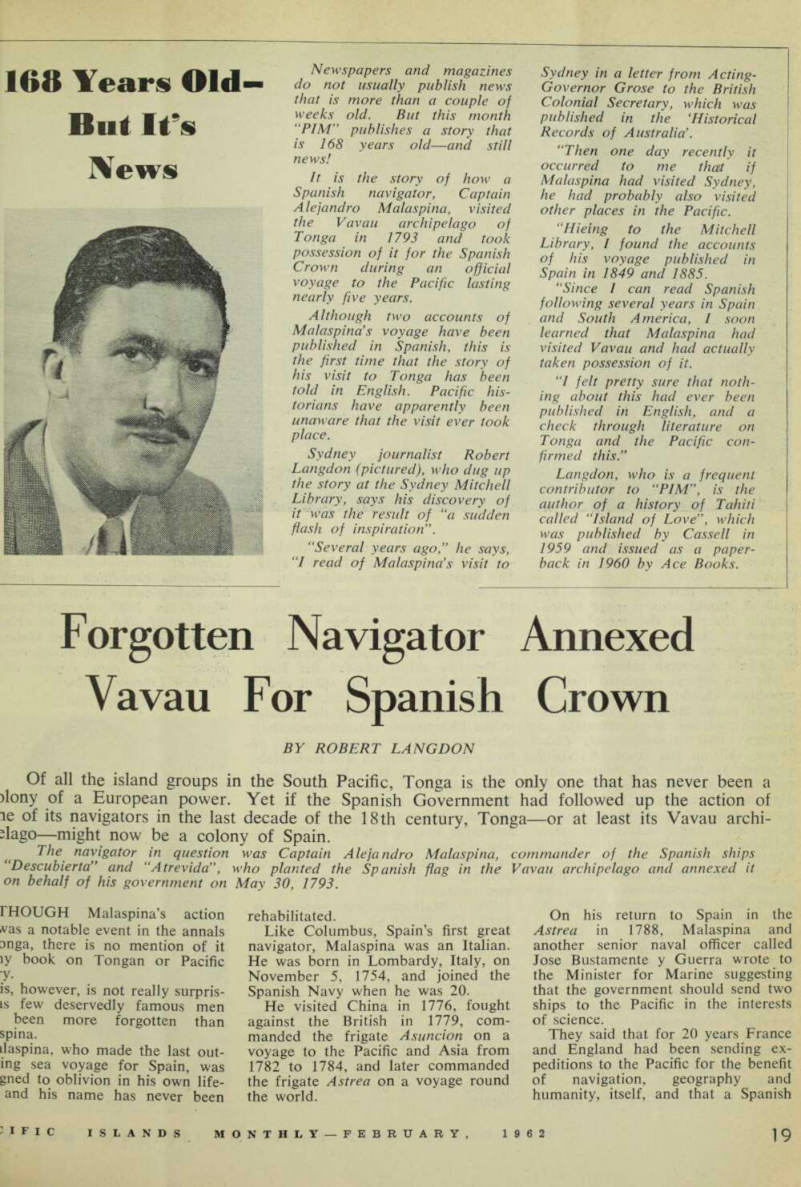
Forgotten Navigator Annexed Vavau For Spanish Crown
By Robert Lang Don
Of all the island groups in the South Pacific, Tonga is the only one that has never been a >lony of a European power. Yet if the Spanish Government had followed up the action of le of its navigators in the last decade of the 18 th century, Tonga —or at least its Vavau archi dago—might now be a colony of Spain.
The navigator in question was Captain Alejandro Malaspina, commander of the Spanish ships “Descubierta” and “Atrevida”, who planted the Spanish flag in the Vavau archipelago and annexed it on behalf of his government on May 30, 1793.
FHOUGH Malaspina’s action a notable event in the annals anga, there is no mention of it ly book on Tongan or Pacific T. is, however, is not really surprisis few deservedly famous men been more forgotten than spina. ilaspina, who made the last outing sea voyage for Spain, was gned to oblivion in his own lifeand his name has never been
rehabilitated.
Like Columbus, Spain’s first great navigator, Malaspina was an Italian.
He was born in Lombardy, Italy, on November 5, 1754, and joined the Spanish Navy when he was 20.
He visited China in 1776, fought against the British in 1779, commanded the frigate Asuncion on a voyage to the Pacific and Asia from 1782 to 1784, and later commanded the frigate Astrea on a voyage round the world.
On his return to Spain in the Astrea in 1788, Malaspina and another senior naval officer called Jose Bustamente y Guerra wrote to the Minister for Marine suggesting that the government should send two ships to the Pacific in the interests of science, They said that for 20 years France and England had been sending ex peditions to the Pacific for the benefit of navigation, geography and humanity, itself, and that a Spanish
expedition should be along the lines of those of La Perouse and Captain Cook.
They said that the Spanish ex pedition should also prepare hydro graphic charts of the most remote regions of America and investigate the commerce and political situations of Spain’s American colonies.
The two officers suggested that the expedition should visit the Falkland Islands, round the Horn, run up the western coast of South America to Mexico, visit Hawaii and Cali fornia, sail up the coast of North America as far as the snows per mitted, call at Canton, the Philippines and the Marianas, sail down the eastern coast of Australia to Botany Bay, visit Tonga and Tahiti, then sail home via the north of Australia and the Cape of Good Hope.
This plan, Malaspina and Bus tamente said, would take about 3\ years, and they suggested July 1, 1789, as the starting date.
When the Minister for Marine submitted the plan to King Carlos IV, the King immediately approved it and ordered two corvettes to be specially built for the expedition.
Malaspina, whom the Minister had described to the King as the most talented and able seaman in the Spanish Navy, was given command, and Bustamente was named as his deputy.
The two corvettes— Descubierta
(Discovery) and Atrevida (Daring) —sailed from Cadiz on July 30, 1789.
The flagship was the Descubierta.
Each ship had a complement of 102 men, including two naturalists and two artists. Another naturalist and two more artists were added to the expedition in South America.
The two ships rounded the Horn in December, 1789, and spent about two years on the western coast of America before crossing the Pacific to the Philippines. From there, they sailed to Sydney passing north of New Guinea, and via the New Heb rides and Dusky Bay, New Zealand.
Reaching Sydney in March, 1793, Malaspina and his men were greeted cordially by Acting-Governor Grose and other leading officials in the five yea,r-old penal colony. Grose gave them permission to make astronomical observations and to collect botanical specimens.
When Malaspina left Sydney on April 12, 1793, he sailed for the Vavau archipelago of Tonga with the express purpose of taking possession of it for the Spanish Crown.
He wrote in his journal that the discovery of Vavau by the Spanish navigator Antonio Maurelle in March, 1781—12 years earlier—had made that archipelago a Spanish possession by right of discovery, but that it was desirable to annex it publicly to put the matter beyond dispute.
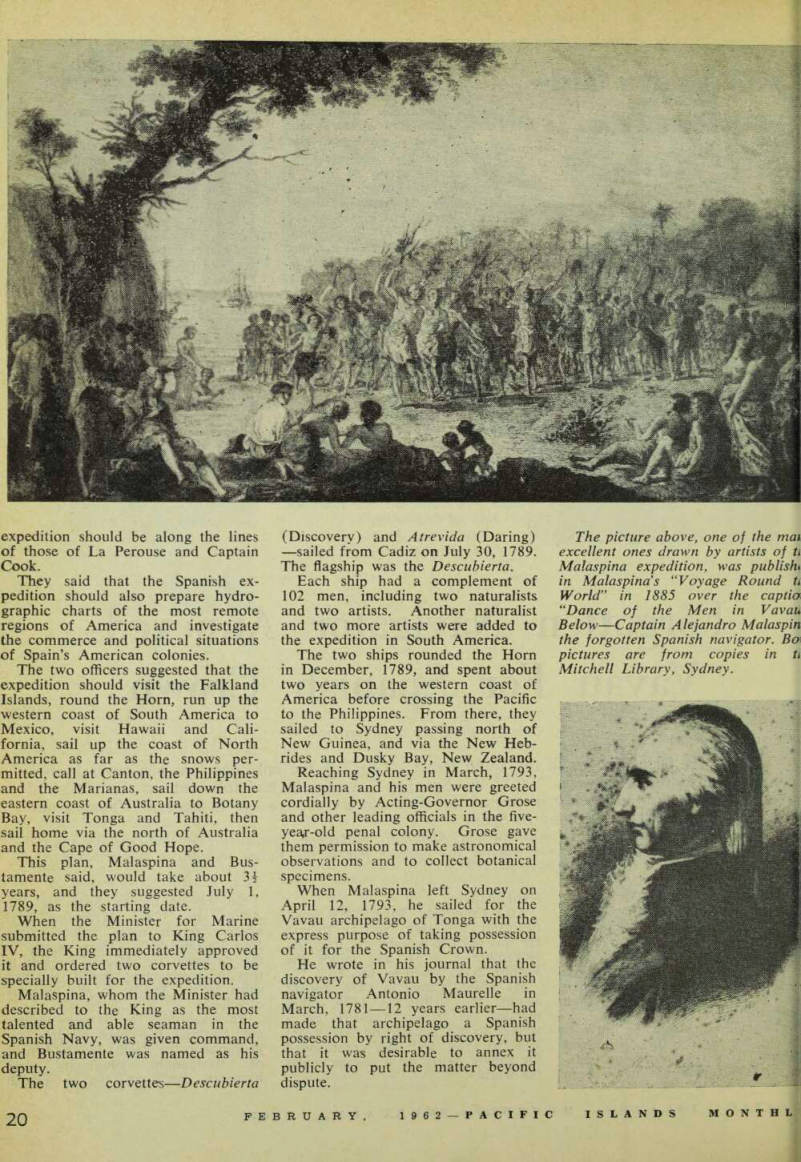
The picture above, one of the ma[?] excellent ones drawn by artists of t[?] Malaspina expedition, was publish [?] in Malaspina’s “Voyage Round t[?] World” in 1885 over the caption “Dance of the Men in Vava[?] Below—Captain Alejandro Malaspin [?] the forgotten Spanish navigator. Bo[?] pictures are from copies in t[?] Mitchell Library, Sydney.
ie Descubierta and Atrevida led the island of Vavau on May 1793, and many canoes came off em before they had anchored, nong the canoes was a large le canoe bearing “an old, fat called Tubou”—an ancestor, loubt, of Queen Salote Tubou, ;a’s present Queen. Maurelle also met Tubou. bou climbed aboard the Des rta, greeted Malaspina with a ing of noses, welcomed him to u, and presented him with a club, a fowl, and some roots— ably taro or yams ilaspina, in return, gave Tubou ngth of cloth and asked him ne at his table, which Tubou did, ducting himself with much -urn and admiring everything id him”. ;anwhile, many other natives had : aboard the two ships. They m carried arms, but if they did, were the first objects they d for the Spaniards’ trinkets, brisk trade in coconuts, bananas roots also developed so that e nightfall the Spaniards had ned fresh food in abundance. make conversation possible, the iards used the vocabulary pub i in Captain Cook’s Voyages. they soon found that the dif ces between English and Spanish aunciation exposed them to gerous and silly mistakes”, so switched to a smaller vocabulary ired by the pilot of Maurelle’s Princesa.
Pilferers Active a precaution against attack and s, Malaspina ordered all the es to leave his ships at night- But two managed to remain card—one in each ship, ie one in the Descubierta was noticed until he had opened al portholes and had escaped l canoe with several suits of ing. On being caught and ght back with Tubou’s help, he lashed to a cannon and given iste of the cat, besides being ?ht the terrors of the musket”, lis punishment, however, did not ■ other natives from pilfering, the Spaniards were plagued by nuisance for the whole of their it apart from this, the Spaniards’ irn was not marked by any un lantness. The natives helped [to water their ships. They ided dances for their entertain t. And they conducted the
(Continued on p. 140)
naturalists on rambles in search of botanical specimens.
Meanwhile, boat parties from the two ships surveyed and charted the coasts of Vavau and neighbouring islands and several officers made astronomical observations at an observatory that was set up on shore.
On May 30, 1793, two days before the Spaniards left to continue their voyage, Malaspina buried a docu ment in a bottle at the observatory site proclaiming the annexation of the “immediate archipelago” in the name of the Spanish King.
To give this act “greater authenticity in the eyes of the natives and those who should follow us”, Malaspina had the flags raised and saluted by both corvettes with seven cries of “Long live the King”.
The natives then gave seven cries of “Vavao toxa Espana” which the Spaniards said meant “Vavau, son of Spain”.
On leaving Vavau, Malaspina decided to sail for the west coast of South America instead of adhering to his original plan of visiting Tahiti and going home via the north of Australia and the Cape of Good Hope, After clearing the Tonga group, the two ships sailed well south of Polynesia and reached Callao, Peru, without sighting any more land.
From Callao, they made their way homewards via the Horn.
When the ships reached Cadiz on June 21, 1794, after an absence of four years and 11 months, Malaspina was given an enthusiastic reception.
Taken to court, he was promoted to the rank of brigadier by the King and publicly praised by Godoy, the Prime Minister. Many people predicted that he would be rewarded for his services by being made Minister for Marine.
A year after Malaspina’s return, the King commissioned a priest, Father Manuel Gil, to edit for pub lication the expedition’s vast collec tion of journals, charts, drawings and reports. Meanwhile, Malaspina
was given permission to visit native Lombardy.
While he was gone, somei occurred at court which causec stocks to drop to zero. One i was that he was the victim I* court intrigue, A more prol story was that both the King an Prime Minister were annoyec an outspoken report he had wi urging more self-government fo South American colonies.
At any rate, in November, I soon after Malaspina returne Spain, both he and Father Gil] arrested and imprisoned—first i: Barracks of the Guardias de ( and then in the Castle of Antonio de Corunna. The . also gave orders that all the p of Malaspina’s expedition wei be seized and withheld from| lication.
Malaspina languished in J until March, 1803, when he released through the interventii a friend of Napoleon, dei to Lombardy, and forbidden 1 turn to Spain under pain of dei Broken in health, humiliated, broken and forgotten, Mah lingered on for six more years the fruits of his expedition gal dust in the Spanish archives, died in Lombardy on April 9, The world knew almost n< of his expedition’s work until when a journal kept by Fra Javier de Viana, an officer c Descubierta, was published ii Spanish town of Cerrito c Victoria. The journal, whicl apparently escaped the g seizure, was published by \ sons.
Thirty-six more years passed 1 Malaspina’s own journal g edited on account of its length published in Madrid in a big of nearly 700 closely printed This volume also contains r by many of Malaspina’s officer scientists. Among these a vocabulary of the Tongan lan and a long “physical examinati the Archipelago of Vavau ai productions”.
Both Viana’s journal and volume published in Madrid an rare, but both are to be fou Sydney’s Mitchell Library.
I have not yet read the two thoroughly, but a quick surve given me the impression Malaspina was equal in s among Pacific navigators to Frenchman, La Perouse, and for patience, thoroughness \ understanding he was not far b Captain Cook, whom he g admired.