Resettlement Offer
pp. 17-138 · Read in the full issue
Eyes on Torres Strait
Nauruans ' Won’t Accept' Resettlement Offer
Prom PlM’s Nauru Correspondent With less than two months to go before the arrival in Nauru of a United Nations Mission which will take a first-hand look at Nauruan resettlement plans, the Nauruan people have shown no signs of changing their attitude.
THEY are still adamant against ac cepting proposals by the three Trustee powers Australia, Britain and New Zealand which would result in their being moved to one of the metropolitan countries, prob ably Australia.
They still want an island of their own, where they can retain their national identity. They still feel that Australia has not done all it could in locating a suitable island.
The Nauruan leaders have several
islands in mind close to the Aus tralian coast.
One of these appears particu larly attractive to them—the large Prince of Wales Island off Cape York Peninsula, right alongside and within sight of Thursday Island.
The Nauru Council wants a small delegation sent to Prince of Wales Island to examine its possibilities for resettlement. It would also like to see some of the other islands. Until this is done, it is unlikely that they will reach a decision on the offer of the Trustees. [Prince of Wales is the largest island in the Torres Strait group— having an area of about 70 square miles. It is uninhabited, apart from oc casional hermits and weekend visitors.
The Pacific Islands Year Book quotes one writer as saying, “There seems to be enough road metal on the island to build a Prince’s Highway from Cape York to Brisbane, enough soul satisfying waterfalls, palm trees, pandanus, and tinkling and trans lucent falls to make a tourist traffic, enough fruit land (so they say) to feed Manila, which usually buys oranges from Sydney, and a climate which in winter is full of the wine of life. Fish and game abound but not humanity!”] The last UN visit to Nauru was m 1959. It was led by Mr. Chiping H.
C. Kiang, of China. The new Mission will be led by Sir Hugh Foot, former Governor of Cyprus. The Mission will also visit New Guinea. It is expected to arrive in Nauru in March, and in January the Administration was preparing the airstrip.
The last Mission said in its report that it felt that if a suitable island could not be found for the Nauruans, “earnest consideration” should be given to the community’s gradual in tegration into one of the three metro politan countries involved, or into a territory of any one of them where living standards were comparable to the high standard at present being enjoyed by the Nauruans. The
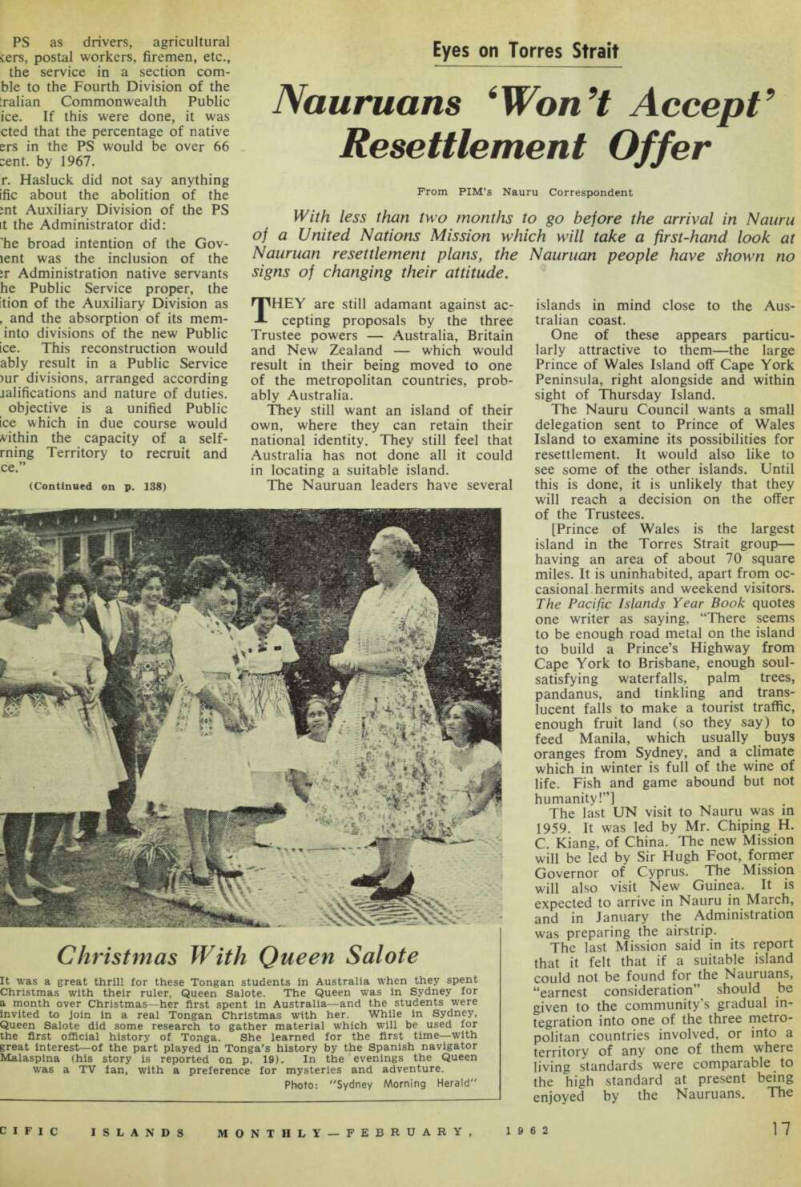
Christmas With Queen Salote
It was a great thrill for these Tongan students in Australia when they spent Christmas with their ruler, Queen Salote. The Queen was in Sydney for a month over Christmas—her first spent in Australia —and the students were invited to join in a real Tongan Christmas with her. While in Sydney, Queen Salote did some research to gather material which will be used for the first official history of Tonga. She learned for the first time —with great Interest— of the part played in Tonga’s history by the Spanish navigator Malaspina (his story is reported on p. 19). In the evenings the Queen was a TV fan, with a preference for mysteries and adventure.
Photo: "Sydney Morning Herald"
Mission suggested the South Pacific Conference might help in solving the problem [the next Conference is in July at Pago Pagol.
Australia, as the administering authority, looked at the situation, and then sent Mr. Dudley McCarthy, an assistant secretary of the Territories Department, to Nauru to outline pro posals for a resettlement scheme. The scheme he outlined at public meetings in Nauru was the one he eventually announced at the UN last June. The UN announcement was the first made publicly, for there had been a certain amount of secrecy involving the whole scheme. Some Nauruans were even taken to Canberra for discus sions, on the quiet.
(Continued on p. 137)
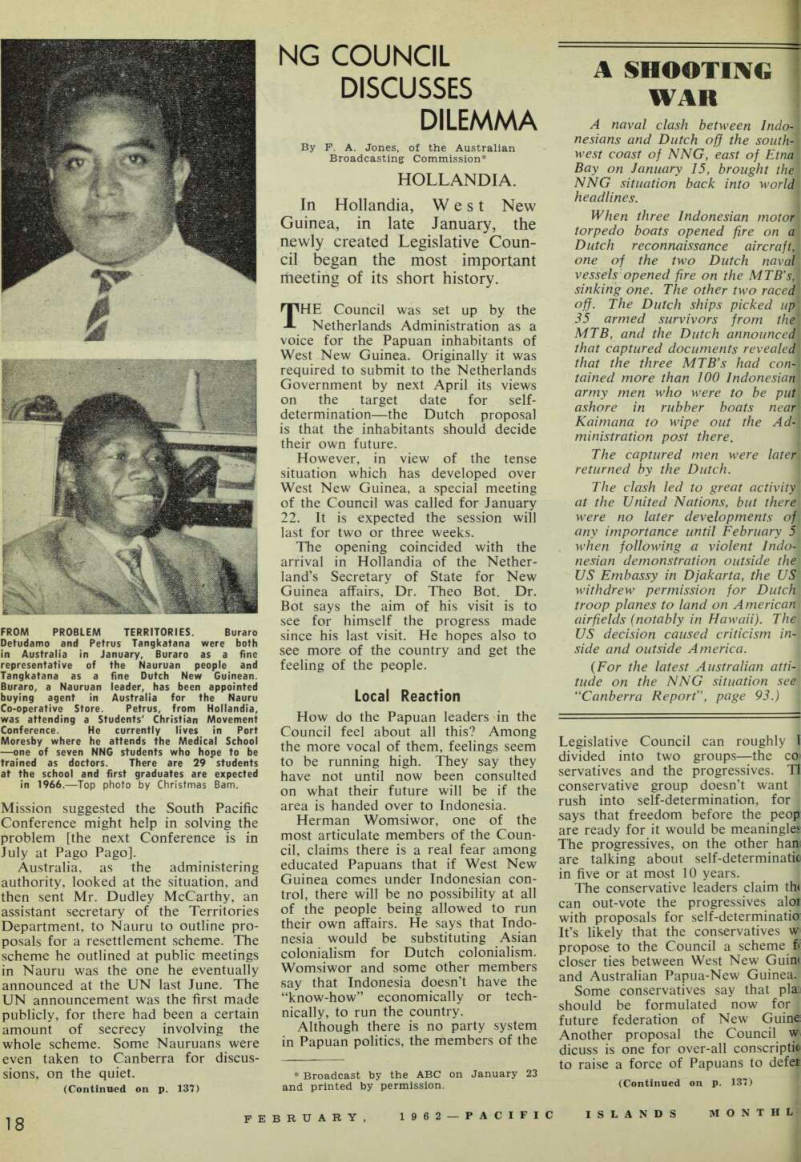
From Problem Territories. Buraro
Detudamo and Petrus Tangkatana were both in Australia in January, Buraro as a fine representative of the Nauruan people and Tangkatana as a fine Dutch New Guinean.
Buraro, a Nauruan leader, has been appointed buying agent in Australia for the Nauru Co-operative Store. Petrus, from Hollandia, was attending a Students' Christian Movement Conference. He currently lives in Port Moresby where he attends the Medical School —one of seven NNG students who hope to be trained as doctors. There are 29 students at the school and first graduates are expected in 1966.— Top photo by Christmas Bam.
The Australian scheme calls for a transfer of Nauruans to Australia over about 30 years. (The Nauru phosphate deposits will last about 40 years.) Children will be brought to the mainland for education and they will be eligible for a deposit on a house when they marry. Adult Nauruans will be given free passage and a house and allowances. Roughly the same scheme would be available in NZ and the UK.
When the plan was announced, Nauru’s representative at UN, Australian - educated Raymond Gadabu, said publicly that his people would not accept it, although they appreciated the offer.
The Australian Government atti tude seems to be that the Nauruans will have to accept the scheme be cause there is no alternative. A search for a suitable island, it says, has been in vain.
The UN gave special instructions to the forthcoming Mission “to ascer tain as fully as possible the wishes of the Nauruan people concerning their future”.
They will find that there has been no change from the attitude outlined by Gadabu.
The Nauruans do not wish to break the ties which bind them closely to their families. Strong family groups have existed for many years and the feeling of “togetherness” is deeply in grained in the minds of the people.
Closely associated with this is, of course, their national identity, of
which they are very proud and which they do not wish to lose. The Nauruans think the scheme will mean the virtual extinction of their own thriving race.
Many have expressed the opinion that they would not be able to com pete with the other people living in these countries due to their limited experience. Their approach to work, as it exists on Nauru, could not be altered suddenly to conform to con ditions in those countries. They can in no way be compared to European migrants who find the changeover to a new country not too difficult.
Although the Nauruans have one of the most advanced standards of living of the islands in the Pacific, they would be lost in their new en vironment despite the assistance promised by the three Governments.
Another question which must raise its head is how the mainlanders will accept the pleasant, but sensitive, Nauruans. The Nauruans are afraid that in Australia there may come to light racial prejudice which could make their life rather miserable.
They think NZ might be better. Over the years NZ has accepted numerous Islands people who are happily co existing.
The islanders realise that a generous offer has been put to them and how genuine the Governments are in their desire to do what is best for their future. Nevertheless a general feeling prevails that a new island has not been fully sought.
The Administrator, Mr. J. P. White, has completed his tour of duty on Nauru and he left for Australia in late January with his wife and family.
Mr. F. W. McConaghy, of the De partment of Territories, has been ap pointed Acting Administrator.