Fiji Enters 1962 With Two
pp. 15-139 · Read in the full issue
New Economic Bosses
There is plenty of resilience in the politico-economic structure ic British Colony of Fiji. It will need every ounce of it if it is I to surmount the rigours of 1962, without acute social suffering.
2AUSE of treacherous intrigues within the Colony’s main in y—sugar production—in 1960lie Colony’s income this year is £2 million to £3 million below it should have been. The con nt obligation to tighten belts, consume less, falls directly upon lasses least able to accept it— ly, unskilled Indians and Euro is, and the detribalised Fijians, 'o agencies now are fiercely at , trying to introduce measures to er the effects of sugar-industry ganisation, and too rapid in -2 in population. They are the new Development Commissioner the equally new Sugar Industry ey are full of promise, but sadly lue. ch is a product of recommenda made by highly skilled and ex iced commissioners: Sir Alan 5, who was asked to find out Fiji is to feed a population that and is increasing in a imenal way; and Sir Malcolm ram Eve, QC, who undertook ask of putting behind the sugar try an organisation which would ct it against various disruptive nces. e great majority of Fiji’s 400,000 e sincerely support the two plans i new staffs, literally working by side, are trying to put into tion. either or both should fail, owing :ompetence without or treachery ti—or a combination of both— Fiji’s plight becomes indescrib worse.
Factors in Fiji's Problem e great majority of the people onscious —they do not know why it menace hangs over Fiji, en the minority who may under something of national eco cs—officialdom, and the top pro •nal and commercial classes—do seem to see the situation very ly. Their comments are often :yed and confused, t the causes of Fiji’s troubles, the obstacles in the way of dial action, are plain to see, and be simply stated:
• The extraordinary Indian birth rate, over three decades, and a high Fijian birthrate over two decades, have produced a population which cannot be fed through the resources now available. • Normally, an increasing popula tion is provided for by a corres pondingly rapid development of natural resources primarily, the land. But in Fiji the land is held generally by the indigenous people— namely, the Fijians—and Fijians generally live under a communal village system, which tends to pre vent the full and proper utilisation of the land.
O The responsible administering authority—the British Colonial Office —although it was warned again and again of what must happen when the irresistible force (of Indian birth rate) met the immovable object (Fijian land-ownership), failed to deal with the situation when it could have been simply dealt with. It ig nored significant reports (for example, the urgent representations
of Governor Sir Ronald Garvey, the land settlement plan submitted by W. G. Johnson in 1956, the urgent Legco warning sent to Whitehall in 1952, on the initiative of Mr. Maurice Scott). • Now, the harassed Colonial Office is trying to do in a year or two, with Fiji’s developing local troubles falling thick upon it, what it should have done, slowly and scientifically, over the last 25 years. • There are five distinct com munities in Fiji (Fijian, Indian, Euro pean, Euronesian and Chinese) and no spirit of unity between them.
The people of Fiji obviously are hanging on every word and action of the Development Commissioner and
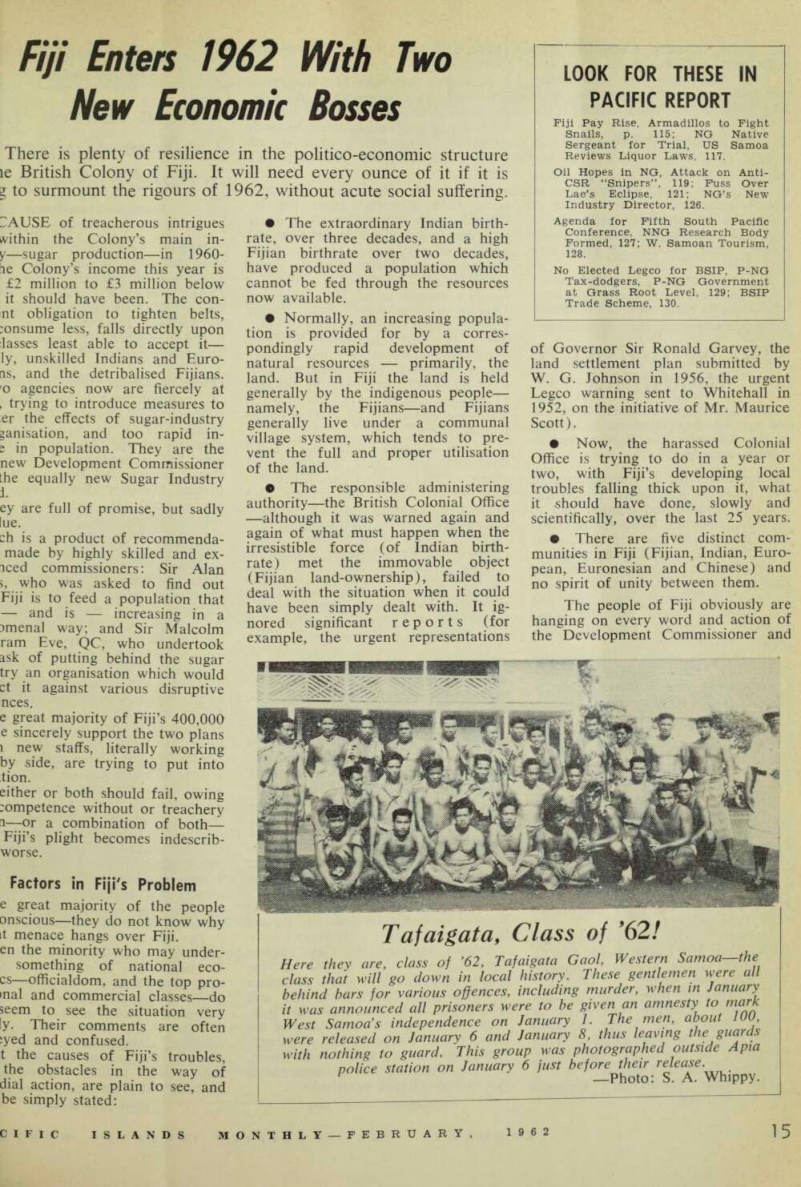
Tajaigata , Class of ’62!
Here they are, class of ’62, Tafaigata Gaol, Western Samoa—the class that will go down in local history. These gentlemen were all behind bars for various offences, including murder, when in January it was announced all prisoners were to be given an amnesty to mark West Samoa’s independence on January 1. The men, about WU, were released on January 6 and January 8, thus leaving the guards with nothing to guard. This group was photographed outside Apia police station on January 6 just before their release. —Photo: S. A. Whippy.
the Sugar Industry Chairman, and wish them well. But it would be idle to deny that these two vital instru mentalities are embarking on their jobs under disheartening conditions.
Development Commissioner
The Development Commissioner, Mr. E. R. Bevington, was (according to the Burns Plan) supposed to be the chairman and executive officer of a Natural Resources Council; and it was supposed that the Council would include local residents of experience and skill.
But in this respect, as in some other important directions, the specifications of the Burns Plan were not followed.
There is no Natural Resources Council.
Probably, that suits Mr. Bevington very well. Top bureaucratic planners, the world over, do hate to be cribb’d, cabin’d and confined to down-to-earth advisory bodies which want to see 20/- worth of gain from each £1 spent.
Instead, Mr. Bevington has in a sense been removed from the in fluence of the Burns Report—it never was very much liked in Government circles, anyway—and he has been, instead, made Chairman of the Land Development Authority, with a Council consisting of Mr. Balgovind (Indian businessman), Ratu Penaia Ganilau (high Administration officer), Mr. G. I. Firmston - Williams (Colonial Development Fund official), Mr. J. C. Potts (Fiji head of CSR Co. interests), Mr. H. P. Ritchie (Financial Secretary), Mr. J. S.
Thomson (head of the Native Lands Commission).
It is claimed that this Land Authority really gives substance and shape to that part of the Burns Re port which urged the greater and planned utilisation of all unused native land.
"Experience"
Perhaps it does. It also, in some respects, has a singular resemblance to the land settlement plan produced by Mr. W, G. Johnson in 1956, and submitted for consideration.
That plan represented decades of experience and months of thought and planning by Mr. Johnson, who was born and reared in Fiji, and whose quality has been proven beyond question in the world of com merce. The bureaucrats greeted it with praise and honeyed smiles; but it got precisely nowhere. After all, what could a mere Kai Viti know of the highly specialised science of ad ministering a British Crown Colony!
It was noticeable that, after that, “Tui” Johnson just quietly faded out of public life, to which he had given decades of useful service, and he took his land settlement plan with him.
There may be here a clue to why the Fiji Government gets only limited help from residents with know-how.
During January, the Development Commissioner—who is one of the most industrious and tenacious Colonial Office men Fiji has seen, and who richly deserves success —has pub lished details of his plans; and of the elaborate, Colonial - Development based finance structure behind them.
Those finance plans are impressive, but they don’t look practical.
(Continued on p. 138)
Millions of pounds are to be spent.
But if, from the total, there is de ducted the huge cost of re-constructing Suva’s port, and the further cost of providing instrumentalities for edu cation, what is left is not nearly suf ficient to open up new country—by means of roads, bridges, land-clearing, housing and agricultural help—to
take care of that large section of population which simply must settled on the land if Fiji’ is to saved from social disaster.
Government planning is a fasci ing occupation, and usually is 1 in the air. Implementation of p is necessarily realistic and close to earth.
How soon can the Developn Commissioner get hundreds of • Indian and Fijian farmers gro\ subsistence crops, and hundreds n engaged in industries secondary primary production? That is the test.
As Sir Alan Burns pointed 1 additional social services—even 1 cation—and amenities like new pi buildings and reconstructed dc must await the day when all this population can be adequately fed housed.
Sugar industry Commander
Meanwhile, during January, t were events of significance on sugar front.
Immediately after he was appoi ‘lndependent Chairman of the S Industry”. Sir Arthur Sanders from the middle of London’s A winter, right into the middle of 1 January heat; and within 10 day was in hospital with pneumonias However, he was out again in other 10 days; completed his tou the sugar areas; organised the S Council (a body set up to advise Sugar Industry Board and its i pendent chairman); and by e February he was on his way bac Britain to settle his personal al and return to Fiji, to perma residence. He displayed en( initiative and thrust.
To say that Fiji watched him curiosity would be to put it mildlj Fiji watched him with its heaj its mouth, and a prayer on its li; because, if this 63-year-old Air C Marshal does not take commam the Colony’s politically-battered s industry, and prevent further ruption, Fiji will have to face s( and political troubles beyond ci lation.
Even if Development Com sioner Bevington has 100 per ( success, it will be years before o Fiji industries, primary and second can absorb the Indian popula which cannot be cared for by sugar industry.
If the sugar industry is fur torn about by the Indian poll wolves which hang around its ed in Fiji’s north-western jungles, tl will be increased unemployn among Indian cane-growers and t workers, to add to the unemployn
eady is growing from natural excessive birth-rate), immediate, and unenviable, Sir Arthur Sanders is to keep ir industry steady and stable, the mills will not be ham their plans to sell, in a world more or less convulsed by surpluses, enough of Fiji’s 1 product to keep Fiji’s y at least evenly balanced. he do it? The tricky, un part of his task lies among ans, in the field of industry. dians, Good and Bad e may judge them by their ar Press, Fiji’s Indians seem lit into irreconcilable factions, ly and socially; and this dis a handicap for Fiji, at this :ime. eeds local leaders, to check planning of the sheltered ats, and help keep their feet ground. There is a lot of al ability among the Indians, inite qualities of leadership; •e men are swamped in the
everlasting turmoil of the Indians’ petty, sectional squabbles. Out of that fact, come these deplorable re sults: • Fiji loses the benefit of what ever Indian leadership is available.
O The Indian community cannot come forward as a united community, to join other communities in making a united Fiji, • Sections of the Indians can be led by the nose into mischievous activities that are close to being sub versive and criminal—as, for example, the prolongation of the 1960-61 strike of cane-growers. • The Fijian community becomes fixed in its determination that it will not join the Indians in self-govern ment in any shape or form, and will demand the continuance of the over all administrative authority of the British Colonial Office.
Sir Arthur Sander’s task lies not so much in efficiently handling an in dustry, as in handling a community (the Indians). Necessarily, in rela tion to that, he will go to the civil authority—namely, the Governor.
The recent record of the civil authority, in that respect, does not inspire confidence.
There have been private conversa tions between the Governor and an organisation called the Indian Asso ciation of Fiji, of which Mr. Lateef, an able and trusted lawyer, is presi dent. The indications are that the majority of the Indians in Fiji, if wisely led, will show moderation and tolerance in the difficult days ahead.
But a section of the Fiji-Indian Press in recent weeks has published statements which indicate that the elements whose vendetta against the mills caused disturbance in the in dustry in 1960 and 1961 is awaiting —in fact, trying to create—an oppor tunity to upset both growers and mill workers in 1962.
So far, the impression made by Sir Arthur Sanders is not unfavourable.
The events of the next few months are awaited with lively interest.
Cynics say that an Air Force Chief Marshal could have the experience needed to put some sort of discipline into the sugar-cane industry. But why bring a Navy Lieut.-Commander, re tired, into the same picture, as secre tary? (Sir Arthur brought Lieut.- Commander Finley out with him in January, as personal secretary; and he now has been appointed secretary of the Board.) The combination of Air Force and Navy in the sugar field is a little start ling. But Fiji will put up with that if only the vital sugar industry can be kept in good shape, to produce the Colony’s life-blood.