[?]Lands Produce
p. 153 · Read in the full issue
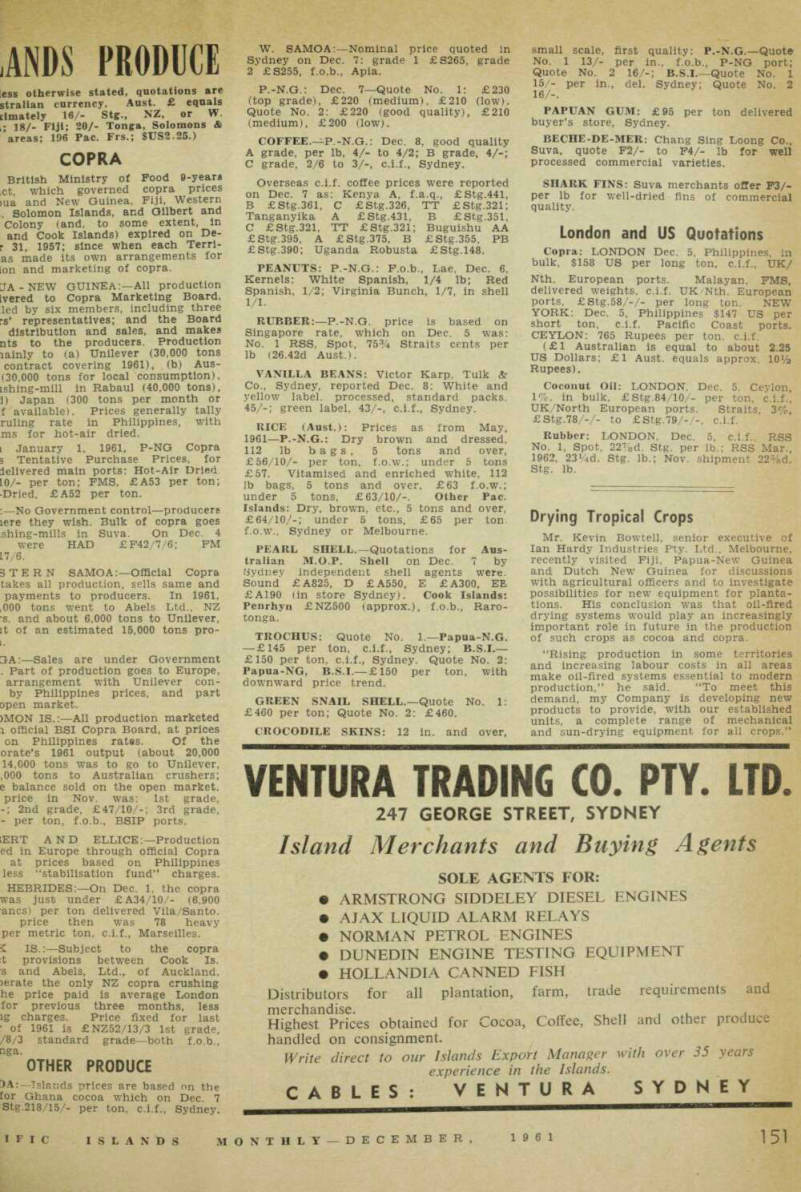
less otherwise stated, quotations are stralian currency. Aust. £ equals dmately 16/- Stg., NZ, or W. 18/- Fiji; 20/- Tonga, Solomons & areas; 196 Pac. Frs.; $U52.25.)
Copra
British Ministry of Food 9-years ,ct, which governed copra prices iua and New Guinea, Fiji, Western , Solomon Islands, and Gilbert and Colony (and, to some extent, in and Cook Islands) expired on De r 31, 1957; since when each Terrl as made its own arrangements for ion and marketing of copra.
JA - NEW GUINEA:—AII production ivered to Copra Marketing Board, led by six members, including three rs’ representatives; and the Board distribution and sales, and makes nts to the producers. Production lainly to (a) Unilever (30,000 tons contract covering 1961), (b) Aus (3o,ooo tons for local consumption), ishing-mill in Rabaul (40,000 tons), 1) Japan (300 tons per month or f available). Prices generally tally ruling rate in Philippines, with ms for hot-air dried, i January 1, 1961, P-NG Copra 3 Tentative Purchase Prices, for lelivered main ports: Hot-Air Dried, 10/- per ton; FMS, £AS3 per ton; ■Dried, £AS2 per ton. :—No Government control —producers iere they wish. Bulk of copra goes shing-mills in Suva. On Dec. 4 were HAD £F42/7/6; FM 17/6. 3TE R N SAMOA:—Official Copra takes all production, sells same and payments to producers. In 1961, ,000 tons went to Abels Ltd., NZ •s, and about 6,000 tons to Unilever, it of an estimated 15,000 tons pro i.
GA:—Sales are under Government . Part of production goes to Europe, arrangement with Unilever con by Philippines prices, and part open market. )MON IS.:—All production marketed i official BSI Copra Board, at prices on Philippines rates. Of the crate’s 1961 output (about 20,000 14,000 tons was to go to Unilever, ,000 tons to Australian crushers; e balance sold on the open market, price in Nov. was: Ist grade, -; 2nd grade, £47/10/-; 3rd grade, - per ton, f.0.b., BSIP ports. lERT AND ELLlCE:—Production ed in Europe through official Copra at prices based on Philippines less “stabilisation fund” charges.
HEBRIDES: —On Dec. 1, the copra was just under £A34/10/- (6,900 ancs) per ton delivered Vila/Santo. price then was 78 heavy per metric ton, c.i.f., Marseilles.
S IS.;—Subject to the copra t provisions between Cook Is. s and Abels, Ltd., of Auckland, derate the only NZ copra crushing he price paid is average London for previous three months, less ig charges. Price fixed for last • of 1961 is £NZS2/13/3 Ist grade, /8/3 standard grade—both f.0.b., nga.
Other Produce
DA:—islands prices are based on the for Ghana cocoa which on Dec. 7 Stg.2lB/15/- per ton, c.i.f., Sydney.
W. SAMOA:—Nominal price quoted in Sydney on Dec. 7: grade 1 £8265, grade 2 £8255, f.0.b., Apia.
P.-N.G.; Dec. 7—Quote No. 1: £230 (top grade), £220 (medium), £2lO (low).
Quote No. 2: £220 (good quality), £2lO (medium), £2OO (low).
COFFEE.—P.-N.G.: Dec. 8, good quality A grade, per lb, 4/- to 4/2; B grade, 4/-; C grade, 2/6 to 3/-, c.i.f., Sydney.
Overseas c.i.f. coffee prices were reported on Dec. 7 as: Kenya A, f.a.q., £Stg.44l, B £ Stg.36l, C £ 5tg.326, TT £ Stg.32l; Tanganyika A £ Stg.43l, B £ Stg.3sl, C £Stg.32l, TT £ Stg.32l; Buguishu AA £ Stg. 395, A £ 5tg.375, B £Stg.3ss. PB £ Stg.39o; Uganda Robusta £Stg.l4B.
Peanuts: P.-N.G.: F.0.B., Lae, Dec. 6,
Kernels: White Spanish, 1/4 lb; Red Spanish, 1/2; Virginia Bunch, 1/7, in shell 1/1.
RUBBER:—P.-N.G. price is based on Singapore rate, which on Dec. 5 was: No. 1 RSS, Spot, 75% Straits cents per lb (26.42 d Aust.).
VANILLA BEANS: Victor Karp, Tulk & Co., Sydney, reported Dec. 8: White and yellow label, processed, standard packs. 45/-; green label, 43/-, c.i.f., Sydney.
RICE (Aust.): Prices as from May, 1961—P.-N.G.: Dry brown and dressed, 112 lb bags, 5 tons and over, £56/10/- per ton, f.0.w.; under 5 tons £57. Vitamised and enriched white, 112 lb bags, 5 tons and over, £63 f.0.w.; under 5 tons, £63/10/-. Other Pac.
Islands: Dry, brown, etc., 5 tons and over, £64/10/-; under 5 tons, £65 per ton. f.0.w., Sydney or Melbourne.
PEARL SHELL.—Quotations for Aus tralian M.O.P. Shell on Dec. 7 by Sydney independent shell agents were.
Sound £ A 825, D £ASSO, E £A3OO, EE £AI9O (in store Sydney). Cook Islands; Penrhyn £NZSOO (approx.), f.0.b., Raro tonga.
TROCHUS: Quote No. I—Papua-N.G. £145 per ton, c.i.f., Sydney; 8.5.1. — £l5O per ton, c.i.f., Sydney. Quote No. 2: Papua-NG, 8.5.1. £l5O per ton, with downward price trend.
Green Snail Shell.—Quote No. 1:
£460 per ton; Quote No. 2: £460.
CROCODILE SKINS: 12 in. and over,
small scale, first quality; P.-N.G. —Quote No. 1 13/- per in., f.0.b., P-NG port; Quote No. 2 16/-; B.S.l.—Quote No. 1 15/- per in., del. Sydney; Quote No. 2 16/-.
PAPUAN GUM: £95 per ton delivered buyer’s store, Sydney.
BECHE-DE-MER: Chang Sing Loong Co., Suva, quote F 2- to P 4- lb for well processed commercial varieties.
SHARK FINS: Suva merchants offer P3/per lb for well-dried fins of commercial quality.
London and US Quotations
Copra: LONDON Dec. 5, Philippines, in bulk, $l5B US per long ton, c.i.f., UK/ Nth. European ports. Malayan, FMS, delivered weights, c.i.f. UK/Nth. European ports, £Stg.sB/-/- per long ton. NEW YORK; Dec. 5, Philippines $147 US per short ton, c.i.f. Pacific Coast ports.
CEYLON; 765 Rupees per ton, c.i.f. (£ 1 Australian is equal to about 2.25 US Dollars; £1 Aust. equals approx. 10Va Rupees).
Coconut Oil: LONDON, Dec. 5. Ceylon, 1%. in bulk, £Stg.B4/10/- per ton, c.i.f., UK/North European ports. Straits, 3%, £Stg.7B/-/- to £Stg.79/-/-, c.i.f.
Rubber; LONDON, Dec. 5, c.i.f.. RSS No. 1, Spot, 22 7 8d. Stg. per lb.: RSS Mar., 1962, 23V4d. Stg. lb.; Nov. shipment 22%d.
Stg. lb.
Drying Tropical Crops
Mr. Kevin Bowtell, senior executive of lan Hardy Industries F'ty. Ltd.. Melbourne, recently visited Fiji, Papua-New Guinea and Dutch New Guinea for discussions with agricultural officers and to investigate possibilities for new equipment for planta tions. His conclusion was that oil-fired drying systems would play an increasingly important role in future in the production of such crops as cocoa and copra.
“Rising production in some territories and increasing labour costs in all areas make oil-fired systems essential to modern production,” he said. “To meet this demand, my Company is developing new products to provide, with our established units, a complete range of mechanical and sun-drying equipment for all crops.”