Pacific Commerce and Produce
pp. 151-152 · Read in the full issue
Price Still Low
It's Soyabeans Before Copra
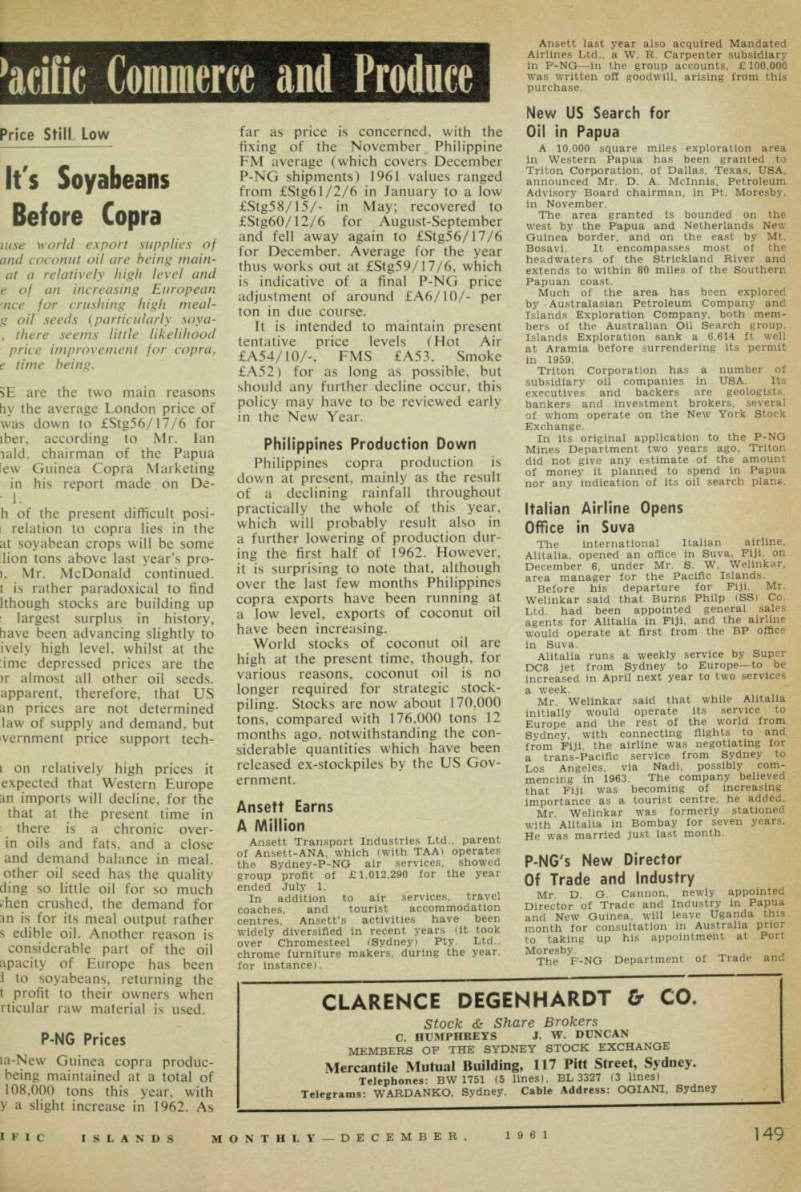
mse world export supplies of and coconut oil are being main at a relatively high level and e of an increasing European •nee for crushing high meal g oil seeds ( particularly soya , there seems little likelihood price improvement for copra, e time being. sE are the two main reasons hy the average London price of was down to £Stgs6/17/6 for iber, according to Mr. lan laid, chairman of the Papua lew Guinea Copra Marketing in his report made on De ■ 1. h of the present difficult posi i relation to copra lies in the at soyabean crops will be some lion tons above last year’s pro 1, Mr. McDonald continued, t is rather paradoxical to find Ithough stocks are building up largest surplus in history, have been advancing slightly to ively high level, whilst at the ;ime depressed prices are the )r almost all other oil seeds, apparent, therefore, that US an prices are not determined law of supply and demand, but vernment price support tech i on relatively high prices it expected that Western Europe an imports will decline, for the that at the present time in there is a chronic over in oils and fats, and a close and demand balance in meal, other oil seed has the quality ding so little oil for so much /hen crushed, the demand for an is for its meal output rather s edible oil. Another reason is considerable part of the oil apacity of Europe has been 1 to soyabeans, returning the t profit to their owners when rticular raw material is used, P-NG Prices ia-New Guinea copra produc being maintained at a total of 108,000 tons this year, with y a slight increase in 1962. As
far as price is concerned, with the fixing of the November Philippine FM average (which covers December P-NG shipments) 1961 values ranged from £Stg6l/2/6 in January to a low £StgsB/15/- in May; recovered to £Stg6o/12/6 for August-September and fell away again to £Stgs6/17/6 for December. Average for the year thus works out at £Stgs9/17/6, which is indicative of a final P-NG price adjustment of around £A6/10/- per ton in due course.
It is intended to maintain present tentative price levels (Hot Air £AS4/10/-, FMS £AS3, Smoke £AS2) for as long as possible, but should any further decline occur, this policy may have to be reviewed early in the New Year.
Philippines Production Down Philippines copra production is down at present, mainly as the result of a declining rainfall throughout practically the whole of this year, which will probably result also in a further lowering of production dur ing the first half of 1962. However, it is surprising to note that, although over the last few months Philippines copra exports have been running at a low level, exports of coconut oil have been increasing.
World stocks of coconut oil are high at the present time, though, for various reasons, coconut oil is no longer required for strategic stock piling. Stocks are now about 170,000 tons, compared with 176,000 tons 12 months ago, notwithstanding the con siderable quantities which have been released ex-stockpiles by the US Gov ernment.
Ansett Earns
A Million
Ansett Transport Industries Ltd., parent of Ansett-ANA, which (with TAA) operates the Sydney-P-NG air services, showed group profit of £1,012,290 for the year ended July 1.
In addition to air services, travel coaches, and tourist accommodation centres, Ansett’s activities have been widely diversified in recent years (it took over Chromesteel (Sydney) Pty. Ltd., chrome furniture makers, during the year, for instance).
Ansett last year also acquired Mandated Airlines Ltd., a W. R. Carpenter subsidiary in P-NG —in the group accounts, £lOO,OOO was written off goodwill, arising from this purchase.
New US Search for
Oil in Papua
A 10,000 square miles exploration area in Western Papua has been granted to Triton Corporation, of Dallas, Texas, USA, announced Mr. D. A. Mclnnis, Petroleum Advisory Board chairman, in Pt. Moresby, in November.
The area granted is bounded on the west by the Papua and Netherlands New Guinea border, and on the east by Mt.
Bosavi. It encompasses most of the headwaters of the Strickland River and extends to within 80 miles of the Southern Papuan coast.
Much of the area has been explored by Australasian Petroleum Company and Islands Exploration Company, both mem bers of the Australian Oil Search group.
Islands Exploration sank a 6,614 ft well at Aramia before surrendering its permit in 1959.
Triton Corporation has a number of subsidiary oil companies in USA. Its executives and backers are geologists, bankers and investment brokers, several of whom operate on the New York Stock Exchange.
In its original application to the P-NG Mines Department two years ago, Triton did not give any estimate of the amount of money it planned to spend in Papua nor any indication of its oil search plans.
Italian Airline Opens
Office in Suva
The international Italian airline, Alitalia, opened an office in Suva, Fiji, on December 6, under Mr. S. W. Welinkar, area manager for the Pacific Islands.
Before his departure for Fiji, Mr.
Welinkar said that Burns Philp (SSI Co.
Ltd. had been appointed general sales agents for Alitalia in Fiji, and the airline would operate at first from the BP office in Suva.
Alitalia runs a weekly service by Super DCS jet from Sydney to Europe—to be increased in April next year to two services a week.
Mr. Welinkar said that while Alitalia initially would operate its service to Europe and the rest of the world from Sydney, with connecting flights to and from Fiji, the airline was negotiating for a trans-Pacific service from Sydney to Los Angeles, via Nadi, possibly com mencing in 1963. The company believed that Fiji was becoming of increasing importance as a tourist centre, he added.
Mr Welinkar was formerly stationed with Alitalia in Bombay for seven years.
He was married just last month.
P-NG's New Director
Of Trade and Industry
Mr D. G. Cannon, newly appointed Director of Trade and Industry in Papua and New Guinea, will leave Uganda this month for consultation in Australia prior to taking up his appointment at Port Moresby. , .
The F-NG Department of Trade and
Industry has been created to enable trade and industrial matters, in which there has been considerable development recently in the Territory, to be co-ordinated within the one organisation. When the Depart ment commences to function, after the new Director takes up his appointment, it will absorb the existing Department of Customs and Marine. Other functions of the Department will relate to the sale and marketing of P-NG products, the promotion of industrial development, tariff questions, promotion of native co operatives and other business activities, and control over migration.
A Victorian, Mr. Cannon is 44. During World War II he served with the RAAF in the Middle East and Europe, and was awarded the DFC. For the past 15 years he has lived in East Africa where, in addition to business activities, he has been a member of both local and central government bodies and also a member of various marketing, financial and commercial boards.
Enterprise of NG
Misses Out Again
Directors of Enterprise of New Guinea Gold and Petroleum Development NL report that its application for Oil Permit No. 32 has been refused by the P-NG Administration.
Application for a permit to search for oil in an area in NW New Guinea (near the Netherlands NG border) covering 3,600 sq. miles was refused last year, mainly on the grounds that the company did not have sufficient resources to survey and carry out the necessary in vestigations in such a large area. Earlier this year, after husbanding its funds carefully, it made this further attempt to secure the permit.
Guam Firm Takes Over Adi
Timber Concession in NNG
The logging concession on Adi Island, Netherlands New Guinea. which was abandoned earlier this year when Adi Timber Development Pty. Ltd., of Sydney, folded up after a series of shipping, staff and financial difficulties, has been taken over by an American firm, Jones and Guerrero Inc., of Guam.
Jones and Guerrero Inc. is a well established company with plantations and stores at Agana. Guam, Mariana Group (which is American territory, but not part of the US Trust Territory of the Pacific Is.). It conducts business throughout the SW Pacific and in Australia.
A sawmill will be established at Adi, in addition to the main export of logs.
Heavy equipment, light transport, work shop, store and prefabricated houses will be moved to the island by the new concessionaire. Operations will be under an Australian manager, with Australian assistants, and a working staff of Filipinos, Japanese and natives.
Papuan Apinaipi's Partner
Will Provide the Money
The advantage of Papuan Apinaipi Petroleum Co.’s tie-up with the new oil exploration concern, Associated Continental Petroleum NL, was referred to in the
Directors’ report at the annual meeting in Sydney on November 21.
The Associated Group has an active exploration programme over the next seven years in Papua (its Permit 22 covers 8,740 sq. miles), Queensland, Northern Territory and West Australia “but Papuan Apinaipi shareholders will virtually enjoy an armchair ride during this period”, declared the report. Associated Con tinental has 1 assumed responsibility for meeting Papuan Apinaipi’s share of the Group expenditure (up to £1,250,000), in return for a half interest in Papuan Apinaipi’s equity in the results of the Group’s operations.
For the year ended June 30, Papuan Apinaipi spent £196,047 on development, after deducting net Commonwealth subsidy of £34,019; development account stands at £974,848. Costs of explora tion and operations increased by £56,395 to £210,184.
Placer Dev. Has New
Major Shareholder
International Mining Corporation, of New York, biggest shareholder in Placer Development Ltd., which has a large interest in New Guinea’s Bulolo Gold Dredging Ltd. (and for which it made a take-over offer in October) sold 600,000 of 800,000 shares last month to Noranda Mines Ltd., Toronto, Canada, for 25 dollars (about £All/2/2) a share. Total sale price was 15m dollars (£A6.56m).
Noranda Mines Ltd. is one of the major copper producers and refiners in North America.
Placer’s BGD take-over deal is pro gressing steadily, but much work has to be done both in New Guinea and in Australia in connection with the preliminary formalities of lease and property transfers if BGD shareholders agree to the sale. In the meantime, Placer’s shares have been making marked gains in price on Sydney Stock Exchange —Placer buyers early December offered £ll/8/- per share, against £9/12/- in October.
Fiji's Copper Find
Could be Duplicated
What is probably the first discovery of an important porphyry-type copper ore in the South Pacific Islands is soon to be worked in Fiji, at Udu Point mine, on the northeasterly tip of Vanua Levu.
The Japanese Pacific firm, Banno Bros.
Ltd., let a contract for exploration drilling to Nippon Mining Company, and 1,000,000 tons of three per cent, copper ore have been proved. Plant and equip ment will be imported to set up a treatment mill, and ore will be exported to Japan.
The ore body is described by geologists as “the disseminated ‘porphyry’ type in acid volcanics”, and hypogene ore has been drilled to a depth of 600 ft., well below sea level.
This discovery might well lead to a change in thinking regarding the Pacific Islands as a source of economic mineral deposits. Recent information suggests that the British Solomon Islands might have copper mineralisation of this type. One area in Western Guadalcanal will be
examined by a Canadian mining organ® tion, the Commonwealth Geophysics $ which has opened up offices in Blak Building, Honiara.
In the past, the only prospecting ®I in the Pacific has been for gold s manganese. The old-time prospectors Jj no attention to pyrite or other base mei sulphides that might have had low valtJ In recent years, metallurgical deveL ments have made payable much lot grade copper deposits than hitherto.*