The 'Only Free Railway’
p. 84 · Read in the full issue
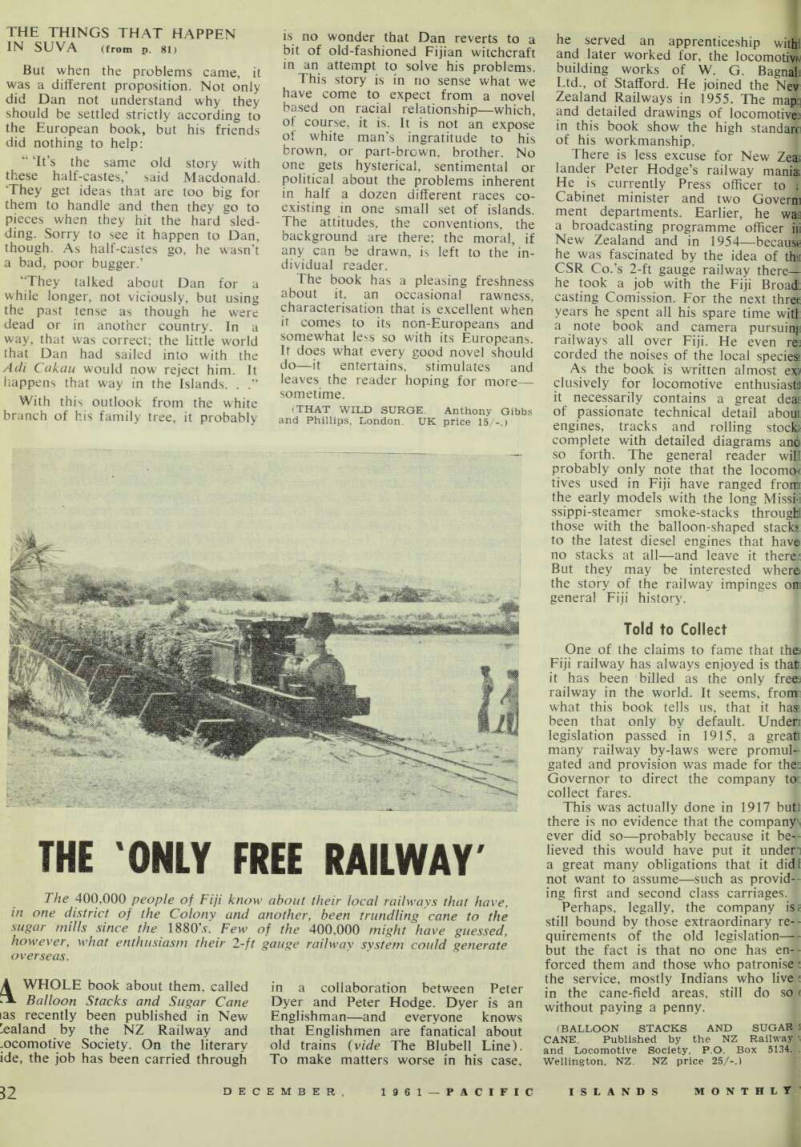
The 400,000 people of Fiji know about their local railways that have, in one district of the Colony and another, been trundling cane to the sugar mills since the 1880’x. Few of the 400,000 might have guessed, however, what enthusiasm their 2-ft gauge railway system could generate overseas.
A WHOLE book about them, called Balloon Stacks and Sugar Cane las recently been published in New Zealand by the NZ Railway and : ocomotive Society. On the literary ide, the job has been carried through
in a collaboration between Peter Dyer and Peter Hodge. Dyer is an Englishman—and everyone knows that Englishmen are fanatical about old trains {vide The Blubell Line).
To make matters worse in his case.
he served an apprenticeship withl and later worked for, the locomotivw building works of W. G. Bagnalt Ltd., of Stafford. He joined the Nev Zealand Railways in 1955. The mapq and detailed drawings of locomotives in this book show the high standarn of his workmanship.
There is less excuse for New Zeas lander Peter Hodge’s railway manias He is currently Press officer to \ Cabinet minister and two Govern] ment departments. Earlier, he was a broadcasting programme officer iii New Zealand and in 1954—because he was fascinated by the idea of thi CSR Co.’s 2-ft gauge railway there— he took a job with the Fiji Broadt casting Comission. For the next three years he spent all his spare time with a note book and camera pursuing railways all over Fiji. He even rea corded the noises of the local species As the book is written almost exs* clusively for locomotive enthusiasts it necessarily contains a great deae of passionate technical detail about engines, tracks and rolling stocks complete with detailed diagrams ano so forth. The general reader will probably only note that the locomo< tives used in Fiji have ranged from the early models with the long Missi-i ssippi-steamer smoke-stacks through! those with the balloon-shaped stacks; to the latest diesel engines that have no stacks at all—and leave it But they may be interested where the story of the railway impinges om general Fiji history.
Told to Collect One of the claims to fame that thea Fiji railway has always enjoyed is that, it has been billed as the only frees railway in the world. It seems, fromn what this book tells us, that it has been that only by default. Unden legislation passed in 1915, a great! many railway by-laws were promul gated and provision was made for thes Governor to direct the company to collect fares.
This was actually done in 1917 butt there is no evidence that the company\ ever did so—probably because it be lieved this would have put it unden a great many obligations that it did I not want to assume—such as provid ing first and second class carriages.
Perhaps, legally, the company is? still bound by those extraordinary re quirements of the old legislation but the fact is that no one has en forced them and those who patronise the service, mostly Indians who live e in the cane-field areas, still do so ( without paying a penny.
(Balloon Stacks And Sugar 5
CANE. Published by the NZ Railway \ and Locomotive Society, P.O. Box 5134. .
Wellington. NZ. NZ price 25/-.)