Magazine Section
pp. 73-97 · Read in the full issue
Pacific Islands Monthly
The Rise of Samoa
By R. W. Robson
The unrecorded human history of Western Samoa may go back 1,500 years. There is no clear :ation that there were people in the lovely Central Pacific archipelago prior to the first Polynesian •ation. The Polynesians—a varying mixture of the Indo-Aryan (Caucasian), Negroid and Mongoloid s —first spread out among the Pacific Islands, apparently from the northwest (or South-East Asia 3r), between 1,000 and 1,500 years ago.
is believed that the first migra on, a generally light-skinned le, reached the Samoan Islands became established there, and that point perhaps settled the pelagoes to the east and north ic theorists—and there are very / of them, and they rarely agree y there were earlier migrations, in same general direction; but that thrusts were made by folk who ed a larger admixture of Negroid, followed a more southern track. does seem to be established that iamoans have been there at least ousand years; that they are the
descendants of men who once were magnificent boat-builders, sailors and navigators; and that they have been separated a long time from their fel low-Polynesians in the South (Maoris), east (Cook Islanders, Tahitians and Marquesans) and North-East (Hawaiians).
They found in Samoa a very large, exceedingly fertile, beautiful, disease free archipelago in which the means of sustaining life were provided in overwhelming measure. Except for occasional invasions by related peoples in neighbouring groups— Tonga and Fiji in particular—they were left undisturbed for hundreds of years; and, apart from the fact that
they were everlastingly fighting among themselves, they developed a way of life that the first Europeans who came among them—around 1800 AD—found very pleasant and orderly. The Samoans were kindly, hospitable folk, and were not canni bals.
According to European standards,, the Samoan way of life, however well-ordered and sybaritic, was primi tive. They never made a written re cord, without which no race can make real progress; and, in material things, they had never learned the use of the wheel, nor of metal. On the other hand, they had developed high skills in the shaping of wood and
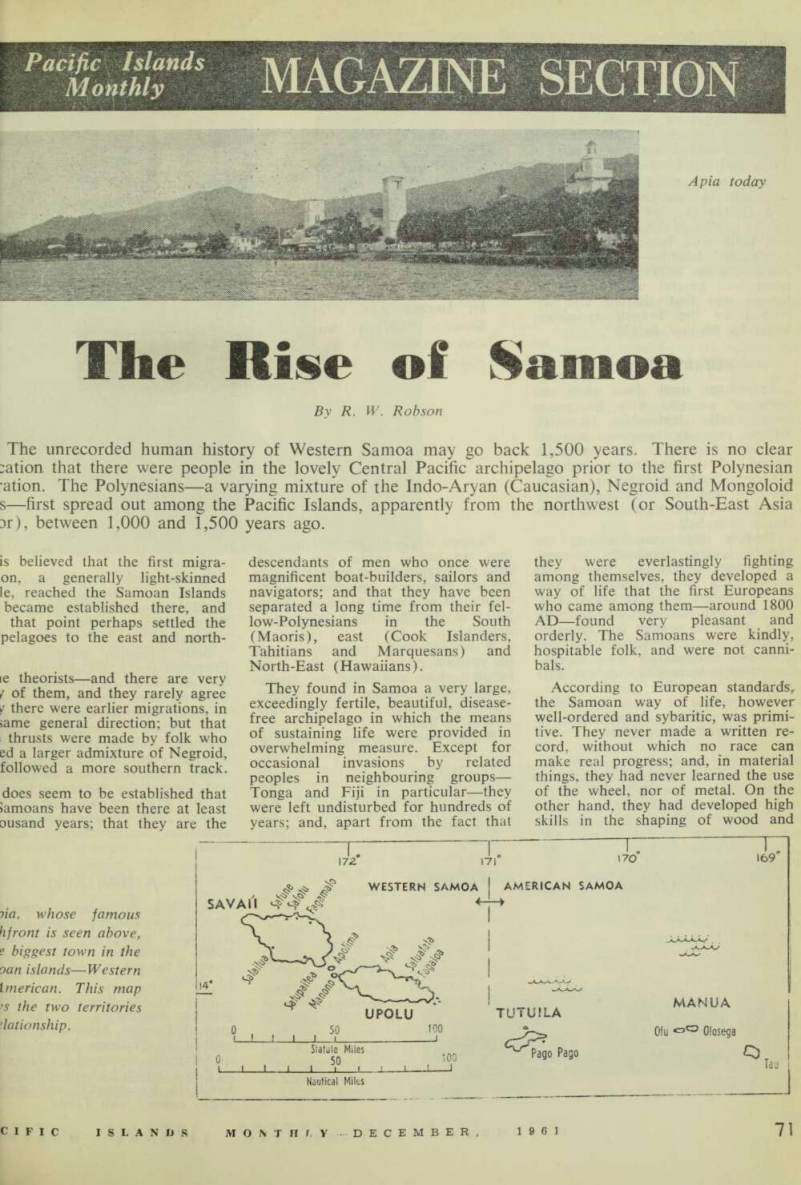
Apia today
[?]ia whose famous [?]hfront is seen above, [?]e biggest town in the [?]an islands —Western [?]merican. This map [?]s the two territories [?]lationship.
shell, the making of cloth from bark, the plaiting of cords from various fibres, the planning of villages and the construction of houses.
The expedition led by Dutchman Jacob Roggeveen brought the first Europeans to see the Samoans, but they only looked briefly at Manua in 1722, and sailed away.
Bougainville, the French navigator, on much the same track, saw Manua and Tutuila in 1768 and, impressed by the quality of the Samoans’ boats, and their skill, he called them the Navigators’ Islands—a name which stuck until the 1800’s, when “Samoa” came into general use. The archi pelago was first charted and de scribed by the French expedition under La Perouse, in 1787.
Drama Begins
From then until about 1840, the Samoans’ contacts with Europeans were wholly deplorable. Deserting sailors, runaway convicts, piratical sea-rovers, found a little paradise among these hospitable, trusting islanders; and, introducing liquor, fire-arms and the filthy diseases of Europe and Asia, turned it in places into a little hell.
Trading ships came among the islands, seeking foodstuffs, coconut oil, certain woods and fibres; and trading-posts were established. Some of the traders were of good class, and married Samoan women; and their efforts to protect and help the Samoans were supported by the Christian missionaries who entered the group in increasing numbers after 1830.
It is possible to record the known history of Samoa, thereafter, in a series of dramatic episodes.
Perhaps it should be explained, so that the casual reader can himself link these episodes together, that in the last 150 years, the growth and de velopment of Samoa has been shaped by three sharply-defined influences— namely: e An apparently ceaseless struggle for political power by the four noble familes which constitute the Tamai a-Aiga, and known as Malietoa, Tupua Tamasese, Mataafa and Tuimaleali’ifano. • The determination of the Chris
tian churches—or certain of them to establish their religion in this Poi nesian country. • The 19th century eagerness three nations (Britain, Germany s United States) —or some sections them—to gain possession of this n archipelago.
Both Christian missionaries ai European politicians did not hesitd to use the quarrelling Samoan f 3 tions for their own ends.
These conditions came partly to end when Germany acquiii supreme rights in 1900, although 1 Samoans still kept on squabbliJ among themselves; and wholly to end (except for the Mau trouble in 1914 when, as one result of Woe War I, New Zealand occupied as administered the former Gerrm colony.
A New King
In 1830, following a period furious wars and massacres, Maliett Tavita, a strong and wise Samos noble, established suzerainty on most of the group, and became KL of Samoa.
In 1830, the Rev. John William pioneer missionary of the new created London Missionary Socies arrived off Malietoa Tavita’s villas of Satapalili; anchored his Messen&: of Peace (which he built with his ov< hands in Rarotonga); and made e happy contact with Tavita.
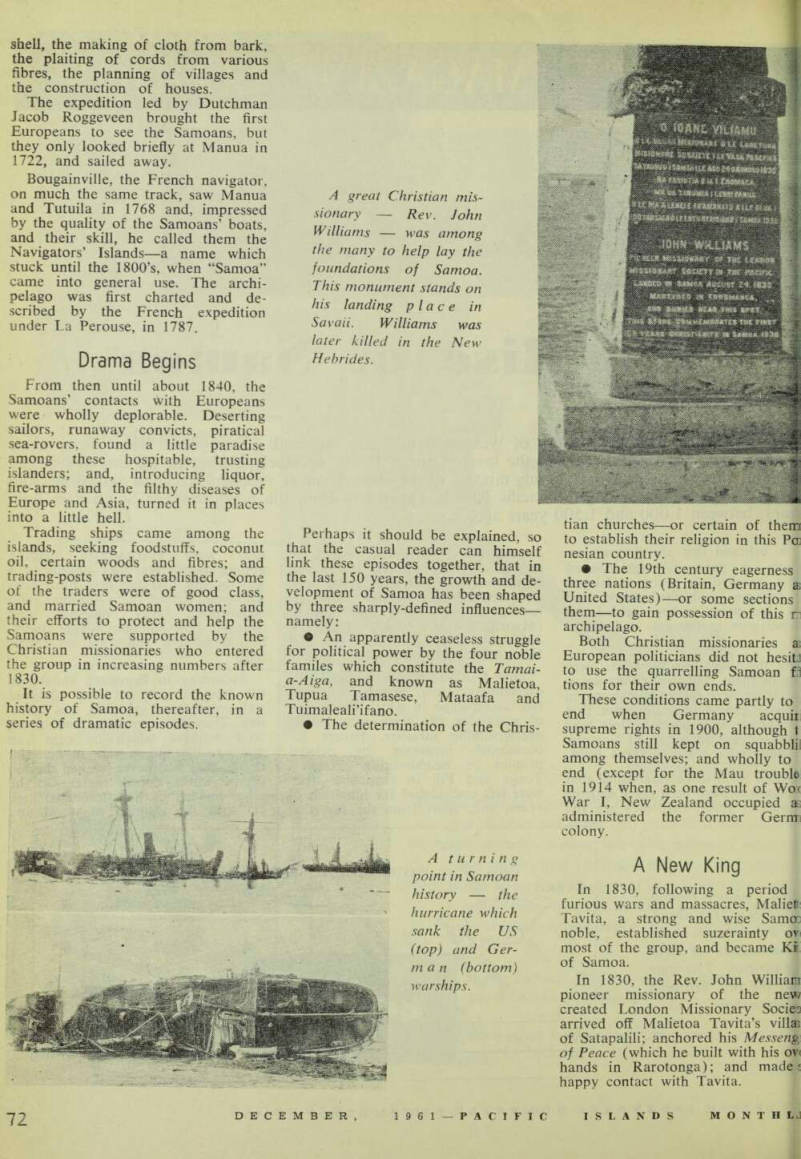
A great Christian mis sionary Rev. John Williams was among the many to help lay the foundations of Samoa.
This monument stands on his landing place in Savaii. Williams was later killed in the New Hebrides.
A turning point in Samoan history the hurricane which sank the US (top) and Ger man (bottom) warships.
reat stone monuments in Sata -1 village, to Williams and to ita, commemorate the meeting, bear testimony to the fact that reat missionary, assisted by a t native king, laid the foundations he future Samoan nation, fithin ten years, Christian mis aries—European and Polynesian— j all over the group, bringing re n and education to the Samoans, he strong and wise Tavita ruled lallenged as King until he died 841; and then his son Moli as ed the throne. But he lacked igth, and his claim to kingship disputed by other chiefs claiming illy royal blood, and soon there a resort to arms, eft to themselves, the Samoans jably would have settled the ter, as heretofore, by fighting aselves into the ground. But by there were rival groups of Euro i traders in Samoa, who took s. he first traders were English, but r soon were followed by Ameri > and Germans; and Britain, ted States and Germany presently doped a colonising impulse in South Seas which was expressed intense rivalry in trade, and—in case of Samoa—demands for an ation. France was rather busy in
this period in the areas of New Cale donia and Tahiti, and never became involved in Samoa, Britain appointed her first Consul i n Samoa in 1847. He was the rather famous George Pritchard who, as a very active anti-French LMS mis sionary in Tahiti, had resisted the de thronement of the Pomare family by the French, and so precipitated a crisis between Britain and France. He w as deported by the French and ! ate f established himself as a trader m Apia; and he was succeeded by his son » the well-known W. L. Pritchard, who was both trader and British Con su\. i. n Samoa before he went on to Frj l in a similar capacity. One writer has given to the Pritchard store in Apia the credit of organising the first regu i ar sa i e G f European liquor to X"* „ at - the Samoan natives.
Intornatinnal Pix/alrv
1111617131101131 KlV3iry
xh e United States appointed its first Commercial Agent in Samoa in 1853; and in 1855 the famous Ham burg firm of J. C. Godeffroy made Apia the headquarters of its South Seas enterprises. Its general managers —at first August Unshelm and, later, the famous Theodor Weber—were the recognised official representatives of Germany.
These Consuls naturally were
deeply concerned with the interna tional rivalry.
Britain officially wanted no annexa tion—only freedom to trade—but her missionaries did. The Americans at first were not interested—they were too busy with the Civil War—but when that ended, in the late ’sixties, there was intense American interest in trying to force a reluctant Congress to accept a Protectorate over Samoa.
The Germans, led by Unshelm and Theodor Weber, and using Apia as a base for all their Pacific Islands ac tivities, were thrusting on in trading and in land ownership. Weber, for example, bought 75,000 acres from the Samoan chiefs for his firm in the early ’sixties.
During this period, 1841-1870, the kingship seemed always in the melt ing-pot; and each of the three white communities generally was backing a candidate, in the hope that he might get the top job, and give his backers a dominating influence in Samoan affairs.
German Traders
It was in 1861 that Andrew and Charles McFarland established a big trading business in Samoa; and in 1868 August Nelson arrived, and be gan trading at Safune, and thus estab lished the big trading concern of O.
F. Nelson & Co., which now has been operating for nearly 100 years.
Due to over-trading, and heavy losses in the Franco-German war, Godeffroy & Son went bankrupt, and out of that wreckage was formed a famous German trading corporation, called by a name so long that it was universally known as the DH and PG, or “the Long-Handle firm”. From the 1870’s until World War I it had a big influence in German-Pacific af faire- . . , , This was a very active period ot trading in Samoa. The Germans were expanding rapidly, and the Americans were thrusting in and, although Eng land kept out of political develop-
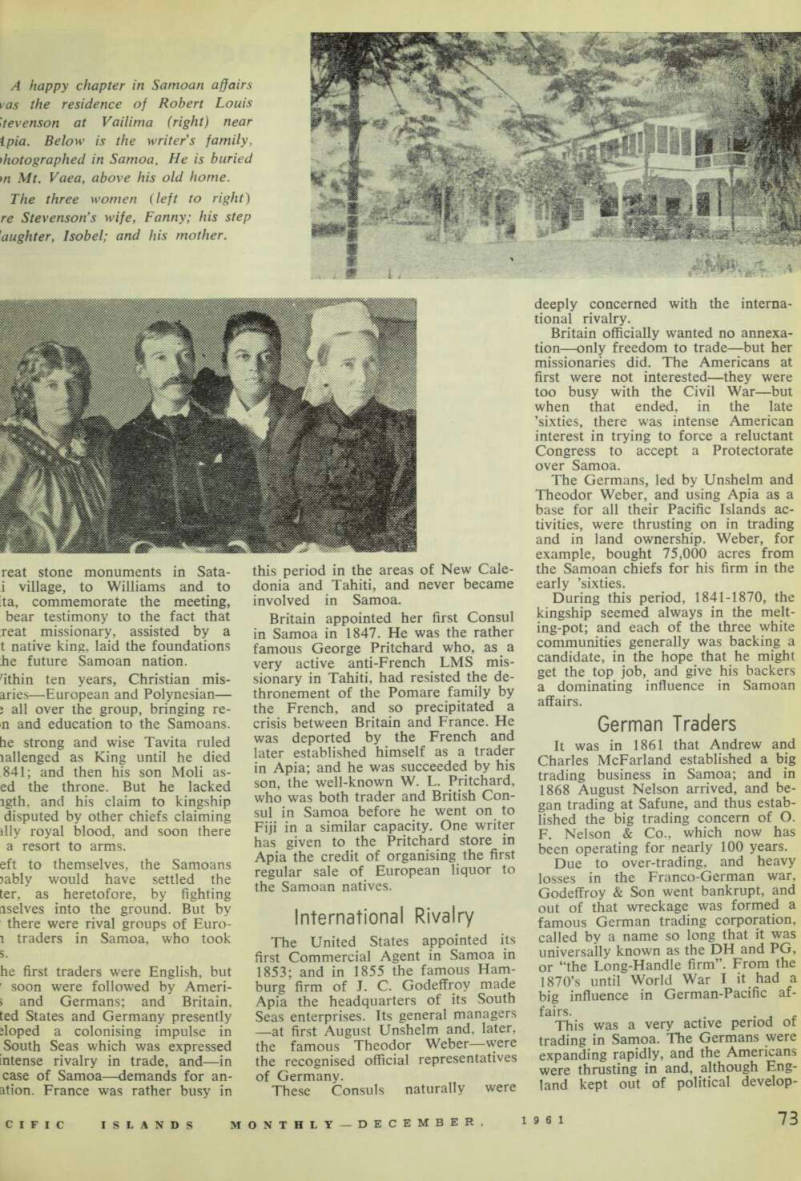
A happy chapter in Samoan affairs [?]vas the residence of Robert Louis
[?]I tevenson at Vailima (right) near
[?]pia. Below is the writer’s family, [?]hotographed in Samoa. He is buried [?]n Mt. Vaea, above his old home.
The three women (left to right ) [?]re Stevenson’s wife, Fanny; his step [?]aughter, Isobel; and his mother.
Time of Turbulence
ments, there was plenty of what might be called an interference impulse from the new colonies of Australia and New Zealand.
The records of that time (around 1870) show that along the two miles of beach, which represented the trading centre and port of Apia, there were no less than 20 hotels and saloons, and an equal number of brothels, An event of that period shows the conditions that prevailed, A section of Samoans wanted Malietoa Laupepa, son of Malietoa Moli, as their king—he was a weak type who had been trained and educated by the LMS missionaries and was strongly supported by them. Another section favoured Malietoa Talavou, who was Laupepa’s uncle.
Finally, after endless intrigue and skirmishing, a savage battle began on Good Friday, 1860, along the shores of Apia Bay. Talavou’s forces were based on Mulinuu (western point of Apia Bay), and Laupepa had his headquarters at Matautu, on the eastern point.
Tiwil War
Vjvii Wdl
For three days the Samoans fought from end to end of Apia, all around and about the houses and stores of the Europeans, but no European was interfered with. On the contrary, many stories are told of how, when European men or women came along the beach road between Matautu and
Mulinuu, the contending armies would respectfully cease fire and step aside until the Europeans were out of danger.
Fighting continued sporadically for another three years, The Samoans—usually encouraged by the Europeans—were so wrapped up in their political quarrels and their battles that they neglected their own interests and many were near star vation. They sold everything they had in order to buy foodstuffs, arms and ammunition; and it was during this period that many Europeans bought valuable lands at ridiculously low prices.
About 1869, the Polynesian Land and Commercial Company was in corporated in Honolulu by certain Americans, “with a view to getting possession of all available land in what are now known as the Naviga tor Islands”,
Copra \S KinQ
It was the German organisation, DH an d PG, in Samoa, which rea l|y launched the copra industry The Germans discovered that it was easier to ship the dried kernel of the coconut, and mill it overseas, than to depend upon the natives to extract the oil from the kernel and bring it to them in jars. Once this practice was established the copra industry de veloped very quickly and profitably, and the Germans instead of depend ing upon wild coconuts gathered haphazard, began to plant coconut
plantations systematically in Same and also in Micronesia and Ne 1 Guinea.
In the early 1870’s the Europee communities, heartily sick of ruinoc native wars and political troubld made their first real attempt to brii the quarrelling factions together, establish stable government. But tl; was defeated by the Steinberger I cident.
By 1870, America was recoverii from the Civil War, and certs American interests wished to establr a regular line of the then new steau ships, between San Francisco ai Australia. They sought rights ov Pago Pago, for use as a coalii station. This alarmed now recovering from the Frano German War and eagerly seekii Colonies—and Britain, who want* the status quo.
President Ulysses Grant, prompt! by American shipping tycoo William Webb, and the Polynesii Land Company, sent Colonel A.
Steinberger to Samoa in 1873 examine the Samoan situation. He cb so thorough a job that the Samoae insisted he was one of the very fe' white men they would trust; aii after he had formally reported President Grant in 1874, and o gaged in certain other activities whii involved a visit to Germany, he r turned on his own account to Samr in 1875. He organised an efficiei; independent native government ft Samoa, put in Malietoa Laupepa King, and made himself Prin Minister.
Steinberger Era
The Samoans always afterwards i sisted that his rule was humane au sound, and that he protected tho against the extortions of the Apic based European communities. E cleaned up the drinking-dens and tt brothels, brought order into Ap:c and displayed strength in checkii the European claims to Samoan lam Among other things, he fougg bitterly with the emissaries of tit
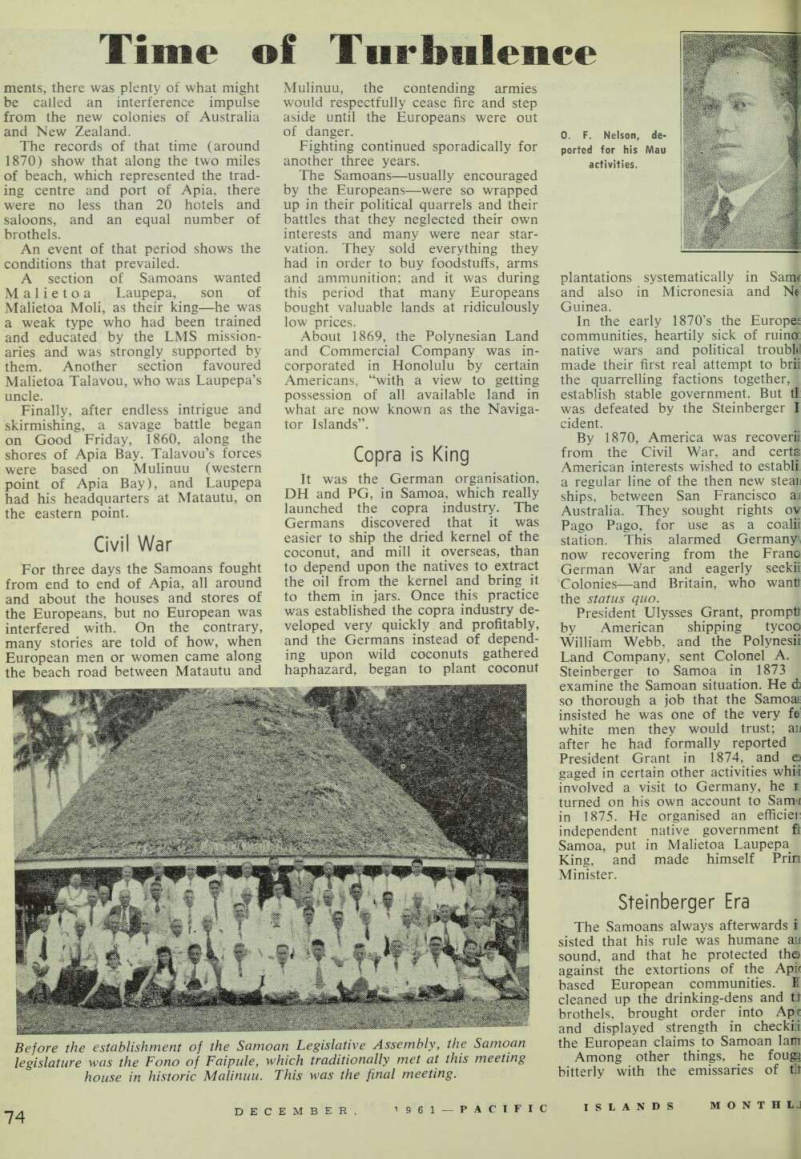
Before the establishment of the Samoan Legislative Assembly, the Samoan legislature was the Fono of Faipule, which traditionally met at this meeting house in historic Malinuu. This was the final meeting.
O. F. Nelson, de ported for his Mau activities.
ned king; but two more claimants 2 from the noble families ruling districts—Tamasese and Mataafa. erally, the British and the iricans supported Laupepa, and nan support went to Mataafa Tamasese. uring the 1880’s German strength ambitions grew rapidly. The Ger s deported Malietoa Laupepa, and pd much authority in the hands amasese and Mataafa. There was casing menace in the way in :h the three nations watched i other, and the factional fighting, stationed their warships in oan waters. he situation was exceedingly
serious in 1888. One hasty move by the parties concerned would have started the warships of the three Powers shooting at each other, By mid-March, 1889, no less than seven warships lay inside the reef opposite Apia—three German, three American and one British. The weather was menacing, but the poli tical tenseness was such that the war ships would not move out to sea, for greater safety.
The hurricane of March 16 struck Apia harbour, and the three Ameri can and three German ships were either wrecked or thrown ashore— the Germans lost 92 men and the Americans 54. The one British ship
Calliope managed to steam out to sea without loss.
One or two of the German and American ships were salvaged but the hurricane put an end to the threat of war that had been developing there; and within six months (on June 14, 1889) the Berlin Treaty was con cluded. Under it, an “independent” government was set up under Malietoa Laupepa; but it was one in which the Consuls of the three Governments had a dominating voice.
During the 1880’s, a German ar tillery officer named Captain Brandeis came out to the service of the Ger man firm; subsequently attained much influence and power in Samoan
[?]nesian Land Company, and their [?]ting brought him down early in [?]. There was a sharp skirmish, some deaths, at Mulinuu, and [?]berger, and the former United [?]s Consul, Jonas M. Coe, were [?]d by the captain of a British [?]hip and forcibly removed from [?]oa. [?]ll this was very much against wishes of the native Samoan gov [?]ncnt. The British Admiralty subse [?ntly sacked the naval captain and [?]d Steinberger’s appeal for com [?]ation. But that was the end of attempt to establish sound oan government, and there en several more years of interna [?]l intrigue, and fights between Samoan factions over the king 1880 Malietoa Talavou died Malietoa Laupepa was pro-
During her rise to indepen dence, West Samoa was at times the unhappy pawn of international rivalries. At one stormy period at the end of last century, Britain, Germany and the United States almost went to war over her. These two pictures illustrate her two longest periods under foreign flag Apia on the Kaiser's Birthday in the early years of the century, and Apia during the King's Birthday Regatta in 1923. On January 1, Samoa at last flies her own flag.
A Federation Failed
affairs; and finally was sent away in disgrace—a curious parallel of the Steinberger Incident.
Another strange event of that time was seen in an attempt made by one of the last kings of Hawaii to set up a Polynesian Federation, with the King of Hawaii in its forefront.
On January 3, 1887, there arrived in Apia the Hawaiian armed cruiser Kaimi\o<i, carrying a delegation under envoy J. E. Bush. Bush had been sent by a man named Gibson, who had made himself Premier of Hawaii, to negotiate for a Confederation of the Pacific Islands.
Decorative uniforms and Hawaiian Orders were presented to the Samoans, and on February 17, 1887, a Deed of Federation actually was signed by Malietoa and the Chiefs— but that was the end of it.
Political troubles of all kinds were then descending upon Malietoa and, within three months, he was a fugi tive, while Tamasese, with Captain Brandeis as Premier, was claiming the kingship.
Meanwhile, things were going seriously wrong in Hawaii, and neither money nor supplies were sent out to the Hawaiian delegation in Samoa. Finally, the ship’s plate and gear were bartered for food—and the affair ended in a complete fiasco.
Berlin Treaty
The Berlin Treaty of 1889 brought no permanent peace. It restored Malietoa Laupepa to his throne, with Mataafa supporting him; but by 1891 Mataafa had drifted away from Malietoa and was setting up an inde pendent kingdom of his own.
In 1890 Robert Louis Stevenson arrived and established himself at Vailima, and from his writings we get much of the history of the signi ficant decade between 1889 and 1899, when active war between the rival chieftains finally drove the three jealous powers to a settlement which established peace in the archipelago.
By the settlement of December, 1899, the Berlin Treaty was com pletely annulled; Germany annexed Western Samoa; the United States acquired Eastern Samoa and Pago Pago; and various German claims in other South Pacific Islands—more especially Tonga and the Solomons— were abandoned in favour of Britain.
Incidentally, that is why the islands of Bougainville and Buka, which geographically are in the northern Solomons, are now part of the Trust Territory of New Guinea, and ad ministered by Australia. In that 1899
settlement Britain took all the Solo mons except Bougainville and Buka, which then were added to the Ger man Colony of New Guinea—and, as everyone knows, the German Colony of New Guinea was taken over by Australia under Mandate at the end of World War I.
The German flag was hoisted in Apia on March 1, 1900, and Germany wholly controlled Western Samoa for 14 years. The turbulent little country was on the whole governed firmly and well, but it took years to dis courage the kind of political agita tion to which apparently the Samoans always had been accustomed. The Germans developed Samoan re sources with vigour, and put in the structure of what appeared to be a sound Colonial administration.
This era ended suddenly with the outbreak of World War I, in 1914.
NZ Takes Over
On August 29, Colonel Robert Logan arrived in Samoa with 1,365 New Zealand troops and formally occupied the German Colony, with out serious opposition—the German administrative staff, with German Governor Schultz, were sent to New Zealand for internment.
The New Zealanders continued the administration as organised by the Germans and the German ordinances and policy were continued, without notable incident, until 1919-20.
But after World War I, from Sep tember to December, 1918, the “black” influenza epidemic raged in Samoa, and there were between 6,000 and 7,000 deaths, and the Wes tern Samoan population was reduced to about 32,000 or 33,000.
In all the troubles which have beset Samoa in her chequered history there was no greater disaster than this. The speed with which the little country recovered from that blow— its population now is over 100,000 — is testimony to the strength and virility of the Samoan race.
The next decade in the history of Western Samoa—roughly, 1920 to 1930—was the first decade of ad ministration by New Zealand under the Mandate system, contrived under the Treaty of Versailles, of 1919.
Theoretically, all the German colonies taken from Germany under the Treaty became League of Nations Territories, administered in Trust un der Mandates; and Mandates to ad minister were divided into A, B and C classes. Mandates were entrusted mostly to the countries which had (Continued on p. 92)
occupied the Colonies in World Wa I.
Australia, for example, took ove German NG under a “C” Clasj Mandate: Japan got Marshall am
dine Islands under “C”; and New and was given Western Samoa under a “C”. A “C” Mandate it that in the League of Nations ion the people concerned were capable of any form of self rnment, and the Mandatory was pletely responsible for adminis m. those first 10 years New Zea s record in Western Samoa was :rom happy. The little Dominion had no experience in this respon ty. It very conscientiously ied laws in which Samoan tradi ; and customs were observed and 'hich it included the best in the nan Ordinances and Regulations, len it handed the duties of ad stration over to men whose only ification was that they had held rank in the New Zealand Army, s there was put in charge of tern Samoa a line of colonels, who, through lack of knowledge experience, were incapable of lling this “Ireland of the Pacific”, tie stern measures of the Germans 'een 1900 and 1914 and the defi y military character of the ad stration from 1914 to 1919 had luraged the Samoans’ customary ;ical activity and rebellious spirit; as soon as the country settled n under the NZ Civil Administra , troubles began. he expropriation of all German >erty; the conversion of the large tes of the DH and PG into the -known New Zealand Reparation tes; and the manifold readjust ts thus made necessary created imerable social, political and lomic problems—and the gentle i now in charge were woefully in ible of handling them. Injustices 5 perpetrated against both Samoan non-official European property ers, and some of the latter there n made common cause with the loans.
The Mau
he tendency of the NZ authorities to ride rough-shod over the in lerable harassing complaints cted to them; they invoked police on frequently; and finally the loans brought into existence in 5-26 a rebellious, and in some ree subversive, native organisa called the Mau. he Mau was supported by some minent Europeans, among whom O. F. Nelson was conspicuous, icre had been a Mau organisation ve in the German time, but the •mans suppressed it.) lecords show that Europeans who e active in criticism of the NZ linistration —although not neces ly in sympathy with the Mau—in
eluded Messrs. O. F. Nelson, S. H.
Meredith, E. W. Burr, A. Williams, A. G. Smythe, G. E. L. Westbrook.
The New Zealanders tried quite sincerely to find answers to the various grievances, and to a degree they succeeded; but when the Mau, with a good deal of European support, continued its agitation in various forms, the Administration seemed to lose patience and resorted to police action, civil prosecution and finally deportation of leaders. Between November, 1926, and July, 1927, the Administration issued no less than 59 Orders of Banishment, There were various official inquiries and finally a Royal Commission of investigation late in 1927,
whose findings generally supported the Administration.
The Samoans remained defiant, and in 1928 New Zealand sent a couple of cruisers and finally a large body of special police to maintain order, In December, 1929, the Mau paraded in strength in Apia to wel come home Mr. A. G. Smythe, who had been fighting some of their battles in New Zealand. Conflict with the police resulted in the deaths of Chief Tamasese, ten other Samoans, and one of the special constables. The Mau fled into the bush and, during 1930, were hunted by special parties of armed men from NZ warships, The Mau was declared a seditious organisation. (Over)
In the next two or three yes there was constant friction and occ sional conflict between the more ( section of the Samoan peog and the Administration. Mr. O.
Nelson, who acted as spokesman ! the Samoan extremists, was frequenr in conflict with police, and finally was sentenced to imprisonment a deportation.
This era of restlessness and po tical disturbance and frequent co flict really lasted from about IS until early 1936, when New Zeala elected its first Labour Governme A New Zealand Ministerial delej tion immedately was sent to Samoaj reconcile the conflicting factions; t declaration of Mau as a seditio organisation was revoked; vario other laws made for Mau suppressii were revoked; and Mr. O. F. Nels and his family were returned Samoa as guests of the Governme; Another important thing done the Ministerial delegation in 19( was seen in a decision to deport fro Samoa the remnant (some 200) the Chinese labourers who had be brought into the Territory by tJ German Government and allowed settle there. One effect is seen in t) fact that Western Samoa, now wr 100,000 people, is the only lan territory in the South Pacific whii does not include a sharply-define well-established community of Asia —although, of course. Weste Samoa, as is well-known, is the hon of about 7,000 or 8.000 Europea Samoans, and a small number Asian-Samoans.
Restless 'Thirties
The Territory in the ’Thirties w< generally regarded as a restless, sera rebellious country. Few, if am thought of it in terms of se; government and independence.
What has happened in the ensuir quarter-century, so that (in the wor of Professor J. W. Davidson) “o January 1, 1962, it is expected to tl come an independent State and tl; first Pacific Islands Territory to ha* passed through a period of coloni rule and gained full independence; The whole story is set out in dets in “The Transition to Independent in Western Samoa—the Final Stage written recently by Professor Davii son.
The process of political and co;< stitutional development was com menced about 1947, by both Nes Zealand Government and UN Trra teeship Council agencies, and it h;j been pressed on steadily during til ensuing 14 years. The NZ Prim Minister, in 1953, made a comprr
ive statement in which he an iced that a Constitutional Con on would be set up, in close nation with the Samoan people. ;gan work in 1954. le most important step was the dishment, in 1958, of a Working mittee on Self-Government, h was largely dominated by the :>ans themselves, and which >d the steady movement from the ing of the Constitution to inte on with the processes of planned government, through the intro ion of Cabinet Government in . and the final drafting of the ititution, to the acceptance of the dilution by plebiscite on May 9, , and the final agreement to the ititution and self-government by Trusteeship Council and the As )ly of the United Nations late in
The Constitution
though New Zealand was help in every possible way, the aans decided in 1958 to seek their :ipal adviser outside New Zea , and they selected for that pur- Professor T. W. Davidson, of Australian National University, had lived in Samoa and was m to the Samoans. Most of the t for the shapeliness and order s of the procedure since 1958, for the harmony between the re l Trustee (New Zealand) and Samoans, is due to his skill and iere were very awkward prob to be solved. For example: The future citizenship of those hitherto had claimed European s.
TTie protection of the property hose who do not take Samoan mship.
The form of suffrage to be em ed, in view of the Samoans’ tra nal inclination towards the Matai m (voting not as individuals, but agh the head of the family) and Trusteeship Council’s support of adult system.
The future status of indepen- Samoa in relation to the British imonwealth. »me have been solved, provision —others still are in the air. owever, with tolerance, patience skill, for which full credit must ;iven to Professors Davidson, of tralia, and Aikmann, of New and. the country has reached the t where it now is ready to step into national independence— :h means also that it will be on )wn in a cold, hard world where lism is finished with and realism t be faced.