Never Like This
pp. 63-65 · Read in the full issue
[?]dneyiider Goes Walkabout
The Pacific Was Never Like This
This is Hawaii—the first hint of the tropics in her balmy r—and the inherent instinct of most Americans to make n of themselves in gaudy attire, in fuller flower than the cal hibiscus.
EVERY horrible thing said about tourists and their fancy dress, in other ports in the Pacific, comes true in Honolulu. In its male form, it erupts in an epidemic of wild, hula shirts.
Or in the garments called shorts, which in the United States mean an article with the cut and drape of a pair of slacks sawn off at the knees.
With these, the accepted adjuncts are a hang-out shirt and a pair of coloured, city sox that end two inches above the ankle bone. Hawaiian men also, occasionally, wear girly mata dors.
The female of the species, as Kip ling once said in another context, is more deadly than the male. She arrives from the mainland, hot in civilized clothes and swathed in tiers of leis. (You can wire ahead and arrange to be suitably draped). With in 24 hours, after surreptitious visits to the shops in the hotel lobby, the metamorphosis has taken place; with in 48 she is indistinguishable from the “Hawaiians”. (Or something.) Probably it is a muu-muu, that hideous, rich relation of the New Guinea “Mary’s blouse” or Mother Hubbard, on which her errant fancy has lighted. She has divested herself of her foundation garments and put it on, and although she probably looks like a milk-cow done up in a bag, she wears it, so help me, with aplomb.
The American female tourist d9es not believe in this business of growing old gracefully; she may be fat and pear-shaped; or stringy, like a piece
of sun-dried meat, but if it is fashion able, she’ll give it a go.
Feminine ingenuity does not stop with the muu-muu, or its long, fish tailed variant which is called some thing else and, so far, has not made such an impact on fashion. In Hawaii there are a 100 other peculiar local garments that have never seen the in side of a couturier’s workshop. Some billow, some are tight; they come long, medium or short. Some show the Chinese influence; or Japanese; or Filipino. Some are split up the sides; some down the front. But whatever, they are all different to what you had back home —so why hold back, you’ve got to be in it to win it.
On the eve of departure, Papa puts on his dacron-and-wool business suit; Mama gets back into her foundation garments, which after the comfort of the muu-muu probably hurt. They are draped again with leis, go to the airport—and depart. Two more satis fied customers. . „ jr> Why are they satisfied? Un doubtedly by the myth of the Pacific and not its realities.
That Pacific
Mystique
Americans are suckers for the Pacific—but they like it from a i lanai suite, with bath, and who can blame them? If you are a tourist, in America, you may be a vulture for the culture of the Navajo Indians but do you want to live in a tepee in the middle of the Painted Desert?
They call their West Coast the Pacific Coast, do up teaspoonfuls of the ocean in polythene bubbles and send them on postcards to the tolks back home. (over)
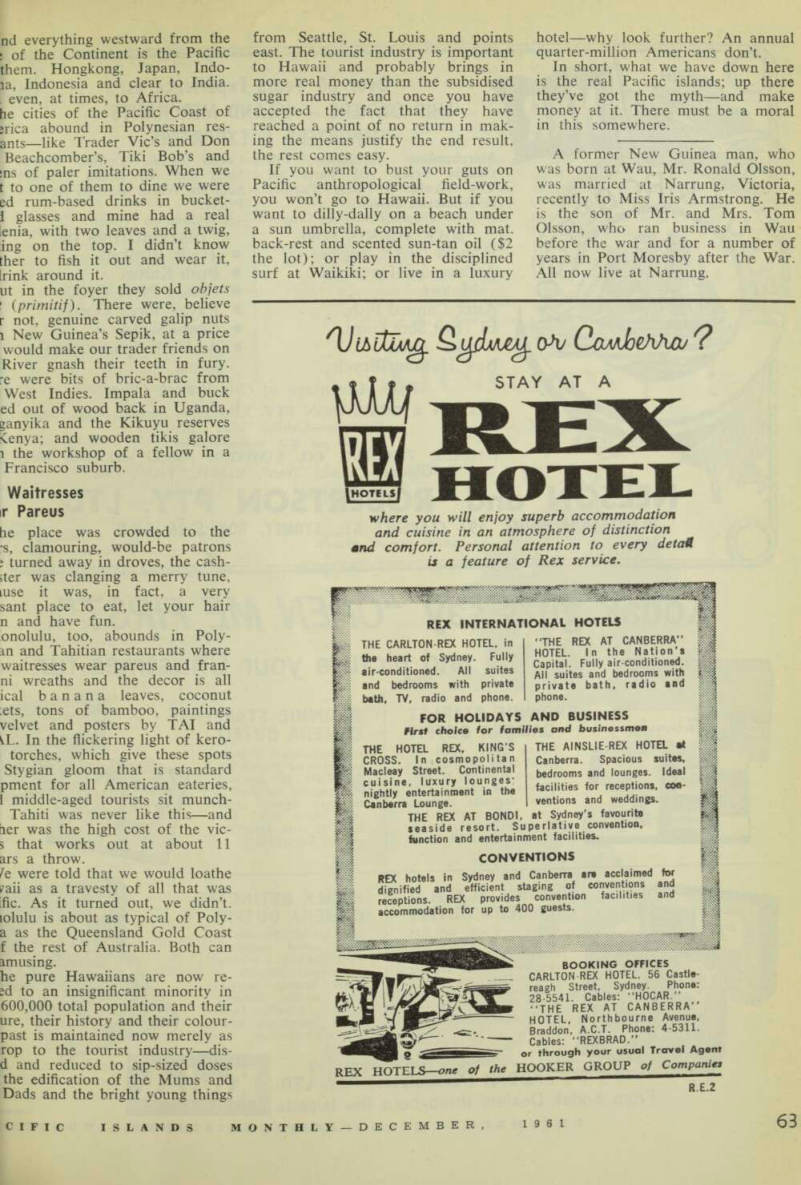
Flitted Through By Fishes! There
be a fortune in this for someone [?]ide of the ocean. This is a post-card, [?]ble on the Pacific coast of the USA at [?]about 5/- in Australian money. The polythene bubble stapled to the top [?]ns a teaspoon of water—allegedly from [?]acific —and some grains of grey sand, [?]ords beneath are: [?]ind swept, sun kissed. Graced with the [?]flakes of ore from Pacific coast streams; [?]ed by sandy beaches, flitted through by [?]w coloured fishes and greatly admired [?]est coast inhabitants." [?]itors to the Pacific coast are supposed [?]t a stamp on the back and post the [?]to their friends. What the friends do [?]it, we hate to think but only the high of the experiment prevented us from [?]ig some to our more rugged Pacific [?]s friends to get their reaction.
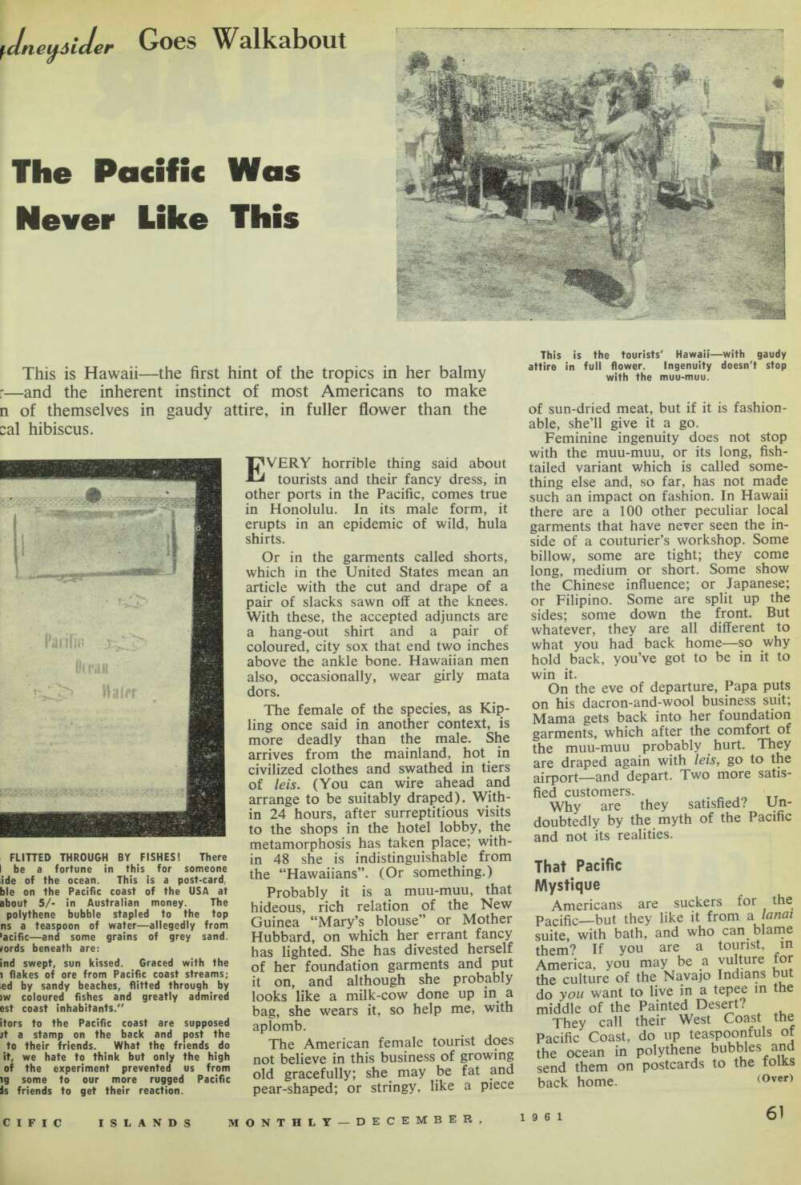
This is the tourists' Hawaii—with gaudy attire in full flower. Ingenuity doesn't stop with the muu-muu.
nd everything westward from the ; of the Continent is the Pacific them. Hongkong, Japan, Indo la, Indonesia and clear to India. , even, at times, to Africa, he cities of the Pacific Coast of ;rica abound in Polynesian res ants—like Trader Vic’s and Don Beachcomber’s, Tiki Bob’s and :ns of paler imitations. When we t to one of them to dine we were ed rum-based drinks in bucket -1 glasses and mine had a real lenia, with two leaves and a twig, ing on the top. I didn’t know ther to fish it out and wear it, [rink around it. ut in the foyer they sold objets ' (primitif ). There were, believe r not, genuine carved galip nuts i New Guinea’s Sepik, at a price would make our trader friends on River gnash their teeth in fury. :e were bits of bric-a-brac from West Indies. Impala and buck ed out of wood back in Uganda, ganyika and the Kikuyu reserves Cenya; and wooden tikis galore i the workshop of a fellow in a Francisco suburb.
Waitresses r Pareus he place was crowded to the •s, clamouring, would-be patrons ; turned away in droves, the cash >ter was clanging a merry tune, iuse it was, in fact, a very sant place to eat, let your hair n and have fun. onolulu, too, abounds in Poly an and Tahitian restaurants where waitresses wear pareus and fran ni wreaths and the decor is all ical banana leaves, coconut :ets, tons of bamboo, paintings velvet and posters by TAI and ln the flickering light of kero torches, which give these spots Stygian gloom that is standard pment for all American eateries, 1 middle-aged tourists sit munch- Tahiti was never like this—and tier was the high cost of the vic -5 that works out at about 11 ars a throw. te were told that we would loathe /aii as a travesty of all that was ific. As it turned out, we didn’t, lolulu is about as typical of Poly a as the Queensland Gold Coast f the rest of Australia. Both can amusing. he pure Hawaiians are now re sd to an insignificant minority in 600,000 total population and their ure, their history and their colour past is maintained now merely as rop to the tourist industry—-dis d and reduced to sip-sized doses the edification of the Mums and Dads and the bright young things
from Seattle, St. Louis and points east. The tourist industry is important to Hawaii and probably brings in more real money than the subsidised sugar industry and once you have accepted the fact that they have reached a point of no return in mak ing the means justify the end result, the rest comes easy.
If you want to bust your guts on Pacific anthropological field-work, you won’t go to Hawaii. But if you want to dilly-dally on a beach under a sun umbrella, complete with mat. back-rest and scented sun-tan oil ($2 the lot); or play in the disciplined surf at Waikiki; or live in a luxury
hotel—why look further? An annual quarter-million Americans don’t.
In short, what we have down here is the real Pacific islands; up there they’ve got the myth—and make money at it. There must be a moral in this somewhere.
A former New Guinea man, who was born at Wau, Mr, Ronald Olsson, was married at Narrung, Victoria, recently to Miss Iris Armstrong, He is the son of Mr. and Mrs. Tom Olsson, who ran business in Wau before the war and for a number of years in Port Moresby after the War.
All now live at Narrung.