The South Seas
pp. 55-59 · Read in the full issue

Their Hearts Are In
Irish, American and Blown-away Samoan
Islands people have always been prodigious travellers but w, as a sign of these confused times probably, they are also :oming settlers in foreign places. For reasons of geography i climate, the Pacific coast of the United States has a grow ' quota of people who spend some part of their time thinking stalgically of "the Islands”.
SOME —like Tom McCuaig and Ralph Craib—have been ex posed to the Islands’ virus for com paratively short times but are none the less enthusiasts. Both are news papermen—Tom near Los Angeles on the San Gabriel Valley Tribune and Ralph on the San Francisco Chronicle.
The Republican
Tom was the editor of The Fiji Times for a couple of recent years, until itchy feet drove him to Honolulu and now to California. He’s still a wild Irishman, still plans to return home, someday, and take a more active part in furthering the Republi can cause.
In the meantime, he’ll show Islands visitors Los Angeles—what you can see of it for the smog—at the drop of a hat. He took us to a place called Ghost Town on the outskirts
of the city and that is where the photo of Tom was taken—outside the Silver Dollar Saloon (where they sell only root-beer and coke).
Some millionaire with a pretty shrewd idea of mass American psy chology, has transplanted whole streets from deserted Western towns to a large area of suburban dust and gum trees. Characters dressed in 1850 fashions, Indians with feathers, imita tion sheriffs and cowboys roam amongst it for the edification of the thousands of visitors, mostly adults, who come to inhabit this dream world briefly and to play cops and robbers with the “sheriff” and his “deputies”.
The erroneous impression it gives overseas visitors of even modest in telligence, of course, is that all Americans are of a mental age of no more than 14.
The Expert
Ralph Craib first saw the South Pacific on a Qantas Press junket six or seven years ago. When fellow journalists were taking a look at the flesh-pots of Australia, he took a ride to New Guinea and on the strength of a few days there says he became an “expert” when he got home.
But because he was an “expert”, he later was given a Fellowship to spend about 18 months in Australian and Netherlands New Guinea. He re turned to New Guinea earlier this year, under his own steam, for a
shorter period.
Like Tom McCuaig he likes to show you his town but with San Francisco has a bit more to show.
As he says—Sydney has the prettiest
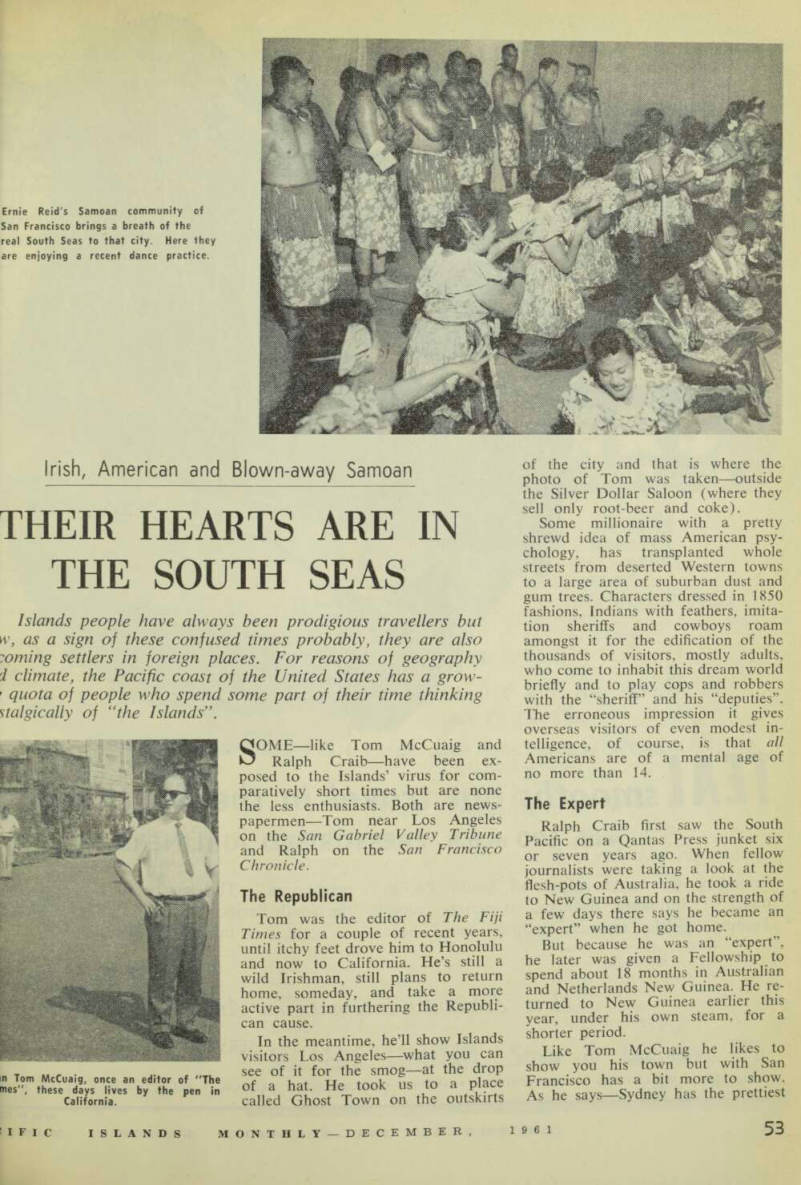
Ernie Reid's Samoan community of San Francisco brings a breath of the real South Seas to that city. Here they are enjoying a recent dance practice.
In Tom McCuaig, once an editor of "The mes", these days lives by the pen in California.
ur; San Francisco the prettiest is. re closely related to the Islands le Glucks, who live out in the ind suburb of Hillsborough San Francisco’s International rt, in the fabulous kind of house we imagine all Americans live util we’ve been there to see for ves that they don’t.
ess with Monkeys
iford Gluck served in the US r orce, in Fiji, during the war. it he returned to Suva for Pan ican Airways, and during this 1 time round he married lona rson. Next move was to Singa about the time medical science to be really interested in eys for research and more par rly for the manufacture of anti- Salk vaccine. i American Airways transported of these animals and manager was in a position to see that was room for someone in the ry to organise things from the / end—it then being a pretty nd miss affair of Any Old ey Will Do. im this idea has grown the ihing business of Asiatic Animal ts Inc. which will import you ing from a spiny ant-eater to a elephant but which still makes of its money from monkeys for al research. (Some chimpanzees recently imported with the idea lining them as astronauts.) der the Gluck set-up it’s no r a case of any monkey will do; ; receiving houses near the air n San Francisco, the animals are led for the job—they are put on il diets, attended by veterinary 's and get used to the idea that are no longer living in trees. ; Glucks have investments in quite outside their animal busi and are frequent visitors to the iy other couple of ex-Fiji residents live in the same San Francisco as the Glucks, are Dr. and Mrs. . Cruikshank, Dr. Cruikshank formerly Director of Medical :es in Fiji—one of the few Cana in the Colonial Service—and WHO director for the South c area. :ouple of years ago they went to arnia for family reasons. They fit and well in spite of the re ibilities of running a private irium there.
lesia Transplanted
t probably the people with the st ties with the South Pacific hose belonging to the Samoan
community of San Francisco. The number fluctuates between 1,500 and 2,500, with permanent residents tending to grow. The original reason for this large community being so far from home was the closing of the Navy Base at Pago Pago, American Samoa, in 1951 after it had for 50 years been the biggest factor in the small Territory’s economic life.
Hundreds of Samoans migrated to jobs in Honolulu and California and there is still a considerable coming and going between the three points.
Not all the Samoans in San Francisco keep together as a group—many of them tend to become absorbed in the rest of the community—but a large contingent under the leadership of one of their own people, Mr.
Ernest C. Reid, make a real effort to preserve the ties, the culture and the language of Samoa in their new homeland.
We asked Ernie Reid to come in and have coffee with us but he sent word for us to come out to his house in Daly City where they were “prac tising some dances”, We left the taxi in a typical San Francisco street, walked across the threshold of the Reid house and straight back into Samoa. Three rows of girls and women in the middle of a siva took up most of the space on t * ie living-room floor, A dozen other men and women perched on pieces of furniture sing ing and playing guitars; some fat, small children skirmished around on
mtskirts; and in an adjacent room a dozen people with serious I sat around a table. xwe the music Ernie said the le around the table were the i committee” and that the com ity was, in the coming week, ing a ball in San Francisco. The ng and dancing were part of the show that was to be given, le “floor-show” practised for t an hour and a half, men and en taking their turn at singing dancing with the minimum of and instructions, relaxing com ly into the traditional Polynesian im and idiom although some of youngsters had never been nearer Jouth Pacific than Hawaii, xcasionally, when the music really to them, a member of the food nittee would heave up from the and come in and perform a solo ; the floor-show took a breather, lere had been some discussion as ffiat they would charge for the tickets but $3.50 had finally been led on—profits to go to the com ity fund to help members over less and education crises.
Driving Power
»e focal point of this community idoubtedly Reid himself who has lordinary driving power and ities of leadership, and with his and two small children around is an established Californian citi (Mrs. Reid is the daughter of Rev. Tikeri Tauoa, who spent i years in Papua as a LMS Pastor who went to California in 1957 now has his own Congregational ■ch in San Francisco.) ost of the families came from rican Samoa but many of them family ties and affiliations with ;ern Samoa. After supper, Mrs. miu Fonoimoana, who said that originally came from Apia, ed to see us back into the city, er teen-age daughter, Elsie, who born in Honolulu, drove for of the way and then left us with cousin Montey Tuia. Mrs. Fonoi na completed the task before ng heaven knows how many c miles out in another direction.
II drove like seasoned veterans on confusing system of freeways and ited roadways—proving that al gh their hearts may still be in the h Seas they have certainly learned djust to this part of the American
of life.-
Judy Tudor.
Fiji Registered Nurses Associa , open to all registered nurses the Colony, has recently been blished in Suva. Organisers hope ee it make overseas affiliations.
Canadian Traders
Look at the Pacific
Papeete, Tahiti, had its first visit from a Canadian trade official in October when Mr. J. H. Stone, whose headquarters is at Wellington, New Zealand, made a short stay there.
Mr. Stone thinks that tourism is Tahiti’s only chance of balancing its trade account after the phosphate
deposits on Makatea are worked-out in another five years.
He said when he got back to Wellington in early November that Tahiti was already doing something about this alternative industry by building fine new hotels and im proving tourist facilities generally.
He said that Canadian trade with the South Pacific Islands had not been important until the last couple of years when dollar restrictions were lifted by most administrations.