Will Samoa Follow Tonga’ Lead
pp. 47-50 · Read in the full issue

In National Development?
A Review of Tongan Enterprise, by R. W. Robson.
Western Samoa, emerging into independent nationhood, faced immediately with some lively problems of finance and idgeting. Maybe Tonga, its cousin and near neighbour, its tiior in population but its senior in nationalism, may be able supply some useful answers, and warnings.
4GI, Tonga’s Crown Prince and ireless Premier, will visit Samoa cember, and remain to represent i there on Independence Day. ne is better qualified than Tungi 11 Samoa how a little country limited production for export, finance an administrative ine and still find money where to buy, overseas, the expensive ment —ships and complex mod plant, building materials and d technicians—needed to de the country’s resources, and mortgaging its financial soul erseas corporations, nee Tungi has made his mistakes i his European critics love to least them!—but his achieve s have been so remarkable that, y opinion, his name will remain fs high and honoured in the ry of Twentieth Century Tonga, e new satellite town he has built miles out of Nukualofa, in what years ago was flat swampy e, is almost unbelievable.
Tongatabu, when you clear away ungle, and rain comes, you sink mr knees in black mud. The mud grow anything, but it is not the you naturally choose for big. ern buildings.
But there, on eight or ten acres, are now a dozen large modern build ings, designed to avoid internal pil lars—they could house aeroplanes, if necessary—and constructed (except in two cases, where galvanised iron has been used) of steel and cement.
The concrete in some cases was poured, but mostly the walls are made of cement blocks. They used crushed coral instead of sand.
The black soil was bulldozed away to give hard foundations, and the whole area now seems set in con crete.
Lavish Offices In the front, facing the bitumen road, is a beautiful one-storey build ing, which houses the lavish offices of the Tonga Copra Board and the Tonga Construction Company —the latter, Government-owned and oper ated—built this satellite town. Ad joining the office building facing the road, are four very large, very modern bungalows, set amid lawns and gar dens, accommodation for senior staff. Prince Tungi occupies one of them.
Behind this impressive facade, there are rows of very large buildings
several copra stores, a timber-work ing factory, a joinery shop, a machine-shop where simple engineer ing jobs are done, a large shop which produces concrete blocks, a plumbing and tinsmithing shop, a desiccated coconut factory and a coir factory (neither yet in production), a builders’ hardware store (which carries stocks worth £70,000), a staff restaurant, two concrete tanks carry ing hundreds of thousands of gallons, a pump to push both well-water and rain-water (every vast roof is a catch ment) up into a pressure tower.
Electric power comes from the town. The whole place is sewered.
Out of the wood-working shops now comes a steady stream of furni ture and joinery.
High Quality
Office equipment (desks, chairs, cabinets, counters, trays) are beauti fully finished —the score of Tongan clerks in the Board s main office are better equipped than their opposite numbers in any Sydney insurance office. There are all kinds of domestic furniture, door and window frames, roof struts, and so forth, for sale in Tonga and the adjoining islands.
One store holds a great stock ot finished goods.
Teams from the Construction Com pany go out and erect government buildings.
And the materials? All from over seas —cement from Japan, timber from North America, a little from New Zealand, much from Fiji—the cabinet-makers have done full justice to Fiji’s lovely grained woods. Metals
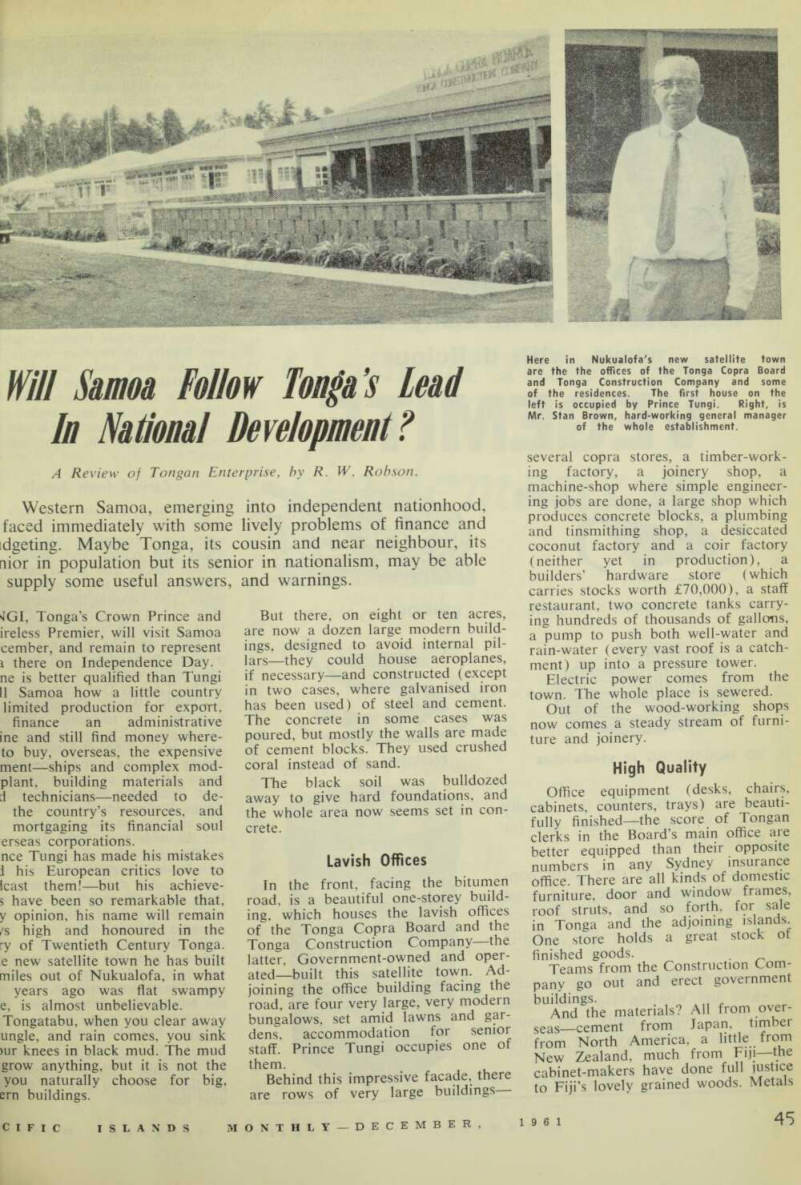
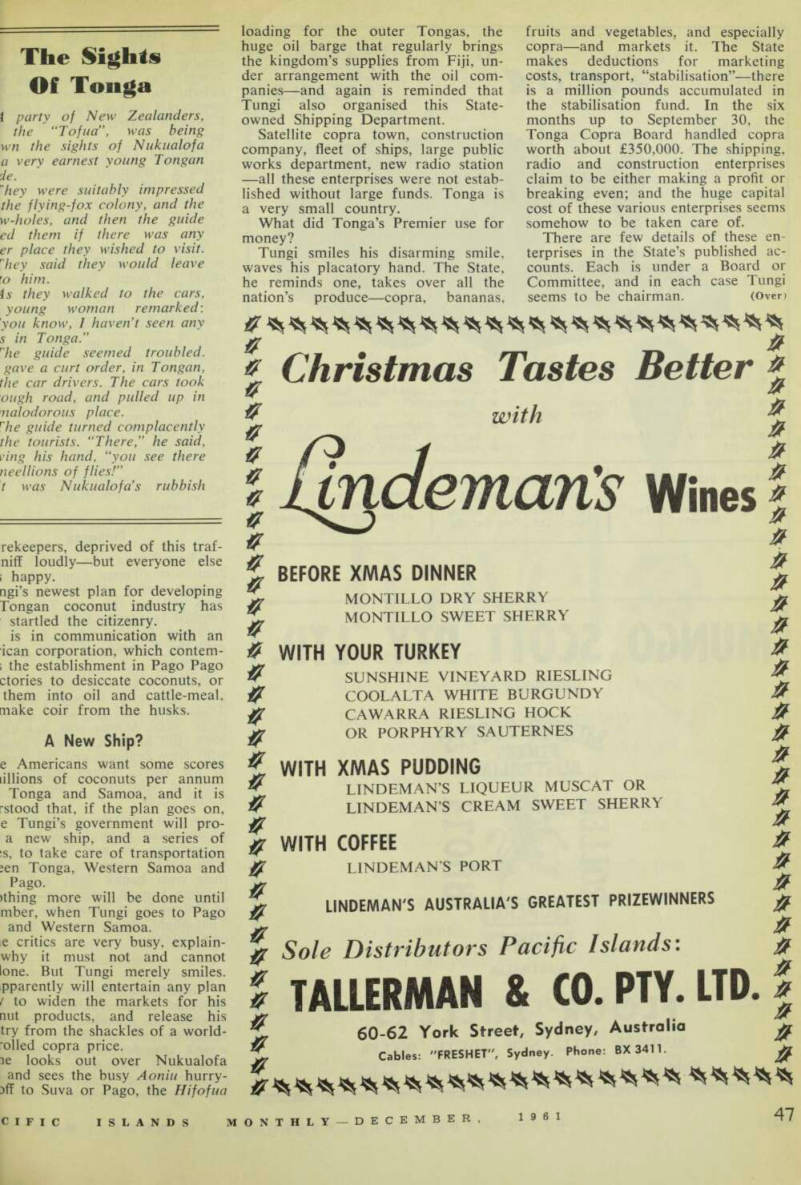
Here in Nukualofa's new satellite town are the the offices of the Tonga Copra Board and Tonga Construction Company and some of the residences. The first house on the left is occupied by Prince Tungi. Right, is Mr. Stan Brown, hard-working general manager of the whole establishment.
—iron and steel bars, tin, meshe: are from Australia.
And the staff? Among all the e cutives, and all the hundreds of n so intent on their work—and I ne saw men handle delicate machii more lovingly than the Tongansj those furniture-making shops—th is not one full European.
The general manager of the wk establishment, Mr. Stan E. Broi is part Tongan. His able assists who gives most of his time to Construction Company, Mr. S.
Nakao, a Bachelor of Commerce; a NZ University, is part Japan, part Tongan. The foreman of woodworking sections is a keen
competent Filipino.
I talked to some of these pec and was impressed by their regard and loyalty to Premier Tungi. “I haps he does make mistakes,” s one. “But he is a great man to w for. He doesn’t dither around listens to you and soon makes up mind—and then action is so qu that he keeps you right on y toes.”
Carved from Jungle That may explain why this s< little town, all concrete and mod amenities, complete already \ water and power and sewers, \ artistic fences and green lawns, carved out of the jungle in tl years. The Tongans themselves, as State-owned Construction Comps built the place under the direc of Tungi and the guidance of a overseas technicians; and those 1 gans really worked.
The Tongan Government, thro its Public Works Department, ; built the little township, also oui the jungle, which now houses Ton new radio broadcasting serv Strong and clear, and admirably by a handful of technicians ur New Zealander Mr. R. G. Hagj Tonga Radio already has listener: Fiji and Samoa, as well as throv out the widely scattered Tongas.
“We are the Friendly Islar broadcasts Tonga; and the Fiji Samoa radio station managers sp: little, and want to know what’s wr with the kind of friendliness i dispense. But it looks as if Tub radio directors are going to m fullest use of the happy name gi the group by Captain Cook 180 y< ago. Advertisers seem to agree—t are buying time from Station ZC “What’s the radio licence fee? asked.
“None,” said Tungi, with kindest smile. “We sell receiving to listeners—we have a monoj over that trade.”
rekeepers, deprived of this traf niff loudly—but everyone else i happy. ngi’s newest plan for developing Tongan coconut industry has startled the citizenry, is in communication with an ican corporation, which contem ; the establishment in Pago Pago ctories to desiccate coconuts, or them into oil and cattle-meal, make coir from the husks.
A New Ship? e Americans want some scores lillions of coconuts per annum Tonga and Samoa, and it is rstood that, if the plan goes on, e Tungi’s government will pro a new ship, and a series of :s, to take care of transportation jen Tonga, Western Samoa and Pago. )thing more will be done until mber, when Tungi goes to Pago and Western Samoa, e critics are very busy, explain why it must not and cannot ione. But Tungi merely smiles, pparently will entertain any plan f to widen the markets for his nut products, and release his try from the shackles of a world 'olled copra price, le looks out over Nukualofa and sees the busy Aoniu hurry 3ff to Suva or Pago, the Hifofua
loading for the outer Tongas, the huge oil barge that regularly brings the kingdom’s supplies from Fiji, under arrangement with the oil companics—and again is reminded that Tungi also organised this Stateowned Shipping Department.
Satellite copra town, construction company, fleet of ships, large public works department, new radio station —all these enterprises were not established without large funds. Tonga is a very small country.
What did Tonga’s Premier use for money?
Tungi smiles his disarming smile, waves his placatory hand. The State, he reminds one, takes over all the nation’s produce—copra, bananas,
fruits and vegetables, and especially copra—and markets it. The State makes deductions for marketing costs, transport, “stabilisation”—there is a million pounds accumulated in the stabilisation fund. In the six months up to September 30, the Tonga Copra Board handled copra worth about £350,000. The shipping, radio and construction enterprises claim to be either making a profit or breaking even; and the huge capital cost of these various enterprises seems somehow to be taken care of.
There are few details of these en terprises in the State’s published ac counts. Each is under a Board or Committee, and in each case Tungi seems to be chairman. (Over)
Few Boards could resist t famous Tubou smile and gently j suasive tongue—and the Kingdom Tonga goes on to newer and big enterprises, and remains solvent, apparently takes orders from European Government or overs corporation.
I should not be surprised, if when I return to Nukualofa at 1964, I find that Tungi has instaj a helicopter service between Premier’s Office and the sate' town!
Western Samoa, starting off with economy not unlike that of Toi could be deeply interested in w the massive young Tongan Prince tell them of his experiences in world of finance and commerce.
In Samoa, as in Tonga, there only one race to be provided Samoans may be expected to ti their Fautua (or hereditary chi who are to be their Heads of St£ as the Tongans trust their rc family. As in Tonga, the means which Samoa will purchase overs goods—from cloth to tractors, fi petrol to drugs— must come from soil, from the sale of coconuts, co and bananas.
Finances Where Tonga uses a marketing ganisation (Tonga Copra Board) finance capital projects, Samoa i haps will use the new Trust Esti Limited (successor to the famous parations Estates, which for so L gave the Territory so much econo backbone).
Both Tonga and Samoa issue paper currency through their c Treasuries, and get some advant there. West Samoa now has its c bank. But Samoa’s currency is at with New Zealand, and NZ coins in use there. Tonga maintains with the Australian £, and uses A tralian coins.
As both countries would like to accumulated bank funds for cap expenditure, it was inevitable t both would sooner or later estab their own banks. Why not a j( Samoan-Tongan enterprise—the B; of Polynesia, or something like tl: That might enable them to mint tl own coinage.
When the 300th baby for 1961 delivered at the Prebyterian Miss hospital at Lenakel, Tanna, h Hebrides, on September 6, th wasn’t any doubt that records w being well and truly broken, greatest number of babies delivered any one year previously was 84