Two Nobles Are Joint Heads
pp. 39-41 · Read in the full issue
Of New State
The difficulties which faced the draughtsmen of the new Constitution of Western Samoa (a Committee representing Western Samoa and New Zealand, advised by Professor J.
W. Davidson, of Australia, and Professor C. C. Aikman, of New Zealand) give some idea of the political and social prob lems peculiar to the country; and —and this is important— most of those problems have been only temporarily adjusted.
They again will confront the new State of Western Samoa.
THE principal of these problems are found in: • The traditional rights and privi leges of the ruling families. ® The reluctance of the Matai (heads of the family groups) to give way to the voting system represented by universal adult suffrage. 9 The influence of the several old mixed-race families, established mainly by Europeans who married Samoans. • The established interests of European property-owners.
The Social Structure At the head of the Samoan nation, now and always, and holding most of the power and privileges, are the noble families; and at the head of the nobility are the four family groups of persons of royal lineage— namely, the Tamai a Aiga.
In old Samoa—and the mass of people still think this way—there was nothing like democracy. The common man had neither voice nor privilege. The nearest to it is the Matai—he is the head of a group of families, and he speaks on behalf of a small number of adult males
who, with their families, make up a community—often owning land in common.
When the Constitution-makers de cided to follow the British model in their planning, and to have a Head of State rather than an elected presi dent, they met their first real hurdle.
The Samoans always have had one of the Tamai a Aiga —a Malietoa, a Mataafa, a Tamasese or a Tuimaleale’ifano to head their com munity or nation; and the custom is so deeply ingrained in their think ing and traditions that it had to be embedded in this Constitution plan ning.
They spent weeks in debate, and finally agreed that two of the Tamai a Aiga (one of whom had been most prominent in the move towards independence) namely Tupua Tamasese Mea’ole and Malietoa Tanumafili—should jointly hold the post of Head of State; and that the survivor of them should carry on for life as sole holder of the office.
But a plan for filling the office, after that, could not be found, for a long time. A large and growing section of Samoans, who do not be lieve in the hereditary system, and
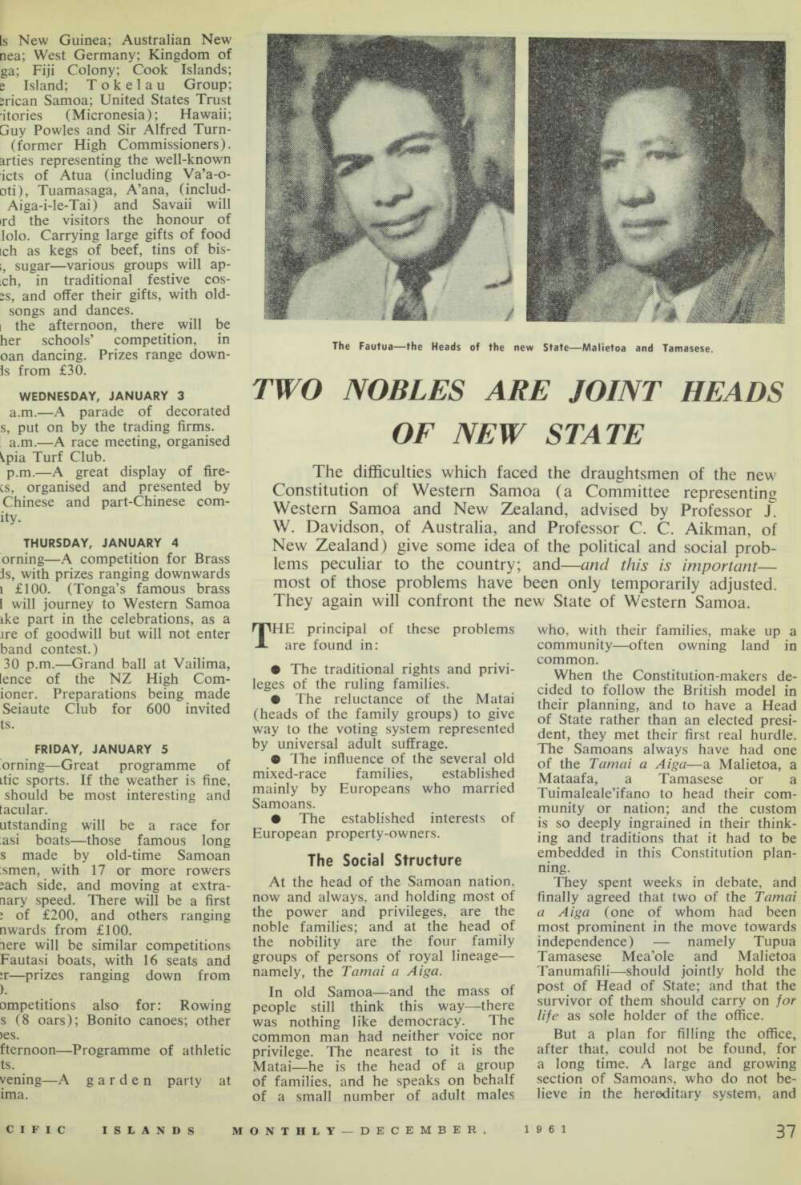
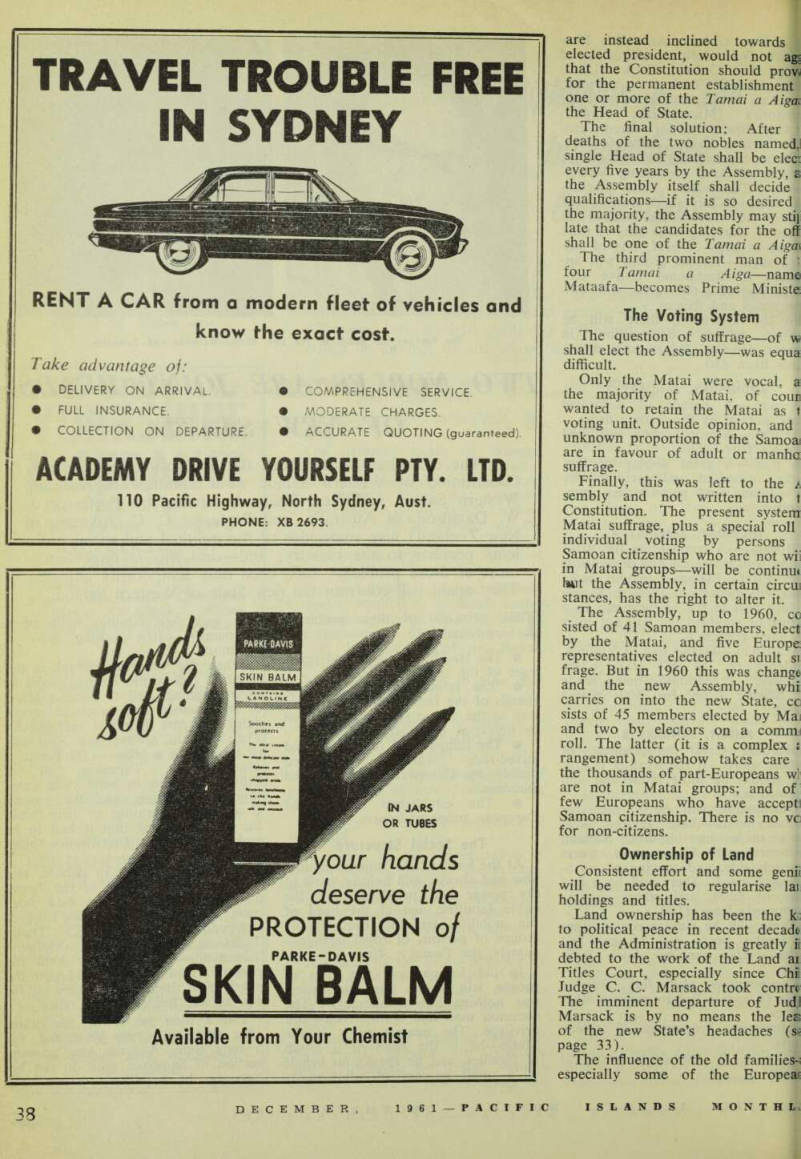
The Fautua —the Heads of the new State —Malietoa and Tamasese.
are instead inclined towards elected president, would not ags that the Constitution should provi for the permanent establishment one or more of the Tamai a Aigac the Head of State.
The final solution: After deaths of the two nobles named,! single Head of State shall be elec: every five years by the Assembly, s the Assembly itself shall decide qualifications—if it is so desired the majority, the Assembly may stiji late that the candidates for the off shall be one of the Tamai a Aigca The third prominent man of ] four Tamai a Aiga —name Mataafa—becomes Prime Ministe
The Voting System
The question of suffrage—of w? shall elect the Assembly—was equa difficult.
Only the Matai were vocal, a the majority of Matai, of coun wanted to retain the Matai as t voting unit. Outside opinion, and unknown proportion of the Samoa* are in favour of adult or manha suffrage.
Finally, this was left to the a sembly and not written into t Constitution. The present system Matai suffrage, plus a special roll individual voting by persons Samoan citizenship who are not wii in Matai groups—will be continue bait the Assembly, in certain circm stances, has the right to alter it.
The Assembly, up to 1960, co sisted of 41 Samoan members, elect by the Matai, and five Europe representatives elected on adult si: frage. But in 1960 this was change and the new Assembly, whi carries on into the new State, co sists of 45 members elected by Maj and two by electors on a comnu roll. The latter (it is a complex t rangement) somehow takes care the thousands of part-Europeans wi' are not in Matai groups; and of : few Europeans who have accept!
Samoan citizenship. There is no vo for non-citizens.
Ownership of Land Consistent effort and some genii will be needed to regularise lai holdings and titles.
Land ownership has been the k: to political peace in recent decade and the Administration is greatly ii debted to the work of the Land ai Titles Court, especially since Chit Judge C. C. Marsack took contra The imminent departure of Judl Marsack is by no means the les of the new State’s headaches (s<? page 33).
The influence of the old families-! especially some of the Europear
i families who settled in long d became rich—is a factor of iportance that it needs special tion (see page 41). Old feuds could disrupt any i Government.
ote: Significant Meeting
ever, a comforting and signi icident occurred in Apia on ber 18. 2toa, Tamasese and Mataafa )n Tonga’s Queen Salote, who passenger aboard the Tofua, 1 not leave the ship. 2 high-caste Samoans are related to the Tongan royal —and they went together to i Salote—such a thing, said otocol-minded Samoans, had >ccurred before. e—who is as wise and clever is gracious and amiable— sed the significance of the call.
Four of them sat down together cabin, all alone; and Her r talked to them very frankly the future of their common ;ian race, and of the new t State. : realises more clearly than that, if the clans of the Tamai get quarrelling between them -as they have done so often >ast 150 years—they will make ■ogress impossible, and per estroy the new State. But if ders will remain united, they create in Western Samoa a and secure Polynesian nation, luld not be surprised to know ey discussed Samoa’s future iship with Britain, and the ity of a close association in iture between Tonga (pro i and Western Samoa (affilia it present uncertain).
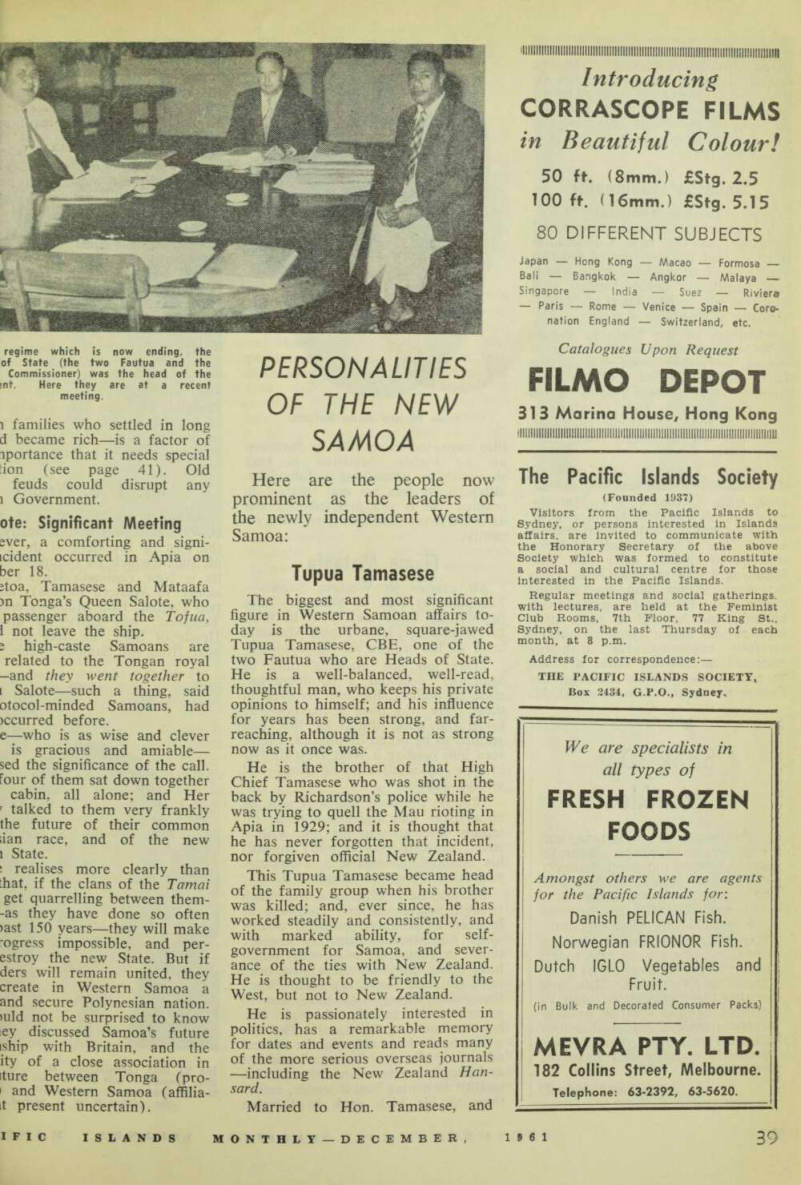
[?]regime which is now ending, the [?]of State (the two Fautua and the Commissioner) was the head of the [?]nt. Here they are at a recent meeting.