Independent Samoa Faces
pp. 31-34 · Read in the full issue

M Publisher R. W. Robson Reports from
Apia on Independence Eve
Independent Samoa Faces Grim Financial Future
Needing a copy of Western Samoa’s published accounts, epped into the upstairs office of the Treasurer and, seeking Iness, head for a door overlooking the lagoon.
JOU!” yelled a clerk, and leaded me off. “All right— t on the balcony,” I explained. —the balcony is not safe any explained the Samoan. “It fall down into the street.” ;n saw the flimsy barrier across arway. “Gripes”, I said. “You new Treasury”, s building is seventy years aid the official, sadly. “There money for new Government gs—other things are more ; is the general picture in Apia, iwn and port, which stretches than a mile along the lovely re about the shabbiest in the Pacific. There are only two ;e new buildings in the whole and the present edifices need tion and painting, as Father needs a shave.
Western Samoa is not really "Uneasiness" it with a fall in the values ira and cocoa, and in banana ;tion, today’s overseas trade appear a bit sick; but for W. Samoa has enjoyed an is trading surplus (exports over s) of anything from half to [uarters of a million pounds, illy, there should have been srable accumulations of funds the country, to take care of lions, new buildings, new rises. Why not? answer probably lies in the ness which the last decade’s al activities have generated in inds of money-owners. Some )ing things have been said by ians about European property -5 and the greed of traders and )rs. year by year, there has trickled overseas much of the private ' that might have been used to ate new industries, and give a bit of a face-lift.
I, Western Samoa has got its
self-government and independence.
Now, it must forget politico-social idealism for a while, and face up to hard economic facts. It needs a lot of money, if it is going to maintain among these amiable Samoan people (increasing in numbers at a phenomenal rate) the standard of living which the young Samoans now think they are entitled to.
Myself, I have seen many govern ments working, in many countries.
I feel that Samoa has entered too hurriedly into this business of self government. The task would have been much easier if they had waited until there were, say, 250,000 better educated Samoans, instead of the present 113,000.
The basic administrative structure of a country, whether it has 10,000, or 100,000 or 1,000,000 people, is much the same.
It must have a whole series of Departments, and buildings to house them, and quite expensive equipment for their use, no matter how small the population. After that, a larger population is taken care of generally by a larger staff.
The administrative machinery needed to govern Samoa’s 113,000 will be a heavy burden on Samoa’s income (some say it will absorb 65 per cent). But, if the population were 250,000, a much larger pro portion of the income collected from the 250,000 would be available for stimulating enterprise and develop ment.
The Headaches?
However, independence has come; the feasting and the dancing are on.
After that come the headaches — and the calculations.
Samoa has three main industries, from which she exports each year copra, cocoa and bananas sufficient to provide her with about £3 millions—copra, 16,000 tons worth £1 million; cocoa, 4,000 tons, worth another £1 million; and bananas, sold to NZ for anything up to another
million. Out of the basic economy thus created, the Government gets about £1,500,000 in taxation in various forms, and spends it approxi mately as follows:
There is not much elasticity in that kind of budgeting—it leaves less than £200,000 available for economic development. And a very large measure of economic development is vital to the future security of Samoa —either that, or drastic birth control.
The Samoan birth-rate per thou sand hovers between 36 and 41, which is phenomenal in a Polynesian community. It is almost equal to the Indian birth-rate of 42 per thousand in Fiji—which has created socio political nightmares in that Colony.
The new Samoa’s new Govern ment takes over at a difficult time.
For reasons outside Samoa’s control decreased world prices, diseases in crops, a tendency of the growing population to eat rather than export much of the banana production—money from exports this and last year has decreased; and this in turn means less revenues from taxes and fees.
Samoa definitely wants more in come, rather than less, not only for administration, but also for the stimulation of industry and pro-
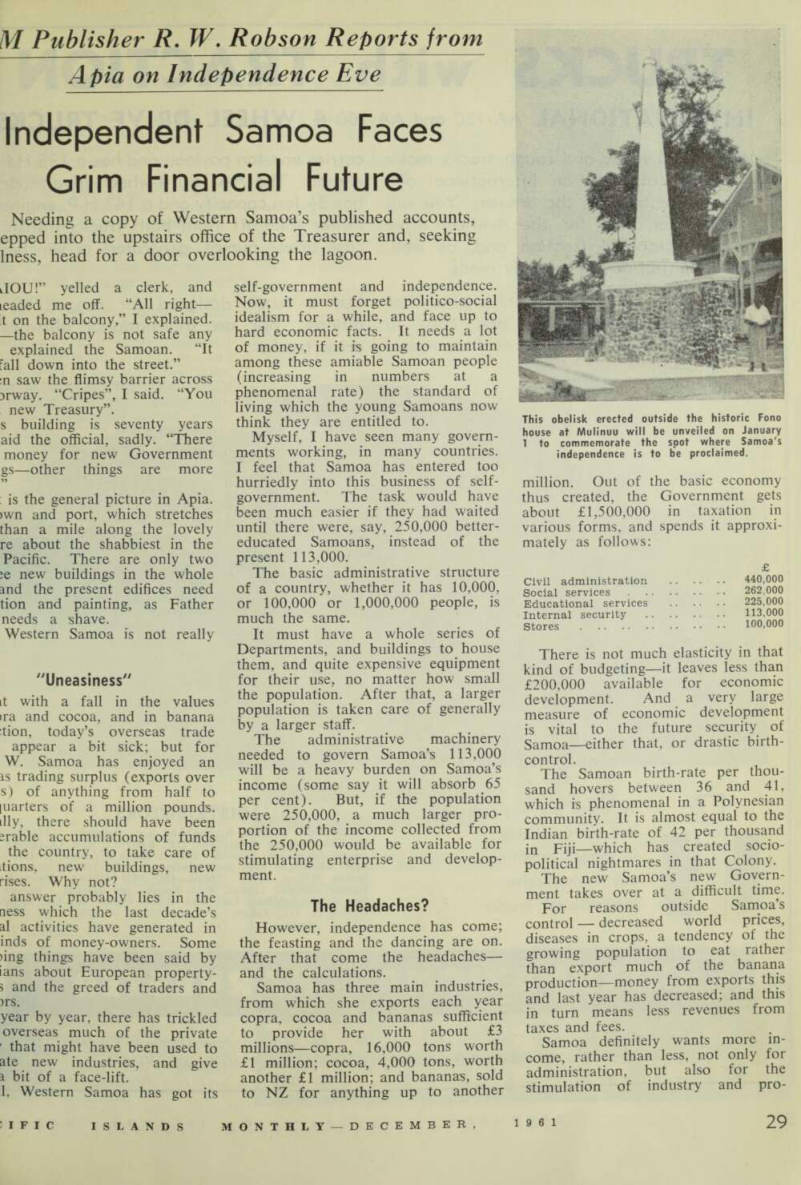
This obelisk erected outside the historic Fono house at Mulinuu will be unveiled on January l to commemorate the spot where Samoa's independence is to be proclaimed.
£ Civil administration 440,000 Social services 262,000 Educational services 225,000 Internal security . . .. 113,000 Stores 100,000
Confidence in the Government
ion. It can come only from two ces —increased normal revenues ich come most easily from in sed production for export) or i loans. here are two kinds of loans— ts from sympathetic countries :h wish to help, or (most desir of all) investments made in new truction and new industry by »le who believe that their capital fe, and in no danger of socialistic iscation, ) far as the latter source is con ed, it is all up to the new Samoan ernment. If it wants substantial ite investment in Samoa—and ing could be better for the future he country—it first must satisfy investors, through policy sup sd by action, that private invest t is safe. lat may take some time, eanwhile, there is another way in h the country’s finances can be oyed, fairly quickly—namely, a ction of imports, both seen and en, so that the overseas trading lus can be increased, hy does Samoa import each year 1.000 of “shooks” (sawn timber he making of fruit cases)? Why 150.000 spent on imported meat, i the best cattle produced any ■e in the Pacific Islands are grown amoa? Why spend £90,000 per im on imported tobacco, £90,000 preserved fish, £60,000 for rice? looks as if the most important awaiting the Government is that Minister for Development.
Future Plans it of many conversations and ctions, I expect the following: The establishment of a Govern : Insurance Office, and punitive ures to prevent overseas in ice offices from operating. (I told that about 17 insurance sies in Samoa annually send !eas beween £70,000 and ,000 in insurance premiums.) A change in the incidence of ne taxation as applied to cor dons, so that the tax will be on >ver instead of on annual profits.
Government believes that in big trading organisations with seas connections deliberately their retail prices (and their ts) down, which reduces the > they pay and severely irrasses competitors who are 1 solely in Samoa.
• A close examination of the machinery available for banking and exchange. This could affect the operations of the overseas trading firms (like Burns Philp & Co. Ltd., Morris Hedstrom Ltd.), and the position of the Post Office Savings Bank (which, under NZ administra tion, has some hundreds of thousands of pounds of Samoan depositors’ funds invested in NZ).
Such measures are not calculated to make friends and favourably in fluence people overseas; and this Government will need overseas friends—that is, overseas money.
However, the great majority of
the people in Samoa, including well-informed, have much confide in the Government as now constitui and in its ability to handle the jo I had an interesting chat with !
E. Annandale, executive head Messrs. O. F. Nelson & Co. LI and a leading businessman.
“Well,” I remarked, “the new S< is ready for business. I supp the main business is new devel; ment, to take care of new pop< tion. What are they going to for money?”
“Same as they’ve always ust; he retorted. “They are not lo:< anything in the change-over.”
That was a good viewpoint. M Zealand has spent a lot of moc in her administrative tasks, but has made no big cash gifts to Sam like Australia in New Guinea.
Whatever funds Samoa got fn New Zealand came mostly fn the huge accumulation of Sami properties mostly plantations which New Zealand received reparations from the Germans, at 1914-19, and administered for years as the New Zealand Repj tions Estates. The organisatk profits were returned to Samoa; in 1957 the whole valuable set (worth £1,000,000) was presented!
NZ to the Samoan Government, is being worked profitably as West Samoa Trust Estates Corporation
Shabby Apia
The WSTEC shows a reserve; about £lOO,OOO, invested in NZ. should be of material help to new nation’s new government.
If Western Samoa’s capital sea a little shabby and down-at-heel, blame goes with the rather talkai politicians of the old regime.
“Sound government will earn a fidence overseas, and developmei loans should become possible,” s Mr. Annandale. “There are so really able men in the Governmi that will be taking over—l for i have confidence in them.”
Thinking in terms of finances talked to people interested in bas ing. “I presume the government 1 be guided by the Bank of Westt Samoa,” I remarked. “Bank of has a 55 per cent, interest tha and will allow no wild financing”..
“That’s what the Russians howling about,” said one man. <trv Bank of NZ is wholly owned by NZ Government, and the Russii; say that ‘Samoan independence”; only a fake—that the New ZeaLl British will still be in charge, throw the finance structure.”
“But it provides some security an overseas investor,” said anottwi