Fiji Legislative Council
pp. 19-20 · Read in the full issue
New Constitutional Arrangements Fiji Legislative Council To Be Enlarged
Prom a Correspondent , .
Uu V A
Fiji is to have a new constitutional setup, but it won’t go as far as a move planned by the Government last March, when it was suggested that a “member” system, moving gradually to a “ministerial” system, be introduced.
THE Governor, Sir Kenneth Mad docks, announced the proposals when he opened the Budget session of the Legislative Council late in November.
The number of unofficial members will rise from 15 to 18, made up of six each of the three main racial groups.
The Europeans, Indians and Fijians will each elect four members by popular vote and the remaining two will be nominated (the Indians and Europeans by the Governor, and the Fijians by the Council of Chiefs).
The increased size of the unofficial benches will necessitate an increase in the official ranks from 16 to 19 to allow the Government to retain a majority.
The Government announcement means that there will be a delay of six months at least in the next Legis lative Council elections. The electoral boundaries will have to be redrawn, and new rolls will have to be pre pared.
A revolutionary change as far as
Fiji is concerned will be the franchise for women, although women have been eligible to stand for local gov ernment bodies for many years.
The Governor had many divergent views to reconcile before sending off his proposals to the Secretary of State for the Colonies, Mr. Reginald Maulding, for approval. There was a wide measure of agreement through out the Colony that separate com munal rolls should be retained, but some Indian members said they would like to see the experimental introduction of a common roll con stituency.
One member even suggested that there should be five members elected for each race on separate communal rolls and that in addition there should be three members, one from each race, elected on a common roll.
The European and Fijian members were utterly opposed to the intro duction of a common roll in any form, and two Indian members agreed that they could not support a com* mon roll at present. (Over)
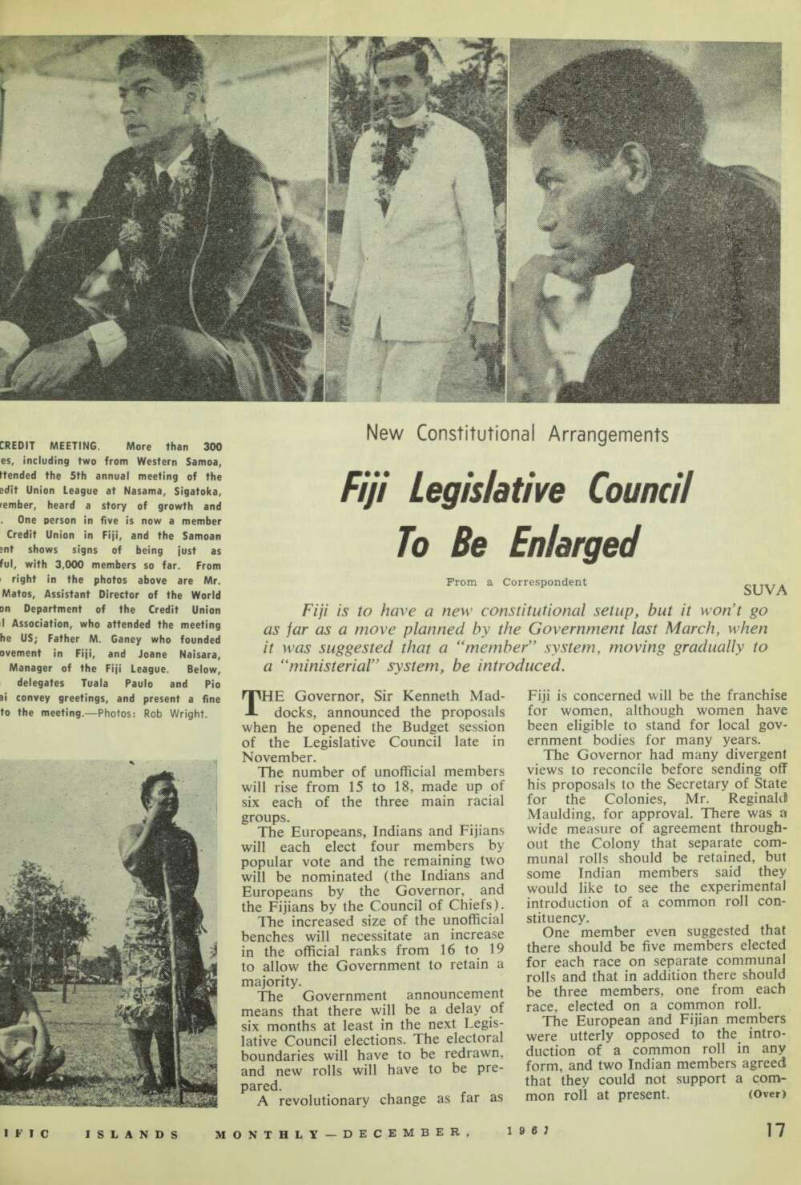
[?]CREDIT MEETING. More than 300 [?]es, including two from Western Samoa, [?]tended the 5th annual meeting of the [?]edit Union League at Nasama, Sigatoka, [?]rember, heard a story of growth and [?]One person in five is now a member [?]Credit Union in Fiji, and the Samoan [?]nt shows signs of being just as [?]ful, with 3,000 members so far. From right in the photos above are Mr. [?]Matos, Assistant Director of the World [?]on Department of the Credit Union [?]I Association, who attended the meeting [?]he US; Father M. Ganey who founded [?]ovement in Fiji, and Joane Naisara, Manager of the Fiji League. Below, delegates Tuala Paulo and Pio [?]ai convey greetings, and present a fine to the meeting.— Photos: Rob Wright.
The view of unofficial members on the numerical representation of the main racial groups differed con siderably. The Fijians considered that there should be four directly elected Fijians and two elected by secret ballot by the Council of Chiefs.
They suggested that the Europeans and Indians should be represented by four elected members and one nominated each, which would give the Fijians one more member. The Fijians were strongly of the opinion that European representation should remain equal to that of the Indians.
The European members raised no objection to the Fijian proposal and welcomed the suggested increase in the number of elected members.
The Indian members, with one ex ception, were opposed to the sug gestion that the Fijians should have an additional member, but there was no unanimity among them about the composition of the Council.
The Indian member who wanted to see the common roll also wanted an unofficial majority. Another wanted to see the end of nominated members.
A third asked that there should be a separate Muslim roll and that the Muslims should elect one member be cause no Muslim could hope to be elected on either an Indian communal roll or a common roll.
The suggestion that there should be a Muslim roll received little at tention for, as the Governor rightly pointed out, it would be a retrograde step to have a roll on a religious as well as a racial basis.
"Extension"
Failing a Muslim roll the member wanted three Europeans, three Fijians and three Indians all elected on a common roll with two nominated members from each race.
The Governor was against giving the Fijians an extra seat at the ex pense of the other two races and settled for four elected and two nominated members from each race.
The present council would nor mally end its life on September 15 next, but its life will be extended for another six months.
The next election will then be about March or April, 1963.
The life of the council may also be extended to five years. Unofficial members generally agreed that three years was too short a term and the Governor agreed with them.
It took new members a little time to become accustomed to the pro cedures of the council, and in the third year the approaching general election had an unsettling effect. The Governor suggested that the term be extended to five years, a practice adopted in most other Colonies.