The Rockefeller Search
pp. 16-138 · Read in the full issue
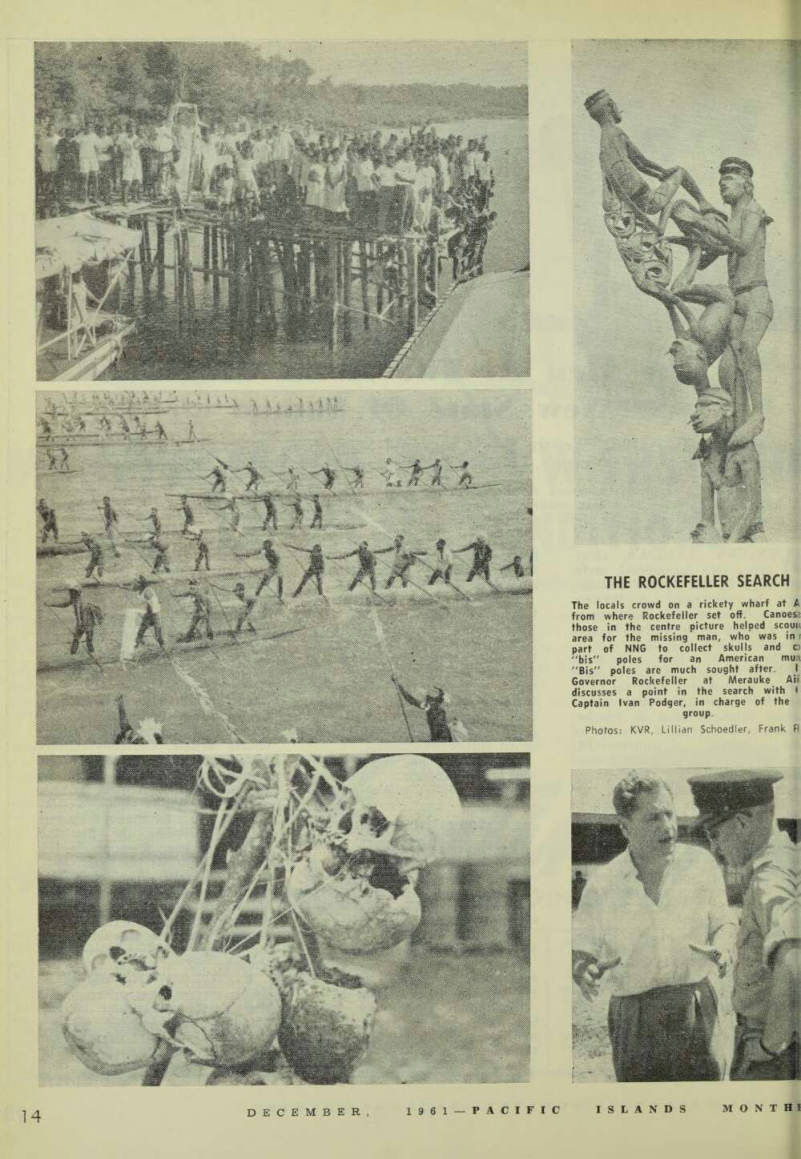
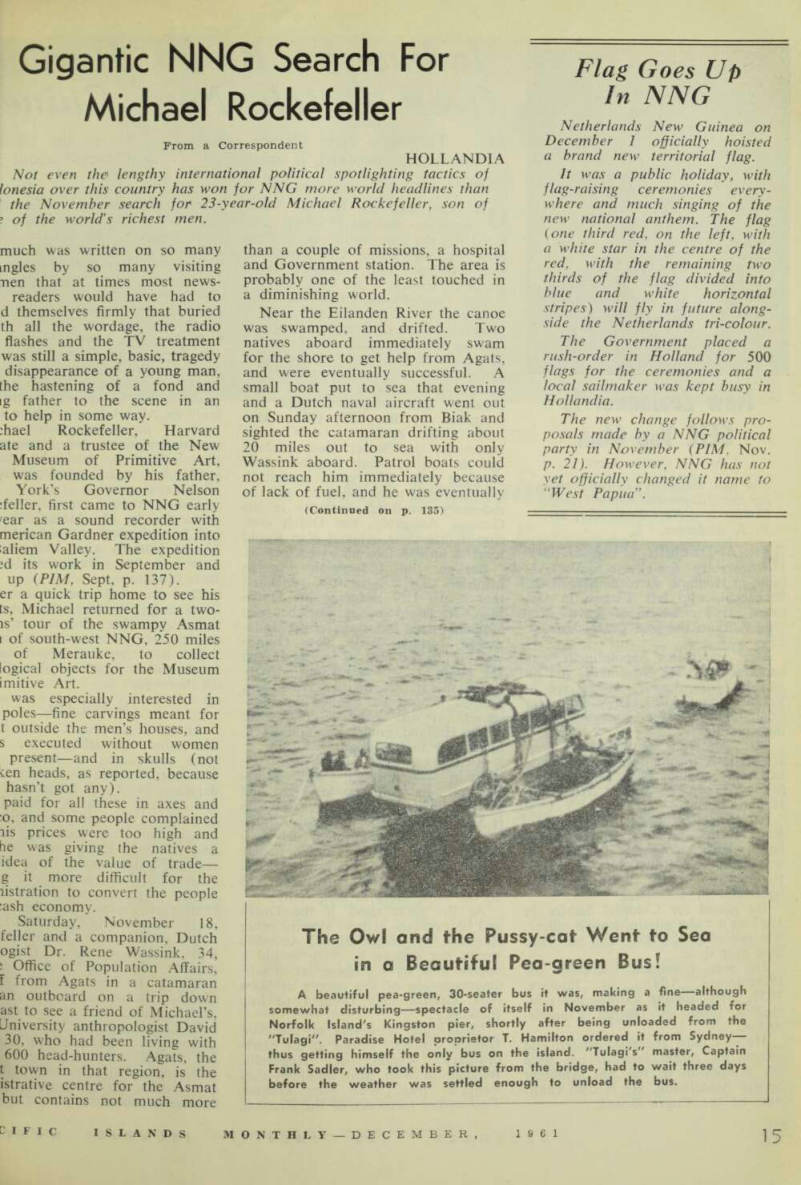
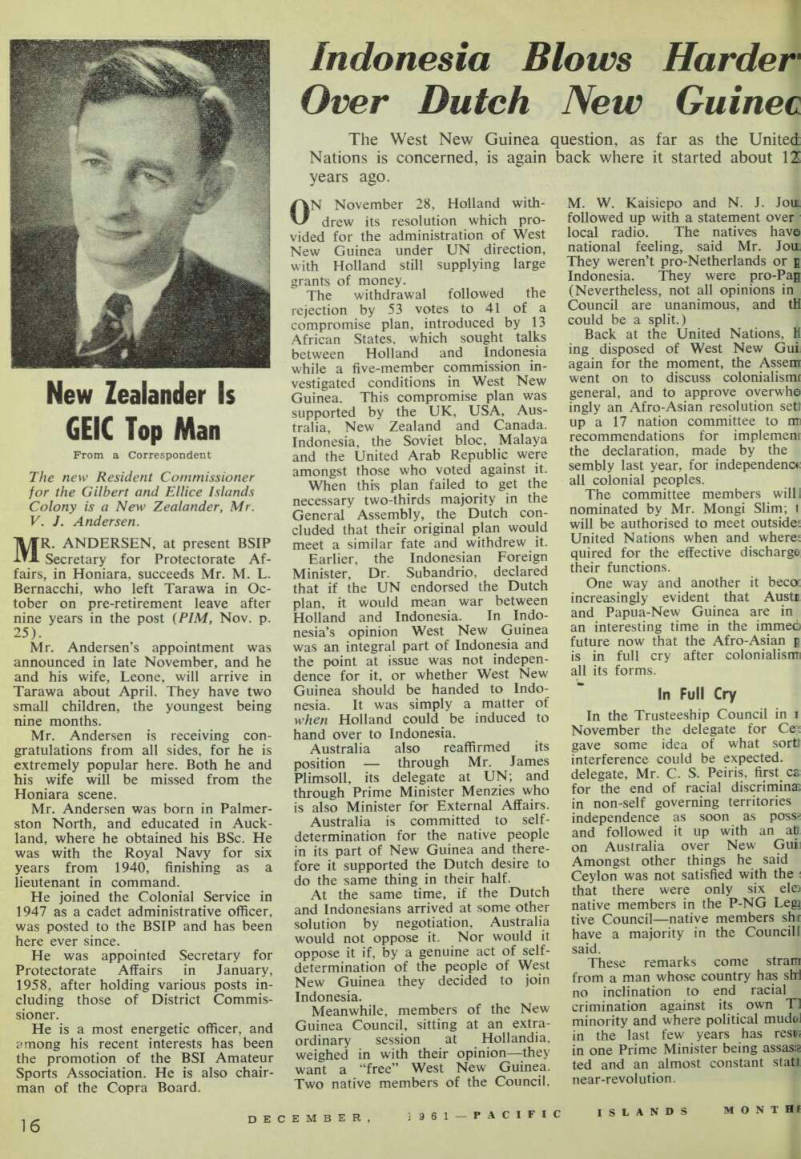
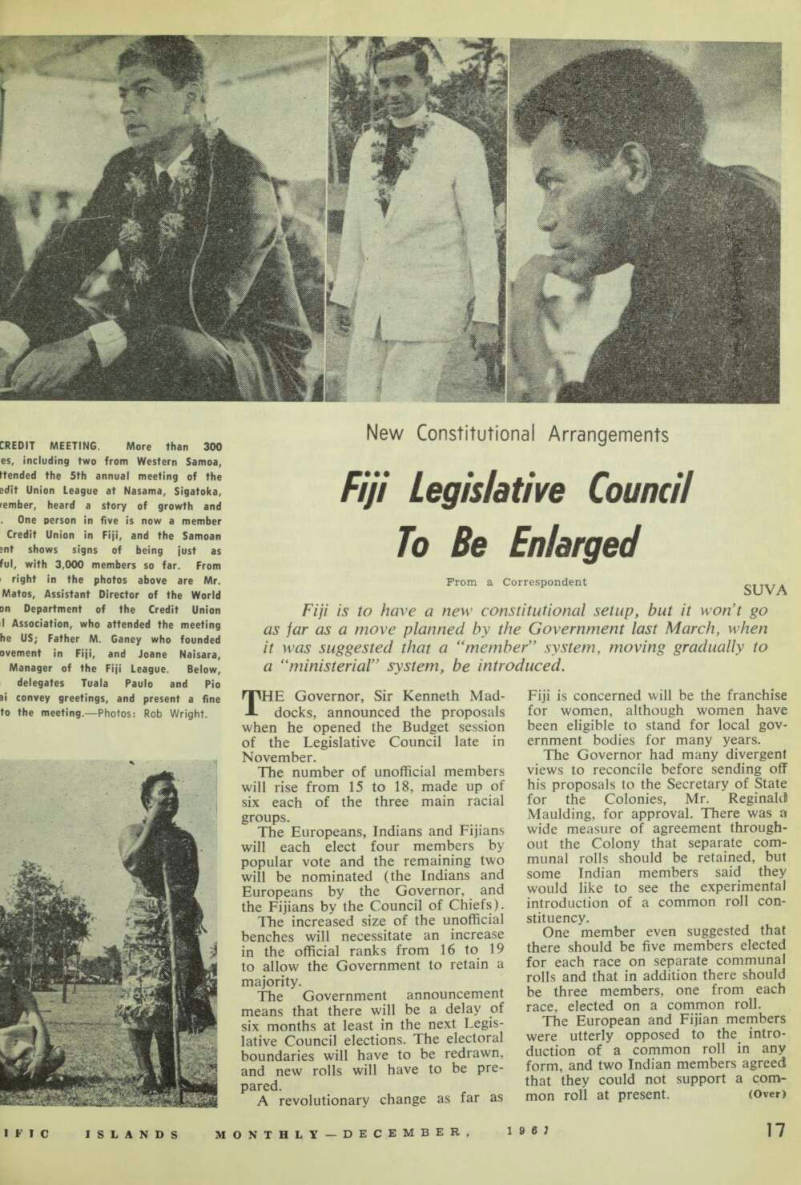
The locals crowd on a rickety wharf at A[?] from where Rockefeller set off. Canoess[?] those in the centre picture helped scouu[?] area for the missing man, who was in [?] part of NNG to collect skulls and C[?] "bis” poles for an American mu[?] "Bis" poles are much sought after. I[?] Governor Rockefeller at Merauke Aii[?] discusses a point in the search with Captain Ivan Rodger, in charge of the[?] group.
Photos: KVR, Lillian Schoedler, Frank R[?]
Gigantic NNG Search For Michael Rockefeller
From a Correspondent
Hollandia
Not even the lengthy international political spotlighting tactics of lonesia over this country has won for NNG more world headlines than the November search for* 23-year-old Michael Rockefeller, son of ? of the worlds richest men.
much was written on so many ingles by so many visiting nen that at times most news readers would have had to d themselves firmly that buried th all the wordage, the radio flashes and the TV treatment was still a simple, basic, tragedy disappearance of a young man, the hastening of a fond and ig father to the scene in an to help in some way. :hael Rockefeller, Harvard ate and a trustee of the New Museum of Primitive Art, was founded by his father, York’s Governor Nelson :feller, first came to NNG early 'ear as a sound recorder with merican Gardner expedition into aliem Valley. The expedition id its work in September and up (PIM, Sept, p. 137). er a quick trip home to see his ts, Michael returned for a two is’ tour of the swampy Asmat i of south-west NNG, 250 miles of Merauke, to collect logical objects for the Museum imitive Art. was especially interested in poles—fine carvings meant for t outside the men’s houses, and s executed without women present—and in skulls (not ten heads, as reported, because hasn’t got any), paid for all these in axes and o, and some people complained lis prices were too high and he was giving the natives a idea of the value of trade— g it more difficult for the listration to convert the people :ash economy.
Saturday, November 18, feller and a companion, Dutch ogist Dr. Rene Wassink, 34, ; Office of Population Affairs, F from Agats in a catamaran an outboard on a trip down ast to see a friend of Michael’s, University anthropologist David 30, who had been living with 600 head-hunters. Agats, the t town in that region, is the istrative centre for the Asmat but contains not much more
than a couple of missions, a hospital and Government station. The area is probably one of the least touched in a diminishing world.
Near the Eilanden River the canoe was swamped, and drifted. Two natives aboard immediately swam for the shore to get help from Agats, and were eventually successful. A small boat put to sea that evening and a Dutch naval aircraft went out on Sunday afternoon from Biak and sighted the catamaran drifting about 20 miles out to sea with only Wassink aboard. Patrol boats could not reach him immediately because of lack of fuel, and he was eventually
(Continued on p. 135)
sighted again, and picked out of the water, on Monday morning.
Wassink told how Rockefeller had started for shore the previous morn ing, swimming with the aid of two petrol cans, but he had not seen whether Rockefeller had made it.
The shore was then anything from three to eight miles away, and he had tried to persuade Rockefeller from making the attempt, pointing out the dangers of crocodiles.
Rockefeller was a strong swimmer.
Dutch troops and local boats soon joined the search for the missing Rockefeller, and in New York Governor Rockefeller and his daughter, Michael’s twin, Mrs. Mary Strawbridge, set off for the scene.
In Honolulu Rockefeller chartered a Pan Am 707 jet, reportedly at a cost of $38,000 and flew direct to Biak, where he let the jet go and flew on to Merauke, via Hollandia.
With the Governor in his aircraft came a party of US Pressmen. These were soon reinforced from all direc tions, by more charters, until at the peak, 43 reporters and photographers, representing the world’s Press, radio and TV, were jammed into Merauke.
Governor Rockefeller and his daughter shared the house of hard working, popular District Com missioner F. Eibrink-Jansen; the news men were four to a room in the Merauke hotel; were billetted at the Dutch Army barracks or anywhere else they could get a bed. Water supplies couldn’t cope with the demand, so everyone went dirty; the thirst problem was solved with beer.
Nor could the telegraphic system cope with the unprecedented rush of the newsmen, with the result that the average wire took 24 hours to get to Sydney, often routed through Amsterdam. Pressmen chartered air craft from P-NG to run their news stories and film to Sydney via Port Moresby.
President Kennedy asked Aus tralian Prime Minister Menzies to help, so an RAAF transport Hercules, two Army helicopters, 26 men and a Dakota arrived as a self-contained unit and got stuck into the search task, together with the Dutch, hundreds of natives in canoes and a TAA Catalina from Port Moresby.
The US Seventh Fleet offered a carrier and aircraft but they weren’t needed.
The Press saw little of the Governor, thanks to his Press agent. (Over)
After making local flights himself, the Governor saw that even if Michael had reached the “shore” he might have had to go another 10 to 20 miles to find dry land, so extensive were the crocodile-infested swamps.
Hope of his being found alive seemed slight indeed, and even less when one of his petrol drums was found well out to sea.
The disheartened father and his daughter left Merauke for home on November 28 after six days in that heartbreaking area. With them, their separate ways, went the newsmen.
Just what did happen to Michael Rockefeller probably nobody will ever know. Most likely he never reached shore.