Pacific Commerce and Produce
pp. 155-156 · Read in the full issue
Improvement in
Fiji Trade
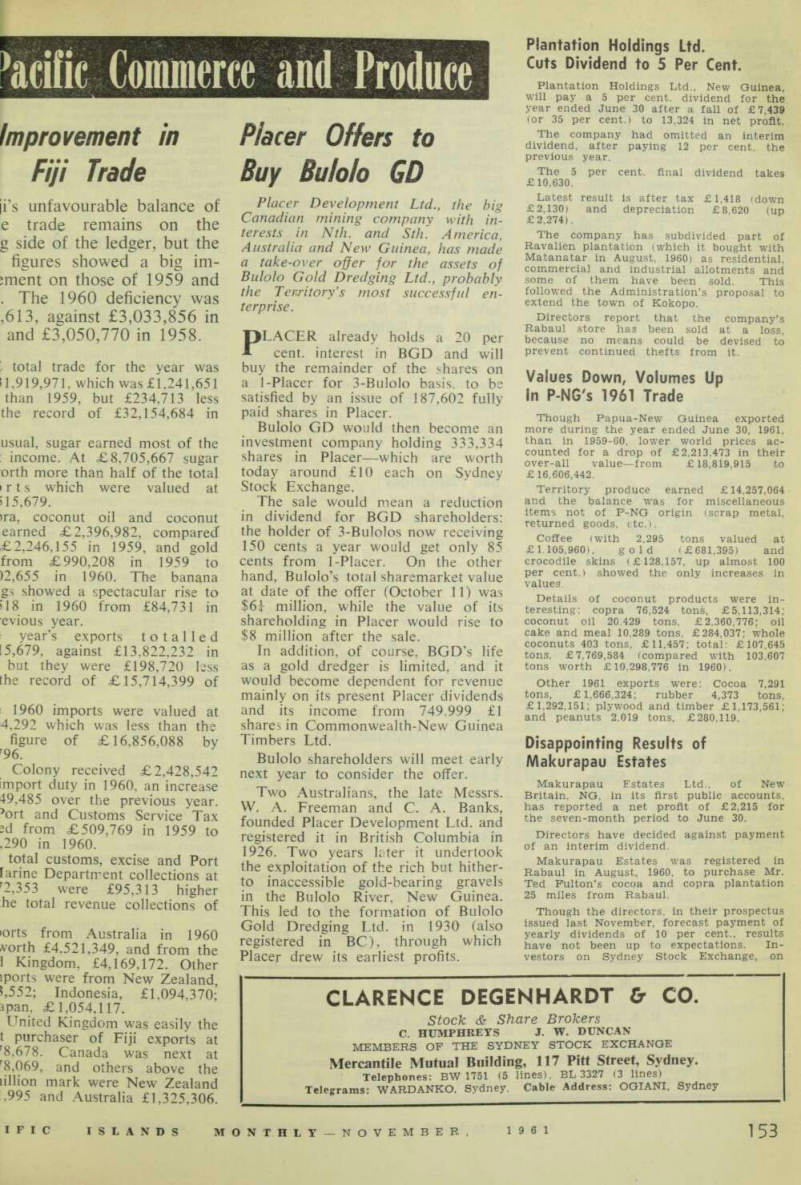
ji’s unfavourable balance of e trade remains on the g side of the ledger, but the figures showed a big im minent on those of 1959 and . The 1960 deficiency was
,613, against £3,033,856 in
and £3,050,770 in 1958. total trade for the year was (1,919,971, which was £1,241,651 than 1959, but £234,713 less the record of £32,154,684 in usual, sugar earned most of the ; income. At £8,705,667 sugar orth more than half of the total i r t s which were valued at >15,679. >ra, coconut oil and coconut earned £2,396,982, compared' £2,246,155 in 1959, and gold from £990,208 in 1959 to )2,655 in 1960. The banana gs showed a spectacular rise to >18 in 1960 from £84,731 in evious year. year’s exports totalled 15,679, against £13,822,232 in but they were £198,720 less the record of £15,714,399 of 1960 imports were valued at 4,292 which was less than the figure of £16,856,088 by r 96.
Colony received £2,428,542 import duty in 1960, an increase 49,485 over the previous year. 5 ort and Customs Service Tax -d from £509,769 in 1959 to ,290 in 1960. total customs, excise and Port larine Department collections at r 2,353 were £95,313 higher he total revenue collections of iorts from Australia in 1960 vorth £4,521,349, and from the 1 Kingdom, £4,169,172. Other iports were from New Zealand, (,552; Indonesia, £1,094,370; apan, £1,054,117.
United Kingdom was easily the t purchaser of Fiji exports at r 8,678. Canada was next at r 8,069, and others above the lillion mark were New Zealand ,995 and Australia £1,325,306.
Placer Offers to
Buy Bulolo GD
Placer Development Ltd., the big Canadian mining company with in terests in Nth. and Sth. America, Australia and New Guinea, has made a take-over offer for the assets of Bulolo Gold Dredging Ltd., probably the Territory’s most successful en terprise.
PLACER already holds a 20 per cent, interest in BCD and will buy the remainder of the shares on a 1-Placer for 3-Bulolo basis, to be satisfied by an issue of 187,602 fully paid shares in Placer.
Bulolo GD would then become an investment company holding 333,334 shares in Placer—which are worth today around £10 each on Sydney Stock Exchange.
The sale would mean a reduction in dividend for BGD shareholders: the holder of 3-Bulolos now receiving 150 cents a year would get only 85 cents from 1-Placer. On the other hand, Bulolo’s total sharemarket value at date of the offer (October 11) was $6£ million, while the value of its shareholding in Placer would rise to $8 million after the sale.
In addition, of course, BCD’s life as a gold dredger is limited, and it would become dependent for revenue mainly on its present Placer dividends and its income from 749.999 £1 shares in Commonwealth-New Guinea Timbers Ltd.
Bulolo shareholders will meet early next year to consider the offer.
Two Australians, the late Messrs.
W. A. Freeman and C. A. Banks, founded Placer Development Ltd. and registered it in British Columbia in 1926. Two years later it undertook the exploitation of the rich but hither to inaccessible gold-bearing gravels in the Bulolo River, New Guinea.
This led to the formation of Bulolo Gold Dredging Ltd. in 1930 (also registered in BC), through which Placef drew its earliest profits.
Plantation Holdings Ltd.
Cuts Dividend to 5 Per Cent.
Plantation Holdings Ltd., New Guinea, will pay a 5 per cent, dividend for the year ended June 30 after a fall of £7,439 (or 35 per cent.) to 13,324 in net profit.
The company had omitted an interim dividend, after paying 12 per cent, the previous year.
The 5 per cent, final dividend takes £10,630.
Latest result is after tax £1,418 (down £2,130) and depreciation £8,620 (up £2,274).
The company has subdivided part of Ravalien plantation (which it bought with Matanatar in August, 1960) as residential, commercial and industrial allotments and some of them have been sold. This followed the Administration’s proposal to extend the town of Kokopo.
Directors report that the company’s Rabaul store has been sold at a loss, because no means could be devised to prevent continued thefts from it.
Values Down, Volumes Up
In P-NG's 1961 Trade
Though Papua-New Guinea exported more during the year ended June 30, 1961, than in 1959-60, lower world prices ac counted for a drop of £2,213,473 in their over-all value—from £18,819,915 to £16,606,442.
Territory produce earned £14,257,064 and the balance was for miscellaneous items not of P-NG origin (scrap metal, returned goods, etc.).
Coffee (with 2,295 tons valued at £1 105,960), gold (£681,395) and crocodile skins (£ 128,157, up almost 100 per cent.) showed the only increases in values.
Details of coconut products were in teresting: copra 76,524 tons, £5,113,314; coconut oil 20,429 tons, £2,360,776; oil cake and meal 10,289 tons, £284,037; whole coconuts 403 tons, £11,457; total: £107,645 tons, £7,769,584 (compared with 103,607 tons worth £10.298,776 in 1960).
Other 1961 exports were: Cocoa 7,291 tons, £1,666,324; rubber 4,373 tons. £1,292,151; plywood and timber £1,173,561; and peanuts 2,019 tons, £280,119.
Disappointing Results of
Makurapau Estates
Makurapau Estates Ltd., of New Britain, NG, in its first public accounts, has reported a net profit of £2,215 for the seven-month period to June 30.
Directors have decided against payment of an interim dividend.
Makurapau Estates was registered in Rabaul in August, 1960, to purchase Mr.
Ted Pulton’s cocoa and copra plantation 25 miles from Rabaul.
Though the directors, in their prospectus issued last November, forecast payment of yearly dividends of 10 per cent., results have not been up to expectations. In vestors on Sydney Stock Exchange, on
which the company is listed, have taken a poor view of its prospects—and its 57shares have been below par all the year.
Current quotation is: Buyer 2/-, Seller 2/3.
NG Goldfields Ltd/s Profit
Lifted by 50 Per Cent
New Guinea Goldfields Ltd.’s profit rose 50 per cent, in the year to June 30, 1961, following higher mining and trading profits. It earned £60,607, against £40,179 last year.
Result before tax was made up of £6,610 mining profit, against a loss of £5,927 previously; £65,394 trading profit, up £10,710; and £463 from dividends.
The company’s trading operations now including sawmilling and logging, road transport, a coffee plantation and various shipping and motor agencies.
The mining loss last year was the result of a loss of £ 17,233 from joint operations with Koranga Gold Sluicing Ltd.
This year’s profit is after £2,860 higher tax at £11,860 and £44,778 depreciation and redemption. Gold subsidy to June 30, estimated at £33,470, has been in cluded.
The company will pay a steady annual dividend of 3d a share, absorbing £55,904, wholly from gold mining profits reserve.
Norfolk Is. Takes Its
Whale Quota
The permitted quota of 170 whales for its NT station was taken by October 31, reports Norfolk Island and Byron Bay Co. Ltd. At that date, 140 of the Byron Bay quota of 150 whales had also been caught.
Earnings of both these stations will be profitable, but the company ran into difficulties earlier in the year with its NZ subsidiary. Barrier Whaling Co. Ltd., which will affect over-all results.
The run of whales at Barrier Island, which is one of the two whaling stations in NZ, was markedly poor and Norfolk Is. Whaling decided to discontinue opera tions there. A receiver was placed in charge of the NZ subsidiary.
However, NT Whaling Co. in its latest report says that the receivership now has been withdrawn, and a New Zealand group may attempt to work the station on a profit-sharing basis, with an option to purchase the assets.
Mr. E. V. Crisp Leaves
"Steamies" in Good Shape
Veimauri Estate, 45 miles west of Ft.
Moresby, in Kanosia District, has been acquired by Steamships Trading Co. Ltd., Mr. E. V. Crisp (chairman) told share holders at the annual meeting last month.
The property comprises 600 acres of rubber and 400 acres of coconuts and brings to eight the number of planta tions owned by Steamships, comprising more than 3,000 acres of coconuts, 900 acres of rubber and 1,100 of cocoa.
Over-all net earnings from coastal vessels showed a decided improvement, due to increased cargoes handled and reduced
operating costs. Delivery of a new steel vessel nearing completion in Hongkong is expected soon. It has been designed for timber freighting with which it will be continuously employed. The company’s slipways and engineering works have been working to capacity.
Output of timber from the sawmills in Western Papua showed an appreciable increase and even better results should be forthcoming during the current year’s operations as the entire output of 1,500,000 super ft of sawn timber has a ready local market.
Mr. Crisp told the meeting that he was retiring on October 31, the 35th anniversary of his joining Steamships Trading Co. (familiarly known throughout P-NG as “Steamies”). His place as chairman of directors and managing director would be taken by Mr. H. D.
Underwood.
Suva Puts Up More
Homes and Buildings
A large increase in building activity in Suva is disclosed in figures just issued by the Suva City Council.
In the first nine months of 1961, the value of building work carried out in Fiji’s capital was nearly £190,000 more than in the corresponding period of 1960 £539,255 compared with £349,914.
Biggest increase was in new homes and new commercial buildings.
Bali Plantations'
Profit Falls
Net profit of Bali Plantations Ltd., New Guinea, copra and cocoa plantation owners, fell by £7,720 to £46,523 for the year ended August 31. Directors reveal this in a preliminary profit statement released early in November.
Result was after tax provision of £3,284, compared with £11,137. Lower tax in the current period was brought about by over-provision last year, directors pointed out.
Depreciation charge was higher at £10,946 (£7,249 for 1960).
Directors said that details of final dividend will be announced on completion of the audit.
Change of Name for
Choiseul Plantations ltd.
Choiseul Plantations Ltd., of Bougain ville, NG, which is one of the sweetest subsidiaries of Burns Philp and Co. Ltd., is to change its name to Choiseul Planta tions (Holdings) Ltd.
Directors have called a special meet ing for November 24 to consider the change, believed to be the preliminary step in a reconstruction of the company.
Following this, it will probably seek admission to the Sydney Stock Exchange official list. It has been for years called on the “unofficial” list.
Profit of Choiseul for the year ended November 30, 1960, at £109,125 equalled 72.7 per cent, on capital of £150,000.
Dividend of 40 per cent, was paid.
Choisuel Plantations derives its i from Choiseul Is., ESI, where it W operations as a copra planter in However, it found the original sites suitable for development and subsequt emigrated to Bougainville Is., now pae the Australian-controlled Territory* Papua and New Guinea.
Choiseul owns and operates five plsJ tions on Bougainville, a rich volt island eminently suitable for copra, cocoa planting.
Its £ 1 shares were unofficially qij in early November at buyers £B—wiff sellers.