Travel
pp. 144-145 · Read in the full issue
Talk
A Pacific
Bargain Voyage
The once bargain-priced round-trip Suva-back-to-Suva by Union Steam Ship Company ship has gone up steeply in price in recent years—like all fares—but it is still good value for money.
The 10-days round trip from Suva in Tofua, calling at Nukualofa and Vavau, Tonga; Niue Island; Pago Pago, American Samoa; and Apia, Western Samoa, costs £Aust.s6/5/-. (Approximately £49 in Fijian cur rency, £42 in Stg. or SUSI 26.) This works out at about £AS/12/- per day for board, lodging and transportation which, on today’s rates, is a bargain.
The price quoted, of course, is for minimum rates—probably a three berth cabin. Better cabins—and par ticularly the few single-berth cabins available—carry a surcharge.
Tofua was built in 1952 and at 5,299 tons gross is of sufficient size to ensure comfort in those waters.
Rough weather can, of course, be ex perienced there as elsewhere, on occa sions, but the hauls between ports are short and frequently made at night.
A day is spent in most ports and in Apia, Western Samoa, anything up to 2i days.
The great advantage of a Tofua trip is that there are no worries over shore accommodation in these less publicised Polynesian islands.
Nukualofa, which is usually the first port of call after leaving Suva, is the capital of the Kingdom of Tonga. It’s on the island of Tongatapu which is almost completely flat. Most visitors want to see Queen Salote’s Palace, which is right on the water front; and the huge new Methodist Church, but after visiting the town it is a good idea to arrange to go by motor vehicle to see some of Tonga’s historic sights. About seven miles from the capital is the ancient forti fied town of Houma; and in the same vicinity, the Blowholes where the Pacific rollers coming up through
holes in the reef shoot waterspouts 60 or 70 feet into the air.
At Mua are the burial places of the Tui Tonga, or sacred kings; and further on, the Haamonga, two enor mous pillars of stone with a third morticed in across the top to form an arch 17 ft high. Who erected the ancient stones and why is not now precisely known.
Apart from these recognised monu ments, a drive through the villages, plantations of coconuts and fruit, is pleasant enough in itself.
Neiafu is the port of Vavau and is reached by steaming up a long sound of considerable beauty. The
island of Vavau, unlike Tongatapu, is hilly and covered with lush tropical growth.
It is more dif ficult here to take
car trips but usu ally launch trips are arranged from the ship so that tourists may visit some of the local caves. The most famous of these is Mariner’s Cave— so called because it was mentioned by Mariner in his book—but ad mittance is only by diving and there fore is off-limits for most tourists.
The cave most frequently visited is Swallow’s Cave which is nearly 100 ft high and 200 ft in circumference.
The launch goes right inside.
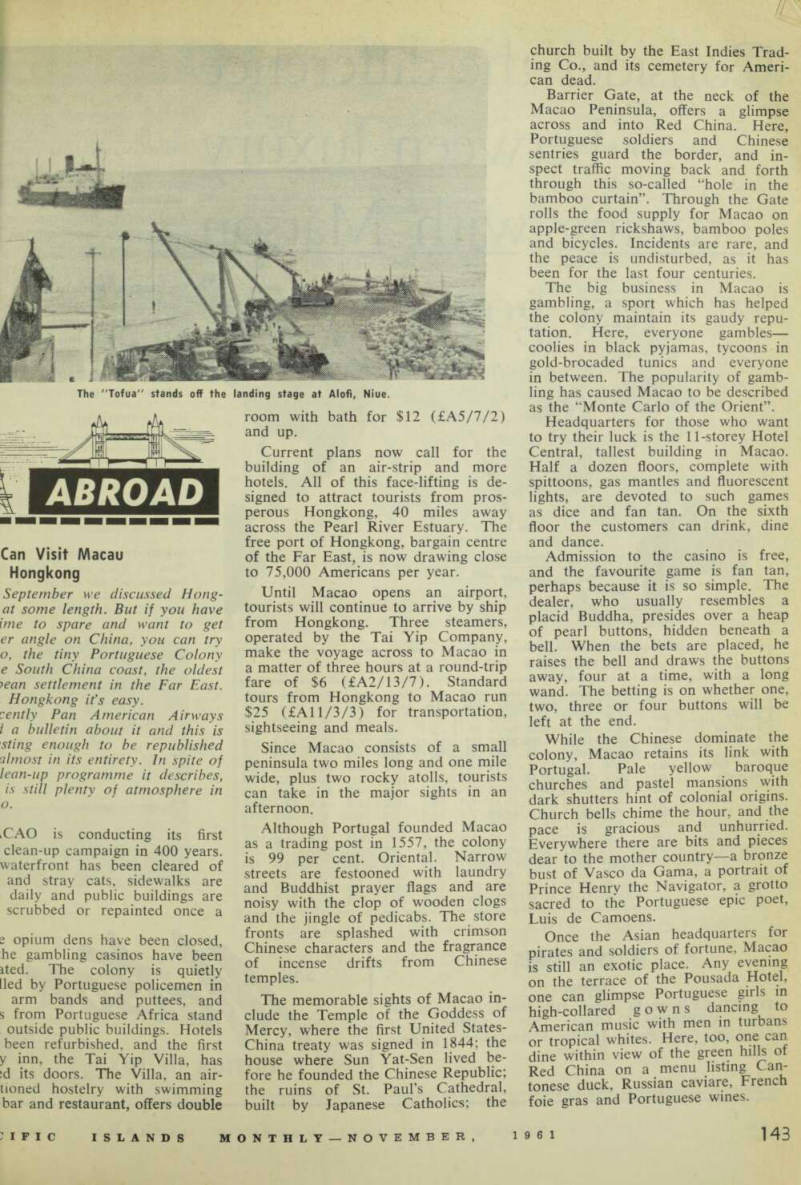
Niue, about 300 miles eastward, is a New Zealand dependency. It is one of the up-thrust coral islands of the Pacific, its general formation be ing that of two terraces that rise abruptly out of the sea. The port and Administrative centre is at Alofi; steamers anchor off here and cargo and passengers are landed on the jetty at the foot of the cliffs.
There are about 100 miles of road on the island and it is possible, at times, to get transport to visit some of the villages. However, most tourists will find plenty to interest them around Alofi. The Niue Islanders pro-
duce some of the best plaited-v in the Pacific—bags, baskets, i and hats may be bought here (pq cularly just before the ship is diu leave) for a few shillings.
American Samoa’s claim to t is the deep sheltered harbour of I Pago which was for 50 years • 1951, an American naval base, setting of Pago Pago, with err mountains in the background, is s tacular. The American administrs hopes to develop the Territory tourist resort now that it is Hi with the US by air through Ha’j The port of entry in Wes Samoa—at the moment a Trustee Territory administered by New land but from January, 1962, an dependent territory—is Apia. T lies out between two reefs and loading and unloading is done surf boats. There are good roadd the main island of Upolu and nui out taxis for hire.
Things to see in the town Vailima, currently Government HI but once the home of Robert L Stevenson; and, if you are the e getic type and don’t mind walkin the tropics, RLS’s tomb on the; of Mt. Vaea.
The town itself, which stretch]
mile or two at the bay, is pn it has three hi but owing to local liquor none of then licensed. With]
few miles of town there are bathing beaches; « you prefer it, there are fresh w bathing pools in the nearby I Papaseea, or Sliding Rock, where; can slide down a waterfall intoi pool beneath is about four miles fl Apia and well-worth a visit by pe who like new sensations.
There are no problems in arr ing long drives out through villages or the coconut or cot
plantations.
Western Samoa, like all the isl;J visited by the Tofua, produces tinctive plaited ware and other ha crafts for sale to tourists.
Home port of Tofua is Auckll NZ, and a round trip can be arrai from that port also—at extra cosi; course. But wherever the traw intends to board this ship, it is ne sary to book passage long in advas Tofua leaves Auckland at ah monthly intervals but for one mtj out of the 12 she is withdrawn ft service for overhaul.
The "Pacific islands Monthly" is a member of the Australian National Travel Association (ANTA) and the Pacific Area Travel Association (PATA), which are pledged to promote tourist travel in the areas covered by these organisations.
Can Visit Macau
Hongkong
September we discussed Hong at some length. But if you have ime to spare and want to get er angle on China, you can try o, the tiny Portuguese Colony e South China coast, the oldest yean settlement in the Far East.
Hongkong it’s easy, gently Pan American Airways 1 a bulletin about it and this is sting enough to be republished almost in its entirety. In spite of lean-up programme it describes, is still plenty of atmosphere in o.
ICAO is conducting its first clean-up campaign in 400 years, waterfront has been cleared of and stray cats, sidewalks are daily and public buildings are scrubbed or repainted once a 2 opium dens have been closed, he gambling casinos have been fled. The colony is quietly lied by Portuguese policemen in arm bands and puttees, and s from Portuguese Africa stand outside public buildings. Hotels been refurbished, and the first y inn, the Tai Yip Villa, has :d its doors. The Villa, an air tioned hostelry with swimming bar and restaurant, offers double
room with bath for $l2 (£AS/7/2) and up.
Current plans now call for the building of an air-strip and more hotels. All of this face-lifting is de signed to attract tourists from pros perous Hongkong, 40 miles away across the Pearl River Estuary. The free port of Hongkong, bargain centre of the Far East, is now drawing close to 75,000 Americans per year.
Until Macao opens an airport, tourists will continue to arrive by ship from Hongkong. Three steamers, operated by the Tai Yip Company, make the voyage across to Macao in a matter of three hours at a round-trip fare of $6 (£A2/13/7). Standard tours from Hongkong to Macao run $25 (£AII/3/3) for transportation, sightseeing and meals.
Since Macao consists of a small peninsula two miles long and one mile wide, plus two rocky atolls, tourists can take in the major sights in an afternoon.
Although Portugal founded Macao as a trading post in 1557, the colony is 99 per cent. Oriental. Narrow streets are festooned with laundry and Buddhist prayer flags and are noisy with the clop of wooden clogs and the jingle of pedicabs. The store fronts are splashed with crimson Chinese characters and the fragrance of incense drifts from Chinese temples.
The memorable sights of Macao in clude the Temple of the Goddess of Mercy, where the first United States- China treaty was signed in 1844; the house where Sun Yat-Sen lived be fore he founded the Chinese Republic; the ruins of St. Paul’s Cathedral, built by Japanese Catholics; the
church built by the East Indies Trad ing Co., and its cemetery for Ameri can dead.
Barrier Gate, at the neck of the Macao Peninsula, offers a glimpse across and into Red China. Here, Portuguese soldiers and Chinese sentries guard the border, and in spect traffic moving back and forth through this so-called “hole in the bamboo curtain”. Through the Gate rolls the food supply for Macao on apple-green rickshaws, bamboo poles and bicycles. Incidents are rare, and the peace is undisturbed, as it has been for the last four centuries.
The big business in Macao is gambling, a sport which has helped the colony maintain its gaudy repu tation. Here, everyone gambles— coolies in black pyjamas, tycoons in gold-brocaded tunics and everyone in between. The popularity of gamb ling has caused Macao to be described as the “Monte Carlo of the Orient”.
Headquarters for those who want to try their luck is the 11-storey Hotel Central, tallest building in Macao.
Half a dozen floors, complete with spittoons, gas mantles and fluorescent lights, are devoted to such games as dice and fan tan. On the sixth floor the customers can drink, dine and dance.
Admission to the casino is free, and the favourite game is fan tan, perhaps because it is so simple. The dealer, who usually resembles a placid Buddha, presides over a heap of pearl buttons, hidden beneath a bell. When the bets are placed, he raises the bell and draws the buttons away, four at a time, with a long wand. The betting is on whether one, two, three or four buttons will be left at the end.
While the Chinese dominate the colony, Macao retains its link with Portugal. Pale yellow baroque churches and pastel mansions with dark shutters hint of colonial origins.
Church bells chime the hour, and the pace is gracious and unhurried.
Everywhere there are bits and pieces dear to the mother country —a bronze bust of Vasco da Gama, a portrait of Prince Henry the Navigator, a grotto sacred to the Portuguese epic poet, Luis de Camoens.
Once the Asian headquarters for pirates and soldiers of fortune, Macao is still an exotic place. Any evening on the terrace of the Pousada Hotel, one can glimpse Portuguese girls m high-collared gowns dancing to American music with men in turbans or tropical whites. Here, too, one can dine within view of the green hills of Red China on a menu listing Can tonese duck, Russian caviare, French foie gras and Portuguese wines.
The "Tofua" stands off the landing stage at Alofi, Niue.