Pacific Shipping And Cruising Yachts
pp. 101-115 · Read in the full issue
There is still room for enterprise in the South Pacific hipping world judging by several new services, or new vari itions of old services, that are being inaugurated.
IE Burns Philp Line has added Mackay, North Queensland, to so-called Australian coastal ser , and MV Malekula showed the flag there for the first time in -October. She discharged cargo a Melbourne, Sydney and Bris -2 and then went on to other th Queensland ports before con ing the usual run around the New nea group and back to Sydney, he Burns Philp ships used to :e regular calls at Cairns and msville until the late 1930’5, then idrew from these ports until a months ago. The call at Mackay, previously on a BP route, was at request of local authorities. :kay was without a general cargo »ping connection with southern ts. l number of the BP ships are now ing at North Queensland ports, uding the Malaita which left ney on October 20. There have n persistent rumours recently in (ua-New Guinea that Malaita has n sold and will be withdrawn from Islands service. We understand t she hasn’t, and she won’t. (How r, if a buyer came along with the it amount of money in his hand, ier for the Bulolo or Malaita, the
owners probably wouldn’t throw him out of the Bridge St. offices.) Two vessels belonging to the Tas man Pacific Line Cap Domingo and Cap Corrientes may, in future, be regular callers at Suva with cargo direct from Napier, Hawke’s Bay, New Zealand. The vessels have been carrying frozen meat from NZ to the USA and Tahiti, and if sufficient in ducement is offering, will include Suva in the service.
An initial cargo of canned beer and other canned goods left Napier on Cap Domingo late in September and it is hoped that the direct link with the islands will open up new markets for Hawke’s Bay district producers.
At present, it costs as much to rail goods to Auckland from Napier as it does to ship them from Napier to Suva. Napier agents for the Tasman- Pacific Line are Colyer Watson Ltd., a name well-known in the S-W Paci fic. (C-W was established in New Zealand before developing Islands in terests.) The Crusader Shipping Co. has ap pointed Messageries Maritimes their agents in Noumea, New Caledonia, for the new shipping service linking New Zealand with that port and with Vila, New Hebrides. The two vessels
which will operate the service are Crusader and Saracen. Both carry re frigerated as well as general cargo.
The service is expected to begin in mid-November.
One of the jobs of Mr. K. W.
Davies, New Zealand Trade Commis sioner for the Pacific Islands, on his recent visit to the New Hebrides and New Caledonia, was to promote local interest in the Crusader Shipping Company’s new plans.
• Back In Business; Accord
ing to our Noumea correspondent.
Captain H. J. Helme has bought a new vessel (name not given), for the New Caledonian coastal service. He lost his small island trader Manava on August 14, off Mare Island ( PIM, Sept., 1961), but subsequently was successful in getting the contract for the subsidised coastal service for the next five years. He will shortly take delivery of the new vessel—said to have cost him about £AIO,OOO.
• First Blow Struck: Work
on the long talked-about new Suva Wharf got under way on October 17 after the Fijians had officially launched the project with the tradi tional yaqona (kava) ceremony and the contractors had driven the first pile. (There are 899 other piles to follow).
The Acting Governor, Mr. P. D.
Macdonald, and other VlP’s were there to see the beginning of the £F2i million project which will be carried out by Christiani-Nielsen & Gammon, the same contractors who built the Lautoka wharf, which opened for business earlier this year.
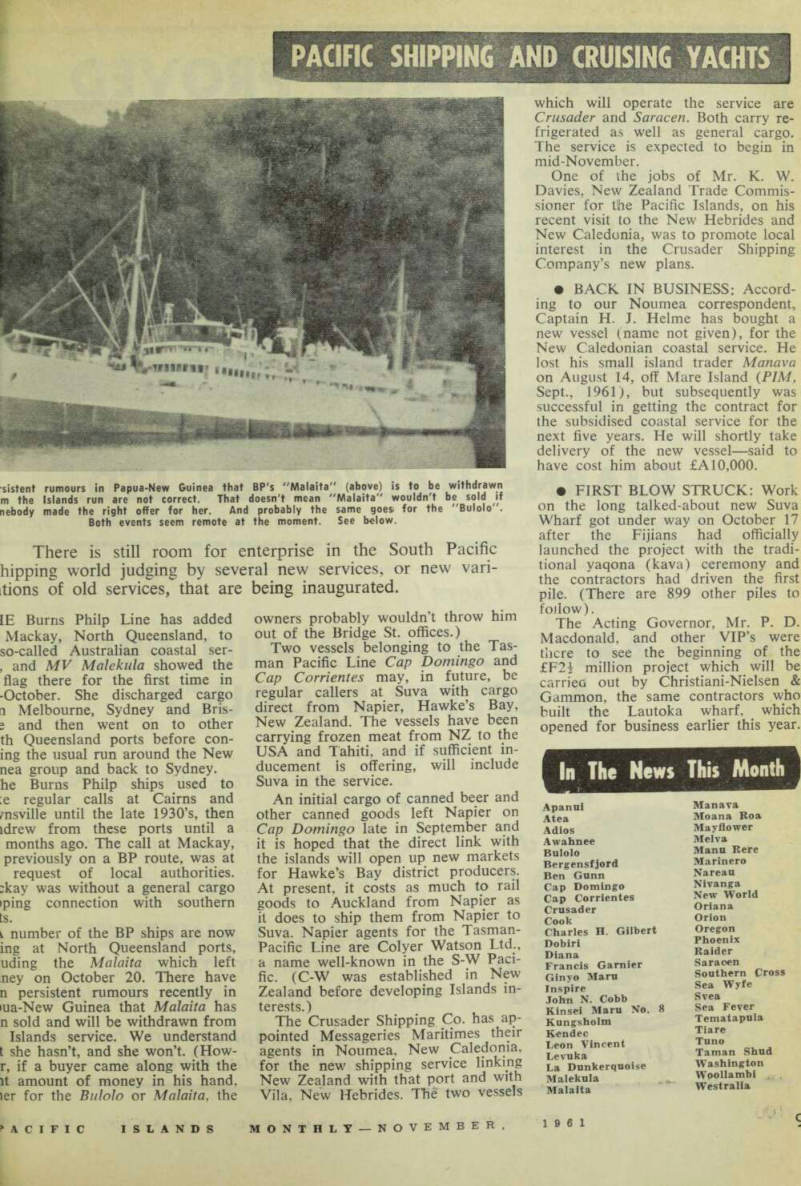
[?]sistent rumours in Papua-New Guinea that BP's "Malaita" (above) is to be withdrawn [?]m the Islands run are not correct. That doesn't mean "Malaita" wouldn't be sold if [?]nebody made the right offer for her. And probably the same goes for the "Bulolo".
Both events seem remote at the moment. See below.
End Of Another Jap
JEL; Wreckage sighted floating e sea 150 miles off the New ides by a Fiji-based RNZAF ;rland flying-boat was identified ►ctober 16 as the Kinsei Maru 8. The Japanese tuna fishing [ had got parted from other of the fishing fleet and had missing for about two weeks, other vessels could not give the i until they were joined by the er-ship, Ginyo Maru, which left Fiji, on October 8. A surface i was carried out initially but ictober 15 the RNZAF Sunder and a French Lancaster based ontouta, New Caledonia, were cd into the search.
First Birthday: The New
nd Government’s motor vessel la Roa completed a year of itions in October, and according ook Islands sources, has already d a special corner in the hearts ook Islands residents who travel :r. ter the old Maui Pomare, which eplaced, they say they appreciate omfort of travel in the new ves- What’s more, she has already red the “friendly atmosphere” le old ship. Maui Pomare was le run for 32 years and earlier was sold East. As the May ?r she now trades out of Hong —probably giving a lot of ese passengers that well-known feeling around the region of the OLD AND NEW: The Gilbert Ellice Islands Colony ship au, which was sold to Mr. :rt Reimers of Majuro, Marshall ds, in September was due for ery to her new owner in Octo- The delivery crew was then ex ;d to go on to Hongkong to take ery of the 137-ft Nivanga which seen launched there by the Hong ; and Whampoa Dock Co. ie Nivanga replaces two older smaller G&EIC vessels — Nareau, h was the Resident Commis jr’s touring vessel until two years and the Tematapula.
Shipping Man Retires:
Terence E. Rowe, vice-president Large of Matson operations in South Pacific, retired on Novem 1. The Sydney-based task is be taken over by Mr. William F. ske (see photo on p. 67). [r. Rowe retires after a long and urful career in shipping. A Cana by birth, he went to sea as a on Alaskan trawlers, became a
radio operator, graduated to purser with Dollar Line vessels, then rep resented the Dollar Line ashore in Europe, Japan and Honolulu, where he later joined the prominent Island company, Castle and Cooke. He moved to Matson and was vice president in charge of the Marine De partment until his appointment 4J years ago to the South Pacific.
• Captain Hugh Williams
RETIRES: After nearly 10 accident free years of inter-island trading in the Cook Group, Captain Hugh C.
Williams has retired.
Recently, Skipper Williams sold his 135 tons gross Dobiri to the Cook Islands’ Co-operative Society,
and even more recently, his 296 tons gross Apanui to D. C. Brown and Sons Ltd., of Rarotonga.
Hugh Williams, an Australian, first visited Rarotonga in 1951 in the Inspire, a Brixham trawler he had bought in England and was sailing to Sydney for conversion for Islands’ trading. The following year he re turned to the Cook Group and began trading with the Inspire. His en gineer, Mr. Les Livingstone, also an Australian, had known Captain Williams for some years, and was to spend several more with him as en gineer on a succession of ships.
The Inspire kept a good sailing schedule, even during hurricane seasons when all other local vessels
left for the safety of Auckland Papeete. She carried 43 tons of ► and 11 cabin passengers. Two is gave her a cruising speed of nots.
June, 1956, Captain Williams the Inspire to Mr. D. C. Brown, ok Islands’ trader and shipowner, bought a larger ship, the MV a. e Melva, 265 tons gross, was in Auckland during the latter ; of World War 11, one of six ar vessels ordered by the United s Navy. For some years after war the Melva was used for :ting scrap iron from the Pacific ds battlegrounds, mainly New ea. e vessel’s two 160 hp diesels her a service speed of eight >, and to keep his numerous Cook ds deck passengers amused, Cap- Williams installed a 16 m.m. e projector and a Hi-Fi record ng unit worth £2OO. When Tahi music was played on the Hi-Fi lative passengers went wild. irotonga’s two tiny harbours at ua and Avatiu can only accom ate small vessels, and are un when strong northerly weather ails, consequently the Melva t a lot of time lying in the road l. There was talk of deepening harbours, but little real pro 1, and Captain Williams decided avour of a smaller vessel, e sold the Melva in Sydney,
bought a 135 tons, shallow draft, wooden motor vessel, the Dobiri, at Port Moresby and sailed her against headwinds and seas to Rarotonga. In November, 1958, the Dobiri made her first Cook Islands’ voyage—from Rarotonga to Aitutaki.
Although the Dobiri’s shallow draft enabled her to enter Avarua and Avatiu harbours, Captain Williams was still dissatisfied with harbour facilities. He said that unless they were improved within a reasonable time, he would leave.
In January, 1961, he took the Dobiri to Auckland for a refit. Late the following month he bought the Apanui, a German-built steel single screw vessel, from the Northern Steamship Company of Auckland.
The Apanui was built in 1938, is 296 tons gross and is powered by a single diesel. The New Zealand Gov ernment had decided to subsidise inter-island vessels which were “in survey” with firms such as Lloyd’s, or the NZ Marine Department, and the Apanui qualified for the subsidy.
Skipper Williams had put up the Dobiri for sale, but decided to operate her with the Apanui in Cook
Islands’ waters in the meantime. He had the Apanui converted to take 16 passengers and 385 tons of cargo, then both vessels sailed for Raro tonga where they arrived on May 5.
The Dobiri was sold late in Sep tember to the Cook Islands Co operative Society, and in early Oc tober Mr. D. C. Brown bought the Apanui.
After more than a decade of work ing together Hugh Williams and his mate, Les Livingstone, split up, Les continuing to act as the Dobiri’s engineer, and Hugh going into retire ment.
Captain Williams plans to settle in Sydney with his wife and child and will probably leave the Cooks in November. He is determined that all future voyages he may make will be as a passenger.
• Already Afloat: The
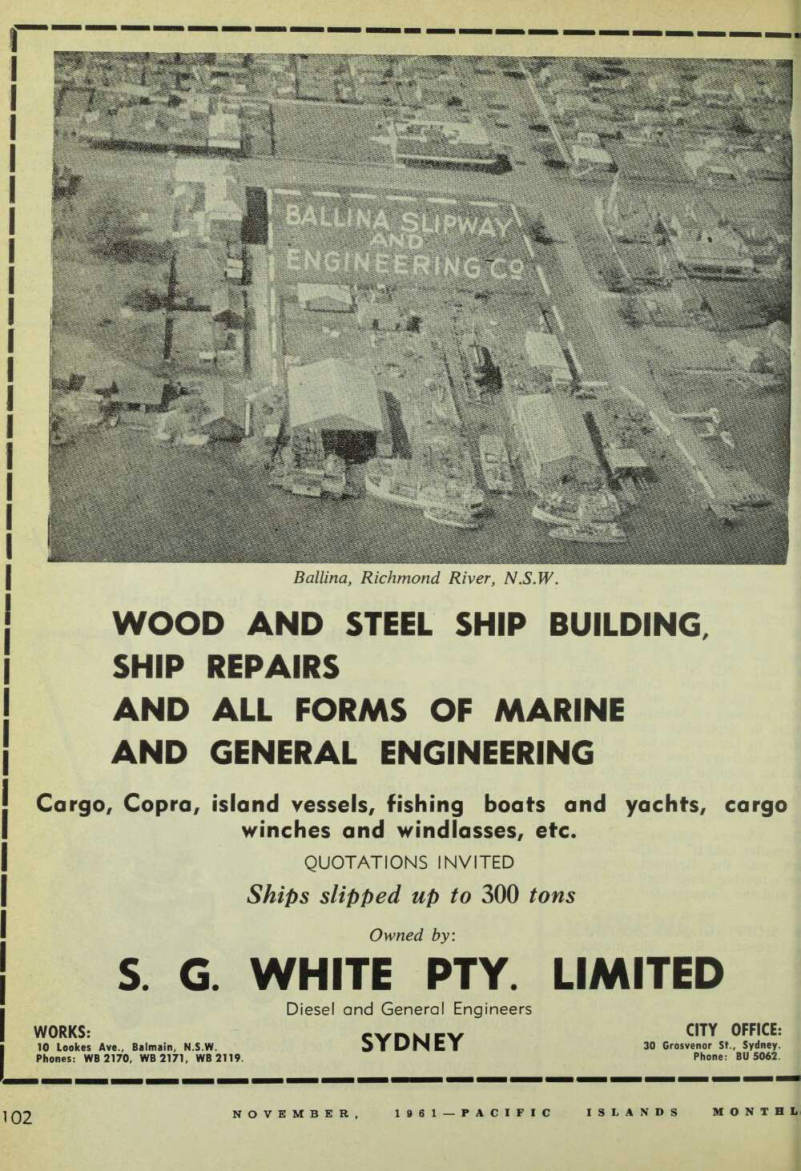
Melanesian Mission vessel Southern Cross IX was launched at the Ballina Slipway and Engineering Co. yard in northern NSW in late September, and if all goes well she should be in ser vice in the South West Pacific in De cember. (It was incorrectly reported
[?] Hugh Williams will retire to live in [?]. This photo was taken in Auckland [?]rear just before he departed for the Cooks with his new "Apanui".
; last month that she would not launched until December.) 'he new vessel replaces Southern ss VIII, also built at Ballina, but in gales off the Guadalcanal st in mid-1960 when she had been icrvice only two years, he new vessel, at 87 ft 1.0. a., is biggest wooden vessel to be built NSW since the end of the war. i her predecessor, she will be used he floating home of the Bishop of anesia, the Rt. Rev. A. T. Hill 10 is himself a Master Mariner), [veil as for the transport of mis i personnel and stores. According the last issue of the Melanesian sion magazine, a Master is still ig sought for her. lo one seems to have got on to et, but there must be a book in history of the nine vessels called them Cross that have served the lanesian Mission in the South jt Pacific over a century of time, le of the nine outlived their mis i usefulness and were sold to other iers; other ships came to adven >us ends while still in Mission dee. \ CRUISES AHEAD: Plans are ady made by the big shipping ipanies for cruises to the Pacific nds next year—and some have n made for 1963. he 42,000 tons Oriana will make 11 day “Winter cruise” leaving ney on June 13, and returning -eto on June 24 after having ted the Barrier Reef island of Honiara, BSIP; and Suva, . On August 24, 1962, the tourist ;s P&O liner Orion will leave Syd for a cruise that will include ;kland, NZ, Suva, Fiji, Rarotonga, jk Islands, and Papeete, Tahiti, n February, 1963, Rarotonga, ?k Islands, will have two Ameri cruise ships within a week of h other. The Swedish-American
Line vessel Kungsholm will arrive there in February 8 and spend five hours in the port. On February 14, the Norwegian-American Line ves sel Bergensfjord will spend 10 hours there.
• The Fisheries Front:
Australia has one of the longest coastlines of any country in the world—but imports more than half the fish consumed locally. It is hoped that the new Fisheries Training School at the CSIRO Marine Labora tory, Cronulla, NSW, which was opened on October 9, will be one means of rectifying this unbalanced situation. Fisheries officers from all States will attend for training then return to work “in the field” as advisers to their departments.
As Australia’s population increases, imports of fish rise also, much of it in varieties available in coastal waters.
Australia has some problems pe culiarly her own, including the long distances between ports; and what appears to be a natural decline in the catches of some varieties in re cent years.
On the other side of the picture, however, there has been a spectacular growth in the tuna fishing industry, and crayfish exports last year pro duced a valuable $Bl million. (Ex porters of crayfish tails must be dis appointed that their wares are never heard of in the United States although “New Zealand” Lobster Tails feature on every menu of any pretentions in every State of the Union.) At the same time that the Cronulla school was opened, news came from Honolulu that the US Fish and Wild life Service there had received an appropriation of $1,763,400 for a new research ship.
Design of the vessel and super vision of its construction will be the responsibility of W. C. Nickum and Sons Co., naval architects and marine engineers of Seattle, Washington. The Nickum firm has handled a wide range of specialised ship design tasks for private and Government clients, including the designing of the John N. Cobb and the conversion of the Oregon and the Washington for Fish and Wildlife Service exploratory fish ing work.
The general specifications of the new ship call for a large and versa tile vessel with a 10,000-mile cruising range and accommodation for 10 scientists and 20 crew. The oceano graphic installations will permit col lection of water samples and water temperature measurements to any
Port Moresby
Yacht Club
Port Moresby Yacht Club's club-house has a new look. More than £7,000 worth of ex tensions have made it an attractive building, and it was crowded out on the evening of September 30 when the
P-NG Administrator,
Sir Donald Cleland, officially opened it. The club-house overlooks the harbour near the marine base, but un fortunately a busy road separates it from the water.
THE SMALLEST This is "Spartan Spirit", 18 ft 6 in. Bermuda-rigged sloop which is sailing round the world east-about. If she makes it she will be the smallest craft to have done the voyage "Trekka" was about 18 in. longer. As far as we've heard, "Spartan Spirit" got away from Avonmouth in September, after having left Bristol on August 26 on the start of the voyage. Owner-skipper Jim Wakefield and two shipmates were aboard. Wakefield spent two years in RN submarines.
i and the towing of a variety of [ton nets and mid-water trawls sampling the smaller members ic marine animal community, ina and other large fish will be :ted for study by means of long gill-nets, and trolling gear. The oard laboratory will have ria for experiments in the hatch nd rearing of fishes and for hold ive specimens for observation, iderwater glass viewing ports at and stern, which were first em d for the study of tuna be ur in the Laboratory’s present I. the Charles H. Gilbert, will be a feature of the new ship.
French Vessel In Suva:
French minesweeper La erquoise was on the slipways iva in October, for inspection, ship replaced the Tiare which been decommissioned and sent to France. La Dunkerquoise built in Canada and went to :e in 1954 to join the mine )ing forces, but after a short she was put in “mothballs”. Her in, Lieutenant-Commander J. >illot, said in Suva that the ship recommissioned in January, and was sent to Noumea to re- Tiare. He expects to be back iva with his ship in about six bs, when she is to be slipped . He explained that this has to me at regular intervals to keep vood hull clean of fungi and damage. La Dunkerquoise is 0 tons, has a cruising speed of 16 knots, and carries 32 men hree officers.
Matson Liner For
MEA: A vice-president of lie Steamship Co.’s Matson has recently visited Noumea, Caledonia. He had some hard > to say about the lack of port ies and the high cost of poor es in the town. It was later an :ed the Monterey will be routed gh Noumea in January as a is call”, (See “Pacific Report”.)
Trouble For Kendec
TUNO : The pilot boat Ken which was the object of search rescue operations a few days msly, arrived in Noumea under iwn power but escorted by the h frigate Francis Gamier, on >er 24. She seemed little the 1 for wear. 2 vessel was built for the New lonian government in Mary igh, Qld., by Capricorn Char md was on her delivery voyage oumea when she struck a sub ed object 630 miles NE of ane and began to take in water iavy seas.
The distressed vessel was located by a RNZAF Sunderland and the frigate Francis Gamier was directed to her aid. She was pumped out with the aid of a motor pump from the frigate and restarted on her voyage.
The delivery crew of five Austra lians was headed by Captain G. A.
Wyeth.
The ketch Tuno which went ashore at the entrance to Havanah Passage, New Caledonia, on October 18, was refloated three days later with the as sistance of the Leon Vincent, a tug owned by the Nickel Co. The vessel which is owned by a Mare Island co-operative society was on a voyage
to Noumea when the engine failed off Havanah Passage. Gale force winds washed the vessel onto a coral plat form.
• Fate Of Woollambi :
Woollambi, ex-Delfino, ex-Westralia, which has looked like becoming a fixture in Sydney Harbour where she has been tied up for some time, may have new owners after November 6.
Tenders for her purchase were called some time ago and closed early this month.
Westralia, 8,174 tons gross, was well-known in the Australian inter state passenger trade until a few years
vhen she was bought by the In tional Shipping and Import cy and converted to carrying i across the Pacific to America, e vessel was registered in Suva, for a while had a Fijian crew, name was changed first to Del and later Woollambi. The opera proved uneconomic, and accord o Court evidence last April, the rs owed the Standard Insurance of New Zealand over £900,000. insurance company has since ed.
Captain Wilding On The
L PATH: Captain Bill Wilding, le BP Line Bulolo takes a dim of visitors to his ship in Port :sby. He says that local residents their cars on the wharf and f approaches and crowd round wharf itself, thus delaying the round of ships and increasing hazards of the waterfront ers. len Bulolo was in Port Moresby ictober 8, there were 68 private and 270 people obstructing wharf ng. Some of the cars were parked iat it was almost impossible for s lorries to manoeuvre. ptain Wilding has put his com ts in a letter to the Minister for tories. ere is probably something in he says, of course, but it all up to the fact that the era when t day” was the big event of the h has now departed. There has a system of wharf passes for going on to Port Moresby wharf everal years, so it seems that if :les are cluttering up Captain
Wilding’s wharf, the problem could be solved by restricting the number of passes.
News of Cruising Yachts
• PHOENIX left on her anti bomb cruise September, as reported in October PIM, but before sailing from Hiroshima, Japan, owner-skipper Dr.
Erie Reynolds sent out a circular letter to friends and newspapers. He said his destination was Vladivostok and the object of his voyage was to protest against tests of nuclear weapons. He asked people who were
with Phoenix in spirit to write to newspapers, world political leaders and to the United Nations.
At least it can be said that Phoenix and her crew are taking their pro tests to the right place. If they can organise some anti-bomb demonstra tions amongst the Russians they might be achieving something.
Writing letters to political leaders of the free nations of the world, who aren’t letting off bombs, seems fruit- On Oct. 29, Reynolds and his party were turned back from a Rus sian port by a warship. The Phoenix is now back in Japan.)
[?]s for the "Woollambi", closed in early [?]ber. The vessel is almost a fixture in [?]y Harbour these days. See below.
SEA WYFE arrived at Auck- NZ, on October 22 about a i out from Tahiti which she a September 23. This last leg of ney which started in Seattle two ago, was a “succession of 5 or flat calms”, said owner ir Curtis Ashford, who was ac inied by a crew of one— a, a Tahitian from Tahaa Is. rd expects to spend at least six is in NZ refitting the 9-ton ier.
TAMAN SHUD, which arrived ckland earlier in October also sd calms on the last leg from -to such an extent that the was reported overdue at one The passage took 23 days—the t trip in six Pacific voyages, ling to owner-skipper S. Holder ickland. The 30-ft cutter left and on May 13 and visited and American Samoa as well i.
LEVUKA, the 24-ft Fiji yacht ch eight people almost came to Icy end in early October, has ocated by a Fijian in 20 ft of between Malolo and Tavua off Nadi Bay in NW Viti Earlier a search from the air :en called off. The owner of the Mr. P. Doyle of Nadi, does link that he will be able to r her.
October 7, Mr. Doyle and other people left Nadi for a on Malolo Is. The yacht cap n heavy weather and the occu were thereafter in the water for urs. They finally managed to to Malolo from where they
were rescued. Apart from Mr. Doyle, all were members of TEAL or PAA flight crews. Survival drill, which they immediately put into operation once they were in the water, probably is responsible for the fact they are all alive. (See PIM, p. 133, Oct.) • THREE YACHTS from overseas, were for the first time that anyone can remember all at Alofi, Niue, together in mid-September, They were Atea, from New Zealand; Svea (also reported as Sver) of America; and Ben Gunn, also of America.
Niue has no sheltered anchorage and is a nightmare to commercial shipping which just hangs off and on while unloading and loading cargo. The yachts, of course, anchored right at the Alofi jetty where they were described as “looking a pretty sight”. Nonetheless, as even the surf boats are taken out of the water at Alofi, the skippers probably kept an eye on the weather. • NEW WORLD, 30-ft ketch owned by Mr. and Mrs. W. Graeber, of Vancouver, arrived at Whangaroa, NZ, on October 23. They had taken two weeks from Suva, Fiji, and roughly a year from their home port.
Plans are to work in New Zealand for the next few months to finance the next leg of their round-the-world „ rill -„„ 6 • A DIOS and Tom and Janet Steele should be somewhere around
Aden or the Red Sea at the moment, if they are on the schedule planned when we last heard of them—at Diego Garcia Is., one of the outliers of Mauritius, Indian Ocean, We had previously reported them from Portuguese Timor from where they attempted to sail to Bali but had to give the idea up due to contrary winds and currents. They spent a couple of pleasant weeks at Christ mas Island at the end of May and an other 25 days at Cocos where they seem to have been enthusiastically adopted by Qantas staff, the cable station and the Clunies-Ross family. • MANU RERE, schooner owned by Wesley Hurr, arrived in Honolulu in mid-October 29 days out of Papeete, . , • AWAHNEE, going m the op posite direction, left Honolulu about the same time and expected to be in Tahiti at the end of October. She is owned by Dr. Robert L. Griffiths and both ship and owner are well known in Australasian waters where last year they entered both the Trans- Tasman and Sydney-Hobar y races. ~.r iIX7r7D/n . Uq c nn
• Marinero, T E .
Diego yacht was expected to leave Rarotonga, Cook Is., i , , for Tonga and the "
Aboard her are the owner and tus wife, Floyd and Doris Christenson, and their two children, aged 4 and Keren, 2 months. Also aboard is
D? This is the "Levuka", which Doyle thinks he might not be able to recover.
SURVIVED. These are the eight who survived the sinking of the 24 ft yacht "Levuka" off Nadi Bay, Fiji, in October. They lashed themselves to the yacht and carried out survival routine which undoubtedly saved their lives. All but one are employed by air lines. See below, and also October, p. 133. From left, standing, they are: Captain lan Gemmell, TEAL; Captain Jack Adriance, PAA; Fit./Engineer Derek Stubbs, TEAL; Fit./Officer Keen Langhorne, PAA; Mr. P. Doyle, of Sky Lodge, Nadi (the yacht's owner). Seated from left are Misses Gudran Meisner, Stella Navarro and Peggy Kircher, all flight hostesses with PAA. Miss Meisner cannot swim. Photo: S. A. Whippy.
Sibthorpe, an American crew ;r. Marinero has been in Raro since the first week in Sep • On her trip from Tahiti to nga, the rudder was carried while hove-to in a severe SW The boat was steered the rest way into Rarotonga by means n spinnakers and sea-anchors, imall marine railway there, was built after the tidal wave Tie back, was too deteriorated , so the boat was weighted in the bow, and her stern hard aground at spring ide. A temporary steel-plate was then welded on the -post at low tide, and the floated off again at high In NZ her engine, which :en inoperative since she left arquesas 18 months ago, will laced.
EA FEVER owned and sailed arry, Margaret and young r Alexander, left Rarotonga in iber for Vavau, Tonga and Fiji. A Rarotongan sailed with is crew. ~>IANA of England, which we lorted a year ago as just enter “ Pacific for her second-time (owner-skipper Norman Young ir out here in 1957), was in Fiji, in October. Skipper expected to be leaving there end of that month for New d. Since leaving Balboa in Sep ’ 1960* the 24-ton yacht has :ruising in French Polynesia, and Fiji, Normally she carries r of four or five but the only aember who has been with her ir any length of time is Unga natangi of Nukualofa who is
a veteran of cruises on Manawanui, Nereides and Trade Winds. (In June PIM, p. 107, Brian Ferraz, who sailed in Diana in her 1957 rmice cr a ten: col !fs G t e n -iSrs Diana and telling him that Colin Gallon and his Raider disappeared about two years ago somewhere west of the Cape Verde Islands.) • MERIDIAN, 44 ft cutter with American couple Richard and Abbie Stafford aboard, arrived in Vila, New Hebrides, on October 18. The popular Staffords are en route to the
Solomons before finally heading home.
They are real veterans now. The Staffords and the Meridian left Panama in 1956 for their South Seas’ cruise—being in no hurry, they said.
They have taken a good long look at many islands on their easy-going tour, and spent the last two years on the Australian coast. b Their trip will probably go into the records as one of the most suc cessful of the long “just cruising” cruises of the Pacific, for they have taken life as they have found it, worked hard and long when the need arose, and annoyed nobody. And what could be more successful than that!