Beautiful Story Of
pp. 85-86 · Read in the full issue
[?]He Month S New Reading
Beautiful Story Of The Outback
Australian playwrights may have discovered the cities ee Great Outback continues to interest the writers of ks.
ELS of the Outback appear )m time to time as they always je review below), but lately end appears to favour the of fact, and some factual of absorbing interest have ap in recent years, more of the factual kind this month, A. M. Duncan- Our Channel Country, and Bird’s Born to Fly. The very : Our Channel Country will ' it as an Outback book, but o Fly is something of a sur- It’s as much a book of Out iterest as of flying interest. author of Our Channel y also is a woman. Mrs. i-Kemp grew up in the chan mtry of south-western Queens ;o-called because it is naturally d by a maze of channels fed he rivers that flow towards yre, including the Diamantina.
Duncan-Kemp is now a in her sixties, still living in land, book covers the years up to ■ly adulthood, and the result eautiful piece of writing, a hat surrounds that amazing if country with a sense of —almost at times having the of a Dreamtime. drama of the book is the quiet that unfolds as Mrs. Duncan tells of the harmony and the ; of the channel country people e pioneers, the aborigines, the nd animals, the droughts and
Particularly is it a story of animals, and even of insects; particularly is it the story of the aborigines—the full bloods whom the author says have never intruded upon the European— “for blacks never intrude—they only ask to be left alone”.
Other writers have said, as Mrs.
Duncan-Kemp says somewhere, that “living close to the bush and its creatures gives you a vague and curious sense of participating in the mysteries of nature herself”. But here
is a writer who makes the phrase mean something, and Our Channel Country is a work which should be come an Australian classic of Out back life—the kind of Outback life that might already have disappeared.
Nobody who reads the social columns of the Sydney newspapers could fail to be aware of Nancy Bird in her role of Mrs. Charles Walton— wife of a big department store execu tive, and a prominent worker for charity. They live in a big house in
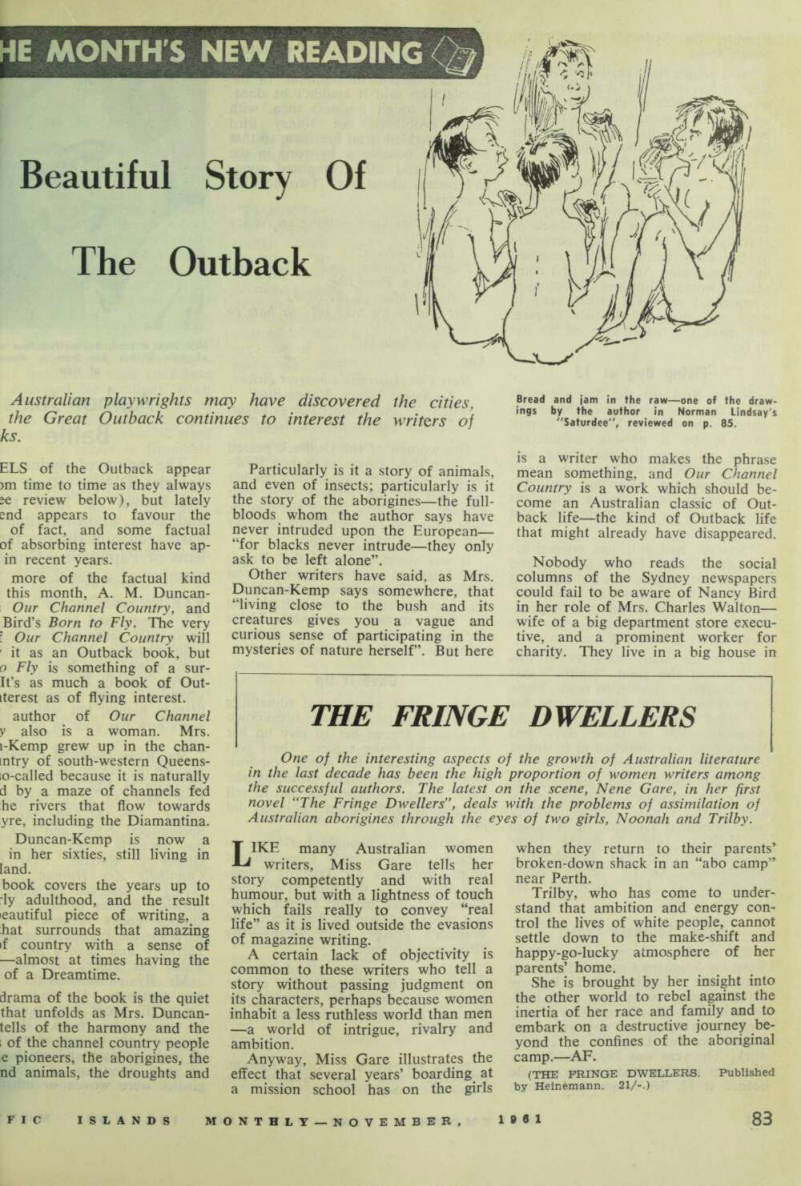
Bread and jam in the raw—one of the draw ings by the author in Norman Lindsay's "Saturdee", reviewed on p. 85.
Pymble, on Sydney’s upper - crust North Shore.
Most people have realised that Mrs.
Walton has a “flying” background of some sort before the war, when aviation for women was in its infancy, but the details have probably been forgotten even by those who were in a position to know them.
It is a straightforward account, with no writing frills, yet somehow through it there shows a sympathy and even a love for the Outback of NSW and its people. Her chronicle of her early battles, which resulted in her becoming Australia’s first com mercial woman pilot and the youngest commercial pilot (of either sex) in what was then the British Empire, will make the reader take off his hat to her.
Flying Bug at 13
Nancy Bird got the flying bug at 13, when she read everything she could on the subject. What her family took to be a passing infatuation turned out to be the real thing, and August, 1933, found her at Sydney’s Mascot airstrip receiving her first flying lesson from Charles Kingsford Smith —paid for from money she had saved up.
“Smithy” had only just opened his Kingsford Smith Flying School, and his need for pupils was as urgent as Nancy Bird’s need to fly. “Smithy” at that time was planning his record breaking England-Australia solo run in the Miss Southern Cross.
There are many passages in this book about the great “Smithy” that his admirers will want to read. Their trails crossed on many occasions, for the flying fraternity was a small and close-knit club in those days and Nancy Bird was absorbed in it almost to the point of hero-worship.
Aviation names—and viewpoints on them—are sprinkled through every page—Reg Ansett, Arthur Affleck (now Regional Director of Aviation in P-NG), John Stannage (now manager of the Fiji Broadcasting Commission), G. U. “Scotty” Allan (chairman of Fiji Airways), Sir Gordon Taylor.
Flew "Southern Cross"
She is the only woman to have flown the Southern Cross. When news came that “Smithy” and Tommy Pethybridge were missing over Ran goon in Lady Southern Cross Nancy Bird was winging her way west from Sydney in her Leopard on charter work. The year was 1935 and Nancy Bird was 19. She had got her private licence at 17, her commercial licence
two years later and already had been barnstorming the West and operating charters in a Moth—making her job keep her despite the opinions of the people who said it couldn’t be done.
It was a tough business then, with many problems, but Nancy Bird happily tackled it on her own, so that her name became a by-word in the Outback and they composed songs and poems about her. Two horrible examples: The birdies have nothing on Nancy Bird, T ra-la-la-la-la!
There’s Smithy and Lindy and Wiley Post too, In the blue, in the blue, But Nancy we take off our hats to you, T ra-la-la-la-la!
And, Here’s to Australia’s bravest girl, To Sweet Nancy, Nancy Bird!
Where ’er the Empire’s flags unfurl Let the gallant tale be heard!
The women of the Outback peered up from their stoves as Nancy Bird’s aircraft droned by and envied her her life, and on the ground men were amazed when they found the charter pilot who had just landed on the clay pan was a young woman.
It was about that time that Nancy Bird began to work for the Far West Children’s Health Scheme and on fly ing doctor work in the Outback and her fame spread even wider. There are many warm and moving passages about her work with the Scheme.
Gave It Up The author admits that something in the nature of a nervous breakdown eventually forced her to give up her commercial flying career. There was too much work, too much responsi bility for one woman. Suddenly she hated flying; suddenly she had to sell her aircraft and get out. This she did just before the war.
But the war brought her close to aviation again as NSW Commandant of the Women’s Air Training Corps, and afterwards —this time as a hobby —she got her private licence again and twice took part in America in the Women’s Powder Puff Derby—the all-women air race.
But the pages that tell of her ex periences in the Outback, and of the people who make the Outback, are the ones that make Nancy Bird’s book
worthwhile.
S.I.
(Born To Fly, 25/-. Our Channel
COUNTRY. 28/6. Both published by Angus and Robertson.i