A Guide To The Gilbert And Ellice
pp. 78-99 · Read in the full issue
By a Staff Writer
There are still places on earth where life can be a comparative uncluttered affair of owning a basic wardrobe of a half-dozen pairs of white shorts and ditto shirts; and setting up house with government issue of the regulation number of chairs, beds and tables (plus one Ant Cupboard , presumably for keeping ants out and not in).
WHERE is this place? The Gilbert and Ellice Islands Colony—and they have recently issued a roneoed book about it, for the encouragement of new and/or intending Government officers.
Whether it is successful or not in this aim we wouldn’t like to bet, but if it gets into the wrong hands it could result in a stream of refugees from this world of traffic jams, nuclear fall-out and TV advertising, beating on the door of the Principal Immigration Officer for a “permit to reside”.
There are, says the booklet, no newspapers, no banks and only ‘ very irregular” mails. And if this doesn’t get them in, it goes on to record that there are no air services and that overseas shipping (except to Ocean Is.) runs on schedules of “three times a year” or “once every 15 months”.
For travel by land, officers and their wives already in possession of bicycles are advised to bring them.
Those who have none may buy them locally at £24 apiece.
But you want to travel about, inter-island? Well, this we have, and we quote: “Travelling is usually undertaken
in the small Colony vessels. Island travelling involves frequent embar kations and disembarkations in ships’ boats or native canoes, often through surf. Articles such as ex pensive watches, cameras and other things which may be ruined by im mersion in sea water should be adequately protected.
Inter-island travelling involves comparatively long voyages out of sight of land. The currents, or sets,
in these seas are strong, varialf and often unpredictable. Due low-lying and small atolls it is n easy to make a reliable landfall at at many islands there are anchorages. Navigation in t Colony is accordingly more diffic: than in more compact groups high islands.”
However, as compensation for g ting your best camera ruined and t possibility that, due to sets and di cult navigation, you may end up the Solomons, you are assured in t next paragraph that the fishing very good: “Travelling can give plenty opportunity for fishing; kingfr barracuda, tuna, etc., can be taK with a trolled feather near the n when approaching or leaving island.”
On the domestic front houses described as ranging all the way fn “full European construction w plumbing, etc.”, to “native type dwv ings . . . sand box toilets attach© Foodstuffs usually are imported! though it is possible to buy fresh ft chickens, eggs, pawpaws, taro t breadfruit. The booklet lists se;
(Continued on page 95)
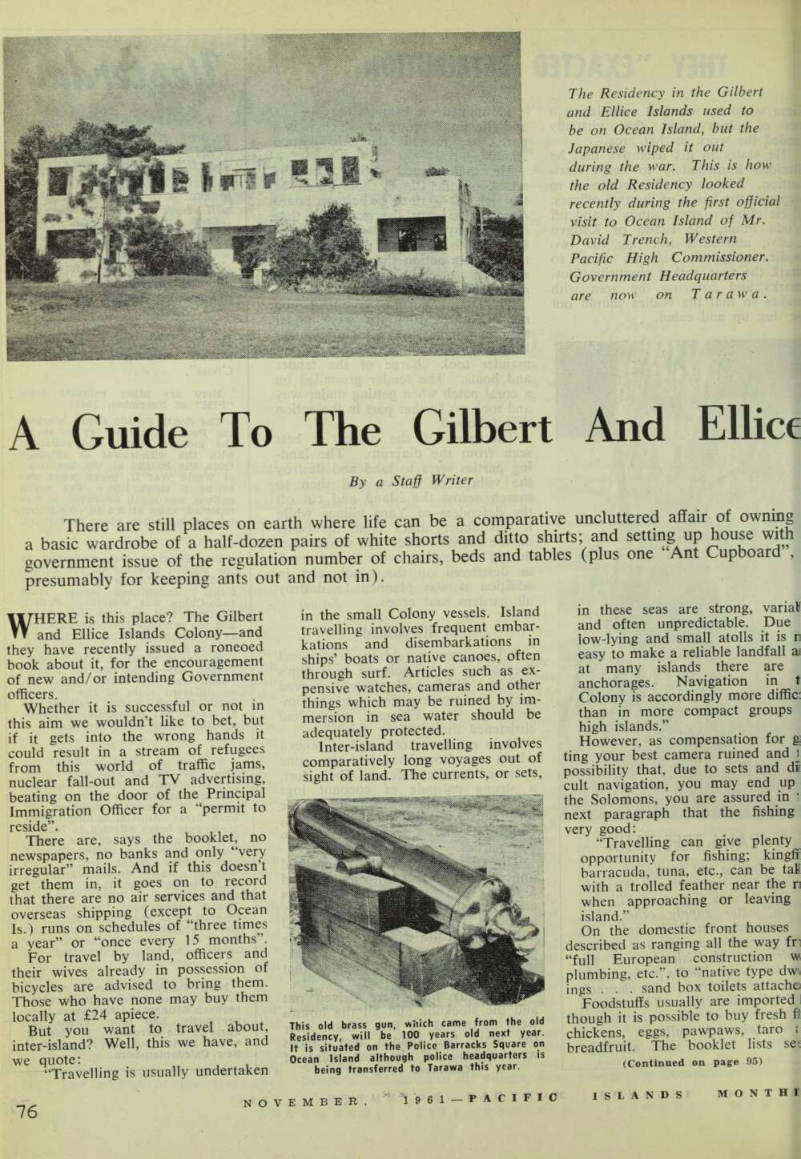
The Residency in the Gilbert and Ellice Islands used to be on Ocean Island, but the Japanese wiped it out during the war. This is how the old Residency looked recently during the first official visit to Ocean Island of Mr.
David Trench, Western Pacific High Commissioner.
Government Headquarters are now on Tarawa.
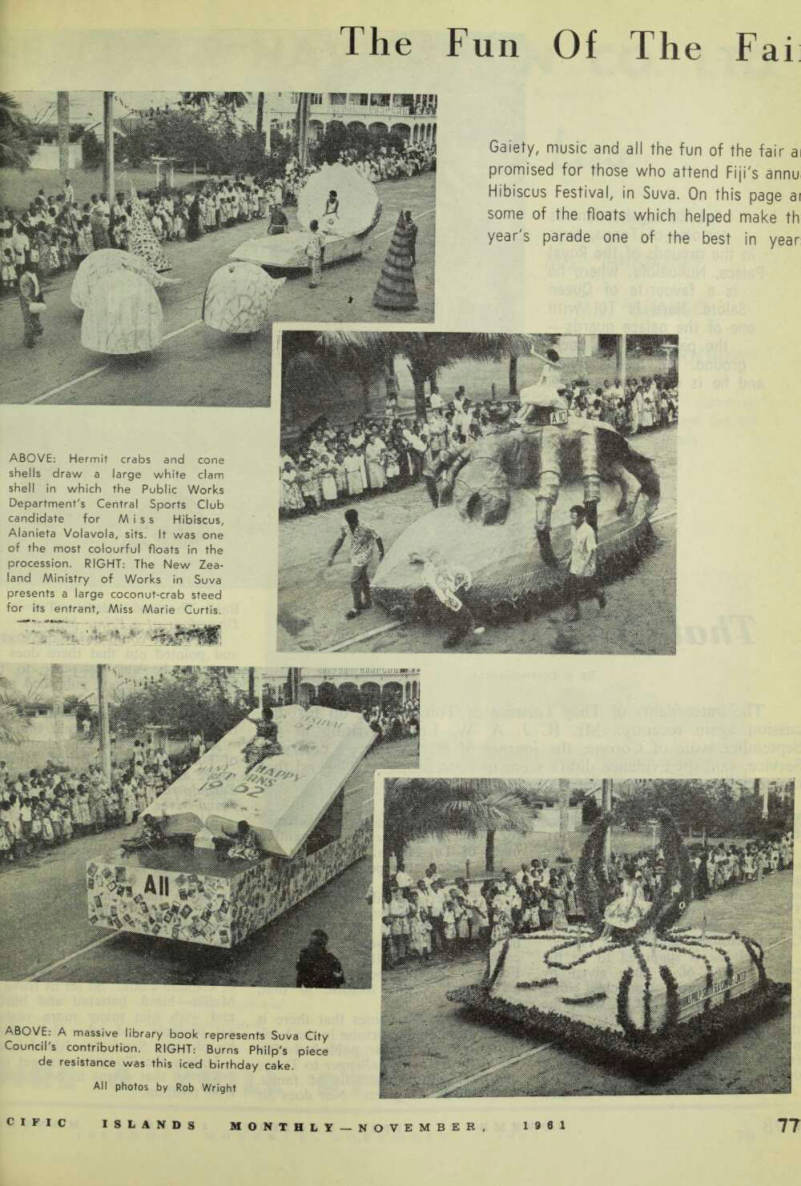
This old brass gun, which came from the old Residency, will be 100 years old next year.
It is situated on the Police Barracks Square on Ocean Island although police headquarters is being transferred to Tarawa this year.
that aren’t available locally food, books and magazines, ics, shoes, clothing, contra s and gramophone records) lot that are—at a price (all in Australian currency)! is 1/1 per lb; flour, 7id; sugar, 9d; a 12 oz can of beef and cereal, 3/4; butter, er lb; a 12 oz can of powdered 4/5; tea 10/6 per lb and coffee Potatoes and onions vary in 3ut are generally around 1/7
per lb, and oranges, when procurable, 10/- per dozen. Eggs are 7/6 per dozen imported and 6/- if you prefer the very small local ones. Sausages are 4/6 per lb, bacon 10/-, ham 7/9, veal 7/6, topside steak 5/6 and grill ing steak from 8/- to 9/-. Lamb is 6/9 per lb and sirloin 6/6 to 7/6.
But if the high cost of eating is get ting you down, you’ll be cheered to know that, by comparison, the cost of drinking is dirt cheap. Gin is 19/a quart bottle; whisky 24/6 per quart bottle; beer 3/4 per quart bottle; brandy from 16/9 to 40/- per quart.
Domestic servants are in reasonable supply, at reasonable prices.
Socially, officers and their wives are
warned that they must “be prepared to a large degree to make their own amusements and hobbies”. And that, although the “Colony is not a dressy place”, everyone is expected to do the right thing on occasions. Mrs. Official, for example, will need a hat and gloves on the Queen’s birthday and “for visits to the High Commissioner, etc.” (Having presumably first ridden there on her bicycle.) Men will be able to get by on the six pairs of white shorts afore said, plus a pair of longs for night and black trousers and mess jacket “on occasions”.
Finally and a wealth of ex perience of spreading infant feet and
vn footwear seems to have ito this sentence “Children wear shoes but need them for ling on leave”. ve said in the beginning, we mow how this little booklet ike the “joining officer” or his ut for our money it’s like a out of the old-time Pacific of s isolation. A place where you ; got at by plane, train or mass ion media and only occasion ship; where problems shrink y-day size instead of remaining 50 megaton range, les which, apart from an oc -1 fling on a three-and my can of corned beef and (to say nothing of a piece of eak and a quart of whisky), light even manage to save
them, by coincidence, also called Solevu, but at that time had met with no resistance.
On his return to the United States after commanding a very successful expedition for four years, Wilkes was court-martialled “for murder and cruelty to natives” as his two reprisal raids were described by disgruntled officers who had been disciplined and returned home before the return of the Squadron.
A statement declared that the victor of Malolo had made the natives crawl to him on their hands and knees.
This was merely the traditional Fijian method of acknowledging a victor in battle.
He was acquitted on all charges, but few Naval Commanders, after a four years’ absence, engaged in work that is still widely valued today, can have been accorded such a poor welcome.
The two villages on Malolo still exist—Yaro on the original site while the village of Solevu has been moved to the east coast, close to the point where Lt.-Commander Ringgold landed with his men to attack.
Nearly 20 years ago they were to see another squadron, which shortly grew into a fleet, take up positions off their islands, but on this occasion their target was Tokyo, to be reached three years and many battles later!