America In Split-Level
pp. 65-73 · Read in the full issue


Sydneysider Goes Walkabout America In Split-Level And 3-D
Crossing the United States by bus is regarded there by people who matter in the same light that people who matter in the Soviet Union probably regard crossing Siberia, third class, by rail.
RAVEL by bus in America is not what it is in Europe—a recognised m of tourist locomotion. In the tes it is a stern form of getting m one place to another, at low t. Americans with more sense more money and less spirit of ad ture take the plane, train or drive ir own cars. But there is this to said for this method as tourist rel—it shows you a side of the lerican way of life you don’t see the movies, and in this department s well worth the price to be paid, d I don’t mean dollars, fhe equipment you need is a mini m of luggage—because you will quently be called upon to lump it redibly long distances; and a cast i digestion for exotic dishes like id corn-meal mush, thick wedges butterless bread and meat (sand hes); cold fatty doughnuts and 3ges of pie in seven flavours and ours, in the 15 to 20 minutes )wed for eating at rest-stops, r'inally, you’ll need the disposition an angel for coping with bus vers, all of whom must have been ruited from the American equiva t of regimental sergeant-majors;
bus line personnel generally; and the dispensers of food in the Post Houses, all of whom are convinced that the customer can never be right, if indeed, he can be regarded as a customer at all.
Forewarned, admonished and pleaded-with by friends and well wishers, the Boss and I nonetheless recently decided, in the interests of scientific research, to cross America by Greyhound bus (the third member
of the party having prudentl; elected to return to Australia fron the UK by ship).
When it got down to the realitie of the situation, the Boss stood it ; little less well than I did—mostly be cause he took a dim view o struggling each morning with 40 othe bus travellers for the privilege o NOT sitting in the seat that is li inches from the lavatory door.
And, to a lesser degree, becausi the food got him down. I shal always cherish a picture of him re turning dejected to the table afte winding through the Post Housi cafeteria with two convergent bu loads of people. It had been a dawi start and this, at 9 a.m., was th( breakfast “rest stop”, but on th( metal tray he carried was a glass o: raspberry cordial, two iced dough nuts and two slices of raw tomato.
Why? Because (a), among all tha “array of God-awful food”, they wen the only things he could recognise
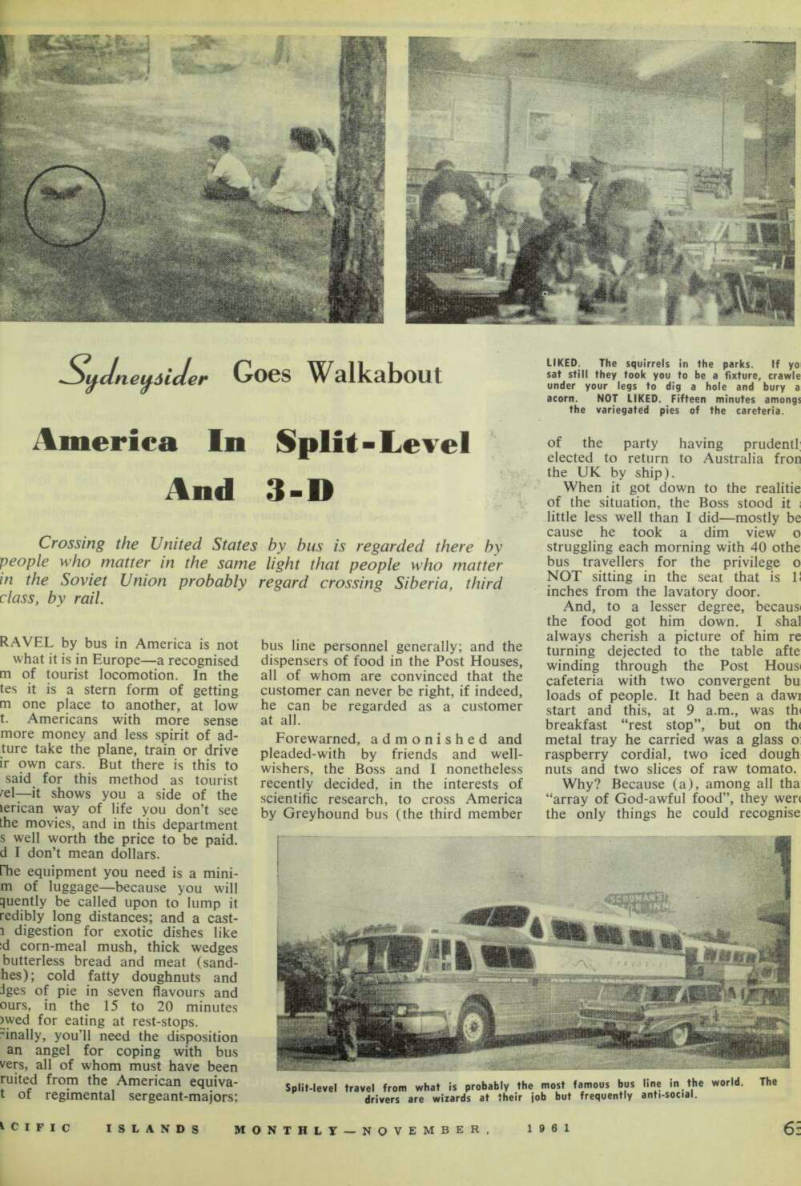
Split-level travel from what is probably the most famous bus line in the world. The drivers are wizards at their job but frequently anti-social.
LIKED. The squirrels in the parks. If yo sat still they took you to be a fixture, crawle under your legs to dig a hole and bury a acorn. NOT LIKED. Fifteen minutes amongs the variegated pies of the careteria.
1 (b) every time he hesitated, the Dured man immediately behind i in the queue had nudged him ily in the back with a tray, lut rigorous though the ex ition turned out to be, it was -stuff in comparison with the way > tackled by many Americans who t their travels at the Atlantic side journey on, in the same bus, night day until after 3,000-odd miles, r time-zones and several climates, / hit the Pacific. Whole families ;rate in this fashion, the poorest hem with the minimum of luggage existing on stale rolls out of er bags and numerous cups of ee. i Full Hotel atment Ve spread our crossing over about 30 miles in 11 days, with a day’s ak every third day, and carefully aring those that Greyhound recom ided, chose hotels several notches the scale.
Tiis move, as it turned out, tended ards psychological confusion as in space of a short taxi ride we ild be whisked from the queues 1 regimentation of the bus station ■ pitched into an expense-account el, where more often than not a ivention was at full boil. There
were Morticians in Niagara, Episco palians in Detroit, Allied Industrial Workers’ Association, in Chicago, in Oklohama City, blind people with their seeing-eye dogs, and various other organisations, elsewhere.
Then would follow a half-hour of adjusting to our hotel rooms and their gadgets, curtains, blinds, door locks, plumbing, water works (scalding, cold or iced from the same tap according to the button pressed), the piped hot air that can fry you, the air conditioning that can freeze you, the TV set and the free hotel literature that goes with the set up, all of which is absolutely guaranteed to differ in
working method from what was sup plied in the hotel of the previous night. A degree in electronics and a diploma in space-heating and re frigeration is a help in getting real benefit from this sudden exposure to the American way of life, but when really flummoxed you can always ring the bell captain for advice.
In comparison with this elevated life, Greyhounding is a simple, if de flating, experience.
The bus stations vary from the occasional modern edifice that’s a close relation to an air terminal, to the more usual barn-like structure, with its hot cafeteria at one end, the
[?]S STATESIDE. Fiji-born Mackie McCown, [?]hter of well known Levuka businessman G. McCown, has been living in Honolulu [?] last year when she married Major J. [?]olb, Jr., of the USAF. Recently the major posted to Nadi as liaison officer for the USAF Deep Freeze operation to the retie, so the Kolbs are in Fiji until [?]mber. Mackie loves her life in Hawaii.
>” and “Women’s” at the other, he information desk in the , where getting advice is as is extracting teeth, ted into odd corners are the ir shop, candy bar and slot ics which accept nickels and in return for an assortment of mdise including rock n’ roll the Lord’s Prayer inscribed on dal (“wear it for a lucky ’), your own personal horo or your weight. stations come in different is but always along one side m is a series of glass doors h which you will eventually to struggle with the impedi of travel so as to join your Tiere are no booked seats; first 5 first pick. When you and ms begin the journey, at the >oint, you have as much chance rest. When you join a trans mtal bus at an intermediate fou take what no one else is When all the seats are full, npany puts on another bus. At >int four of us left-overs rode For 500 miles, with a mid-way of drivers, in a huge air oned bus. buses come in two varieties— lecker and split-level. They ivatories, adjustable seats, heat cooling, as required.
The drivers come in three varieties: Top Sergeants; Funny Men, who are carried away by the fact that they are supplied with a microphone and perhaps the notion that a Hollywood talent-scout may be with them travelling in disguise; and Human Beings.
The first category tar outnumbers the second and third.
The customers, of course, come m just about every variety there is for a nation of 180 million people to come, but the economics of it make it unlikely that you will be travelling with the upper crust.
Erskine Caldwell fhararfprc T ~... . - , addition, t^? er ® 18 a reasonable sprinkling of Latin American tourists; S® encountered the Registrar of Hobart University and his wife be t)veen Missouri ancl New Mexico; in Arizona, a Scots nurse who had been working in Canada; and m California, an English woman tourist, As usual, the majority of the travel lers are middle-aged to elderly females travelling to or from family visitations. But each bus holds a quota of the younger members of the
[?]ATSON CHIEF. Mr. William F. Meeske [?]ved in Sydney from the United States [?]up his duties as vice-president in [?]of all Matson Lines' operations in the pacific area. He succeeds Mr. Terence [?], who officially retires on November 1. [?]eske, after graduating from the Uni [?]of Southern California, joined Matson [?] the pursers department of the SS [?]sa", forerunner to the present liner, his appointment to the South Pacific various executive posts for Matson New York and San Francisco.
aore often than not in tight, white matador pants, led blouse, painted toe-nails, hed face, mascaraed eyes and hair. Escapees from an e Caldwell novel, re are rough-clothed men with 'en faces and others in business dozing, staring out of the vs, brooding. Going somewhere, here, and why in a bus in this y, where there are more cars ad of population than anywhere i earth, you’ll never know, illy there are the coloured gers, with their God-given gift y-boned. relaxed patience and nbelievably good children who ched in grandma’s hot arms for ds of miles without a wriggle diimper. le the human element settles and the driver takes his bus augh the gears to a steady 60, he will maintain for hour after R the four- and six-lane high that now all but cross the States, the great continent of :a slides by outside the tinted vs of the bus. here The
begins
lush green of the Hudson of New York State, the fruit f southern Ontario and the flat ds that stretch endlessly i Ohio up into Michigan, Indiana and down into Illinois come and go. iss the sluggish Mississippi and ito Missouri’s rolling green . and on to Oklahoma “where 1 West begins” and with it the ards.
In serried rows they march, mile after mile, along the road, begging the traveller to See Real Rattlesnakes (or Alligators, Jack Rabbits or Pet Brama (?) Cows); to eat Chicken Dinners, Hamburgers (in king, medium or ordinary sizes), or the Biggest Broiled Steaks West of the Mississippi; to buy Mexican Jackets, Hand-Tooled Leather Holsters, Western Hats, Indian Headdresses, Navajo Rugs.
Every mile or so, for hundreds of miles, you are warned to fill your water bags, or perish in the desert; and when things are really dull, you can calculate on getting a grin out of the advertising antics of a firm of shaving-cream manufacturers who. in
a series of boards, which at 60 mph you read in short pants, tell you that: “Dear Lover Boy Your Picture Came But Your Darned Beard Won’t Fit —The Frame.” Or, alternatively: “Angels That Guard You When You Drive Usually Retire At 65.”
Back to the Pacific And so, across the dried-up trickle of the Rio Grande in upper New Mexico to the blue skies, thin air, Autumn-golden aspens of Arizona’s mountains, down into the Californian desert—and to the Pacific, The Pacific at Los Angeles isn’t blue and, for the most part, isn’t even
;. It hides under a vast blanket og composed primarily of car lonoxide pumped from millions r exhausts and suspended in must be a natural sea mist, held in place over LA by the ains behind and the hot desert d that creates an air lock over the smog cannot escape.
LA beaches, south of the city, i grey and uninspiring, crowded i jumble of hideous suburban i, interspersed with literally nds of pumps, pecking away lonstrous giant birds and ex g wealth from the petroleum arth. As an example of what s things man can do to his ament, Los Angeles and its e cities can leave any of the coalfields for dead, t people have some one iional preconceived idea of :a but the reality of it that i second and third dimension an impact that can be shatter fhis is particularly so, when fleet that the people who have it what it is, in the material either came from countries I in tradition or descended )eople therefrom, hard to understand how these ts from beautiful cities like i and Rome, from the soft sss and flowers of the English inside could, in the New World,
□blimated everything to utility’
and hurry.
To have created the hideous do mestic architecture that crowds each San Francisco hill; to have created the traffic problems and solved them with the loops, double clover-leaves and whorls of overhead roadways that make their cities look like a Wellsian nightmare; and to have used natural phenomena like Niagara Falls for their own purpose—set its air a-quiver with chemical stinks; diverted water here, pumped it there and flood-lit what remains of it in rainbow colours for those who still want merely to look at it.
Individual Americans are, para doxically, something else again.
Australians who, as a Nation, pride themselves on being friendly are cold and withdrawn in comparison. Hospi tality, help and friendliness are what you can expect from the vast majority of Americans, and as a result the average Australian feels more at home there than in England where the English traditionally still regard him as the rough-neck cousin from Down Under.
What We Liked Most: Ameri
cans; the squirrels in Central Park, New York, and their smaller cousins, the chipmunks, in the National Parks of the West; the mountains of Arizona. WHAT WE FOUND
Hardest To Bear: New York
City and Los Angeles; most bus drivers; the over-sweet food, and what was worse, the huge helpings in which it was served.