Colonial Office[?]
pp. 28-29 · Read in the full issue
Iain Macleod 'Goes Upstaii[?]
What Now In Th[?]
The circumstances disappearance of lain Macleod i the office of British Secretary c State for the Colonies are of int\ to South Pacific Islands dwellers, ,■ more especially those in Fiji, S mons, New Hebrides, Gilbert Ellice—he was their supreme I ministrative head.
Lain Norman Macleod,,
is hated by the die-hard of the British Conservative They dislike the cold-blooded 1 struction he has wrought in BriL Colonial Empire in his brief yeaif office; and they resent his cleaiu termination to be the next Constg tive Prime Minister.
In Africa, in July, I the incredible mess made them the Macleod policy of liquidating Colonial Empire, and I heardfc curses upon his name uttered by thousands of British men and wo' who had been persuaded to settt: the African colonies, and now an ing pushed out.
In London, in August, by a cun chain of accidents, I found rrn among a section of Consent who would quite willingly the Party wide open, and destnl the Macmillan Government, in < to halt Macleod’s performances ii Colonial Office.
But they were afraid of Maoi as a strong and ruthless dominating one section of the H and they were reluctant to pull the Government at that stage; cause of the crises created by the lin situation and the Common Mb plan.
But I sensed a grave uneasinei British political circles, and somei approaching demoralisation inn British Colonial Office, where tffir style officials were regarding dew ments in Africa, West Indies, Gib South-east Asia, even Fiji, with • thing like panic.
Britain's Grave Problems* Writing from London in AA to Pacific Islands Monthly anor Times. I expressed, in view of 3 conditions, my own unhappinei relation to the future of Fiji.
So in October, in America, ! not surprised to learn that ther hard Tories had solved the pm
arily by pushing Macleod up- He displaces R. A. Butler as of the House, and becomes Chairman, and he now is and openly in line as next Minister. The very able Butler horn it is said that he surely have been Prime Minister, in )f Macmillan, if he had not Roman Catholic—is moved ) take charge of the critical m Market situation. , adroitly, Macmillan has got out of the heap of troubles surrounded him in August, say most observers, it is a ary respite. How long can lan ride the bitter winds that wing upon him from Berlin, ind more strongly? Berlin is the label on a steadily ng situation.
Germany now is committed to n to challenge Russia and re er place in Central Europe, chev is equally determined to ermany now, before she gets onger. America is supporting ly, and dragging Britain and with her. The great mass of people are most unwilling to a Third World War to help ay, after suffering so much in ler World Wars in order to Germany’s lust for power. . . es Bureaucracy Return? eod has gone; and into the il Office Ministry comes an icuous political figure, Regin tudling, aged 44, who knows h about the complex adminis economic, political and social is which now bedevil the Colonial Office as the Bishop lingham knows about Bahai, eod may not have been right; is a man of great organisa ability, with a prodigious f, and he had a mastery of .1 Empire detail that staggered w-moving bureaucrats of the 1 Office. At least, he was boss too soon yet to see whether •pointment of Mr. Maudling
means a reversal of the policy of rapidly liquidating the Empire, or that policy’s continuation in milder form; or merely a return to nominal rule by the Minister, while the top ranking bureaucrats run their slow moving machinery.
If it is to be the latter, then bureau cracy probably will finish what the dynamic Macleod began.
Examples of British Colonial Office failure may be seen all across the world—but we need go no further than Fiji.
It was known there, 20 years ago, that racial, population and economic conditions demanded a measure of skilled planning and administrative strength in the government, if poli tical trouble was to be avoided. Some of the Governors sent out by London saw the Colony’s needs, clearly enough.
But Colonial Office lethargy and lack of imagination defeated all plans for the future of Fiji, and broke the spirit of more than one Governor; so that today the Colonial Office bureaucrats are trying most hastily— with the mad dogs of subversion and unemployment snapping at their heels —to do for Fiji in a matter of months what should have been attempted, under far easier conditions, ten or twenty years ago.
The situation is bad in Fiji. It is far worse in many other British Colonies. Bureaucracy is responsible for these conditions. Is it to be assumed that, with the removal of lain Macleod upstairs, and the ap pearance of Mr. Maudling, we re turn to the pre-Macleod conditions in the Colonial Office?
The question is of great im portance to Fiji. We should soon get some indication of the answer.
R. W. Robson.
The engagement was announced in November of Miss Patricia (Patty) Evans to Mr. Warren Milsom, son of Mr. and Mrs. R. C. T. Milsom, of Concord, NSW. Patty might be re garded as a third generation New Guinea Territorian, having been born in Madang the year before the Jap anese balloon went up, the first child of Mr. and Mrs. Hallon W. Evans and grand-daughter of Mr. and Mrs.
H. Beilby Evans who had plantation interests in Bougainville. Hal Evans went to the Territory as a very small boy and when he left it on retirement a couple of years ago, to take his young family to live in Sydney, was a very well-known member of the Territory Public Service, especially in Madang and Kavieng.
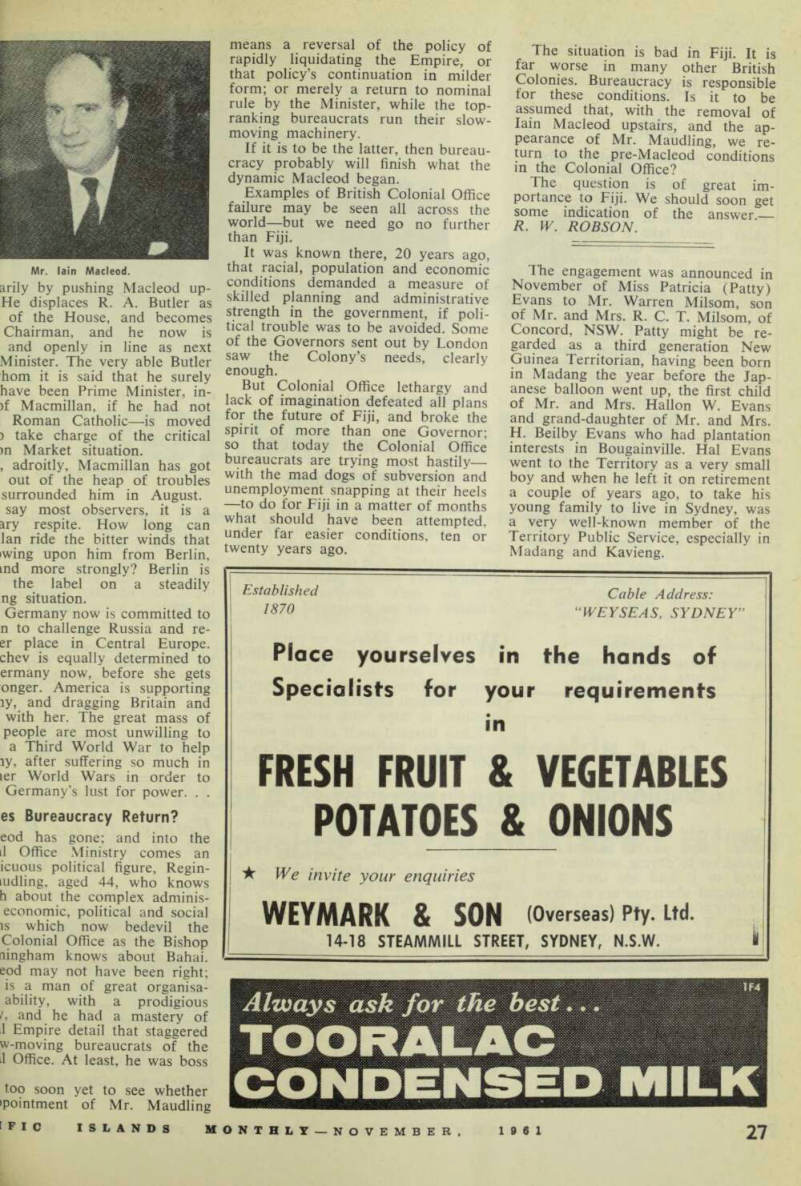
Mr. lain Macleod.